Volcanic rivers on Mars

Granicus Valles

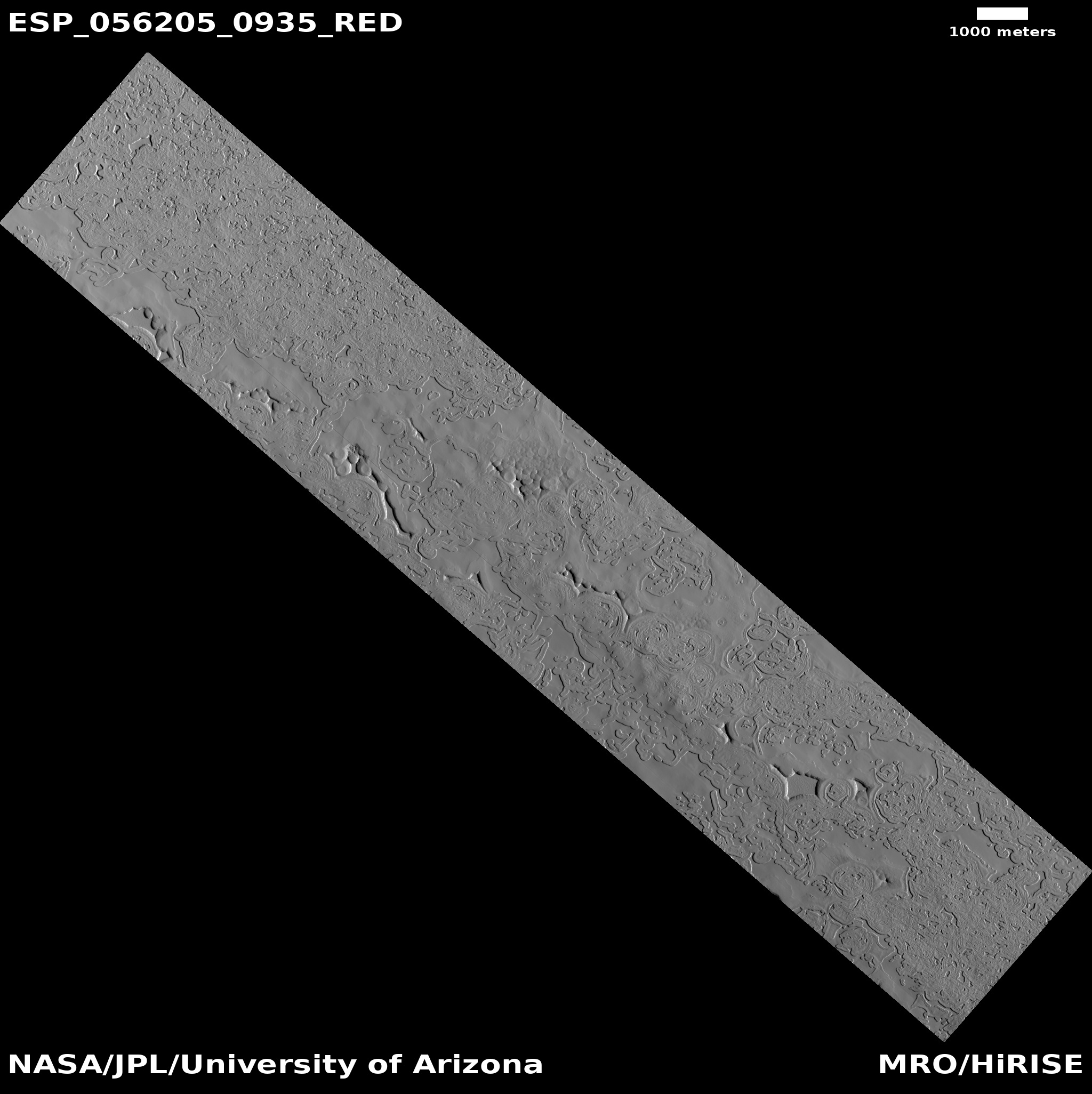
Cool image time! The photo on the right, cropped and reduced to post here, was part of the November image release from the high resolution camera on Mars Reconnaissance Orbiter (MRO). If you click on the image you can see the full resolution picture.

The uncaptioned release webpage is dubbed “Faults in Granicus Valles.” The image itself only shows a small part of Granicus Valles, named after a river in Turkey, that flows down from the estern slopes of the giant volcano Elysium Mons. While far smaller than the four big Martian volcanoes in the Tharsis region to the east and near Marines Valles (which I highlight often), Elysium Mons still outshines anything on Earth at a height of almost 30,000 feet and a width of 150 miles. It sits at about the same northern latitude of Olympus Mons, but all by itself, rising up at the very northern edge of the transition zone between the southern highlands and the northern plains, with the vast Utopia Basin, the second deepest basin on Mars, to the west.

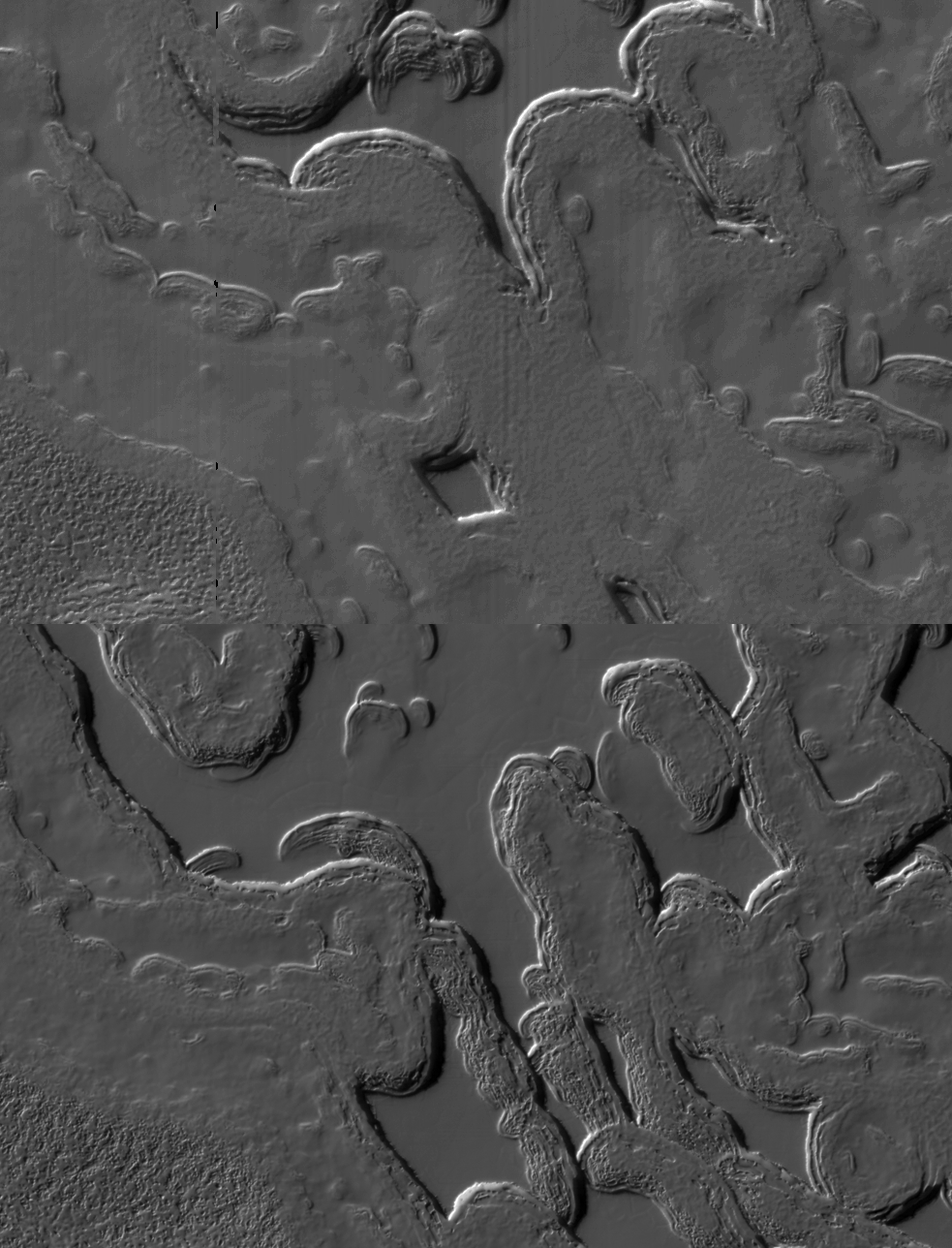
Overview of Elysium Mons and Granicus Valles

Granicus Valles itself is almost five hundred miles long. At its beginning it flows in a single straight fault, but once it enters the northern plains of Utopia Basin it begins to meander and break up into multiple tributaries. The MRO image above shows only a tiny portion in the northern plains, as illustrated by the white box in the overview map to the left.
» Read more

0 comments

SuperEarth orbiting Barnard’s Star?

The uncertainty of science: Astronomers have discovered a candidate exoplanet orbiting Barnard’s Star, the closest single star to our solar system and the second closest stellar system after Alpha Centauri.

The planet candidate, named Barnard’s star b (or GJ 699 b), is a super-Earth with a minimum of 3.2 Earth masses. It orbits its cool red parent star every 233 days near the snow-line, a distance where water would be frozen. In the absence of an atmosphere, its temperature is likely to be about -150 ºC, which makes it unlikely that the planet can sustain liquid water on its surface. However, its characteristics make it an excellent target for direct imaging using the next generation of instruments such as NASA’s Wide Field InfraRed Survey Telescope (WFIRST, [3]), and maybe with observations from the ESA mission Gaia [4].

The reason I put a question mark in the headline is that this is not the first time a candidate exoplanet has been proposed to orbit Barnard’s Star. In the 1960s astronomer Peter van de Kemp claimed the star had at least one gas giant orbiting it every 24 years. It was later found that the periodic motion variations he measured were due to “to an artifact of maintenance and upgrade work” at the telescope he was using.

The result above has not been confirmed by other means, so they must list this superEarth as a candidate exoplanet. More observations are necessary to confirm it.

0 comments

Neutron star merger caused gravitational wave?

The uncertainty of science: Astronomers now believe that one of the half dozen or so gravitational waves detected by LIGO was likely caused by the merger of two neutron stars.

One of these, GW170817, resulted from the merger of two stellar remnants known as neutron stars. These objects form after stars much more massive than the Sun explode as supernovae, leaving behind a core of material packed to extraordinary densities.

At the same time as the burst of gravitational waves from the merger, observatories detected emission in gamma rays, X-rays, ultraviolet, visible light, infrared and radio waves – an unprecedented observing campaign that confirmed the location and nature of the source.

The initial observations of GW170817 suggested that the two neutron stars merged into a black hole, an object with a gravitational field so powerful that not even light can travel quickly enough to escape its grasp.

While intriguing, this result is uncertain, and based on many assumptions.

0 comments

Powerful 1972 solar storm detonated ocean mines in Vietnam

Scientists studying a powerful 1972 storm have also uncovered a recently released Navy report that showed the storm was powerful enough that it detonated ocean mines off the coast of Vietnam.

On the same day [the storm arrived on Earth], while observing the coastal waters of North Vietnam from aircraft, US Navy personnel witnessed dozens of destructor sea mines exploding with no obvious cause. These mines were airdropped by the US Navy into Vietnamese waters as part of Operation Pocket Money, a mission aimed at blocking supplies from reaching North Vietnamese ports.

The Navy promptly investigated the peculiar explosions, working with the National Academy of Sciences and the National Oceanic and Atmospheric Administration, to conclude that more than 4,000 mine detonations were most likely triggered by the solar storm, Knipp said.

A now declassified report about the mining of North Vietnam from the Chief of Naval Operations at the Mine Warfare Project Office noted, “this was the first example of what happens to a major mining campaign in the face of the vagaries of nature.”

Many of the destructor mines were designed to trigger if they sensed changes in magnetic fields associated with moving ships. Solar activity is known to perturb Earth’s magnetic field, and in early August 1972, the perturbations were likely strong enough to meet the magnetic requirements for detonation, Knipp said.

This proves once again that one must not dismiss any possibility in trying to understand what happens in the universe. Don’t be credulous, but don’t be close-minded either. The universe can surprise you.

5 comments

Virgin Orbit completes fastest taxi test of LaunchOne

Capitalism in space: Virgin Orbit this past weekend completed the fastest taxi test of its LaunchOne smallsat rocket airplane, with LaunchOne attached.

In a tweet posted today, Virgin Orbit said the Nov. 11 ground test revved up the plane, nicknamed Cosmic Girl, to a speed beyond 110 knots (125 mph) on a runway in Victorville, Calif. That’s fast enough to simulate an aborted takeoff. “We also used the day as an opportunity to load real flight software onto LauncherOne for the first time,” the company said.

My 2016 prediction, that Virgin Orbit’s LauncherOne will reach space before Virgin Galactic’s SpaceShipTwo, looks increasingly likely. They had said they wanted to do their first launch by the end of the 2018 summer. Though this did not happen, their launch license [pdf] is effective through December 2019, and it appears they are moving towards that first launch within a few months.

1 comment

Vector applies for license for launch in Kodiak, Alaska

Capitalism in space: Vector has applied for an FAA license for a suborbital test launch in Kodiak, Alaska of its Vector-R smallsat rocket.

The launch is planned to occur no later than April 2019.

Their original suborbital test schedule was supposed to have occurred already, but those were mere verbal announcements. This is more concrete.

Vector does need to get off the ground however. Two years ago it was considered in a close race with Rocket Lab. Now Rocket Lab has pulled far ahead, and Vector might be losing ground to other smallsat launch companies.

0 comments

India’s GSLV-Mark 3 rocket successfully launches communications satellite

The new colonial movement: India today successfully launched a new Indian communications satellite on the third launch of its larger GSLV-Mark 3 rocket.

The Geosynchronous Satellite Launch Vehicle Mk.III, or GSLV Mk.III, is India’s newest and most powerful rocket. After making a suborbital demonstration launch in late 2014, the rocket made its first orbital mission last June when it deployed the GSAT-19 spacecraft.

Wednesday’s launch was designated D2, indicating that it was the rocket’s second developmental launch, however like last year’s flight its payload – GSAT-29 – is a fully operational satellite.

I have embedded a video of the launch below the fold. The launch occurs at about 25 minutes in.

With this success, the fifth launch this year by India, that country will be able to move forward on the January launch by the GSLV of its Chandrayaan-2 lunar mission.

The leaders in the 2018 launch race remains unchanged:

31 China
17 SpaceX
10 Russia
8 ULA
8 Europe (Arianespace)

China continues to lead the U.S. in the national rankings, 31 to 28.
» Read more

0 comments

Another private lunar rover unveiled

Capitalism in space: The private start-up company Lunar Outpost today unveiled its tiny 10 kilogram (22 pound) rover, designed to map lunar resources.

The first Prospector was demonstrated driving and drilling in Lunar regolith simulant at the Colorado School of Mines’ new Lunar testbed facility in the Earth Mechanics Institute overseen by the Center for Space Resources. This event marks the first commercial Lunar Prospector publicly tested in the United States.

Evidence of valuable resources on the Lunar surface, such as water, precious metals, and helium-3 have been established by remote sensing on flyby missions around the Moon. This scientific data has been used to create general resource models of the Lunar surface, which now require ground-truthing to establish optimal landing sites and plan future resource extraction operations. Groups of Lunar Outpost Prospectors will map the surface and subsurface resources of the Moon, while autonomously navigating along waypoints and avoiding hazards such as large rocks and craters. These Prospectors can also be teleoperated if needed and can utilize NASA’s Lunar Orbital Platform-Gateway concept as a center of operations.

This is a tiny inexpensive rover, essentially an upgraded drone. Very smart, and efficent. Below the fold is the company’s video of this demo test. The drilling capability is especially impressive.

Their website does not say how much they will charge for this rover, but they also note that it has 5 kilograms of cargo capacity, meaning that they can also offer this to customers.
» Read more

12 comments

LSST’s giant coating chamber arrives in Chile

The giant coating chamber that will be used to coat the mirrors for the Large Synoptic Survey Telescope has arrived in Chile.

The Coating Chamber and its associated equipment will share this level with the camera maintenance rooms, the vertical platform lift, and the shipping and receiving area. The Coating Chamber will be used to coat LSST’s mirrors when they arrive on Cerro Pachón, and to re-coat the mirrors periodically during Operations.

LSST will conduct a 10-year survey, and during this period its mirrors will be exposed to the elements each night as the telescope surveys the sky through the open side of the observatory dome. Over time the mirrors will get dusty, and the mirror coatings may develop small blemishes that eventually affect the telescope’s performance. To ensure that LSST continues to collect the sharpest possible images of the night sky, its mirrors will undergo periodic washing and recoating. It’s anticipated that the Primary/Tertiary Mirror (M1M3) will need to be recoated every two years, and the Secondary Mirror (M2) every five years, during the 10-year survey. Both the washing and recoating will be done inside the observatory; special equipment will be used to remove and transport the mirrors from the telescope to the washing station and coating chamber.

LSST will essentially be imaging the entire visible sky nightly, making it possible over time to track sudden events, such as supernovae, as they happen.

1 comment

Evidence of nitrogen ice glaciers on Pluto

Using data sent back by New Horizons during its fly-by of Pluto scientists now think they have identified land forms created by past nitrogen ice glaciers.

The washboard and fluted terrain … occur at the location on Sputnik Planitia’s perimeter where elevations and slopes leading into the surrounding uplands are lowest, and also where a major tectonic system coincides with the edge of Sputnik Planitia. The low elevation of the area makes it a natural setting for past coverage by nitrogen ice glaciers, as indicated by modeling of volatile behavior on Pluto performed by Dr. Bertrand at Ames.

Through comparison of the washboard and fluted texture with parallel chains of elongated sublimation pits (depressions in the surface formed where ice turns directly into a gas) seen in southern Sputnik Planitia, the ridges are interpreted to represent water ice debris liberated by tectonism of underlying crust. This water ice debris was buoyant in the denser, pitted glacial nitrogen ice that is interpreted to have formerly covered this area, and collected on the floors of the elongated pits. After the nitrogen ice receded via sublimation, the debris was left as the aligned ridges, mimicking the sublimation texture – washboard ridges where deposited on flat terrain, and fluted ridges where deposited on steeper slopes.

This is strange stuff. The solid bedrock here, water ice, will float on the nitrogen ice sitting on top of it. Thus, the material that wants to sublimate away, nitrogen, sometimes has to fight its way past the water ice that has risen to the top of the pile.

To put it mildly, we hardly understand these alien processes. This research is merely a first stab, the first hand-waving.

3 comments
1 17 18 19 20 21 155