Head of Webb investigation: Webb was “a step too far”

The head of an investigation panel into the James Webb Space Telescope admitted this week that, though he and the panel fully support the telescope’s completion and launch, he also believes the telescope was too ambitious and “a step too far.”

Speaking at a meeting of the Committee on Astronomy and Astrophysics of the National Academies’ Space Studies Board Oct. 29, Tom Young said that while the mission may ultimately be a success, its difficulties provide lessons as NASA considers future large astronomy missions in the next decadal survey.

“I, personally, have come to the conclusion that JWST had too many inventions, too much risk, and was a step too far,” he said at the end of a presentation about the review board’s work.

Young emphasized that he was neither opposed to JWST being completed nor had doubts it could be done successfully. “There are a group people who are diehard supporters of JWST, and there are others who support it, but they’re really angry at the cost growth and the schedule delays,” he said.

You think? Webb was supposed to cost about $500 million, and launch in 2007. Its budget is now almost $10 billion, and it will not launch before 2021. In the process it has destroyed the entire astronomy program at NASA, preventing the construction of any other space telescopes.

The key question is whether the astronomy community or NASA has learned anything from this disaster. I personally am doubtful, since they are still pushing for WFIRST, a similar big boondoggle that will cost billions and is already overbudget and behind schedule, though it is only in its design stage.

5 comments

Russians say Soyuz sensor was damaged in manufacture

The Russians yesterday revealed that the sensor they have identified as the cause of the October 11 Soyuz launch failure was damaged during manufacture.

Their response:

Skorobogatov said officials are now taking steps, including putting all assembly staff through competence tests and additional training, to make sure such malfunctions don’t happen again.

The rocket producer will also take apart two other rockets that have been recently assembled and are due to launch in the coming weeks and then re-assemble them, Skorobogatov said.

They do not say how the damage occurred. It also appears that, like all government run operations, no one will be fired. (The Russians only fire people when they are going to criminally indict them.)

2 comments

Dawn’s last look at Ceres

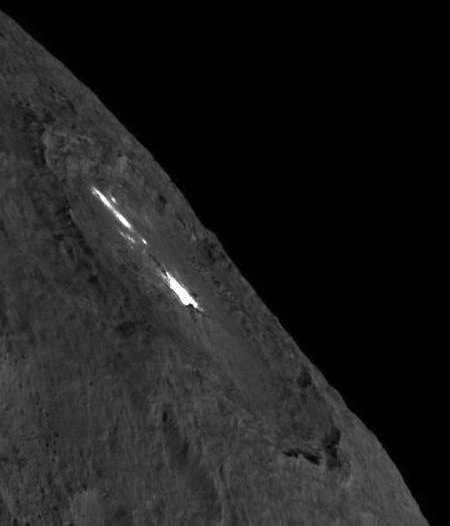
Ceres

The Dawn mission has ended, and the image on the right, reduced to post here, is one of its last views of Ceres, with the bright spots of Occator Crater clearly visible, before its fuel ran out. You can see the full resolution image by clicking on the image.

This photo of Ceres and the bright regions in Occator Crater was one of the last views NASA’s Dawn spacecraft transmitted before it depleted its remaining hydrazine and completed its mission.

This view, which faces south, was captured on Sept. 1, 2018 at an altitude of 2,340 miles (3,370 kilometers) as the spacecraft was ascending in its elliptical orbit. At its lowest point, the orbit dipped down to only about 22 miles (35 kilometers), which allowed Dawn to acquire very high-resolution images in this final phase of its mission. Some of the close-up images of Occator Crater are shown here.

Occator Crater is 57 miles (92 kilometers) across and 2.5 miles (4 kilometers) deep and holds the brightest area on Ceres, Cerealia Facula in its center and Vinalia Faculae in its western side. This region has been the subject of intense interest since Dawn’s approach to the dwarf planet in early 2015.

If NASA made any specific announcement about the end of the mission, I have missed it. Either way, this end is not a surprise, because they have made it clear for the past few months that the spacecraft was about to run out of fuel.

They have also posted today an image of Ceres’ largest mountain, Ahuna Mons.

Update: Even as I posted this, NASA sent out this press release: NASA’s Dawn mission comes to an end

2 comments

China tests its own grasshopper

China has completed its first vertical rocket landing test, using a prototype small scale first stage very similar to SpaceX’s Grasshopper test rocket.

If I was cynical, I’d say that this isn’t just similar, it is a direct steal from Grasshopper. But then, that is generally how the Chinese have come up with their new technology, not by creating it themselves, but by stealing ideas from others and then upgrading them.

Either way, this test shows that China is devoting serious energy to making its first stages reusable.

13 comments

Company focused on cleaning up space junk raises $50 million

Capitalism in space: Astroscale, a Japanese company with British ties, has raised $50 million in investment capital for developing a robot spacecraft for locating and removing space junk from orbit.

The company plans to use the funding to support several ongoing efforts, including the development of a technology demonstration satellite called ELSA-d. That spacecraft, scheduled for launch in early 2020 on a Soyuz rocket, will feature “target” and “chaser” satellites to demonstrate rendezvous and proximity operations. The target spacecraft is being built by British smallsat developer Surrey Satellite Technology Ltd. under a contract announced last November.

The funding will support scaling up an operations center Astroscale established in the United Kingdom in 2017 that also handles engineering, procurement and business development. Astroscale said it plans to establish an office in the United States in 2019.

The article notes also that much of this money comes from Japanese investors, including Mitsubishi, and reflects a growing interest in Japan in private commercial space.

4 comments

Planetary Resources bought by blockchain company

Capitalism in space: The so-called asteroid mining company Planetary Resources has now been bought by computer blockchain company.

Planetary Resources said in a statement that it was acquired by ConsenSys, Inc. in an “asset-purchase transaction.” The companies did not disclose specific terms of the agreement. Chris Lewicki, the president and chief executive of Planetary Resources, and Brian Israel, the company’s general counsel, will join ConsenSys as part of the deal.

ConsenSys describes itself as a “blockchain venture production studio focused on building and scaling tools, disruptive startups, and enterprise software products powered by decentralized technology, specifically Ethereum.” Ethereum itself is a decentralized computing platform best known for supporting a cryptocurrency called Ether similar to the better-known bitcoin.

Don’t ask me how ConsenSys makes its money. I haven’t the faintest. I also haven’t the slightest idea what they intend to do with Planetary Resources. I can say without doubt that it won’t be asteroid mining.

9 comments

OSIRIS-REx snaps image of target asteroid Bennu

Bennu

OSIRIS-REx has snapped its sharpest image yet of its target asteroid Bennu, set for a rendezvous on December 3. The image on the right is that image, at full resolution but cropped.

This “super-resolution” view of asteroid Bennu was created using eight images obtained by NASA’s OSIRIS-REx spacecraft on Oct. 29, 2018 from a distance of about 205 miles (330 km). The spacecraft was moving as it captured the images with the PolyCam camera, and Bennu rotated 1.2 degrees during the nearly one minute that elapsed between the first and the last snapshot. The team used a super-resolution algorithm to combine the eight images and produce a higher resolution view of the asteroid. Bennu occupies about 100 pixels and is oriented with its north pole at the top of the image.

It is beginning to appear that the OSIRIS-REx engineering team is going to have the same kind of problems now faced by the Hayabusa-2 engineering team. In this first glance Bennu appears very similar to Ryugu, a rubble pile shaped approximately like a box, rotating on one point. If so, they are also going to find it difficult to locate a smooth landing site.

Bennu by the way is in an orbit that makes a collision with the Earth possible in the late 22nd century. Knowing its composition, density, and solidity is critical for determining what to do, should that collision become likely.

0 comments

China launches two more GPS-type navigation satellites

Completing its 31st successful launch this year, China today placed two more GPS-type Beidou satellites into orbit, using a Long March 3B/G2 rocket.

The article says this is China’s 32nd launch, but that includes one failure. The leaders in the 2018 launch race:

31 China
17 SpaceX
9 Russia
8 ULA
7 Europe (Arianespace)

China has widened its lead over the U.S. in the national rankings to 31 to 26.

0 comments

Russia releases video of October Soyuz launch, showing failed strap-on release

Russia has released video from the outside of its Soyuz rocket during the failed October 11 Soyuz launch, showing one of the rocket’s four strap-on boosters not releasing properly.

The key moment of the video, embedded below, is at 1:25. The booster on the left does not appear to release at its top. The article at the link says the Russians now believe that a failed sensor prevented the opening of a valve that would allow the venting of oxygen to push the booster away.

0 comments

Parker begins first perihelion fly-by of Sun

It’s getting hot in here: The Parker Solar Probe has begun its first close orbital fly-by of the Sun, set to last from now until November 11.

This solar encounter encompasses the first perihelion of the mission, the point at which Parker Solar Probe is closest to the Sun. Perihelion is expected at about 10:28 p.m. EST on Nov. 5. The spacecraft will come within 15 million miles of the Sun’s surface and clock in at a top speed of 213,200 miles per hour relative to the Sun — setting new records for both closest solar approach and top heliocentric speed by a spacecraft. At perihelion, Parker Solar Probe will fly through material at about 3.6 million degrees Fahrenheit — but because material in this region is so tenuous, it doesn’t influence the temperature of the spacecraft. However, the Sun’s intense radiation heats the Sun-facing side of the spacecraft’s heat shield, called the Thermal Protection System, to about 820 F.

For several days around the Nov. 5 perihelion, Parker Solar Probe will be completely out of contact with Earth because of interference from the Sun’s overwhelming radio emissions.

The article provides some nice details about the spacecraft’s design.

7 comments

October 31, 2018 Zimmerman/Pratt podcast

Today I sent a half hour with Robert Pratt of Pratt on Texas, doing two segments. In the first segment, available here, we discussed the announcement by SpaceX that it was going to do the first flight tests of its Big Falcon Rocket out of its new spaceport in Boca Chica, Texas.

In the second segment, available here, Robert allowed me to vent about the disgusting behavior of the leftist protesters during a moment of silence for those killed by an anti-Semite in Pittsburgh.

Both are worth listening to, especially the second.

First link fixed!

3 comments
1 22 23 24 25 26 155