
Rick Wakeman – Children of Chernobyl
An evening pause: Hat tip Danae.
An evening pause: Hat tip Danae.
The Midland, Texas city council today voted to renew its contract with the company managing its spaceport there.
The council voted 6-1 to renew its contract with SilverWing Enterprises, an aerospace consulting company that manages Midland’s spaceport license. The one vote came from Spencer Robnett, who has been public with his belief that the spaceport needs to be shut down.
“Yeah I don’t think it would ever have a chance in Midland,” Robnett said. “I do think the space business and space technology and aerospace sector is evolving. There’s a lot of money being invested in it by billionaires, Bezos, Musk, and Branson. Unfortunately we don’t have a billionaire in Midland chasing aerospace investment. We’ve got a small economic development corporation that takes direction from the city council.”
Robnett might have a point. Midland’s spaceport had been the base of operations for XCOR’s Lynx, and with XCOR bankrupt and gone there doesn’t seem to be a lot of interest by anyone else in flying any rockets from there. Part of their problem is their location, which is far from the coast and would likely limit the launch options in order to avoid populated areas.
The question has to be: What does Midland offer to rocket companies that other spaceports don’t? Until they can provide an answer to that question, the money the council is spending on this spaceport is probably going to waste.
NASA has extended its contract with the Smithsonian Astrophysical Observatory in Massachusetts to run the Chandra X-ray Observatory through 2024.
In many ways the longevity of both Hubble and Chandra as well as other space telescopes has demonstrated the robustness of much in-space engineering these days. It suggests that when we finally begin building manned interplanetary spaceships we should have confidence they will operate reliably for long periods.
Capitalism in space: SpaceX has won a contract for two launches of lunar rovers built by a private Japanese company.
Tokyo-based lunar-exploration startup Ispace has signed up for launches on SpaceX’s Falcon 9 rocket in 2020 and 2021. The first will carry a lunar lander into orbit around the moon, and the second aims to put one on the moon’s surface so it can deploy a pair of rovers, Ispace said Wednesday. “We share the vision with SpaceX of enabling humans to live in space, so we’re very glad they will join us in this first step of our journey,” Ispace Chief Executive Officer Takeshi Hakamada said in a statement.
SpaceX already has a contract for another private lunar rover, built by the Israeli company SpaceIL, that is set to launch as a secondary payload in December.
Both companies are former competitors in the Google Lunar X-Prize competition. Based on these contracts, as well as the pending launch of Moon Express’s private lunar rover on a Rocket Lab Electron rocket, it appears that private commercial planetary missions are about to become routine.
Assuming nothing goes wrong beforehand, China has now scheduled the deorbit of its Tiangong-2 test space station module for July 2019.
This decision is not surprising. They want to keep the station aloft and operating as long as possible to test its design and how that engineering can be applied to their full sized station planned for the 2020s.
Capitalism in space: Europe’s Ariane 5 rocket today placed two commercial communication satellites into orbit.
The leaders in the 2018 launch race:
25 China
16 SpaceX
8 Russia
7 ULA
6 Europe (Arianespace)
China remains ahead of the U.S. 25 to 24 in the national rankings.
Good news the future’s children! New data shows that millennials are returning to more traditional marriage patterns, staying married longer and thus causing the divorce rate to plummet.
New data show younger couples are approaching relationships very differently from baby boomers, who married young, divorced, remarried and so on. Generation X and especially millennials are being pickier about who they marry, tying the knot at older ages when education, careers and finances are on track. The result is a U.S. divorce rate that dropped 18 percent from 2008 to 2016, according to an analysis by University of Maryland sociology professor Philip Cohen.
…the divorce rate’s decline isn’t a reflection of a decline in marriages. Rather, it’s evidence that marriages today have a greater chance of lasting than marriages did ten years ago. “The change among young people is particularly striking,” Susan Brown, a sociology professor at Bowling Green State University, said of Cohen’s results. “The characteristics of young married couples today signal a sustained decline [in divorce rates] in the coming years.”
The news is not all good. The drop in the divorce rate is partly there because of the non-stop behavior of baby boomers to get divorced, repeatedly. Their behavior warps the stats, and makes a mediocre marriage stat by Millennials appear better than it is. Nonetheless, the change in behavior between these two generations is a very good sign. And it will be an especially good thing for the innocent children that result from these more stable marriages, which in turn will be better for society as a whole. One of the reasons American culture has become more crude and unstable in the past few decades is strongly linked to the raising of children in broken homes. Give children a stable home and numerous studies have found they will grow up more stable and mature, and thus help make society itself more stable.
An evening pause: Performed live 1976.
Hat tip Jim Mallamace.
Mars Reconnaissance Orbiter has taken a picture through the fading Martian dust storm that spots Opportunity about halfway down Perseverance Valley in the rim of Endeavour Crater.
Engineers have been increasing the number of times per day they are attempting to communicate with the rover, so far all to no avail. The picture thus only really tells us that the storm is lifting and that MRO’s high resolution camera is operating normally after three months of limited picture taking because of the dust storm.
The new colonial movement: An Australian government agency, the Commonwealth Scientific and Industrial Research Organisation (CSIRO), has put forth a space roadmap for that nation that includes a push for them to participate in NASA’s lunar orbiting Gateway project.
“And when you look at a moon base, the support systems of oxygen, water, food – and the general support systems around it – is something that nobody has ever done before,” he said. “When we looked around Australia, these are areas where Australia has as much skill as anyone else. Things like dry farming capabilities, remote mining capability, the fact that CSIRO perfected the titanium dust that you can 3-D print from … there are a whole range of things where we can potentially contribute.” It is an interesting fact that Australia has exceptional expertise in 3D printing titanium. This is even more interesting when you consider that on the moon – according to Dave Williams – there is an oxide that is very similar to titanium that could be reduced to a titanium dust, with oxygen as a by-product.
“Realistically, NASA will lead the whole thing. But they will be looking for partners, and the idea will be to identify which niche areas Australia should try to push its industry into, and try to get support for and to make it work,” he said.
Essentially, they are proposing that Australia get in on the Gateway boondoggle by focusing on and then offering to provide peripheral support services.
Much of this is bureaucratic twaddle, not to be taken too seriously. At the same time, it does outline for Australia areas where there are needs, and where their private space companies could make money.
Aerojet Rocketdyne financial documents suggest that it has given up the bidding competition with Blue Origin to supply a rocket engine for ULA’s Vulcan rocket.
The latest financial release from aerospace manufacturer Aerojet Rocketdyne reveals that the company spent none of its own money on development of the AR1 rocket engine this spring. Moreover, the quarterly 10-Q filing that covers financial data through June 30, 2018 indicates that Aerojet may permanently stop funding the engine with its own money altogether—a sign the company has no immediate customers.
Although Aerojet will continue to receive some funding from the US military through next year to develop its large, new rocket engine, this money won’t be enough to bring it to completion. Instead of having a flight-ready engine for use by the end of 2019, the filing indicates that Aerojet now intends to have just a single prototype completed within the time frame.
Essentially this means ULA will have no choice but to pick Blue Origin’s engine, unless the Air Force pulls its weight and demands it take Aerojet rocketdyne, even if that means a significant delay before Vulcan can launch.
The uncertainty of science: Astronomers have identified four stars as possible home stars for the interstellar object Oumuamua.
Bailer-Jones and his colleagues found four stars that are possible candidates for ‘Oumuamua’s home world. All four of them are dwarf stars. The one that came closest to ‘Oumuamua, at least about one million year ago, is the reddish dwarf star HIP 3757. It approached within about 1.96 light-years. Given the uncertainties unaccounted for in this reconstruction, that is close enough for ‘Oumuamua to have originated from its planetary system (if the star has one). However, the comparatively large relative speed (around 25 km/s) makes it less probable for this to be ‘Oumuamua’s home.
The next candidate, HD 292249, is similar to our Sun, was a little bit less close to the object’s trajectory 3.8 million years ago, but with a smaller relative speed of 10 km/s. The two additional candidates met ‘Oumuamua 1.1 and 6.3 million years ago, respectively, at intermediate speeds and distances. These stars have been previously catalogued by other surveys, but little is known about them.
There is much uncertainty here. None of these stars might be Oumuamua’s actual original star, but might have instead shifted its orbit from its past course.
Scientists reviewing Cassini data have identified dust storms for the first time of Saturn’s moon Titan.
When Rodriguez and his team first spotted three unusual equatorial brightenings in infrared images taken by Cassini around the moon’s 2009 northern equinox, they thought they might be the same kind of methane clouds; however, an investigation revealed they were something completely different. “From what we know about cloud formation on Titan, we can say that such methane clouds in this area and in this time of the year are not physically possible,” said Rodriguez. “The convective methane clouds that can develop in this area and during this period of time would contain huge droplets and must be at a very high altitude — much higher than the 6 miles (10 kilometers) that modeling tells us the new features are located.”
The researchers were also able to rule out that the features were actually on the surface of Titan in the form of frozen methane rain or icy lavas. Such surface spots would have a different chemical signature and would remain visible for much longer than the bright features in this study, which were visible for only 11 hours to five weeks.
In addition, modeling showed that the features must be atmospheric but still close to the surface — most likely forming a very thin layer of tiny solid organic particles. Since they were located right over the dune fields around Titan’s equator, the only remaining explanation was that the spots were actually clouds of dust raised from the dunes.
Obviously there are large uncertainties here. Nonetheless, the conclusion is a reasonable one, as it is expected that such dust storms would occur on Titan.
Posted just outside Zion National Park in the town of Springdale.
An evening pause: The music for this short film is by Ex Makina and is also called Breathe. I think it appropriate to show now, as the monsoon season here in Arizona is winding down.
Hat tip Willi Kusche, who helped me open the monsoon season back in June.
A greenhouse in Antarctica that is partly maintained remotely from Germany has survived through the polar winter for the first time.
Regularly withstanding temperatures below minus 40 degrees Fahrenheit (minus 40 degrees Celsius), the greenhouse provided herbs, lettuce and other vegetables to 10 people who were riding out the winter in the remote station, called the Alfred Wegener Institute’s Neumayer Station III. It’s the first time the greenhouse operated through the winter. “After more than half a year of operation in Antarctica, the self-sufficient greenhouse concept appears to be effective for climatically demanding regions on Earth, as well as for future manned missions to the moon and Mars,” DLR officials said in the statement.
“The harvests are now so plentiful that some of it does not always make it straight to the table, and we now have the luxury of spreading out our consumption of some refrigerated lettuce and herbs over several days,” Paul Zabel, a DLR researcher who works with EDEN ISS, said in the statement. “The overwintering team members are always looking forward to their next fresh meal.”
From a space exploration perspective, the most interesting aspect of this story is that, when the weather was too hostile for its Antarctic maintainer to reach it, the greenhouse was then maintained remotely from Germany, for up to three consecutive days. Clearly hands-on maintenance is necessary for such a facility, but to design it so that remote maintenance can occur is a technical capability that space-colonists are definitely going to want to have.
My previous post was written from Flagstaff, Arizona, where Diane and I are temporarily stuck. Yesterday we had planned to drive to Zion for a week of hiking and sightseeing. South of Flagstaff the car overheated when all the antifreeze leaked out from below. Calls to insurance got a tow truck, which got us and the car to Flagstaff. Hopefully it will be fixed quickly and we will head out to Zion later today.
During this unplanned adventure I could not help wonder at how, in this case, satellites and smart phones have made life much better. In the past getting stranded on the side of the road in a remote place could mean hours of waiting. Unless the highway patrol saw you you had no way of contacting anyone. Yesterday however we immediately called our insurance’s roadside assistance, who arranged a tow truck. I then used the car GPS to local a hotel in Flagstaff near the car repair place and then used the phone to call them to make reservations. We were at the hotel, with the car in the shop, only two and a half hours after we had been forced to pull off to the side of the road. And we did this from a spot on the interstate miles from anything.
If only smart phones did not come with other baggage. Sadly they do, since no gain is ever truly one-sided. One must take the good with the bad, while trying to minimize the bad as much as possible.
Posting shall continue all week, though the timing might be different than normal.
A bill about to be approved by Congress increases funding to the FAA Office of Commercial Transportation while also requiring that office to create several new regulatory positions.
The bill authorizes a significant increase in spending for the FAA’s Office of Commercial Space Transportation, or AST, from the $22.6 million it received in fiscal year 2018 to a little more than $33 million in 2019, growing to nearly $76 million in 2023. Appropriators, though, have not matched that authorized increase for 2019, with House and Senate versions of spending bills funding the FAA offering just under $25 million for AST.
The reauthorization bill includes several policy provisions associated with commercial spaceflight as well. One would require the FAA to designate an official within its air traffic organization to serve as the single point of contact for working with the head of AST on airspace issues associated with commercial launch activity.
Another provision establishes an “Office of Spaceports” within AST intended to support commercial licensing of launch sites and develop policies to promote infrastructure improvements at such facilities. It also requires AST to develop a report within one year of the bill’s enactment on spaceport policies, including recommendations on government actions to “support, encourage, promote, and facilitate greater investments in infrastructure at spaceports.” It directs the Government Accountability Office to prepare a separate report on ways to provide federal support for spaceports.
The bill creates a category of commercial spaceflight vehicles known as “space support vehicles” that cover parts of launch vehicles systems flying for other purposes, such as training or testing. Such vehicles would include the aircraft used by air-launch systems. The bill allows commercial flights of space support vehicles without the need for a full-fledged airworthiness certificate from the FAA.
It is hard to say if these provisions will help or hurt the growth of commercial space. It does appear that Congress’s goal was to help, but their methods always include more spending and greater bureaucracy.
The article also reviews a number of bills not yet agreed to by Congress that would address the regulation of Earth observation satellites as well as satellite servicing. It quotes a number of industry experts supporting the laws being proposed, but once again, it is unclear if those laws would help or hurt. My previous review of one of these laws presently working its way through the House was decidedly mixed. It will clarify and simplify many of the regulatory problems that presently exist, while creating more bureaucracy.
Japan today used a Mitsubishi H-2B rocket to successfully launch an unmanned cargo ship to ISS.
The cargo ship will take five days to rendezvous and dock with ISS. Its most interesting piece of cargo is a small capsule with a heat shield, designed to return experiment samples to Earth.
JAXA says the the capsule has an internal volume of about 30 liters, and astronauts could load up to 44 pounds (20 kilograms) of specimens inside the landing craft, which features a thermos-like container to store refrigerated biological samples. That is a fraction of the carrying capacity of the Dragon capsule, but the new HTV Small Return Capsule will offer station managers a new way to make sure time-critical items can return to Earth for analysis.
Astronauts will assemble the return capsule after the HTV arrives at the station, and mount it into position over the HTV’s forward hatch for deployment once the supply ship leaves the station.
The capsule, which carries no engines of its own, will jettison after the HTV completes its deorbit burn. The re-entry craft will deploy a parachute and splash down in the Pacific Ocean, where recovery teams will retrieve it and bring it back to Japan for inspections.
The leaders in the 2018 launch race:
25 China
16 SpaceX
8 Russia
7 ULA
5 Europe (Arianespace)
5 Japan
For Japan to be tied with Europe this late in the year either indicates that Europe is sagging, or Japan is growing. I suspect it is partly both. In the national rankings China still leads the U.S. 25 to 24.
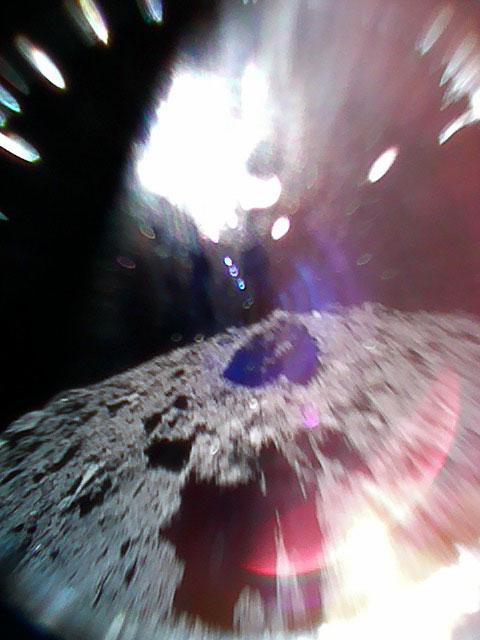
Super cool images! The two Minerva probes released two days ago from Hayabusa-2 have both sent back spectacular images from the surface of Ryugu.
The image on the right was captured by the rover dubbed 1A. I have rotated it to show the surface on the bottom, but the actual picture was taking during one of the rover’s bounces while it was moving, so the returned picture had the surface on left. The white brightness is from sunlight. From the press release:
We have confirmed both rovers landed on the surface of asteroid Ryugu. The two rovers are in good condition and are transmitting images and data. Analysis of this information confirmed that at least one of the rovers is moving on the asteroid surface.
MINERVA-II1 is the world’s first rover (mobile exploration robot) to land on the surface of an asteroid. This is also the first time for autonomous movement and picture capture on an asteroid surface. MINERVA-II1 is therefore “the world’s first man-made object to explore movement on an asteroid surface”. We are also delighted that the two rovers both achieved this operation at the same time.
Other released images were taken just after release. One shows a blurred picture of Hayabusa-2, while the other sees Ryugu’s surface below.
Both of these rovers are designed to travel on the surface by a series of hops, taking advantage of Ryugu’s tiny gravity. There will be more images I’m sure from them in the coming days.
Link here. As I’ve said numerous times in the past year, they’re coming for you next. As carefully documented in the article, no longer does the Democratic Party believe that everyone should be innocent until proven guilty. Now their standard is everyone who opposes their agenda is automatically guilty of any crime any Democratic Party supporter lodges against them.
Any accusation must be accepted, no matter how flimsy, unprovable, or blatantly partisan. If a Democrat says you are guilty of any crime, your career must be ruined and you must be hounded from public life.
Meanwhile, if a Democrat such as Keith Ellison in Minnesota, presently running for that state’s attorney general, is creditably accused of abusing his girlfriend, with good documentary evidence to back up the accusation, we must ignore it completely. All Democrats are always innocent, and any attempt to make them accountable for anything they do is unacceptable.
If we the public accept this standard, the American experiment in democracy is dead. The Democrats will have an endless and unchallengeable veto on everything.