Hayabusa-2’s third mini-lander successfully lands on Ryugu

MASCOT image of Ryugu surface

Update: The image at right, reduced to post here, was taken by MASCOT during its descent. You can see the spacecraft’s shadow in the upper right. If you click on the image you can see the full resolution version.

Original post: The German/French-build mini-lander MASCOT has been successfully deployed by Hayabusa-2 and has successfully landed on the asteroid Ryugu.

MASCOT came to rest on the surface approximately 20 minutes after the separation. Now, the team is analysing the data that MASCOT is sending to Earth to understand the events occurring on the asteroid Ryugu. The lander should now be on the asteroid’s surface, in the correct position thanks to its swing arm, and have started to conduct measurements independently. There are four instruments on board: a DLR camera and radiometer, an infrared spectrometer from the Institut d’Astrophysique Spatiale and a magnetometer from the TU Braunschweig. Once MASCOT has performed all planned measurements, it is expected to hop to another measuring location. This is the first time that scientists will receive data from different locations on an asteroid.

The spacecraft took 20 pictures during its descent, which were beamed to Hayabusa-2 where they are presently stored.

0 comments

Celebrate Earthrise Day!

In only a little less than three months we will be celebrating the fiftieth anniversary of the December 1968 flight of Apollo 8 — first manned mission to another world. During that mission three humans spent 20 hours in orbit around the Moon, during which they read the first twelve verses of the Old Testament on Christmas Eve and became the first humans to witness an Earthrise and to photograph it.

To celebrate that achievement, a new website has been created, dubbed Celebrate Earthrise Day.

The website provides some great background material. You can listen to the astronaut’s Christmas telecast as well as see a recreation of the moment when the astronauts saw that Earthrise and Bill Anders took his famous color photo. The site also includes many photos from before, during, and after the mission, with many pictures coming from the personal family pictures of the astronauts. There is also audio of an 1988 Bill Anders’ interview, as well as a video of a fascinating presentation made by Bill and Valerie Anders, describing their life journey leading up to Apollo 8 and afterward.

Finally, and I think of most interest to my readers here, the site includes the audio of my introduction from the new audio edition of my book, Genesis: the Story of Apollo 8.

The site also includes the audio of one of the best radio interviews I have ever done, broadcast in 1998, on the subject of Apollo 8, our American culture, and the importance of each person choosing their path in life wisely. You can find that audio at the bottom of this webpage.

Check it all out. I think you will find it worth your while.

20 comments

More intergalactic stars discovered

Worlds without end: Using the data from Gaia’s second data release astronomers have identified twenty stars that are moving too fast to be permanent members of the Milky Way galaxy.

More significantly, most appeared to be approaching the galaxy, not flying away from it, suggesting they are visitors from other galaxies.

It is possible that these intergalactic interlopers come from the Large Magellanic Cloud, a relatively small galaxy orbiting the Milky Way, or they may originate from a galaxy even further afield. If that is the case, they carry the imprint of their site of origin, and studying them at much closer distances than their parent galaxy could provide unprecedented information on the nature of stars in another galaxy – similar in a way to studying Martian material brought to our planet by meteorites.

…An alternative explanation is that the newly identified sprinting stars could be native to our Galaxy’s halo, accelerated and pushed inwards through interactions with one of the dwarf galaxies that fell towards the Milky Way during its build-up history. Additional information about the age and composition of the stars could help the astronomers clarify their origin.

At least two more data releases shall come from Gaia, launched by Europe to precisely track the location and motions of a billion stars. So far, they have complete 3D velocity information for about seven million stars. After these additional data releases they expect to have complete 3D velocity information for 150 million stars, and should identify a lot more intergalactic stars at that time.

2 comments

Deployment operations for Hayabusa-2’s MASCOT lander have begun

Engineers have begun the deployment sequence for Hayabusa-2’s MASCOT lander, with deployment planned for tomorrow.

Right now Hayabusa-2 is slowly moving closer to Ryugu, with live images appearing about once every half hour. More information about MASCOT can be found here. The lander can also hop like the MINERVA bouncers, but it can only do it once. Its battery life is about sixteen hours, so once it is deployed it will only operate on the surface for a short while.

Both the MINERVA and MASCOT mini-landers are mostly engineering tests for using small cubesat-sized spacecraft as probes. So far the MINERVA bouncers have been an unqualified success. Hopefully MASCOT will be as successfully.

0 comments

Breakthrough Listen adds southern hemisphere telescope to extraterrestrial listening campaign

Breakthrough Listen has added the MeerKAT telescope in South Africa to its extraterrestrial listening campaign, thereby expanding the campaign to cover almost the entire sky.

Breakthrough Listen’s MeerKAT survey will examine a million individual stars – 1,000 times the number of targets in any previous search – in the quietest part of the radio spectrum, monitoring for signs of extraterrestrial technology. With the addition of MeerKAT’s observations to its existing surveys, Listen will operate 24 hours a day, seven days a week, in parallel with other surveys. “Collaborating with MeerKAT will significantly enhance the capabilities of Breakthrough Listen”, said Yuri Milner, founder of the Breakthrough Initiatives. “This is now a truly global project.”

Built and operated by the South African Radio Astronomy Observatory (SARAO), and inaugurated in July 2018, MeerKAT is a powerful array of 64 radio antennas in the remote Karoo Desert of South Africa. By partnering with SARAO, Breakthrough Listen gains access to one of the world’s premier observing facilities at radio wavelengths. Signals from the 64 dishes (each 13.5 meters in diameter) are combined electronically to yield an impressive combination of sensitivity, resolution and field of view on the sky. MeerKAT also serves as a precursor for the Square Kilometre Array, which will expand and enhance the current facility in the coming decades, eventually spanning a million square meters across South Africa and Australia to create by far the world’s largest radio telescope.

They have also widened their approach. They are not simply looking for intelligent radio communications, they are looking for any signs of technology.

13 comments

“Kill Kavanaugh” now tops Twitter feeds

They’re coming for you next: “Kill Kavanaugh” now tops Twitter search feeds, requiring only the typing of a “k” to get it near the top of any search, with “ki” placing at the very top of the search list.

Although many current tweets on the hashtag are critical of both the hashtag and Twitter’s double standards, earlier tweets use the hashtag unironically and uncritically. Several of these tweets have not been removed by Twitter, and the accounts that tweeted them do not appear to have been punished by Twitter in any way, despite the fact that some users say they have reported them.

It can be argued that some — but not all — of these tweets are metaphorical, calling for the nomination to be “killed” rather than the person, in the same way that a piece of legislation might be metaphorically “killed.” But refusing to take action against those tweets would still be an example of Twitter’s double standards: the platform has in the past permanently banned free speech maximalist users when they employed similar metaphors, using the least charitable interpretation of their remarks. This is the website that has silenced James Woods for tweeting a meme about soy boys that Jack Dorsey and his San Francisco menagerie argue could “impact an election.”

Twitter in general is a sewer of vicious hate and childish emotions, but that its management is willing to tolerate this kind of behavior from the left indicates they really support it.

The left, and the Democrats, are out for full and unopposed power, and they are willing to destroy anyone they perceive as getting in their way. Unfortunately, they have quislings like Senator Jeff Flake (R-Arizona) helping them. The man would have built the gas chambers for the NAZIS if they had asked him.

29 comments

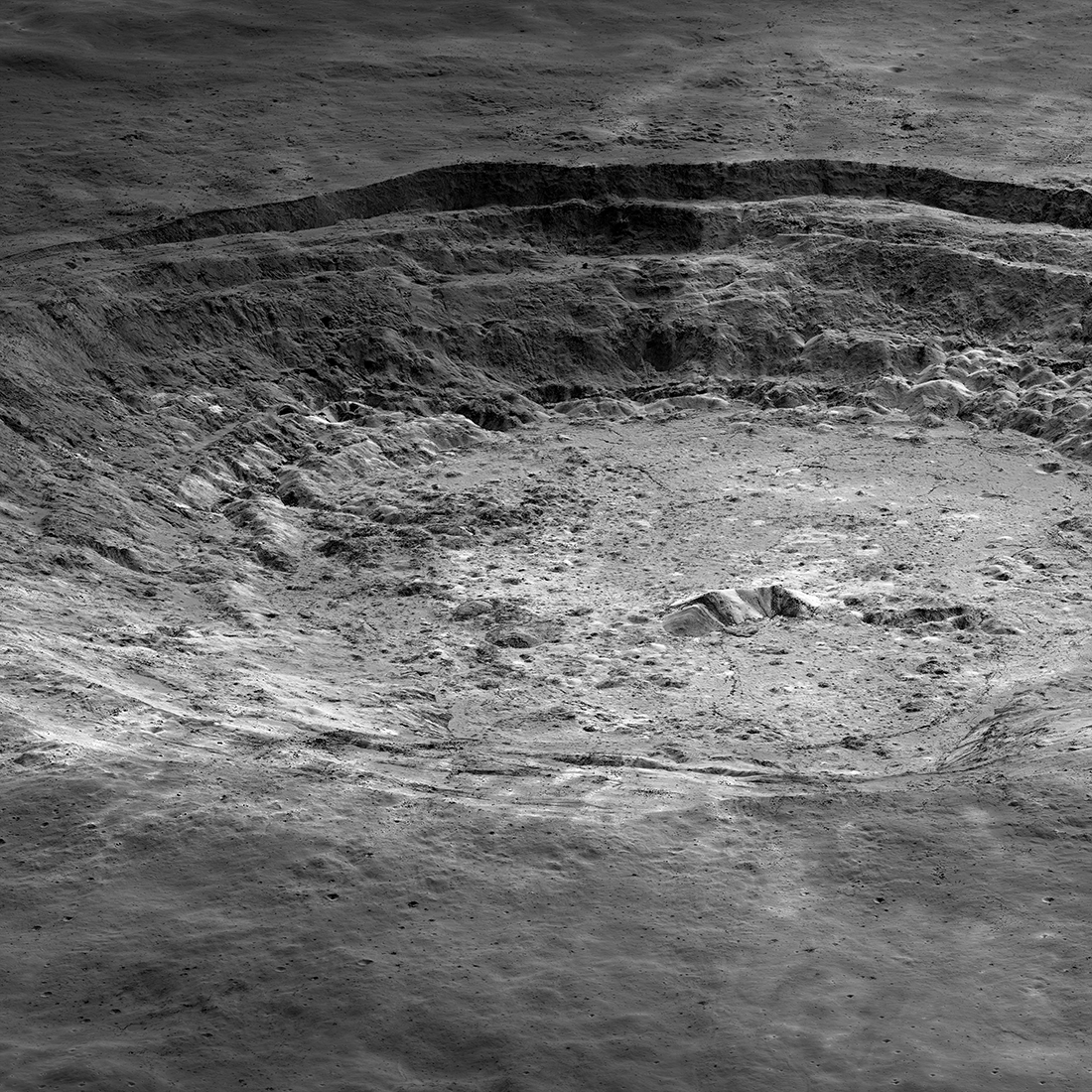
Occator Crater on Ceres

Occator Crater

Cool image time! As Dawn’s long and successful mission to the asteroids Vesta and Ceres winds down, the spacecraft is taking a slew of spectacular close-up images of Ceres. The image on the right, cropped slightly to post here, is an oblique view of Occator Crater, home to the double bright spots that scientists now believe are caused by the upward seepage of a water-based brine from the interior.

The image was taken August 14, 2018 from a distance of 1149 miles. It clearly shows how the bright spots are depressions, not raised features. Additional images released this week of the floor of the crater capture a complex fracture network (seen here and here) with some fractures apparently quite deep.

All this suggests that the surface crust of Ceres is not very structurally strong, allowing a churning process that plows material up and down. The data also suggests that even on a small planetary body like Ceres the geological processes are going to be complex and often on-going, depending on material, energy, and the size of the body.

1 comment

Russia and China sign agreement for future space cooperation

The new colonial movement: Russia and China last week signed an agreement to establish a greater cooperation in future space projects.

“The session ended with the signing of a protocol in which the two parties agreed to take further steps to seek rapprochement in implementing joint projects for the manufacture of space vehicles and rocket engines, exploring the Moon and deep space, remote sensing of the Earth, satellite navigation, creating a base of electronics components for the space industry, and low orbit mobile communication systems and space debris monitoring,” the report runs.

This is a direct negotiating threat from Russia to the U.S., telling us that they might switch teams from NASA to China if they don’t get what they want in the Gateway partnership. And since NASA really doesn’t have the ability to build much itself (more on this later today), if they make this switch it could very well kill Gateway, all by itself.

Because of this, expect NASA management (part of the DC culture) to backstab the U.S. in any negotiations with Russia on Gateway. Rather than defend U.S. interests, they will instead be focused on guaranteeing Russia participation, even if the deal might cripple the burgeoning private American space industry.

1 comment

Three U.S. small space companies establish offices in Luxembourg

Capitalism in space: Three U.S. small space companies have now established offices in Luxembourg in order to take advantage of the financial backing that nation is willing to afford.

The government of Luxembourg announced Sept. 27 that CubeRover, Hydrosat and Made In Space will all establish facilities in the country, in many cases working with local universities and companies. The work those companies do in Luxembourg will range from development of robotic arms to small planetary rovers.

“The success of our development strategy for the space sector, including the recent launch of the Luxembourg Space Agency, is confirmed once more with the settlement in Luxembourg of three space companies that plan to employ up to 85 people in the Grand-Duchy by 2023,” said Étienne Schneider, deputy prime minister and minister of the economy of the Luxembourg government and the driving force for the country’s recent space initiatives.

The largest agreement, in terms of jobs created, goes to Made In Space. That company, best known for additive manufacturing work on the International Space Station, plans to work on a low-cost modular robotic arm for in-space applications, and will create up to 50 jobs in the country.

They did not mention what the terms are of Luxembourg’s financial support, but I suspect it is most helpful for these companies.

1 comment

Musk settles with SEC, pays fine, reduces control at Tesla for 3 years

Elon Musk and Tesla have negotiated a settlement with the SEC, agreeing to each pay a fine of $20 million while Musk reduces his role with the company for the next three years.

Musk and Palo Alto-based Tesla agreed to pay a total of $40 million to settle the case, and he will give up his chairmanship for at least three years. The electric-car maker also is required to install an independent chairman and two new board members, though Musk will remain on the board, according to terms of the settlement.

Musk and Tesla will each pay $20 million to settle the case; both reached the deal without admitting wrongdoing.

I suspect this will not reduce Musk’s influence on Tesla very much. To me, this whole kerfuffle was the SEC acting like a bunch of mobsters, pulling its weight against someone it apparently doesn’t like. “Nice business you have there, Elon. Sure would be a shame if something happened to it.”

11 comments
1 37 38 39 40 41 155