InSight tests its robot arm

InSight has unfolded its robot arm and is beginning to use it to photograph the surrounding area to figure out where to place the spacecraft’s ground-sensing instruments.

With a reach of nearly 6 feet (2 meters), the arm will be used to pick up science instruments from the lander’s deck, gently setting them on the Martian surface at Elysium Planitia, the lava plain where InSight touched down on Nov. 26.

But first, the arm will use its Instrument Deployment Camera, located on its elbow, to take photos of the terrain in front of the lander. These images will help mission team members determine where to set InSight’s seismometer and heat flow probe – the only instruments ever to be robotically placed on the surface of another planet.

They are proceeding carefully, so actually deployment might not occur for several months, just make everything goes well.

0 comments

Sunspot update November 2018: Minimum continues

NOAA’s monthly update of the solar cycle, covering sunspot activity for November 2018, was released yesterday. As I have done every month since this website began in July 2011, I am posting it below, annotated to give it some context.

November 2018 sunspot activity

The graph above has been modified to show the predictions of the solar science community. The green curves show the community’s two original predictions from April 2007, with half the scientists predicting a very strong maximum and half predicting a weak one. The red curve is their revised May 2009 prediction.

As I have been expecting now for the last three months, NOAA has finally revised this graph to extend it past the end of 2018. The graph below is the graph from October, which follows the layout and design used since 2007. You can see the differences by comparing the two graphs. In extending the new graph to the end of 2022, they fortunately did not change the design significantly. However, because the new graph has a slightly different scale, I have stretched the green and red curves to make them fit properly. While I suspect the poor quality of the 2007 and 2009 predictions is one reason they do not include them on their graph, I think it essential to add them to better understand the limitations of the science.
» Read more

15 comments

BepiColombo tests its ion engines

The joint European/Japanese mission BepiColombo has begun testing its ion engine thrusters for the first time in space as it heads to Mercury.

Testing took place during a unique window, in which BepiColombo remained in continuous view of ground-based antennas and communications between the spacecraft and those controlling it could be constantly maintained. This was the only chance to check in detail the functioning of this fundamental part of the spacecraft, as when routine firing begins in mid-December, the position of the spacecraft will mean its antennas will not be pointing at Earth, making it less visible to operators at mission control.

They have so far successfully tested two of the four engines.

0 comments

SpaceX sees no schedule impact from first stage landing failure

Capitalism in space: SpaceX officials expect the first stage landing failure during yesterday’s launch to have little impact on the schedule of upcoming launches.

They also indicated that the cause of the landing failure had something to do with a malfunction in the stage’s grid fins. More important however was this tidbit about the second stage:

Koenigsmann also revealed at the briefing that the rocketโ€™s upper stage, which successfully placed the Dragon cargo spacecraft in orbit, used redesigned composite-overwrapped pressure vessels (COPVs) used to store helium to pressurize the stageโ€™s propellant tanks. SpaceX redesigned those COPVs after a September 2016 pad explosion in order to meet NASA safety requirements for future commercial crew missions.

NASA requires SpaceX to perform at least seven launches with the redesigned COPVs before the agency will allow its astronauts to fly on the vehicle. Koenigsmann said he believed this was the second launch to use the redesigned COPVs, after the launch of the Esโ€™hail-2 communications satellite Nov. 15.

SpaceX appears very unconcerned about getting those remaining five flights, which illustrates their expectation that 2019 will have a substantial number of launches in the first half of the year, prior to the tentative June launch date for the first manned Dragon mission.

1 comment

Solar scientists: sunspot increase in next solar cycle

The uncertainty of science: Using new computer models, two solar scientists are now predicting that the next solar cycle will begin in about a year and will see an increase in sunspot activity, compared to the weak cycle just ending.

Their ensemble forecast surprisingly suggests it could even be stronger than the cycle which is just ending. They expect the next cycle to start rising in about a year following the end of the current sunspot cycle minimum and peak in 2024. Bhowmik and Nandi predict space environmental conditions over the next decade would be similar or slightly harsher compared to the last decade. They find no evidence of an impending disappearance of sunspot cycles and thus conclude that speculations of an imminent Sun-induced cooling of global climate is very unlikely.

Their conclusion is different than other predictions that are claiming a weak next cycle, or even the beginning of a grand minimum, with no suspots at all. Since an real understanding of the sunspot cycle remains elusive, and all these predictions rely on computer models, it is hard to say which will be right. The advantage this particular prediction has is that their model appears able to match what has happened for the past 100 years.

Stay tuned.

10 comments

The vast southern highlands of Mars

Small section of Rocky Highlands

Rocky highlands

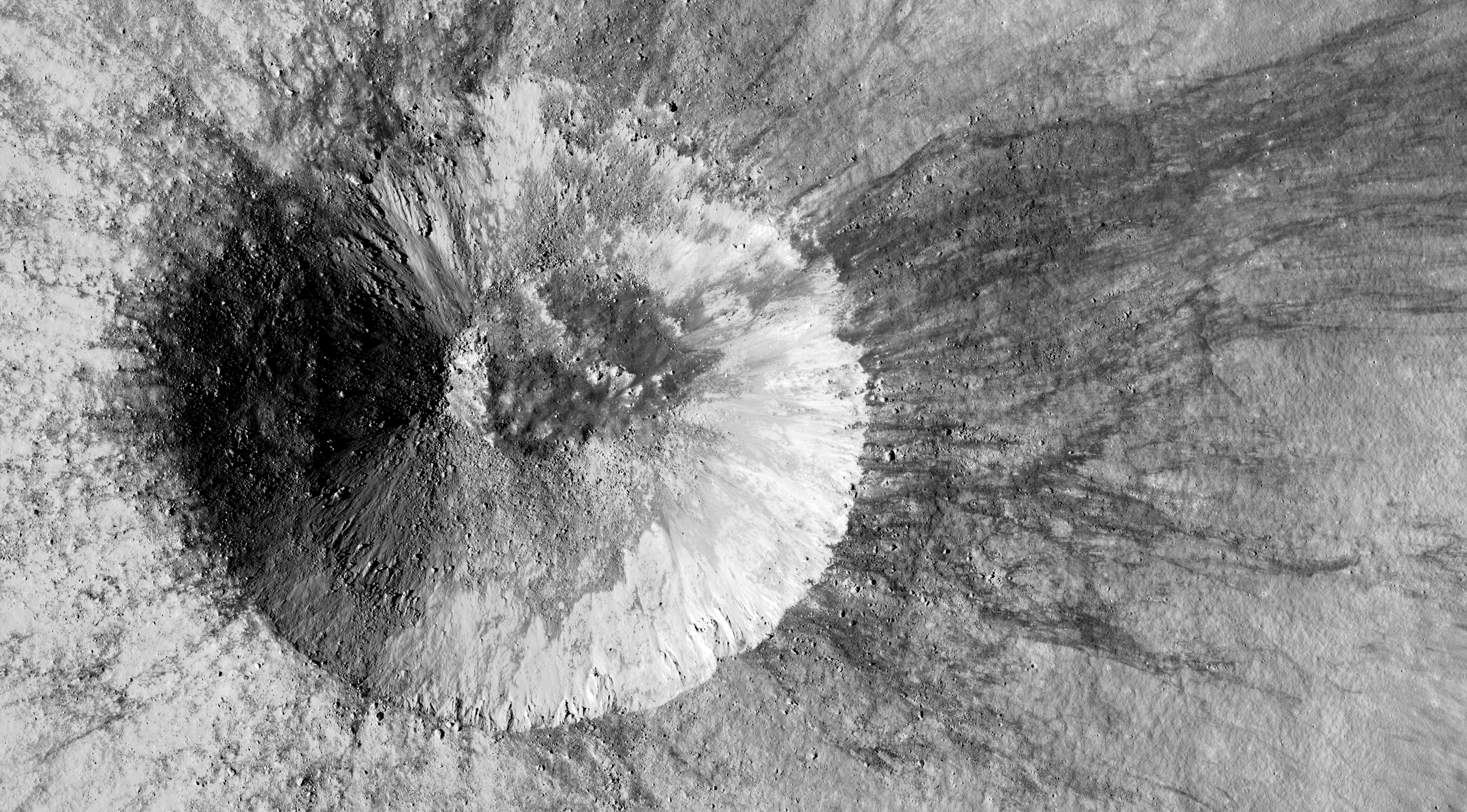
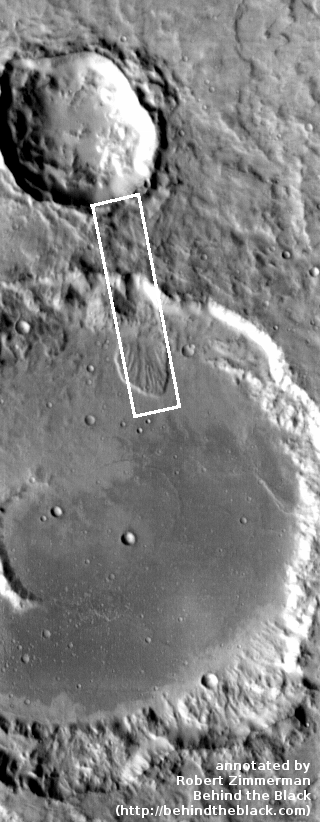
Cool image time! This week the Mars Reconnaissance Orbiter (MRO) science team made available its monthly release of new images taken by the high resolution camera on Mars Reconnaissance Orbiter (MRO). The image above is just a small cropped section from one of those new images, released under the name “Rocky Highlands.” The image on the right is a cropped and reduced section of the full photograph, with the white box indicating the small section above. If you click on either you can see the full resolution uncropped photograph and explore its complex and rough terrain.

What should immediately strike you looking at the small inset section above is the difficulty anyone is going to have traversing this country. There are no flat areas. Every inch seems to be a broken and shattered collection of ridges, pits, craters, or rippled dunes. And the inset above is only a tiny representation of the entire image, all of which shows the same kind of badlands.

This forbidding place is located in the southern highlands of Mars, north of Hellas Basin and south of the transition zone that drops down to the northern lowland plains. The white cross on the map below indicates the image location, with green representing the transition zone, blue the northern plains, and red/orange the southern highlands..
» Read more

4 comments

Falcon 9 launches Dragon; 1st stage return fails

SpaceX’s Falcon 9 rocket today successfully launched a Dragon cargo capsule to ISS.

Unfortunately, a problem with the first stage had it fail to land on its target landing pad, instead landing in the ocean. This failure is the first in quite some time for a SpaceX first stage. It was the first failure however of their Block 5 first stages, which might impact the manned Dragon launch schedule set for this coming year.

The leaders in the 2018 launch race:

33 China
20 SpaceX
13 Russia
10 Europe (Arianespace)
8 ULA

This SpaceX launch was the 100th successful rocket launch for 2018, the first time the global rocket industry has reached the century figure since 1991, before the fall of the Soviet Union. As SpaceX’s 20th launch this year it sets a new record for launches by a private company. In fact, this total exceeds the average number of launches for the entire U.S. from 2001 to 2016, and clearly demonstrates how SpaceX has not only become the world’s dominate launch company, its effort to foster competition into the launch industry has served to energize it, for everyone.

In the national rankings, China continues to lead the U.S. 33 to 32.

23 comments

Ariane 5 launches two satellites

Arianespace yesterday successfully placed a South Korean weather satellite and an Indian communications satellite into orbit using its Ariane 5 rocket.

The Indian satellite was initially supposed to launch in the spring, but ISRO pulled it back to India just after its arrival in French Guiana to do more checks on it because of the failure of another satellite using similar components.

The leaders in the 2018 launch race:

33 China
19 SpaceX
13 Russia
10 Europe (Arianespace)
8 ULA

Arianespace had predicted it would do 14 launches this year. As this launch is described as its last 2018 launch, it appears they have fallen short of that prediction.

These standings will be updated later today, assuming SpaceX’s Dragon launch to ISS goes off as scheduled.

2 comments

Senate committee demands FBI explain whistleblower raid

The Senate Judiciary Committee has demanded the FBI answer some questions about its raid of a whistleblower’s home in November.

This is nice, but the reality is that, as far as I can tell, the FBI is now a rogue agency, working for the Democratic Party in defiance of the law, the Trump administration, and Congress. Consider for example the article’s closing paragraphs:

The raid on Cainโ€™s house was permitted by a court order issued by federal magistrate Stephanie A. Gallagher in the U.S. District Court of Maryland for Baltimore. The court order and all the documents justifying the raid are sealed and not available for public viewing.

On Nov. 30, The Daily Caller News Foundation (DCNF) requested that Gallagher unseal the affidavit and any other documents that served to justify the raid. The court has not yet responded to the DCNF. The FBI did not respond to a request for comment. The IG declined to comment.

The weak response by the Trump administration to their behavior these last two years has taught them they can act with arrogance without fear. For example, why has Trump done nothing about this? He is by law (which in this case is the Constitution, the highest law in the land) entirely in charge of the FBI and what it does.

2 comments

The cameras that saved Hubble

Link here. It is the 25th anniversary this week of the space shuttle mission that installed the two cameras that fixed the mirror issue on the Hubble Space Telescope, and the press release at the link provides a nice short overview of that mission, and what was involved to make it happen.

Of course, for a much more detailed look at this story, you could also buy and read A Universe in a Mirror. There are a lot of very fascinating stories that no single press release can possibly mention that I described with glee in writing this book.

0 comments
1 7 8 9 10 11 155