Opportunity’s parting shot

Opportunity's last panorama
Click for full image.

The Opportunity science team today released the last full 360 degree panorama taken by the rover last spring, prior to the global dust storm that ended its fifteen year mission on Mars.

Over 29 days last spring, NASA’s Mars Exploration Rover Opportunity documented this 360-degree panorama from multiple images taken at what would become its final resting spot in Perseverance Valley. Located on the inner slope of the western rim of Endurance Crater, Perseverance Valley is a system of shallow troughs descending eastward about the length of two football fields from the crest of Endeavor’s rim to its floor.

“This final panorama embodies what made our Opportunity rover such a remarkable mission of exploration and discovery,” said Opportunity project manager John Callas of NASA’s Jet Propulsion Laboratory in Pasadena, California. “To the right of center you can see the rim of Endeavor Crater rising in the distance. Just to the left of that, rover tracks begin their descent from over the horizon and weave their way down to geologic features that our scientists wanted to examine up close. And to the far right and left are the bottom of Perseverance Valley and the floor of Endeavour crater, pristine and unexplored, waiting for visits from future explorers.”

If you click on the image above you can go to the full image and zoom and scan across it.
1 comment

Water system in Caracas goes dry

The water system in Caracas, capital of the socialist paradise of Venezuela, is now shutting down because it needs electricity to operate and it does not have it because of the collapse of the power system.

Caracas began going dry Monday as Venezuela’s power crisis put utilities out of commission, risking supplies for 5.5 million people, many of whom found themselves reduced to carrying buckets of filthy river water.

Service, intermittent in normal times, was scarce to nonexistent in large swathes of the capital and experts saw little reason for hope. Caracas is 900 meters above sea level and water comes from the Tuy system of reservoirs and pumping stations below. Those depend on a reliable electric supply of 2,000 megawatts, said Norberto Bausson, who was the head of state utility Hidrocapital in the 1990s. “As of this morning, this system hasn’t been restarted yet,” Bausson said Monday. “The supply of water for the city is at risk.”

The power crisis — and now the water crisis — are testing the hold of strongman President Nicolas Maduro. Opposition leader Juan Guaido is trying to topple him after a re-election widely viewed as fraudulent and using as his main argument widespread deprivation after six years of Maduro’s rule. Hunger is widespread in the nation. Its infrastructure has decayed to critical levels.

But wait! Think of the wonderful things these people are doing to prevent climate change! No power system, no burning of those evil fossil fuels, and less carbon dioxide in the atmosphere! This is exactly what the modern luminaries of the Democratic Party like Congresswoman Alexandria Ocasio-Cortez (D-New York) want.

We should all congratulate Maduro and work to emulate him here in the U.S.

8 comments

Trump’s budget will not “destroy” or “gut” science

Our terrible press does it again. Yesterday the Trump administration released its proposed 2020 federal budget [pdf], and as usual the pro-government propagandists in the media got to work to lobby against it.

This proposed budget will do none of these things.

These articles all fail to apply even the slightest and tiniest bit of context to their analysis. The budget numbers proposed by the Trump administration might reduce the budgets of some science agencies from what they had gotten the year before, but overall the proposed budgets remain gigantic, far more than received by these same agencies only a few years before.

You don’t believe me? Let me open your eyes.
» Read more

5 comments

New research detects increase in Bennu’s rotation

New research using ground-based observations has detected a slight increase over time in the daily rotation of the asteroid Bennu.

The new research finds the asteroid’s rotation is speeding up by about 1 second per century. In other words, Bennu’s rotation period is getting shorter by about 1 second every 100 years.

While the increase in rotation might not seem like much, over a long period of time it can translate into dramatic changes in the space rock. As the asteroid spins faster and faster over millions of years, it could lose pieces of itself or blow itself apart, according to the study’s authors.

…The change in Bennu’s rotation could be due to a change in its shape. Similar to how ice skaters speed up as they pull in their arms, an asteroid could speed up as it loses material.

Nolan and his co-authors suggest the reason for the increase in Bennu’s rotation is more likely due to a phenomenon known the YORP effect. Sunlight hitting the asteroid is reflected back into space. The change in the direction of the light coming in and going out pushes on the asteroid and can cause it to spin faster or slower, depending on its shape and rotation.

Truth is, this is not a very significant finding. Asteroids don’t weight much, and thus have very weak gravitational fields. It is therefore very easy to change their orbit and rotation, as well as add or subject material from them.

In this sense, the conclusion above is likely incorrect. What they have found is that the asteroid’s rotation increased at a pace of about 1 second per century, during their study period. Their data only covers the period from 1999 to 2005. Bennu could easily slowed its rotation, or increased it even more, during other times.

2 comments

SpaceX about to install engines on Starship hopper

Capitalism in space: Late last week SpaceX officials revealed that they are about to install the first two Raptor engines on their Starship hopper prototype being assembled at the Texas spaceport.

According to an official SpaceX statement, once Raptor is installed on Starhopper, the integrated vehicle will perform a combination of ground systems testing, propellant loading, static fire tests, and low-altitude hover demonstrations to prove out the brand new vehicle, engine, and facilities. Prior to the final months of 2018, the build site, launch pad, and prototype Starship now preparing for imminent hop tests were little more than empty dirt lots on the southern tip of the Texas coast.

…“SpaceX will conduct checkouts of the newly installed ground systems and perform a short static fire test in the days ahead,” he said. “Although the prototype is designed to perform sub-orbital flights, or hops, powered by the SpaceX Raptor engine, the vehicle will be tethered during initial testing and hops will not be visible from offsite. SpaceX will establish a safety zone perimeter in coordination with local enforcement and signage will be in place to alert the community prior to the testing.” – James Gleeson, March 8th, SpaceX

It is not clear when these first hopper tests will occur, but based on the pace that SpaceX is setting, it should not be too far into the future. Before that however they will likely need to first do some static fire tests, on the ground.

10 comments

Anti-Semite Democrat says Trump simply isn’t human

They’re coming for you next: In a discussion noting similar immigration policies of both Trump and Obama, anti-Semite Democrat congresswoman Ilhan Omar (D-Minnesota) said that the comparison was “silly” because “One is human. The other is really not.”

Every Democratic voter had better realize this basic fact: Too many of the people they are voting for see their political opponents in this light, which means it will be very easy for them to treat their opponents as bugs that should be squashed. And this is what almost always happens when leftist socialists gain power, in the Soviet Union, in Germany, in North Korea, in East Germany, in China, and in innumerable other places in the past century.

Omar is simply being honest about her hateful bigotry.

7 comments

The nationwide Venezuela power outage

Link here. The article gives a good overview of the now days-long blackout that will go on for days more. Key quote:

How did the country reach this point, in terms of its power network?

Years of disrepair, lack of maintenance and investment. From a human capital point of view, repressive management, terrible wages, and unsafe working conditions. For instance, the technicians are forbidden to talk about this. In February 2018, union leader Elio Palacios was detained because he said that a national blackout was imminent.

The one detail that would have accurately described those years of neglect would have been “socialist rule.” The people who have been in charge of Venezuela since the 1990s have all been heroes of today’s modern American socialists like Bernie Sanders and Alexandria Ocasio-Cortez as well as most of the leaders in the Democratic Party.

Be prepared for the same here. We already see signs of this collapse in urban cities that have been solid Democratic Party strongholds for decades, such as San Francisco, Chicago, and New York. These fascist political leaders like political and economic collapse, because they can use it as a lever to garner more power and wealth to themselves.

Note also this quote from the second link above:

“What can you do without electricity?” said Leonel Gutierrez, a 47-year-old systems technician, as he carried his six-month-old daughter while he walked to find groceries. “The food we have has gone bad.”

Yet this is exactly the future envisioned by Congresswoman Alexandria Ocasio-Cortez (D-New York) in her New Green Deal, where all future electricity will come only from renewable resources, a concept that is simply impossible. The result will be no electricity at all.

8 comments

Martian massive landslides

Though scientists have found some evidence of slow erosion and change on the Martian surface, it is today generally inactive. While the weak wind of Mars’ thin atmosphere continues to work its will, and the likely presence of underground frozen water acts to shift the surface shape as the seasons come and go, none of this happens quickly.

Essentially, Mars is a quiet place.

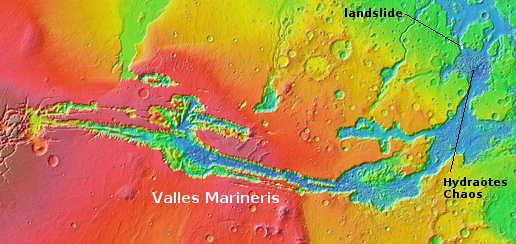
Once however catastrophic events took place, gigantic floods flowing down to the east from the planet’s huge volcanoes to carve out Marineris Valles, the solar system’s largest known canyon. As that water rushed eastward it ripped the terrain apart quickly, creating deep side canyons, drainage valleys, and chopped up regions now dubbed as chaos terrain, multiple mesas separated by numerous fissure-like canyons.

Overview of Marineris Valles and landslide

The overview map on the right shows Valles Marineris and its drainage to the east and north into the vast northern plains of Mars. It also shows the location of one of the largest regions on Mars of chaos terrain, dubbed Hydraotes Chaos, located close to the mouth of this gigantic drainage system more than 2,500 miles long.

Massive Martian landslide
Click for full image.

Recently scientists have used the high resolution camera on Mars Reconnaissance Orbiter (MRO) to begin taking images of the massive landslides on the face of the mesa north of Hydraotes Chaos that was hit directly by these floods. The location of the most immediately interesting of these landslide images is also indicated on this overview image.

To the right is that image, rotated, cropped, reduced, and annotated to post here. The white boxes indicate two full resolution sections that I highlight below at full resolution.

This image shows that full cliff. The total drop from the plateau at the top to the floor where Hydraotes Chaos is located to the south is approximately 8,200 feet, almost exactly comparable to the depth of the north rim of the Grand Canyon.

The image shows numerous evidence of avalanches and erosion, both at its base and at its rim. None of these avalanches likely occurred during those catastrophic floods, but long afterward.
» Read more

0 comments
1 122 123 124 125 126 156