Martian glacier with moraine?

Glacier flow on Mars, with moraine

Cool image time! In the past two decades numerous images and studies of the Martian terrain produced by orbiters have shown us landslides, lava flows, water and ice produced flows, and many glacial features, all vaguely familiar but often having components reminding us of the alien nature of the Martian landscape. I have posted many here at Behind the Black. (Just do a search here for the words “Mars flow” and you will have a wealth of cool images and alien geological features to explore.)

The image on the right, rotated, cropped, and reduced to post here, shows another such feature, but this time it is less alien and more resembling a typical Earth glacier, flowing downhill slowly and pushing a moraine of debris before it. The picture was taken by the high resolution camera on Mars Reconnaissance Orbiter (MRO) and was part of the January image release. If you click on the image you can see the complete photograph at full resolution.

The release has no caption, but is titled “Tongue-Shaped Glacier in Centauri Montes,” referring to the largest tongue-shaped flow on the left. This feature, more than any other in the image, resembles closely many glaciers on Earth. It even has an obvious moraine at its head. As the glacial flow pushed downward slowly it gathered a pile of material that eventually began to act almost like a dam.

The location of this feature is intriguing in its own right.
» Read more
0 comments

Rock from Earth, found on Moon?

The uncertainty of science: Scientists studying rocks brought back by the Apollo 14 lunar mission have concluded that one sample originally came from the Earth, and if so would be the oldest known Earth rock.

It is possible that the sample is not of terrestrial origin, but instead crystallized on the Moon, however, that would require conditions never before inferred from lunar samples. It would require the sample to have formed at tremendous depths, in the lunar mantle, where very different rock compositions are anticipated. Therefore, the simplest interpretation is that the sample came from Earth.

The team’s analyses are providing additional details about the sample’s history. The rock crystallized about 20 kilometers beneath Earth’s surface 4.0-4.1 billion years ago. It was then excavated by one or more large impact events and launched into cis-lunar space. Previous work by the team showed that impacting asteroids at that time were producing craters thousands of kilometers in diameter on Earth, sufficiently large to bring material from those depths to the surface. Once the sample reached the lunar surface, it was affected by several other impact events, one of which partially melted it 3.9 billion years ago, and which probably buried it beneath the surface. The sample is therefore a relic of an intense period of bombardment that shaped the Solar System during the first billion years. After that period, the Moon was affected by smaller and less frequent impact events. The final impact event to affect this sample occurred about 26 million years ago, when an impacting asteroid hit the Moon, producing the small 340 meter-diameter Cone Crater, and excavating the sample back onto the lunar surface where astronauts collected it almost exactly 48 years ago (January 31–February 6, 1971).

The scientists also admit that their conclusion is controversial and will be disputed. If true, however, it suggests that there is significant material on the Moon from the early Earth that can provide a window into parts our planet’s history that are presently inaccessible.

2 comments

India’s PSLV rocket successfully launches military satellite

The new colonial movement: India today successfully launched a military reconnaissance satellite using a new configuration of its PSLV rocket.

The launch was broadcast live here and is still on-going as I write.

Thursday’s launch, the forty-sixth overall for the Polar Satellite Launch Vehicle (PSLV), marks the maiden flight of the rocket’s new PSLV-DL configuration. Filling a gap in payload capacity between two of the rocket’s existing configuration, the PSLV-DL will help reduce the cost of India’s access to space. Its first payload consists of a demonstration satellite built around the rocket’s upper stage, testing this concept for future applications, and a military spacecraft with an imaging payload.

During the speeches after the launch, the head of ISRO, K. Sivan, did several things of note. First, he introduced the launch’s mission director and explained that this was his last PSLV launch, as he is leaving the program to take over important aspects of their manned program, dubbed Gaganyaan. Then he let this man speak, giving him a big platform that suggests he is definitely a rising star in their program. Unfortunately, I was not able to catch his name. We shall see him again, however, for sure.

Sivan also noted that the deadline for that first manned mission is December 2021. He also outlined the next few missions, including Chandrayaan-2 to the Moon.

The 2019 launch standings:

2 China
1 SpaceX
1 Japan
1 ULA
1 India

The U.S. and China are tied 2-2 in the national rankings.

5 comments

Oblique close-up image of Ceres

Ceres from Dawn

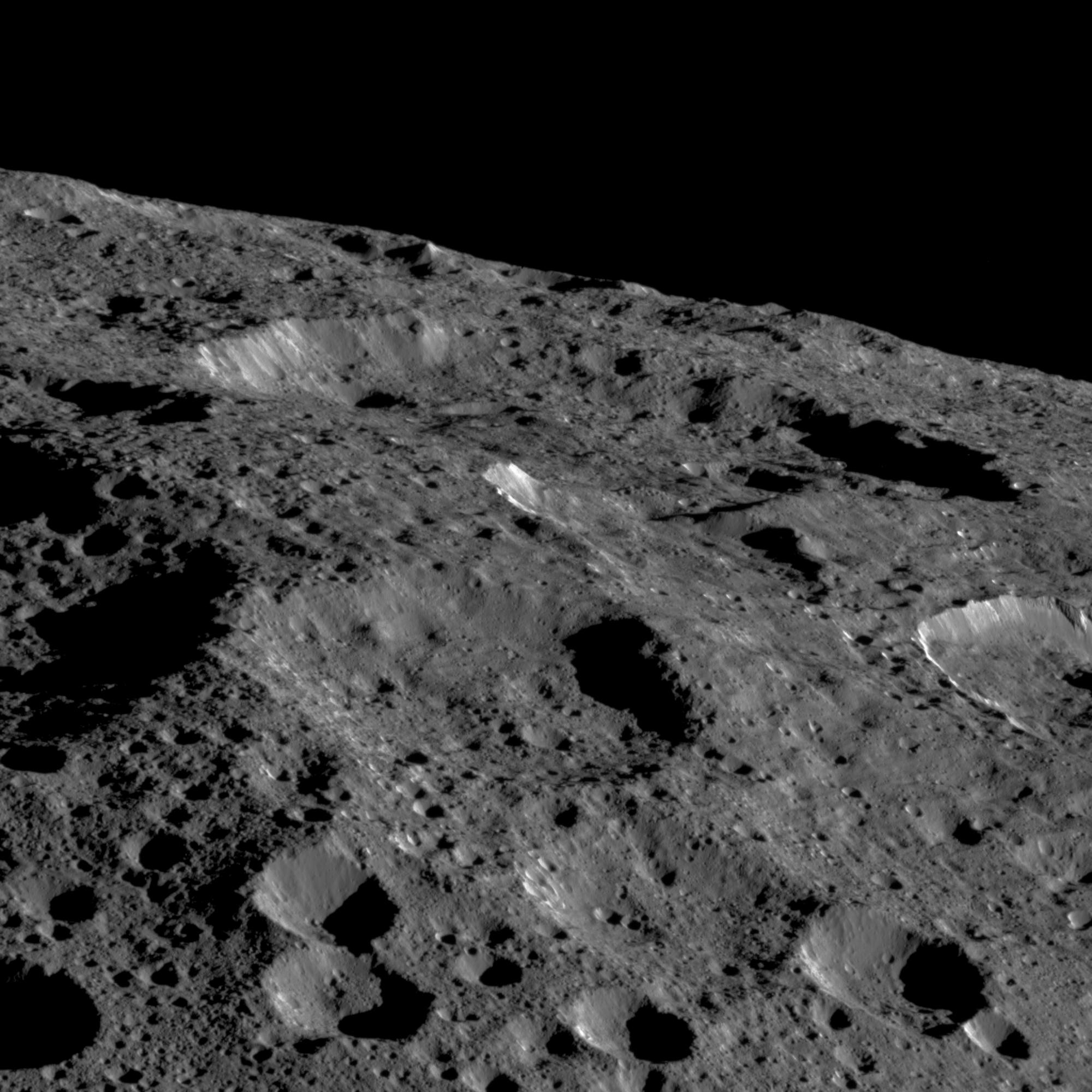
The Dawn science team has released an oblique close-up image of Ceres, taken in May 2018 before the Dawn mission ended. To the right is a reduced resolution version, with the full resolution photograph viewable if you click on it.

Dawn captured this view on May 19, 2018. The image shows the limb of Ceres at about 270E, 30N looking south. The spatial resolution is about 200 feet (60 meters) per pixel in the nearest parts of the image. The impact crater to the right (only partially visible) is Ninsar, named after a Sumerian goddess of plants and vegetation. It is about 25 miles (40 kilometers) in diameter.

Bright seeps running down the interior rims of several craters are visible. To my eye, the image also suggests an overall softness to Ceres. Its surface is like a sandbox, easily reshaped significantly by each impact.

1 comment

Orbital images of Bennu

Close-up of Bennu's southern hemisphere

The OSIRIS-REx science team has released two new images of Bennu’s southern hemisphere, taken from orbit. The image on the right is a cropped section of the highest resolution version of a montage of two images. Click on the image to see the entire two-image montage.

These two OpNav images of Bennu’s southern hemisphere, which each have an exposure time of about 1.4 milliseconds, were captured Jan. 17 from a distance of about one mile (1.6 km). They have been cropped and the contrast has been adjusted to better reveal surface features. The large boulder – fully visible in the middle of the left frame and in partial shadow in lower portion of right frame – is about 165 feet (50 meters) across.

The cropped section to the right shows that large boulder in the middle of the frame.

I’m sorry, but when I look at this rubble-pile asteroid I cannot help but think of the cat-litter clumps I remove from our cats’ litter box. The only fundamental difference is that the grains in cat litter are made to be a uniform size, while at Bennu the grains are much coarser and not uniform. Nonetheless, this asteroid is a clump of many grains, just like those cat litter clumps, and will likely crumple easily into a cloud of grains if smacked just hard enough.

This knowledge is actually very critical, as Bennu is a potentially dangerous asteroid with an orbit that might have it impact the Earth in about two hundred years.

4 comments

Contract cancelled for Vostochny launchpad for Angara

The coming dark age: The Russian government has cancelled its construction contract for the much delayed Vostochny launchpad for their new much delayed Angara rocket.

Deputy Prime Minister Yuri Borisov, who curates the space and defense industry for the Russian government, announced the news on January 23 after the latest meeting with Prime Minister Dmitry Medvedev dedicated to financial problems at Roskosmos. Medvedev singled out Vostochny as a symptomatic example of poor management at the State Corporation. Only five out of 19 facilities were officially completed in Vostochny in the first phase of construction by the deadline last year, Medvedev said, according to the public recap of the meeting released by the Russian government.

After the closed-door event, Borisov told journalists that the aborted contract on the Angara pad cost the project at least six months in delays, but, he essentially admitted that the actual completion of the critically needed facility would be pushed back by around two years. “Let’s not have any illusions, nobody will be able to build (Angara pad) by 2021,” Borisov told reporters about the recent official deadline for the project, “Today, due to the juggling of prime contractors, the deadline is beyond 2021, but it (has to be) no later than 2023, because otherwise, it would be desynchronized with the development of the rocket, which would be ready but no place to launch from.”

These problems suggest that the corruption in Russia’s aerospace industry must be incredibly embedded. They, like our own incompetent federal government, can’t seem to get anything accomplished.

0 comments

New impact on the Martian south polar cap

New impact on Mars' south pole

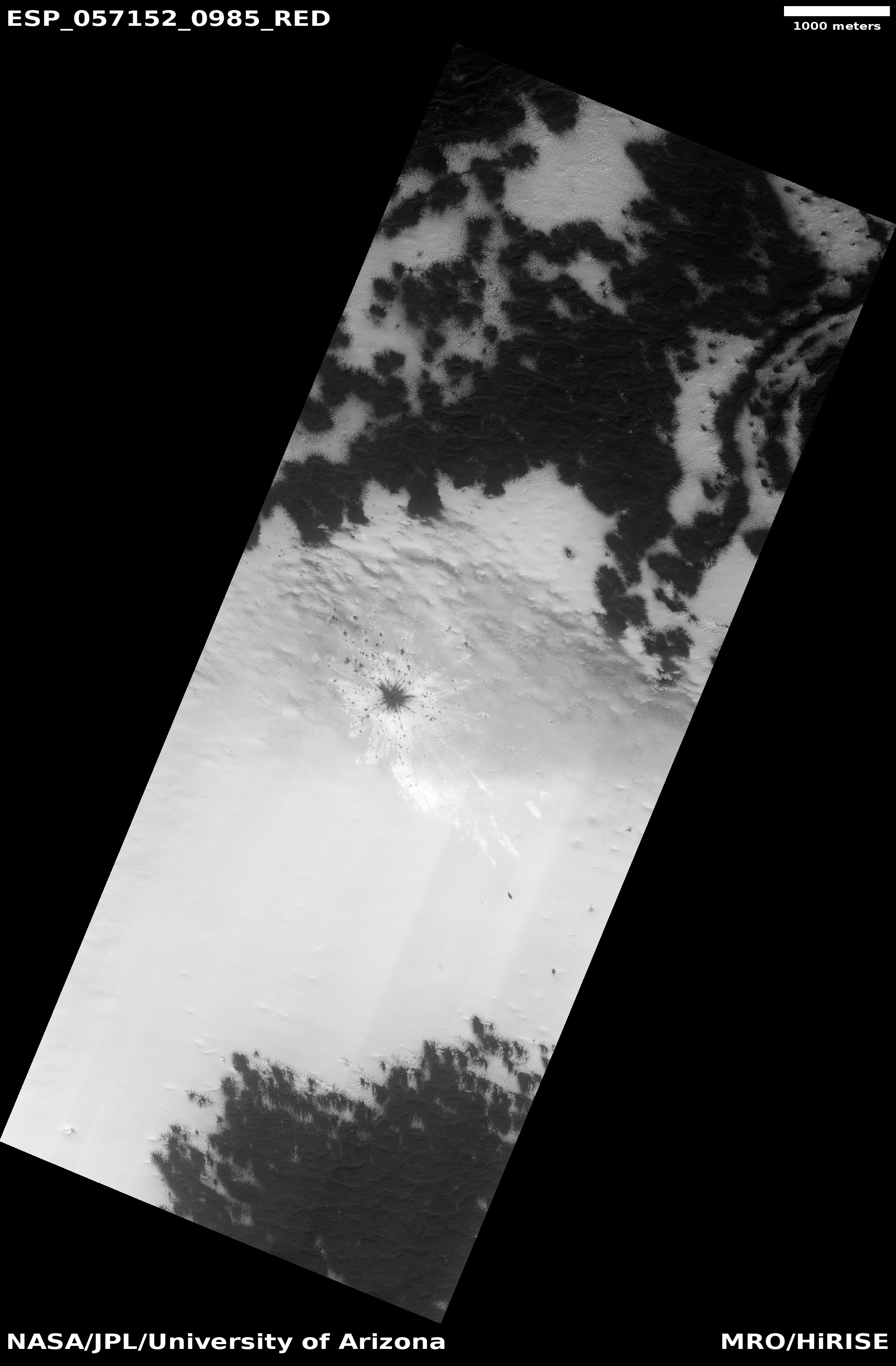
Cool image time! The image to the right, cropped to post here, was taken on October 5, 2018 by the high resolution camera on Mars Reconnaissance Orbiter (MRO) and shows a recent meteorite impact that occurred sometime between July and September of 2018 on the Martian polar cap . If you click on the image you can see the entire photograph. As noted in the captioned press release,

It’s notable because it occurred in the seasonal southern ice cap, and has apparently punched through it, creating a two-toned blast pattern.

The impact hit on the ice layer, and the tones of the blast pattern tell us the sequence. When an impactor hits the ground, there is a tremendous amount of force like an explosion. The larger, lighter-colored blast pattern could be the result of scouring by winds from the impact shockwave. The darker-colored inner blast pattern is because the impactor penetrated the thin ice layer, excavated the dark sand underneath, and threw it out in all directions on top of the layer.

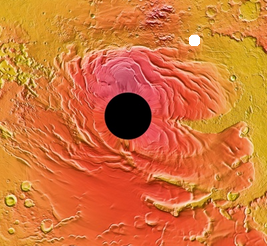
Location on edge of south polar cap

It is not known yet the size of this meteorite. The location is shown in the overview image to the right, with the impact indicated by the white dot. The black circle in the middle of the image is the south pole itself, an area where MRO’s orbit does not allow imagery. This location, on the edge of the Martian polar cap, is helpful to scientists because it has excavated material from below the cap, providing them a peek into previously unseen the geology there. Had the impact been farther south, on the thicker cap, that hidden material below the cap would likely not have been exposed.

The cap itself is made up of both ice and frozen carbon dioxide, though the CO2 is mostly seen as frost during winter months that evaporates during the summer.

2 comments

Blue Origin reveals redesigned New Glenn rocket

Capitalism in space: In a video animation Blue Origin last week revealed a new redesigned version of its orbital New Glenn rocket.

There are a few notable differences between the rocket depicted in the new video and the New Glenn we saw in a similar 2017 animation. For example, the older version featured a payload fairing — the protective nose cone that surrounds spacecraft during launch — that was bullet-shaped and 18 feet (5.4 meters) wide. The current incarnation boasts a 23-foot-wide (7 m) fairing with a traditional snub-nosed look. (A previously envisioned three-stage New Glenn featured this bigger fairing, but this booster variant is no longer part of Blue Origin’s plans.)

And the first stage’s six landing legs will apparently now deploy a bit differently — by unfolding outward from the bottom, much as Falcon 9 legs do, rather than sort of sliding downward.

These changes are almost certainly are the result of the company’s Air Force contract that gave it $500 million in development money in exchange for having a say in how the rocket is built.

For example, I am not surprised that New Glenn now more closely resembles the Falcon 9. The modern American military is not known for its daring or innovation. It had to be sued to finally agree to award contracts to SpaceX. Now that the Falcon 9 is well proven, however, the military bean-counters are probably demanding that New Glenn copy it, rather than introduce innovations of its own.

8 comments

NASA pulls astronaut for medical reasons from Boeing manned flight

NASA has switched one member of the planned astronaut crew for the first manned Boeing Starliner mission presently scheduled in August because of medical reasons.

Eric Boe, one of three astronauts assigned to the first piloted test flight of a Boeing CST-100 Starliner commercial crew ship later this year has been removed from the mission due to unspecified medical issues, NASA announced Tuesday. He will be replaced by veteran astronaut Mike Fincke.

Boe will take over Fincke’s role as assistant to the chief for commercial crew operations in the astronaut office at the Johnson Space Center. In keeping with long-standing NASA policy regarding medical privacy, no details about the reason for Boe’s reassignment were provided.

The article notes that this is only the sixth time in the entire history of American manned space that such a switch was necessary. I hope Boe’s medical issue is not serious, and wish him well with the hope he will be flying on another Boeing or SpaceX flight quite soon.

Though not directly related to this story, to my mind the real question remains: Will NASA’s bureaucracy let this flight happen in 2019? I think it will have no choice, but it will be dragged kicking and screaming to the launchpad.

1 comment
1 144 145 146 147 148 156