China aims for at least 30 launches in 2019

The new colonial movement: The China Aerospace Science and Technology Corporation (CASC), China’s main government agency supervising its space program, has revealed that they have at least 30 launches planned for 2019.

This number brings the known predicted launches for 2019 to about 125, which I think would be the most ever in a single year, since Sputnik. It definitely would be the most since the 1980s.

The article also has the following information about the problems and delays that have prevented a third Long March 5 rocket launch since its second launch failed in 2017.

A redesign has been carried out to the liquid oxygen and liquid hydrogen YF-77 engines, two of which power the Long March 5 first stage, to correct the turbopump issue reported to be behind the 2017 failure. The return-to-flight mission will carry the Shijian-20 communications satellite, or “Practice-20” in Chinese, based on a new, large DFH-5 satellite platform which supports satellites from 6,500 to 9,000 kilograms.

A successful launch would mean the fourth Long March 5 would then be used to launch the Chang’e-5 lunar sample return toward the moon in late 2019. The mission will aim to collect up to 2 kilograms of rocks and regolith from a site near Mons Rümker in Oceanus Procellarum on the lunar near side and bring the samples to Earth.

A nominal return-to-flight would also clear the way for the test launch of the Long March 5B, a variant of the Long March 5 designed specifically for lofting the 20-metric ton modules of the planned Chinese Space Station (CSS) into low Earth orbit. CASC official Shang Zhi told China’s state-run Xinhua news agency that joint tests and exercises involving a test model of the rocket and the CSS core module will be carried out at Wenchang at the end of 2019 in preparation for the maiden flight of the Long March 5B. Launch of the first CSS module is currently slated for 2020.

I wonder if we will ever see the Long March 5 version ever launch again after the 5B launches successfully. I suspect not, as it appears to me that the new variant is really a cover for the significant redesign required after the 2017 launch failure.

2 comments

Well water likely available across Mars

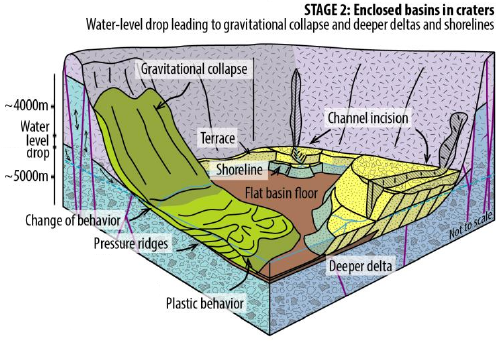
Conceptual model of Martian deep basin evolution

A science paper released today and available for download [pdf] cites evidence from about two dozen deep impact craters located from the equator to 37 degrees north latitude that Mars has a ground ice table at an elevation that also corresponds to other shoreline features. From the abstract:

Observations in the northern hemisphere show evidence of a planet‐wide groundwater system on Mars. The elevations of these water‐related morphologies in all studied basins lie within the same narrow range of depths below Mars datum and notably coincide with the elevation of some ocean shorelines proposed by previous authors.

The image above and on the right shows the middle stage of their conceptual model for the evolution of these deep basins and how that evolution results in many of the geological features seen in many places on Mars, such as the features I have highlighted on Behind the Black previously here and here.

From their conclusion:
» Read more

1 comment

Senator Kamala Harris (D-California) goes full communist

They’re coming for you next: During a townhall broadcast provided for her by CNN in connection with her decision to run for president, Democratic senator Kamala Harris (D-California) made it clear that her policies would follow a full communist agenda, aiming to eliminate the entire fossil fuel industry and the entire private healthcare industry while working to ban private ownership of guns.

Considering that the nation this very moment is suffering from one of the coldest cold spells ever and that millions would die without the ability to warm their homes without fossil fuels, it seems to me that Kamala Harris is a very typical leftist: She believes her ideas are so wonderful that they must be imposed, even if this will cause a genocide.

This at least has been the track record of leftists for the past 150 years, in Germany, in the Soviet Union, in Italy, in Venezuela, in practically every place they have gained power. Why anyone should expect it to be different here?

In fact, we have evidence to believe Harris would do exactly this, based on her own track record. In 2016 Harris tried to use the power of her position as California’s attorney general to force conservative organizations to hand her their confidential tax information so she can obtain the names of their donors. Her effort failed, but only because a judge ruled against her. And he did so because he recognized that Harris and her liberal supporters posed a violent threat to those donors.

Harris also joined a lawsuit by seventeen Democratic attorneys general aimed at harassing climate skeptics.

She has also publicly fantasized about the idea of killing Trump, Pence, or Sessions. She might claim that she was merely making a joke, but this really is not something you should joke about, especially if you are aiming for a position where you will be able to wield great power.

No matter. The American public, especially in the states dominated by Democratic elected officials, wants this. I consider her the frontrunner in the race for Democratic presidential candidacy And if you do not agree, be warned. They’re coming for you next.

57 comments

New report predicts the boom in smallsats will continue in 2019

Capitalism in space: A new analysis of the state of the smallsat industry predicts that the boom in smallsats will continue in 2019.

Coming off an excellent performance in 2018, SpaceWorks analysts project between 294 – 393 nano/microsatellites (1 – 50 kg) will launch globally in 2019, an 18% increase over last year. Of the 262 spacecraft SpaceWorks predicted to launch in 2018, 253 actually launched. “SpaceWorks showed unprecedented accuracy in last year’s forecast, with our prediction coming within 5% of actual nano/microsatellites launched.” stated Caleb Williams, Lead Economic Analyst at SpaceWorks, “Changes to our forecasting methodology, in combination with greater launch consistency and better execution on the part of small satellite operators contributed to our ability to accurately forecast market growth.”

2019 projections remain strong and have been updated to reflect the advancements of dedicated small satellite launch vehicles, changing attitudes of civil and military operators, and the rapid progress of commercial satellite IoT ventures. SpaceWorks analysts continue to gain confidence in the small satellite market as operators begin promising less and delivering more. “The rapid progress of operators focusing on IoT applications is expected to continue and communications applications are expected to quadruple their market share over the next 5 years” says Stephanie DelPozzo, SpaceWorks Economic Analyst, “overall, the maturing capabilities of small satellites are expected to open additional opportunities for growth and keep investors interested in the market during the near-term.” [emphasis mine]

The phrase I’ve highlighted is significant. It appears big government and commercial investors have finally jumped on the smallsat bandwagon after years of resistance.

The report also notes that the number of smallsat launches in the past five years has grown by 150%.

Everything in the full report confirms my sense that we are seeing a bifurcation in the aerospace industry, with the the unmanned branch producing smaller components while the manned space branch learning how to affordably build larger.

0 comments

New technique could make nickel as strong as titanium

A new technique that allows metals to mimic the internal structure of wood could make nickel, and other metals, far far strong.

Led by James Pikul, Assistant Professor in the Department of Mechanical Engineering and Applied Mechanics at Penn Engineering, the new study looked at new ways to take metal and give it the porous structure that gives wood its strength. In the past, this has been done by finding ways to turn molten metal into foam, or using 3D printing with hundred-nanometer precision to build up wood-like metal bit by bit. The problem is that metal foam is crude by modern engineering standards, while the 3D printing process is slow and very hard to scale up from lab-bench scales.

“The reason we call it metallic wood is not just its density, which is about that of wood, but its cellular nature,” Pikul says. “Cellular materials are porous; if you look at wood grain, that’s what you’re seeing  –  parts that are thick and dense and made to hold the structure, and parts that are porous and made to support biological functions, like transport to and from cells. Our structure is similar. We have areas that are thick and dense with strong metal struts, and areas that are porous with air gaps. We’re just operating at the length scales where the strength of struts approaches the theoretical maximum.”

According to the researchers, the key was to go to much smaller scales to produce much greater increases in strength. They manage this by suspending plastic spheres a few hundred nanometers wide in water, which is allowed to evaporate. As the water disappears, the spheres drop into a neat geometrical, crystalline pattern. This is then electroplated with a thin layer of chrome and the spaces between the spheres are filled with nickel. The plastic is then dissolved, and what’s left behind is an open network of metallic struts with 70 percent empty space – making it light enough to float in water.

The process is however very expensive, and so far has only produced some very small samples.

4 comments

ArianeGroup successfully test fires new solid rocket motor

Capitalism in space: ArianeGroup, the private consortium building Europe’s next generation of rockets, has successfully test fired the new solid rocket motor it will use for both its Ariane 6 and Vega-C rockets.

The P120C is designed and built by a European consortium involving a joint venture known as Europropulsion, a venture between ArianeGroup and Avio, as well as CNES, the Italian ASI space agency, and Airbus Safran. This multinational venture uses the Avio facilities in Colleferro, Italy to manufacture the carbon fiber composite casing, a facility in France to build the ArianeGroup composite steerable nozzle, and the propellant casting and integration facilities in French Guiana to build up and prepare these boosters for flight.

The P120C, through its common use across launch vehicle lines and use of existing facilities, is designed to reduce costs as a competitive response to newer companies like SpaceX that have dramatically lowered launch costs and captured an increasing share of the worldwide launch market, dethroning the ArianeGroup from the dominating position it had held until very recently.

Without doubt they are going to save money using this solid rocket motor on both rockets. I remain somewhat skeptical, however, about whether they will achieve enough cost savings to compete with SpaceX. The seeming lack of interest by their primary European customers for Ariane 6 suggests this. It appears that its price might still be too high.

0 comments

Next Long March 5 launch delayed six months to July

The next launch of China’s largest rocket, the Long March 5, has now been delayed another six months until July.

The second Long March-5 rocket was launched from the Wenchang Space Launch Center in the southern province of Hainan on July 2, 2017, but a malfunction happened less than six minutes after its liftoff.

In October the Chinese had predicted this launch would occur in January, so this new schedule represents a six month delay. This further delay also confirms to me that their problem in 2017, which the Chinese have never fully explained other to say it caused damage to a turbopump in one first stage engine, resulted from a fundamental design flaw in the rocket’s first stage engines, requiring major reworking.

This delay also delays the launch of the first module of their space station, as well as their first sample return mission to the Moon.

0 comments

Parker begins second orbit around Sun

The Parker Solar Probe has completed its first full orbit of the Sun and has begun full science operations.

On Jan. 19, 2019, just 161 days after its launch from Cape Canaveral Air Force Station in Florida, NASA’s Parker Solar Probe completed its first orbit of the Sun, reaching the point in its orbit farthest from our star, called aphelion. The spacecraft has now begun the second of 24 planned orbits, on track for its second perihelion, or closest approach to the Sun, on April 4, 2019.

Parker Solar Probe entered full operational status (known as Phase E) on Jan. 1, with all systems online and operating as designed. The spacecraft has been delivering data from its instruments to Earth via the Deep Space Network, and to date more than 17 gigabits of science data has been downloaded. The full dataset from the first orbit will be downloaded by April.

They have been somewhat tight-lipped about any results from the data already obtained. I suspect it has not yet been analyzed fully, and the scientists are reserving comment until they complete their first science papers and get them published.

0 comments

January 26, 2019 Zimmerman on Martian Revelation

I did a long two-hour appearance on a live internet show this past weekend. If you want to listen, you can do so here. Be warned, the audio starts automatically, and I do not appear until the show’s second hour, though you can jump forward.

In some ways this is one of the more interesting interviews I’ve done in awhile. We touched upon SLS, NASA, the bureaucracy, the failure of the federal government in all things, the Space Force, Trump and his real failures and successes, and most importantly, the fundamental necessity of Americans to stop asking the government to do things for them.

Even more entertaining, this was one of the rare times you can hear two guys from the New York metropolitan area having it out, both with loud brass New York accents.

Give it a listen.

7 comments

Weird Martian fracture feature

Fractured collapse feature on Mars

Cool image time! When I first looked at the high resolution Mars Reconnaissance Orbiter (MRO) image on the right, my immediate reaction was, “What the heck is that?” The image to the right is cropped and reduced, but if you click on it you can see the full image at high resolution.

The fractured terrain appears to be all within a collapse. To my eye it appears that while the overall surface has sunk, the fractures indicate an area where there has been an eruption upward, which after the eruption collapsed again, so that the fractured area remains at the apparent bottom of the collapse sink. I was immediately reminded of Upheaval Dome in Yellowstone National Park, which some geologists believe was formed by a “salt bubble” rising upward to create a salt dome.

A thick layer of salt, formed by the evaporation of ancient landlocked seas, underlies much of southeastern Utah and Canyonlands National Park. When under pressure from thousands of feet of overlying rock, the salt can flow plastically, like ice moving at the bottom of a glacier. In addition, salt is less dense than sandstone. As a result, over millions of years salt can flow up through rock layers as a “salt bubble”, rising to the surface and creating salt domes that deform the surrounding rock.

Context image for fracture feature

The process and materials involved were certainly different on Mars. Nonetheless, it does appear we are looking at an eruptive feature unrelated to molten lava. The context image to the right, showing this feature’s location in Mars’ vast northern lowlands, also shows that it has occurred on terrain that has bulged upwards relative to the surrounding lowlands. Nearby MRO images also show similar bulge/collapse features.

To decipher the geological mystery here, we would also need to know when this happened and whether there ever was a liquid ocean residing on top of it, before, during, or after the eruption. We also do not know well the make-up of the underground materials, including whether any frozen water and salt is present.

To be honest, we really don’t know much. I am sure a planetary scientist studying this feature could fill us in on some of these details, such as information provided by the colors in the color image. Even so, I am sure any good scientist would also admit to unknowns.

To get some real answers, we need to be there. It is as simple as that.

0 comments
1 142 143 144 145 146 156