First unmanned test flight of manned Dragon now set for Feb 9

Capitalism in space: SpaceX’s first unmanned test launch of its manned Dragon capsule, delayed repeated in recent months, has now been scheduled for no early than Feb 9, with its dress rehearsal countdown static fire test set for January 23.

It appears that this scheduled date is more firm than the previous ones, as it was announced as part of the upcoming schedule of the Eastern Range’s planning schedule.

The article provides some interesting details about the effect (or non-effect) the government shutdown on this launch. Bottom line: It should not prevent it, in the slightest. It must be repeatedly noted that the launch will use a SpaceX launch team on a SpaceX run launchpad, and will only require NASA participation during docking procedures, procedures that require NASA employees who have been deemed essential and thus are working (even if unpaid at the moment).

12 comments

Is the pole of the Milky Way’s central black hole pointing directly at us?

The uncertainty of science: New data obtained using a constellation of Earth-based telescopes, working as a unit, strongly suggests that the pole of the Milky Way7s supermassive central black hole, dubbed Sagittarius A* (pronounced A-star), is pointing directly at us.

The high quality of the unscattered image has allowed the team to constrain theoretical models for the gas around Sgr A*. The bulk of the radio emission is coming from a mere 300 milllionth of a degree, and the source has a symmetrical morphology. “This may indicate that the radio emission is produced in a disk of infalling gas rather than by a radio jet,” explains Sara Issaoun, graduate student at the Radboud University Nijmegen in the Netherlands, who leads the work and has tested several computer models against the data. “However, that would make Sgr A* an exception compared to other radio emitting black holes. The alternative could be that the radio jet is pointing almost at us”.

The German astronomer Heino Falcke, Professor of Radio Astronomy at Radboud University and PhD supervisor of Issaoun, calls this statement very unusual, but he also no longer rules it out. Last year, Falcke would have considered this a contrived model, but recently the GRAVITY team came to a similar conclusion using ESO’s Very Large Telescope Interferometer of optical telescopes and an independent technique. “Maybe this is true after all”, concludes Falcke, “and we are looking at this beast from a very special vantage point.”

If this is true, it might explain why Sgr A* is generally observed to be one of the quietest central supermassive black holes known. Compared to many others, its flux of emissions is far less.

1 comment

Democratic House threatens Webb cancellation

The House, now controlled by the Democratic Party, has threatened cancellation of the James Webb Space Telescope should that project, already overbudget by $8 billion and 9 years behind schedule, fail to meet its present budget limits.

[The House budget] bill includes the full $304.6 million requested for JWST in 2019, but the report accompanying the bill offered harsh language, and a warning, regarding the space telescope given the cost overruns and schedule delays announced last year.

“There is profound disappointment with both NASA and its contractors regarding mismanagement, complete lack of careful oversight, and overall poor basic workmanship on JWST,” the report states. “NASA and its commercial partners seem to believe that congressional funding for this project and other development efforts is an entitlement, unaffected by failures to stay on schedule or within budget.”

The bill does increase the cost cap for JWST by about $800 million, to a little more than $8.8 billion, to address the latest overruns. “NASA should strictly adhere to this cap or, under this agreement, JWST will have to find cost savings or cancel the mission,” the report states.

I really don’t take this Congressional threat seriously. Our Congress is universally known in Washington as an easy mark for big money. The technique is called a buy-in, where you initially lowball the budget of your project, get it started, and then when it goes overbudget, Congress routinely shovels out the money to continue. Webb is a classic and maybe the worst example of this, but this game has been going on since the 1960s, with no sense that the Congresses of the last half century have had any problem with it.

And I especially don’t take it seriously from the Democrats who, even more than the Republicans, like to shovel money out.

The bankrupt unwillingness of both parties to care for the interest of the country for the past few decades in this matter explains why we have federal debt exceeding $20 trillion.

15 comments

Ariane 6 might be in trouble

Capitalism in space: Arianespace today announced that they will not be able to begin full production of their next generation rocket, Ariane 6, unless they get four more contracts from the partners in the European Space Agency.

With the maiden flight of the Ariane 6 now 18 months away (in July 2020), Arianespace CEO Stéphane Israël said the company had anticipated signing a manufacturing contract with ArianeGroup in the second part of last year to begin production beyond the first rocket.

So far, European public entities have purchased three Ariane 6 missions — two from the European Commission for launching Galileo navigation satellites, and one from France for the CSO-3 military imaging satellite — but have not committed to the number envisioned at the start of the Ariane 6 program in 2014.

“We are confident it will happen,” Israël said of the remaining government missions. “But it is not done yet. We are working in this direction. It is now quite urgent because industry has anticipated the manufacturing of these first launchers, but now we need these institutional contracts to fully contractualize the first Ariane 6s.”

I wonder if the fact that the cost for an Ariane 6 launch is expected to be remain higher than a comparable SpaceX launch is the reason they are having trouble getting a commitment from their European partners. Why buy this rocket, when you can get the same service for less?

7 comments

Stratolaunch ends plan to build rockets for its giant Roc aircraft

Capitalism in space: Stratolaunch has decided to cease work on the family of second stage rockets plus engine, announced in August and September 2018, that would have launched from the bottom of its giant Roc airplane.

Instead, they will only launch Northrop Grumman’s Pegasus rockets from Roc.

This does not look good for the company. Roc is vastly oversized for Pegasus, which really doesn’t need it. It also suggests that the death of Paul Allen has had a bad effect on the company.

5 comments

ULA successfully launches U.S. spy satellite

Capitalism in space: Using its Delta-4 Heavy rocket, the most powerful in its rocket family, ULA today successfully placed a National Reconnaissance Office (NRO) spy satellite into orbit.

It was also revealed in this article that ULA plans a total of seven launches in 2019, including today’s launch, the fewest in a year since ULA was formed in 2007 from a partnership of Boeing and Lockheed Martin.

The standings in the 2019 launch race:

1 China
1 SpaceX
1 Japan
1 ULA

The U.S. leads in the national standings 2 to 1 over China.

7 comments

Scientists calculate length of Saturn’s day

Using Cassini data of the rotation rate of Saturn’s rings, scientists have calculated what they think is the precise rotation rate of the planet itself.

Using new data from NASA’s Cassini spacecraft, researchers believe they have solved a longstanding mystery of solar system science: the length of a day on Saturn. It’s 10 hours, 33 minutes and 38 seconds. The figure has eluded planetary scientists for decades, because the gas giant has no solid surface with landmarks to track as it rotates, and it has an unusual magnetic field that hides the planet’s rotation rate.

The answer, it turned out, was hidden in the rings. During Cassini’s orbits of Saturn, instruments examined the icy, rocky rings in unprecedented detail. Christopher Mankovich, a graduate student in astronomy and astrophysics at UC Santa Cruz, used the data to study wave patterns within the rings. His work determined that the rings respond to vibrations within the planet itself, acting similarly to the seismometers used to measure movement caused by earthquakes. The interior of Saturn vibrates at frequencies that cause variations in its gravitational field. The rings, in turn, detect those movements in the field.

…Mankovich’s research, published Jan. 17 by Astrophysical Journal, describes how he developed models of Saturn’s internal structure that would match the rings’ waves. That allowed him to track the movements of the interior of the planet – and thus, its rotation. [emphasis mine]

This work certainly seems ingenious, clever, and somewhat convincing, but I must admit I laughed when I read their estimate of the day length above, to the second. That is ridiculous. Their margin of error cannot possibly be that small. Mankovich has for sure narrowed the uncertainty in the length of Saturn’s day, but forgive me if I remain skeptical as to the precision claimed.

5 comments

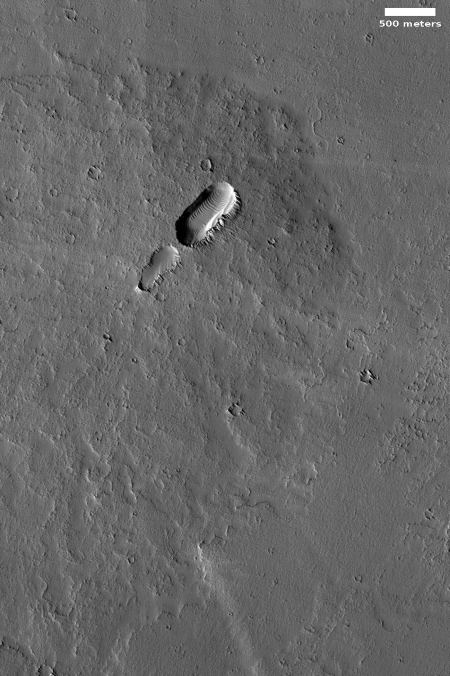
Volcanic vent between Arsia and Pavonis Monsa

volcanic vent on Mars

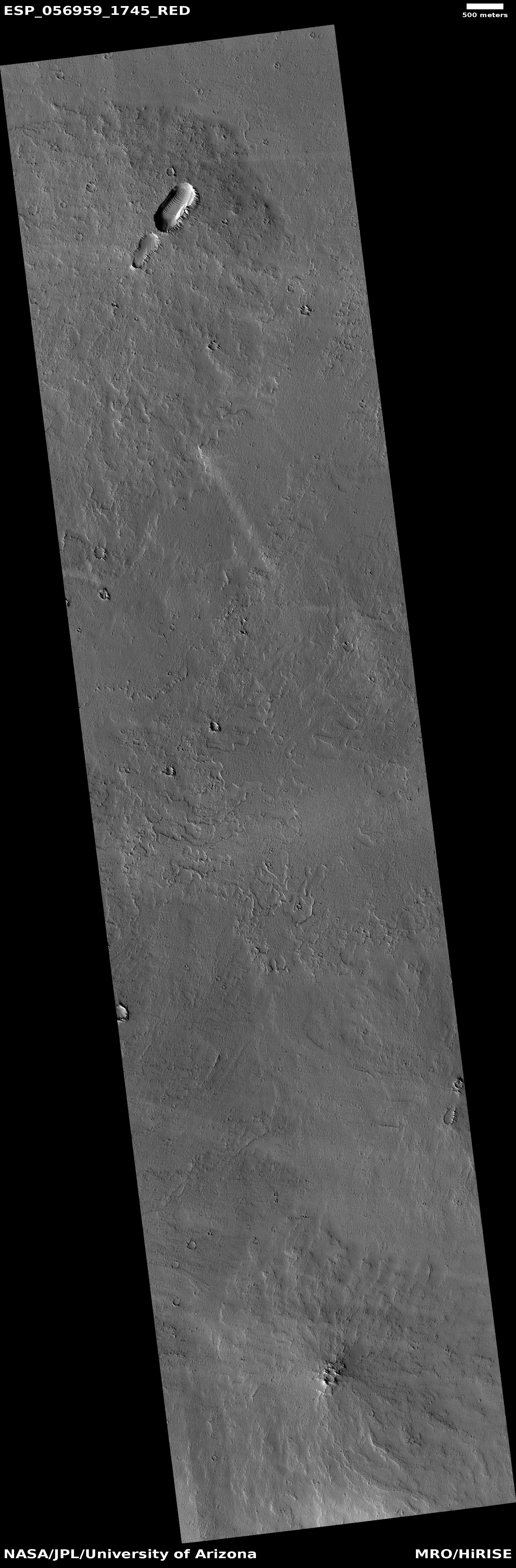
Cool image time. The photo on the right, rotated, cropped, and reduced to post here, was taken in September by the high resolution camera of Mars Reconnaissance Orbiter (MRO) and was part of the November image release. Click on the image to see the entire photograph at full resolution.

The uncaptioned release dubs this feature as “Small Eruptive Vents South of Pavonis Mons.” In truth, these vent pits are located almost exactly the same distance from both Pavonis Mons, the middle volcano in the line of three giant Martian volcanoes, and Arsia Mons, the southernmost of the three.

The image is interesting for several reasons. First, note the bulge surrounding the vent, making this look almost like a miniature volcano all its own. In fact, that is probably what it is. When it was active that bulge was likely caused by that activity, though it is hard to say whether the bulge was caused by flow coming from out of the vent, or by pressure from below pushing upward to cause the ground to rise. It could even have been a combination of both.

To my eye, most of the bulge was probably caused from pressure from below pushing upward. The edge of the bulge does not look like the leading edge of a lava flow. Still, this probably happened so long ago that Martian wind erosion and dust could have obscured that leading edge.

That this is old is indicated by the dunelike ripples inside the large pit, and the pond of trapped dust in the smaller pit. Because of the thinness of the Martian atmosphere it takes time to gather that much dust, during which time no eruptions have occurred.

One more interesting detail: If you look at the pits in full resolution, you will see that, based on the asymmetrical wind patterns between the west and east rims, the prevailing winds here are from the west. Located as it is just to the east of the gigantic saddle between Arsia and Pavonis Mons, this wind orientation makes sense, as a saddle between mountains tends to concentrate the wind, much like a narrowed section in a river produces faster water flow and rapids. As for why the wind blows mostly from the west, my guess (which should not be taken very seriously) is that it is probably caused by the same meteorological phenomenon that causes this generally on Earth, the planet’s rotation.

0 comments

Bill to pay federal workers will not pay those not working

UPDATE: Thanks to my readers (see comments below), it appears that the essence of this story is wrong, and that the bill did provide for payment of salaries, even to those who did not work during the shutdown, essentially giving these federal employees a free paid vacation. What makes it even more galling is that federal workers generally are paid about twice what employees in the private sector get, and also get far better benefits, including vacation and sick time that is far far far longer. Now they get a cherry on top of that.

Some fiscal sanity enters Washington: The bill passed and signed this week by President Trump to pay federal workers will only provide pay to those who actually worked during the government shutdown.

While this might seem cruel to these workers, it is no different that the reality experienced by everyone in the private sector, and it is very fair to the taxpayers.

6 comments
1 146 147 148 149 150 156