
Astronomers begin their 2020 decadal survey

The astronomy community has begun work on their 2020 decadal survey, the report they issue at the start of every decade since the early 1960s outlining their space priorities for the upcoming ten years.

While the first four decadal surveys were very successful, leading to the surge in space telescopes in the 1990s, the last two surveys in 2000 and 2010 have been failures, with the former proposing the James Webb Space Telescope and the latter the Wide Field Infared Survey Telescope (WFIRST), both of which have not launched, are behind schedule, and significantly over-budget.

The new survey appears focused on addressing this.

The 2020 decadal survey will develop detailed cost estimates for each project, as well as guidance for what managers can do if money gets tight. “We have to look at the budget reality while also doing things that are visionary,” says Fiona Harrison, an astronomer at the California Institute of Technology in Pasadena and co-chair of the effort.

Unfortunately, it is also going to focus on leftist identity politics.

Responding to problems of racism and harassment in science, the survey will also assess the state of astronomy as a profession and make recommendations for how it can improve. “We’re going to go there,” says the other co-chair, Robert Kennicutt, an astronomer at the University of Arizona in Tucson and Texas A&M University in College Station.

I do not have high hopes for this decadal survey, or for space science in the 2020s. The space astronomy community chose badly in the past twenty years, and it is likely going to take another decade for it to recover. For example, WFIRST appears to be going forward, and it also appears that it will be the same financial black hole that Webb was, eating up the entire space astrophysics budget at NASA for years.
2 comments

Smallsat rocket company Relativity Space gets Air Force okay to launch from Florida

Capitalism in space: The smallsat startup company Relativity Space has gotten Air Force approval to launch its 3D printed Terran rocket from Cape Canaveral.

They are now in negotiations to obtain a twenty year lease on one of the launchpads there.

Relativity hopes to sign a 20-year agreement granting it exclusive use of Launch Complex 16, a former Titan and Pershing missile site also used by NASA’s Gemini and Apollo programs. It was deactivated in 1988.

The company plans to spend more than $10 million to renovate the pad, build payload processing and integration hangars and install fuel and lightning protection systems.

It’s not yet known how many jobs will be based in Florida. The company has grown from 14 to 60 people over the past year, adding experience with a dozen former senior executives of existing Cape launchers SpaceX, Blue Origin and United Launch Alliance

The company has raised significant investment capital, $45 million, but there is no indication from the article when they plan their first test launches.

0 comments

New local dust storm activity near silent Opportunity

The Opportunity science team reported today that they have noted an increase in local dust storm activity just south of the silent rover.

The storm is expected to increase in opacity (tau) at the rover site to greater than 1.5 over the next few days. No signal from Opportunity has been heard since Sol 5111 (June 10, 2018) during the historic global dust storm. Opportunity likely experienced a low-power fault, a mission clock fault and an up-loss timer fault. Since the loss of signal, the team has been listening for the rover over a broad range of times, frequencies and polarizations using the Deep Space Network (DSN) Radio Science Receiver.

This activity, plus the fact that they have still not been able to re-establish contact with the rover during the recent dust devil season, when they had hoped a devil might clear the dust off the solar panels, bodes very bad for the rover. The Curiosity team is also seeing more dust activity, and notes that these dust storms will also act to reduce the number of dust devils.

0 comments

Making smallsat rockets at Vector

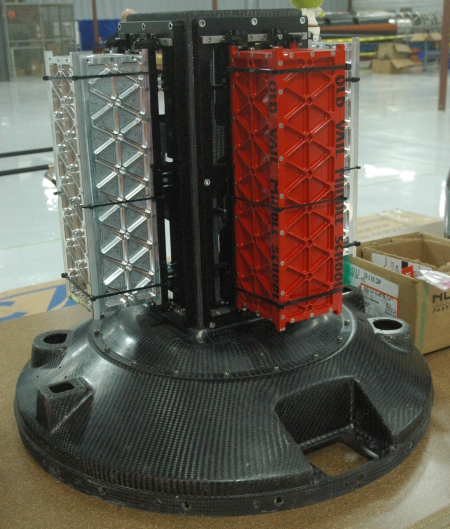
Payload structure for Vector's Vector-R rocket

In the coming year we should see the spectacular first launches from two smallsat rocket companies, Vector and Virgin Orbit, joining Rocket Lab (which has already launched successfully three times) to form an entirely new industry of small rockets designed specifically for launching cubesat and nanosat satellites, what I call smallsats.

The image on the right shows the payload adapter fitting for Vector’s Vector-R rocket. The red and silver rectangular objects are dummy cubesat payloads. Overall, this structure, only about three feet high, will allow Vector to place as many as eight smallsats into orbit on one launch.

The picture was taken yesterday during a tour of Vector’s facilities given to me personally by Vector’s CEO, Jim Cantrell. During my previous tour of Vector back in March 2017, Cantrell had described the company’s planned test launch schedule as follows:

The company is presently in the testing phase leading up to their first orbital launches, which they hope to start in 2018. Right now they are building a series of full scale versions of their Vector-R rocket with a dummy second stage. The idea is to do a string of suborbital test flights, the first of which will fly in about a week from Mohave in California, with the second flying from the Georgia spaceport in Camden County.

The first two launches occurred as promised, first in Mojave on May 3, 2017 and then in Georgia on August 3, 2017. An announcement in October 2017 set the launch of the third test first for January 2018 but that launch did not happen. In March 2018 Vector announced it planned to launch two cubesats into orbit from Alaska by the end of 2018, but this did not happen either.

Because of the delays, with no explanation, I was beginning to harbor doubts about the company’s status. Last week Cantrell gave a talk at Tucson’s Space Business Roundtable, and I went to that talk to find out what the issues were as well as attempt to find out when they did plan to launch.

Cantrell not only filled me in on the details, but generously offered to give me another personal tour of Vector’s facilities, which had grown significantly since my 2017 tour. Then, Vector employed only thirty people and was based in a small warehouse. Now it employs more than 150, and has two much larger facilities in Tucson as well as one in California (where its mission control is based).

First let me outline the company’s launch status.
» Read more

3 comments

Congress and Trump give free paid vacation to federal workers during shutdown

The swamp wins: President Trump yesterday signed a Democratic Party bill guaranteeing the pay for all furloughed federal employees for the time they are either furloughed from work or working now without pay.

The signing of the Government Employee Fair Treatment Act of 2019, sponsored by Sen. Benjamin Cardin, D-Md., requires that all government employees be compensated for “wages lost, work performed, or leave used” during the shutdown, the Whitehouse announced in a news release.

Obviously, it seems just to pay for their time those who have been forced to work without pay. Why those who have not been needed are getting paid however seems very unjust, to the taxpayer. It would seem to me that they should not be paid for work they did not do. More apropos would be to consider removing them from the payroll permanently, as it appears based on this shutdown that most are likely unneeded to begin with.

11 comments

SpaceX shifts some Starship/Super Heavy construction to Texas

Capitalism in space: SpaceX has decided to shift some of the construction of its new Starship/Super Heavy rocket from Los Angeles to its Boca Chica facility in Texas.

In tweets later Jan. 16, Elon Musk, the founder and chief executive of SpaceX, said that development of the vehicle itself, including the Raptor engines that power it, would continue in Hawthorne, while at least the prototype versions of Starship are built in Texas. “We are building the Starship prototypes locally at our launch site in Texas, as their size makes them very difficult to transport,” he said.

A shift to South Texas, industry sources said, could be a way to reduce expenses, given the lower cost of living there versus the Los Angeles area. However, that region of Texas has a much smaller workforce, particularly in aerospace, compared to Southern California.

Meanwhile, I keep hearing from my sources in the industry that SpaceX is facing more serious problems because of the coming decline in the manufacture of large geosynchronous satellites. The smallsat revolution appears to be the cause, and SpaceX’s larger rockets are not ideal for launching these tiny satellites. I am not entirely convinced of this pessimistic conclusion, but if SpaceX is in trouble it will likely be a tragedy for manned spaceflight. The smallsat rockets cannot put people in space. Neither can the gigantic government rockets like SLS. Without innovative companies like SpaceX building and launching large rockets for profit, the development of the large inexpensive rockets needed for human travel will be significantly hampered.

3 comments

Fix pinpointed for Hubble main camera

Engineers have identified the issue that put the main camera of the Hubble Space Telescope into safe mode last week, and expect to have the camera back in operation in two or three days.

Hubble’s Wide Field Camera 3 (WFC3) took itself offline last week as a safety precaution, after onboard software noticed anomalous voltage readings within the instrument. But Hubble team members have now determined that voltage levels actually remained within the normal range, ascribing the glitch to a telemetry issue rather than a power-supply problem.

The mission team reset the relevant telemetry circuits, gathered some more engineering data and then brought the WFC3 back to an operational state. “All values were normal. Additional calibration and tests will be run over the next 48 to 72 hours to ensure that the instrument is operating properly,” NASA officials wrote in a Hubble update Tuesday (Jan. 15).

None of this changes the reality that it is almost a decade since the last shuttle repair mission, and Hubble is facing a long slow decline leading to its eventual loss, with no replacement planned by anyone.

0 comments

Oregon & Washington politicians considering supervision of parents of all newborn babies

They’re coming for you next: The Democratic politicians in both Oregon and Washington are pushing new legislation that would mandate supervision by government health care workers of the parents of all newborn babies.

According to the Beaver Valley Times, “When the program is complete, every new parent — this includes adoptions — would receive a series of two or three visits by someone like a nurse or other health care practitioner. The visits could include basic health screenings for babies; hooking parents up with primary care physicians; linking them to other services; and coordinating the myriad childhood immunizations that babies need.”

The program has been piloted in Lincoln County but has not been tried statewide.

Sen. Elizabeth Steiner Hayward (D-Beaverton), who sits on the powerful Ways and Means Committee that will hammer out the language of the legislation, has said that universal home visits are a priority for her.

And Oregon is not alone in the push for “universal” home visits. Washington Governor Jay Inslee tweeted earlier this month, “My budget would also offer universal home visits. This gives every new parent the opportunity to get a visit from a nurse during the first few weeks back home with their newborn to share important information and build confidence.”

While it’s not clear whether either of these programs would be mandatory, the use of the term “universal” suggests that they would. It’s frightening to think about what would happen to parents who refuse such visits.

Read it all. It is obvious to both the author and I that while the present programs are vague about their mandatory nature, the goal is that they will soon become so.

13 comments
1 147 148 149 150 151 156