
Hillary Klug – Cotton Eyed Joe
An evening pause: Stay with it, it gets better and better, as she triples herself in the second half.
Hat tip Sherman LaViolette.
An evening pause: Stay with it, it gets better and better, as she triples herself in the second half.
Hat tip Sherman LaViolette.
Project Veritas has released its fourth expose on the Bernie Sanders presidential campaign, once again showing us two more radical hard left campaign workers, both field organizers, who seem willing to accept the idea of “destroying property” and using force to obtain power, regardless of whether Sanders is elected.
I’ve embedded the video below the fold. Unlike the radicals exposed in the earlier videos, I find these guys more absurd and intellectually empty than frightening. I do not see how they will be able to achieve a violent overthrow of the American people, especially since their opposition of Trump supporters are also avid and trained gun users who will not take kindly to any attempts to directly oppress them with force.
Regardless, these two Sanders workers do illustrate well the empty-headed policy ideas of Sanders and his campaign. If you jump to 12:00 minutes into the video, watch how Mason Baird struggles when asked how Bernie Sanders is going to carry out his policy. As he admits,
Like, we we get really nuts and bolts stuff, that’s what I really struggle with thinking about is — My answer is kind of like vague. It’s just like the, you know, having the movement and having, and snowballing that movement, and, and thinking more explicit, maybe thinking less about mobilize, or thinking about persuading people and more about mobilizing the people we already have.
He goes on to imply that the use of force against any one who opposes them would likely be the best approach, but he certainly seems very unclear how he and his ilk could do that.
I repeat and beg my Democratic readers, watch and learn. The Democratic Party is not the party you think it is. It is instead becoming a carbon copy of the Communist Party of the early Soviet Union, designed with only one purpose in mind, obtaining power. And we know this by the reaction of the Sanders campaign to these videos, which is to do nothing, to poo-poo what they reveal, and to fire no one.

Click for full image.
Don’t ask me to explain the geology on today’s cool image, rotated, cropped and reduced above. Taken by the high resolution camera on Mars Reconnaissance Orbiter (MRO) on August 16, 2019, the image’s uncaptioned website merely calls these “Convergent and Overlapping Narrow Curved Ridges.”
I don’t know why the sand in the hollows appears light blue, or even if it is sand. I don’t know what created the ridges, or why they seem to overlap each other randomly, or why they seem to peter out to the south.
I am sure there are planetary scientists out there who have theories that might explain these features. I also know that they would forgive me if I remained skeptical of those theories. This geology is a puzzle.
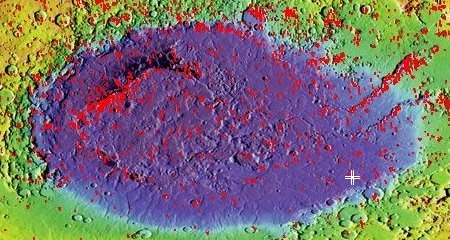
The location of these ridges is in the southeast corner of Hellas Basin, which I like to call the basement of Mars as it is the equivalent of the United States’ Death Valley, having the lowest relative elevation on the planet. As I have noted previously, the geology in this basin can be very strange. To my eye it often invokes a feeling that we are looking at Mars’s “uttermost foundation of stone” (to quote Tolkien), frozen lava that flowed in many ways and then froze in strange patterns.
Or not. Your guess is as good as mine.
According to a company that monitors objects in low Earth orbit, two abandoned satellites might actually collide on January 29..
The two satellites, NASA’s IRAS space telescope and the experimental U.S. Naval Research Lab satellite GGSE-4, will swing past each other at 6:39 p.m. EST at an altitude of about 559 miles in the skies above Pittsburgh, Pennsylvania. They’ll be hurtling along their orbit at a relative velocity of about 32,880 miles per hour and could swing within 50 feet of each other.
LeoLabs noted that, at the time of the tweet, the odds of a collision were about 1 in 100 and said the relatively large size of the two spacecraft increased the risk of a collision.
IRAS was the first infrared space telescope ever launched, and operated for ten months after its launch in 1983. The other spacecraft was a National Security Agency test satellite of surveillance technology.
Images from space of Iran’s rocket launch site appear to confirm their recent claims that they are about to launch a satellite, showing the kind of activity that usually presages a launch.
Satellite photos taken on January 26 by the San Francisco-based commercial company Planet Labs Inc. and shared via the Middlebury Institute of International Studies at Monterey show work at a launchpad at the Imam Khomeini Space Center.
The images also show more cars and activity at a facility at the space center, located about 230 kilometers southeast of Tehran. “It looks pretty clearly to us like Iran is going to try and put a satellite into space,” Jeffrey Lewis, a professor at the Middlebury Institute who tracks Iran’s space program.
If they do launch and successfully get their satellite into orbit, it will be their first such success since 2015.
In a new paper released this week, scientists using instruments on both Mars Odyssey and Mars Reconnaissance Orbiter have found more evidence that there is a large amount of widespread ice close to the surface in the Martian mid-latitudes. As the scientists note in their abstract:
We show that water ice is present sometimes just a few centimeters below the surface, at locations where future landing is realistic, under mobile material that could easily be moved around. This ice could be exploited on‐site for drinking water, breathable oxygen, etc., at a much lower cost than if brought from Earth.
They deduced this by looking at how that ice would change the seasonal temperatures in the atmosphere directly above. Cooler regions suggested more ice close to the surface, while warmer regions suggested either no ice or ice deep below the surface. While this approach is indirect and did not directly detect ice, their conclusions match perfectly with all previous research. Below is a global map of Mars taken from the paper’s the supplementary material [docx file], reduced and annotated by me, showing the regions that seem to have ample shallow ice. Regular readers of Behind the Black will instantly recognize these locations.
» Read more
Capitalism in space: NASA today picked the new space station company Axiom to build three modules to ISS, designed to operate as a private commercial operation.
The first segment launch is targeted for 2024. The three segments will include a node with multi-ports, a crew module, and a research module, and will be the “hotel” for private tourists that Axiom hopes to send to ISS two or three times per year. The entire section will also be designed to eventually separate from ISS when that station is retired and operate, with more additions, as an independent station.
This decision did not include the actual contract, only the choice of company to build this new section of ISS. Later negotiations will determine the fixed price amount that NASA will pay.
Why did NASA pick Axiom, which has not yet launched anything, and bypass Bigelow, which has launched two independent test modules and one that has been attached to ISS and working successfully now for several years? This quote explains:
Although Axiom is a relatively young company, having been formed only four years ago in 2016, there is no lack of experience within the company’s ranks.
Axiom’s Co-founder and CEO is Micheal Suffredini, who formerly worked at the Johnson Space Centre (JSC) as the program manager for the International Space Station project.
The Axiom team also includes Michael Lopez-Alegria, a former NASA astronaut who flew on the space shuttle three times and commanded the 14th Expedition to the ISS, as well as former shuttle commanders Brent Jett and Charles Bolden, the latter of whom served as NASA’s 12th administrator from 2009 to 2017.
Axiom is also working alongside several companies with extensive experience with the ISS program, this includes Boeing, who has made several of the modules that make up the US Segment, including Node 1 and the US Laboratory Module. Axiom is also working alongside Thales Alenia Space, Maxar Technologies and Intuitive Machines to get this project off the ground. [emphasis mine]
In other words, it appears it’s not what you know, it’s who you know. This is not to say that the individuals and companies listed above do not know much, but that the company’s real experience with building private modules is lacking. Boeing has built NASA’s modules, but those were for the government and were therefore costly. I have grave doubts they could do this inexpensively, though I could be wrong.
The key will be whether they aim to make their profits from their commercial customers, or use NASA (and the federal government) as their cash cow. The track record of most of Axiom’s partners suggests the latter. For example, Bigelow built and launched its BEAM module to ISS for $17 million, and got it done in three years. We don’t yet know the cost of Axiom’s modules, but their target build-time is already longer, at four to five years
Don’t get me wrong. I applaud NASA’s approach here. They are ceding ownership and construction to a private company, and allowing its work to be commercialized for profit, something that NASA routinely opposed for decades. I just worry that the company it has chosen will be not up to the task, and is not focused on making those profits.
An evening pause: From the website:
The impetus for “WORLD WAY: The City of LAX” was born in 2013 as I sat on a rooftop in El Segundo, waiting for a shoot to begin and looking out over LA. The incoming planes looked like a highway, evenly spaced and spread across multiple lanes. This led my eye to the end of their path – LAX. I realized I had a fully unobstructed view of the airport, and immediately started capturing timelapses of it. I became fascinated with the many layers of movement that were visible – planes taking off and landing, planes taxiing, ground support equipment moving on the ramp and throughout the airport, passenger vehicles on World Way, passengers on foot outside and inside the airport – all moving at their own unique pace. It made me realize that LAX is a city unto itself, with so many moving pieces and individual people all doing their part to keep it moving.
Hat tip Edward Thelen.

Click for full image.
Cool image time! The photo on the right, rotated, cropped, and reduced to post here, was taken by the high resolution camera of Mars Reconnaissance Orbiter (MRO) on October 7, 2019. In one image it encapsulates the process that forms one of the more intriguing and major Martian geological features, dubbed chaos terrain.
Chaos terrain is typically a collection of mesas separated by straight-lined canyons. It is found in many places on Mars, most often in the transition zone between the southern highlands and the northern lowlands where an intermittent ocean might once have existed. It is believed to form by erosion, possibly caused by either flowing water or ice, moving along fault lines. As the erosion widened the faults, they turned into canyons separating closely packed mesas. With time, the canyons widened and the mesas turned into a collection of hills.
This image shows the beginning of this process. It is centered on a fault line running from south to north. In the south all we can see is the fault expressing itself as a very shallow small depression in the plains. As we move north the depression widens and deepens. The material inside the depression near the top of the photo could very well be a buried inactive ice glacier. Several million years ago, when the inclination of Mars was much higher and the mid-latitudes were much colder than the poles, the water ice at the poles was sublimating from the poles to those mid-latitudes where it fell as snow. At that time this glacier was likely active, helping to grind out this canyon.
The image was taken at the south border of a chaos region dubbed Nilosytis Mensae, as shown by the overview maps below.
» Read more
A new House authorization bill for NASA would shift the agency’s focus from commercial space and getting to the Moon to building Artemis and Gateway and going to Mars.
A NASA authorization bill released by the House Science Committee Friday proposes major changes to the direction of the agency’s human spaceflight programs, with a goal to land crews on the moon by 2028, not the 2024 schedule set by the Trump administration.
The House version for NASA Authorization Act of 2020, which would set NASA policy if enacted into law, calls for the space agency to develop plans for sending a crewed mission to orbit Mars by 2033.
The bipartisan legislation would appear to stand in the way of any plans to build a permanently-occupied moon base or develop methods to mine water ice inside craters at the moon’s poles, which could be converted into breathing oxygen, drinking water and rocket fuel.
The bill, not yet approved by the House committee despite support from the committee heads from both parties, differs significantly from the Senate bill, which places more emphasize on having NASA use private enterprise. For example while the Senate bill calls for NASA to hire privately-built lunar landers, the House bill wants NASA to build the landers entirely.
Read the whole article. The House bill could I think also be labeled the “Orange Man Bad for Space” bill, as it clearly seems designed to block almost all of the Trump initiatives to encourage private space and get a manned mission to the Moon sooner rather than later.
According to one Iranian official’s twitter feed, Iran has completed construction on two new satellites, both of which will launch “soon.”
The article also suggests that four more satellites are is being developed.
Such announcements from Iran must be treated with great skepticism, as they have been making them for years with little actual follow-up. In fact, the last time Iran launched a satellite into orbit successfully was 2015.
On January 25 Boeing successfully flew its new giant 777X commercial airplane for the first time.
Originally unveiled at the 2013 Dubai Airshow, the 777X is an advance on the engineering and interior innovations of the 777 and 787 Dreamliner. The twin-engine jetliner is available in the 777-8 and 777-9 variants with ranges of up to 8,700 nm (10,012 mi/16,110 km) and seating between 350 and 425 passengers.
The key innovation of the 777X is its lightweight wing design based on a composite spar made from over 400 miles (644 km) of carbon tape cured in a specially-built autoclave. This allows the aircraft to have a wingspan of 235 ft (72 m) – a span so long that the wings have folding sections at their tips so the plane can fit in conventional boarding gates.
The test flight lasted just under four hours. The pictures at the link illustrate clearly emphasize the lightweight wings, which look tiny compared to the two engines.
Boeing desperately needs a success, considering the string of problems almost all of its major projects have been having recently.