A typical worker in the campaign of socialist Bernie Sanders

Another Project Veritas undercover video series has begun, this time focused on the violent, hateful, and murderous beliefs of the workers in the Bernie Sanders campaign.

The first video in the series is embedded below. Lots of bad language, but I think it important that every decent American, from both parties, watch it. Kyle Jurek unfortunately is very typical for many in the inner circles of the Democratic Party. He hates anyone who disagrees with him, considers them evil incarnate, and is quite willing to put them all up against a wall and kill them. And he isn’t alone, for if he was, there would no way anyone with his goals would be a “field organizer” for the Sanders campaign.

If you are long time Democrat, it is time for you to face facts. The party you belong to has nothing to do with the party you joined. It is now a hate-rant, aimed at power achieved by any means necessary. Woe to us all if this crowd wins in November.

14 comments

More superEarth exoplanets found circling nearby stars

Worlds without end: Among a new bunch of thirteen exoplanets, astronomers have discovered two more superEarth-sized exoplanets circling nearby red dwarf stars.

The two potentially habitable planets are orbiting GJ180 and GJ229A, which are among the nearest stars to our own Sun, making them prime targets for observations by next-generation space- and land-based telescopes. They are both super-Earths with at least 7.5 and 7.9 times our planet’s mass and orbital periods of 106 and 122 days respectively.

The Neptune-mass planet—found orbiting GJ433 at a distance at which surface water is likely to be frozen—is probably the first of its kind that is a realistic candidate for future direct imaging. “GJ 433 d is the nearest, widest, and coldest Neptune-like planet ever detected,” Feng added.

For a lot of reasons it is likely that life as we know it probably does not exist on these planets. Nonetheless, their close proximity makes it possible to study them, and since we have no such planets in our own solar system they can teach us a lot about planetary formation and evolution.

0 comments

First head of Space Force to be officially sworn in

First head of Space Force, General John Raymond of the Air Force, will be officially sworn in today at the White House.

Raymond assumed the duties of the first head of the Space Force on December 20, 2019, when U.S. President Donald Trump signed into law the National Defense Authorization Act that officially launched the new force. “The Space Force will help us deter aggression and control the ultimate high ground,” Trump said at the NDAA signing last month. Officials say the Space Force will organize, train and equip military personnel who primarily focus on space operations.

Raymond was named commander of the new United States Space Command upon its creation in August of last year. That command, which sought to better organize the U.S. military’s space assets and operations, is being phased out as personnel are transferred to the Space Force.

Not surprisingly, a twitter mob immediately formed to protest the fact that a bible, officially blessed by religious leaders at the Washington National Cathedral, will be used during the swearing in. I especially like the over-the-top outrage expressed by the childish leader of this twitter mob:

Mikey Weinstein, president and founder of the Military Religious Freedom Foundation, said Sunday’s ceremony displayed overtones of “Christian privilege” within the Defense Department. “The MRFF condemns, in as full-throated a manner as is humanly possible, the shocking and repulsive display of only the most vile, exclusivist, fundamentalist Christian supremacy, dominance, triumphalism and exceptionalism which occurred at yesterday’s ‘blessing’ at the Washington National Cathedral,” he told Military.com on Monday.

My response to Mikey-boy: You are a very bigoted, very anti-Christian, and a very hateful person. You should get a life.

Meanwhile, back in the real world, it remains to be seen whether the establishment of a separate organization for handling the space-related military needs of the U.S. will do more harm than good. The idea makes sense, as the military for the past two decades has had a problem giving priority to space matters because of in-house turf wars between the various military branches, and thus the U.S. effort has stagnated somewhat.

The track record of Washington in the past half century when such things are attempted however is not good. Instead of getting more focused and accomplishing more, Washington has instead consistently grown a bloated bureaucracy that actually gets less done for more money. And in this case, it appears that might be what will happen here, as the giant budgets for the Space Force put forth by the Pentagon have suggested they are aiming to use it to build new empires rather than streamline and focus operations.

6 comments

Stardust found in meteorite older than Earth

Scientists studying what they think is grains of stardust in a meteorite the hit the Earth in 1969 have discovered the oldest material ever found on Earth, material that is actually older than the Earth itself.

The meteorite, dubbed the Murchison meteorite after the nearest city in Australia where it landed, has been a treasure trove of information for planetary scientists because so much of it was recovered right after impact.

About 30 years ago it was found that the rocks housed “presolar grains” – tiny grains of silicon carbide older than the Sun. But their exact age hadn’t been determined until now.

To figure that out, the researchers on the new study measured how long these presolar grains had been exposed to cosmic rays. These high-energy particles flit around space and can pass through solid matter, creating new elements inside the existing minerals as they interact with them. That means the scientists can measure the amount of these new elements in the grains to determine how long they were floating around in space – and, ultimately, how old they are.

In doing so, the team found that most of the grains were between 4.6 and 4.9 billion years old. The Sun itself is at the younger end of that range, at 4.6 billion years old, while the Earth didn’t form until 4.5 billion years ago.

But the oldest of the grains were dated to more than 5.5 billion years, making them the oldest known material on Earth. The team says that the history of these grains could be traced back even further, to the stars that birthed them some 7 billion years ago. According to the researchers, this finding suggests that our galaxy went through a period of intense star formation around that time.

Obviously there are uncertainties with this result, though their age estimates are quite reasonable and largely robust.

2 comments

Curiosity climbs a hill

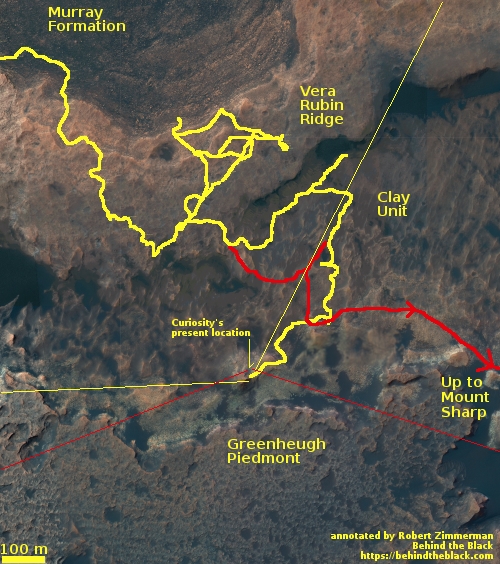
Overview map of Curiosity's journey through sol 2643

[For the overall context of Curiosity’s travels, see my March 2016 post, Pinpointing Curiosity’s location in Gale Crater.

For the updates in 2018 go here. For a full list of updates before February 8, 2018, go here.]

Since my last Curiosity update on November 6, 2019, the science team has sent the rover climbing up what they call Western Butte, the butte directly to the west of Central Butte and part of the slope/escarpment that separates the clay unit from the Greenheugh Piedmont and the sulfate unit above that.

The overview map to the right gives a sense of the journey. The thick yellow line indicates its route since it climbed up from the Murray Formation onto Vera Rubin Ridge in 2017. The thick red line indicates their planned route, which they have only vaguely been following since their arrival in the clay unit.

Below the fold are two panoramas that I created from a sequence of images taken by Curiosity’s left navigation camera from the high point on Western Butte, the first looking north across the crater floor to the Gale Crater rim approximately 30 miles away and indicated by the thin yellow lines on the overview map. The second looks south, up hill towards Mount Sharp, and is indicate by the thin red lines.
» Read more

0 comments

Protests in Iran against Islamic government

The protests in Iran continue, fueled by the admitted shooting down of a Ukrainian passenger jet, killing everyone on board, as well as what appears to be a clear opposition to the Islamic government and the terrorists its supports.

The link has good video of both the protests and the government’s violent reaction. However, the best and most illustrative video indicating where these protesters stand is the one that shows Iranian protesters refusing to walk on the American and Israeli flags, painted on the ground by the government in the hope that they would be trampled.

Meanwhile, other protesters have been ripping down posters of Qassem Soleimani, the head of the Quds forces and master Iranian terrorist leader whom Trump killed last week.

It is unclear what will happen next. The situation in Iran today reminds a great deal of the protests that took place in the Soviet bloc shortly before the fall of the Soviet Union, and helped bring that communist empire down. They also remind me of the same protests in China at the same time, which were met with vicious force, killing thousands, which allowed that communist dictatorship to maintain power.

We don’t know which route the Islamic leadership in Iran will take. They have clearly shown themselves willing to kill thousands. At the same time, they are presently as economically weak as the Soviet communists were, which doesn’t give them the resources needed for resisting an aggressive revolt.

19 comments

No trend in hurricanes since 1970

The uncertainty of science: A new study has found no trend, up or down, in hurricanes that made landfall since the 1970s, despite many global warming predictions that said the numbers of catastrophic hurricanes would increase.

Key quote:

There are a lot of ups and downs in the data, but no obvious trends.

The scientists note that though they see no obvious trends, it is difficult to pin anything down because the variability from year to year is so great.

That large variability in occurrence means – as a simple matter of mathematics – that our ability to detect changes in tropical cyclones one or two magnitudes smaller (or more) on similar time scales is obviously made difficult, if not impossible.

So, when next you hear a global warming expert, either a teenager not attending school or a Democratic politician who doesn’t remember anything from school, claiming we are all going to die from giant hurricanes caused by human-caused global warming, remember this study. It demonstrates that those “experts” have no idea what they are talking about.

38 comments

Farmers swarming to buy used 40-year-old tractors

Buy dumb! The market for used 40-year-old tractors is booming, due to the “smart” but expensive-to-repair designs of modern computer-based tractors.

Tractors manufactured in the late 1970s and 1980s are some of the hottest items in farm auctions across the Midwest these days — and it’s not because they’re antiques. Cost-conscious farmers are looking for bargains, and tractors from that era are well-built and totally functional, and aren’t as complicated or expensive to repair as more recent models that run on sophisticated software.

“It’s a trend that’s been building. It’s been interesting in the last couple years, which have been difficult for ag, to see the trend accelerate,” said Greg Peterson, the founder of Machinery Pete, a farm equipment data company in Rochester with a website and TV show. “There’s an affinity factor if you grew up around these tractors, but it goes way beyond that,” Peterson said. “These things, they’re basically bulletproof. You can put 15,000 hours on it and if something breaks you can just replace it.”

Because of the computer software built into the new machines, a farmer can no longer fix it himself. He must call in a service truck, at high cost with long wait times. This extra cost is on top of the high cost to buy the new tractor, which cost a lot more than the used machines.

I predict that the cost for used tractors is going to continue to rise, until some smart entrepreneur realizes the market possibilities, and begins making new tractors without the bells and whistles.

16 comments

First image of Ganymede’s north pole

Ganymede's north polar region

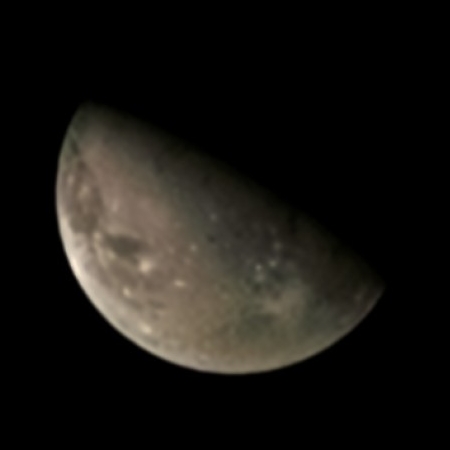
During Juno’s 24th close approach to Jupiter the spacecraft was able to take the first images ever of the north pole of Ganymede, the largest moon in the solar system. The image to the right was processed by citizen scientist Roman Tkacenko, and shows a variety of light and dark features.

The Juno science team decided for some reason to highlight a different set of images processed by citizen scientist Gerald Eichstädt, using the same data. I prefer Tkacenko’s version, because he focused in on the planet itself, making it easier to see what’s there.

In either case, however, the fuzziness of the image reminds me of planetary astronomy in my early childhood. Images like this, taken by telescopes on Earth, were the best we had of any planet beyond the Moon. Made it very hard to understand what was there, or what it meant.

0 comments
1 163 164 165 166 167 169