The icy Erebus Mountains near where Starship will land on Mars

Overview of all SpaceX images in Arcadia Planitia

Glacial filled crater in Erebus Montes
Click for full image.

It has been several months since I posted any new photos of the region on Mars which SpaceX considers its prime candidate landing site for its Starship spacecraft/rocket, now under development. The map to the right shows the location of all the images that SpaceX has obtained from the high resolution camera on Mars Reconnaissance Orbiter (MRO) of this landing region, located in the northern lowland plains at the border between Arcadia and Amazonis and to the east of the Erebus Mountains. (See my post on November 13, 2019 for an analysis of the reasoning for SpaceX to choose this region, along with links to each of the numbered images.)

Time to take another look, this time at the very center of the southern cluster of the Erebus mountains. The crater to the right, its location indicated by the tiny red rectangle on the map above, was taken by MRO on May 6, 2020, and shows the typical glacial features scientists find in mid-latitude Martian craters. The floor appears filled with glacial material, with the repeated cyclical flows repeatedly coming down off the north-facing interior rim. That rim would generally be colder and get less sunlight, so snowfall is more likely to pile up there and then flow downward like a glacier, only to sublimate away once it moves out of shadow.

What makes these mountains enticing, only about 400 miles from the Starship landing zone, is not simply what is inside this crater, but what surrounds it. Below is the wider view provided by MRO’s context camera.
» Read more

1 comment

InSight has buried its Mole

The Mole buried

Using the scoop on InSight’s robot arm, engineers have now successfully filled the large hole that had formed around the spacecraft’s mole, the drill that has been trying but failing to dig down about fifteen feet so that a heat sensor could measure the internal temperature of Mars.

The image to the right shows the filled hole with the mole’s communications tether snaking away. Earlier this month they used InSight’s scoop to scrape surface material into the hole, as planned in June. According to the mole’s principle investigate, Tilman Spohn,

I had estimated that the first scrape of 12 centimetres swath length would raise the bottom of the pit but leave the Mole sticking out of the sand. By the way, this was the condition for some to agree to the quite controversial ‘scratch test’. As one can see in the image from Sol 600 shown below, that estimate was not quite right. The scraping was a complete success! The scrape was much more effective than expected and the sand filled the pit almost completely. The Mole is now covered, but there is only a thin layer of sand on the back cap.

Their next step will be to use the scoop to press down on the dirt of the filled hole, with the hope this added pressure will keep the dirt pressed against the mole as it hammers downward, thus holding it place with each downward stroke.

4 comments

Newly upgraded solar telescope sees first light

Early image from upgraded solar telescope.

Astronomers have finished a major instrument upgrade of the GREGOR solar telescope in the Canary Islands, making it possible for them to observe features on the Sun’s surface as small as thirty miles in diameter.

The image to the right is an example of the telescope’s new capability, showing the Sun’s granular surface features. From the introduction of the paper describing the upgrade:

GREGOR is Europe’s largest solar telescope. … Its 1.5 m diameter with an optical footprint of 1.44 m allows us to resolve structures on the Sun as small as 50 km at 400 nm.

…A past drawback of GREGOR was that its image quality did not reach the theoretical limit, partly because a risk was taken with untested technologies, such as silicon carbide mirrors, which could not be polished well enough, and partly because of design problems. These difficulties have recently been solved by replacing all silicon carbide mirrors with mirrors made of Zerodur, which can be polished to the required quality, and by redesigning the AO relay optics. GREGOR now operates at its diffraction limit. [emphasis mine]

In other words, the initial mirrors did not work as promised, requiring them to replace them to get the telescope to function as initially designed. By the image above, it looks like their upgrade has worked admirably.

8 comments

Rocket Lab reveals it also launched its own satellite on August 30th

Capitalism in space: Rocket Lab today revealed that along with placing a customer’s commercial radar satellite into orbit on August 30th, it also launched the prototype of its own satellite during the Electron rocket launch.

The company calls its satellites Photons, but rather than number them it will give each their own name. This particular satellite has been dubbed “First Light.”

The satellite is primarily a technology demonstrator, a way to test Photon’s systems in orbit and show customers what the spacecraft is capable of. First Light will stay up for the next five or six years, if all goes according to plan, Rocket Lab founder and CEO Peter Beck said during a teleconference with reporters today (Sept. 3).

Photon should be attractive to a variety of customers, allowing them to focus on their sensors and other instruments without having to worry about building and operating an entire spacecraft, Rocket Lab representatives have said.

The goal is to offer this smallsat as a platform to those who wish to launch an instrument into space but don’t want to spend the money building the satellite itself. The company also intends to use a Photon satellite for a science mission to Venus in 2023.

3 comments

China launches its version of X-37B

The new colonial movement: It appears that China has launched its version of a reusable X-37B mini-shuttle, or at least, that is most likely first guess, based on the meager data available.

China launched a new experimental reusable space vehicle on Thursday from the Jiuquan Satellite Launch Center using a Long March-2F/T – Chang Zheng-2F/T – launch vehicle. Launch from the LC43/91 launch complex, under a veil of secrecy with no official launch photos or even a launch time disclosed.

Chinese media emitted a laconic report referring, that “the test spacecraft will be in orbit for a period of time before returning to the domestic scheduled landing site. During this period, it will carry out reusable technology verification as planned to provide technical support for the peaceful use of space.”

More at the link, though the lack of information, especially the refusal to even give a launch time, strongly indicates China wants to limit knowledge of this spacecraft’s position in space, thus limiting the ability of others to photograph it. What is known however does point to this being a variation of a small reusable unmanned shuttle, like the X-37B.

While once again China has not come up with something new, copying (or stealing) the idea from someone else, having such a vehicle gives them a significant capability. They can now test many different technologies in orbit for long periods, and get them back to Earth for study afterward.

The leaders in the 2020 launch race:

21 China
15 SpaceX
9 Russia
4 ULA
4 Europe (Arianespace)

The U.S. continues to lead China 24 to 21 in the national rankings.

2 comments

A star with giant misaligned rings

Star with misaligned rings

Astronomers using the Atacama Large Millimeter/submillimeter Array (ALMA) have detected a nearby star, dubbed GW Ori, with multiple rings of dust with several tilted in relation to the others.

The rings, with dust equaling 75, 170, and 245 Earth masses each, are 46, 188, and 336 astronomical units (au) each from their star. (An au is the distance of the Earth to the Sun.) If you look closely at the image to the right, you can see that the inner rings are circular, while the outer rings appear oval, suggesting that we are looking directly down at the inner rings, but the outer rings are tilted to our line of sight. Moreover, another team of astronomers

…observed GW Ori with ALMA and the European Southern Observatory’s Very Large Telescope (VLT). Near infrared observation with VLT showed for the first time that the innermost ring casts a shadow on the outer rings, which is clear evidence of disk misalignment. Kraus and his colleagues also performed a computer simulation and suggest that the triple star system can create misaligned rings, without gravitational assistance from planets. The two teams have different theories for the origin of the misaligned rings, but no conclusions have been reached so far. Nevertheless, GW Ori is a precious example to understand planet formation in the complex gravitational environment around multiple stars. [emphasis mine]

As noted, there is no agreement on the cause of the misalignment, only that it does exist.

0 comments

Bright-tipped perplexing terrain on Mars

Perplexing terrain on Mars
Click for full image.

The photo to the right, rotated, cropped, and reduced to post here, was taken by the high resolution camera on Mars Reconnaissance Orbiter (MRO) on June 24, 2020, and shows a bit of inexplicable country in Arabia Terra, the widest and largest transition zone region on Mars between the northern lowland plains and southern cratered highlands.

The stuff visible in this image falls into what I call “What the heck?” geology. It is very clear we are looking at a collection of straight and curved ridges and mesas, all of which for some reason are bright at their tips and edges. Some of the curved ridges might be the rims of craters, but only some. Other ridge lines look more like leftovers following a strange erosion process. The problem is that to my uneducated eye I can find little rhyme or reason to these shapes. The mesas and canyon on the image’s right edge might be explained by the erosion processes that create chaos terrain on Mars, but that process does not do a good job of explaining anything else in the photo.

That this uncaptioned image is merely labeled “Arabia Terra” suggests that the scientists involved in getting this image were equally perplexed by it, and could not give it a better description.

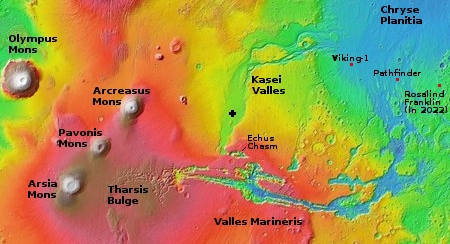
The overview map below provides some location context, including how this geology relates to the landing site of Europe’s Rosalind Franklin rover, now scheduled for a 2022 launch.
» Read more

2 comments

Another successful Starship prototype hop

Starship prototype #6 in flight

Capitalism in space: SpaceX today successfully completed a 150-meter high hop of its sixth Starship prototype, the second such hop but the first for this prototype. They have now flown two different prototypes, plus Starhopper, all successfully. No flight failures, so far.

Next they will be doing a pressure tank test, to failure, of the seventh prototype. That prototype is using what they think will be a better steel alloy, and they want to find out its limits. I have also heard that they will either fly this prototype again or fly the fifth again, sometime in the next two weeks.

I have embedded a few more images below the fold.
» Read more

13 comments

FAA issues Wallops Island launch license to Rocket Lab

Capitalism in space: The FAA has now issued a five year launch license to the smallsat rocket company Rocket Lab, allowing them to launch their Electron rocket from the company’s launch site on Wallops Island, Virginia.

The Launch Operator License allows for multiple launches of the Electron launch vehicle from Rocket Lab Launch Complex 2, eliminating the need to obtain individual, launch-specific licenses for every mission and helping to streamline the path to orbit and enable responsive space access from U.S. soil.

The company hopes to do its first launch from the U.S. before the year is out. It will then have two spaceports, allowing it to double its launch rate.

0 comments

SpaceX attempting another Starship hop today

Capitalism in space: Engineers at SpaceX’s Boca Chica facility in Texas are today preparing the sixth Starship prototype for its first 150 meter hop, the second hop of a Starship prototype overall.

The launch window is anytime between 8 am and 8 pm (Central). I have embedded the livesteam below the fold if you wish to watch. Based on previous attempts, they will try for a morning launch before noon, and if there are issues they will recycle and try again in the afternoon.
» Read more

6 comments
1 55 56 57 58 59 169