Astronomers: A supermassive black hole rotates far slower than expected

Quasar as seen across multiple wavelengths
Click for full image.

The uncertainty of science: Using Chandra astronomers have measured the rotation of a supermassive black hole in a distant quasar about 3.4 billion light years away and found that it spins at about half the speed of other less massive black holes.

Because a spinning black hole drags space around with it and allows matter to orbit closer to it than is possible for a non-spinning one, the X-ray data can show how fast the black hole is spinning. The spectrum — that is, the amount of energy as a function wavelength — of H1821+643 indicates that the black hole is rotating at a modest rate compared to other, less massive ones that spin close to the speed of light. This is the most accurate spin measurement for such a massive black hole.

The black hole, thought to weigh between 3 to 30 billion times more than the Sun and is the heaviest such object measured in this way, rotates at about half the speed of light. Why that rotation is less than other smaller black holes remains a question not yet answered, though astronomers suspect it is related to its formation history.

The image above is a composite showing this quasar across multiply wavelengths. X-rays are shown in blue, radio in red, and optical in white.

1 comment

Rocket Lab’s Photon upper stage completes 3rd of 7 engine firings to get CAPSTONE to Moon

Rocket Lab’s Photon upper stage has now successfully completed the third of seven planned engine burns designed to slowly raise the Earth orbit of NASA’s experimental lunar cubesat CAPSTONE so that it can eventually be sent towards the Moon.

Lunar Photon’s HyperCurie engine will perform a series of orbit raising maneuvers by igniting periodically to increase Photon’s velocity, stretching its orbit into a prominent ellipse around Earth. Six days after launch, HyperCurie will ignite one final time, accelerating Photon Lunar to 24,500 mph (39,500 km/h) and setting it on a ballistic lunar transfer. Within 20 minutes of this final burn, Photon will release CAPSTONE into space for the first leg of the CubeSat’s solo flight. CAPSTONE’s journey to NRHO is expected to take around four months from this point. Assisted by the Sun’s gravity, CAPSTONE will reach a distance of 963,000 miles from Earth – more than three times the distance between Earth and the Moon – before being pulled back towards the Earth-Moon system.

Once in lunar orbit, CAPSTONE will be used to both test operations in that orbit (similar to the one NASA’s Lunar Gateway space station will use) while also demonstrating the use of a cubesat on an interplanetary mission.

1 comment

Amazon to FCC: Consider limiting SpaceX’s Starlink constellation for our benefit

In a letter sent to the FCC last week, Amazon asked the agency to limit the size of SpaceX’s full constellation so that Amazon will be free to someday launch its own Kuiper constellation.

In the recent letter, Amazon recommends the FCC license a “subset of SpaceX’s proposed system” (as opposed to the whole fleet) to give the agency additional time to consider the “novel challenges” such a significant expansion might present. For example, Amazon believes hundreds to “more than 10,000” of SpaceX’s new satellites could be operating in the altitudes already approved for its Kuiper satellites, which could cause interference in the spectrum and “orbital overlap.” The company claims SpaceX has refused its requests for communication around these concerns as it has urged the FCC to approve its application. It also cites eight other satellite operations who have objected to the plan, including Dish Network, which is currently engaged in a public battle over radio frequencies with SpaceX.

Amazon’s concerns might carry more weight if the launch of its constellation was not so delayed. Both Amazon and SpaceX began development of their satellite constellations at about the same time. Yet, while SpaceX has already launched almost 3,000 satellites, and is providing its service to several hundred thousand customers, Amazon has yet to launch a single satellite.

Thus, though what Amazon is asking the FCC seems reasonable, it is also asking the FCC to block a competitor’s successful operation while it dilly-dallies along, accomplishing little.

This pattern from Amazon fits the pattern of all of Jeff Bezos’s space-related projects: Big promises, little action, and when competitors get things done sue or demand the government play favorites. Sure does not seem to me to be a good long-term business plan.

3 comments

India’s PSLV rocket completes launch, putting nine satellites into orbit

India’s PSLV rocket successfully placed nine satellites into orbit today, completing that country’s second launch in 2022.

Since the Wuhan panic arrived in 2020, India’s space program has slowed to a crawl. Beforehand, it had been averaging six launches per year with the expectation that in 2020 it might double that number. Furthermore, the PSLV rocket had been a major player in the emerging smallsat market, routinely putting one to three dozen smallsats into orbit with each launch, with one launch in 2017 putting a record 104 smallsats into orbit.

Then the Wuhan panic arrived and everything stopped. Today’s PSLV launch was only its fifth launch since 2019. With almost all launches canceled, India’s smallsat business moved to SpaceX, Rocket Lab, and other rocket companies that did not panic and continued to launch.

Today’s launch however might signal a renewal. It was not managed by India’s old space agency, ISRO, but a new government agency called NewSpace India Limited (NSIL), which is supposedly focused on encouraging the growth of India’s commercial aerospace sector, independent of the government. Whether a government agency can accomplish such a task in India remains entirely unknown.

The leader board in the 2022 launch race remains the same:

27 SpaceX
21 China
8 Russia
4 Rocket Lab

American private enterprise still leads China 37 to 21 in the national rankings, and the entire world combined 37 to 34.

A ULA Atlas-5 launch later today could change these numbers.

0 comments

SpaceX launches SES communications satellite

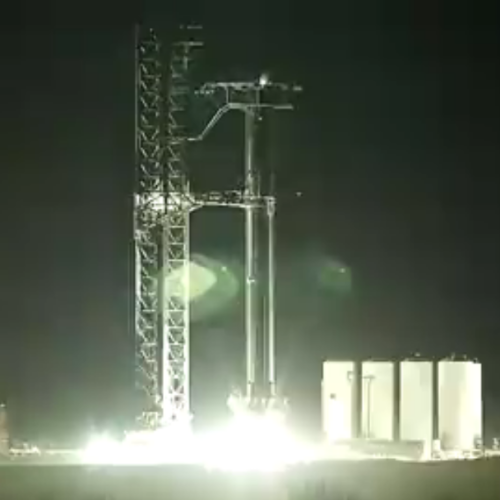
Capitalism in space: SpaceX today successfully launched a SES communications satellite, using its Falcon 9 rocket.

The first stage, making its second flight, successfully landed on a drone ship in the Atlantic. As of this writing, the satellite itself has not yet been deployed.

The leaders in the 2022 launch race:

27 SpaceX
21 China
8 Russia
4 Rocket Lab

American private enterprise now leads China 37 to 21 in the national rankings, and the entire world combined 37 to 34.

0 comments

Today’s blacklisted American: Lincoln bust and Gettysburg Address plaque removed from Cornell library because “someone complained”

Banned by Cornell

Our modern dark age: Apparently because some unidentified individual “complained” about the presence of a bust of Abraham Lincoln and a bronzed plaque of his Gettysburg address, officials running the library at Cornell University immediately removed both.

“Someone complained, and it was gone,” Cornell professor Randy Wayne told the College Fix, referring to a Gettysburg Address plaque and Lincoln bust that had been on display in the Ivy League university’s Kroch Library since 2013. The professor said that he had noticed that the items were gone after stopping by the library several weeks ago, adding that when he asked the librarians about it, they were unable to give any details, other than saying it was removed as a result of some type of complaint.

The plaque and bust have been replaced with, “Well, nothing,” Wayne told the College Fix.

According to professor Wayne, when he asked the librarians why the bust and plaque were gone “they had no details to provide, except to say it was removed after some sort of complaint.”
» Read more

11 comments

The lava tubes on the western slopes of Alba Mons as potential Martian colonies

Lava tubes on western flank of Alba Mons
Click for full figure.

In a new paper detailing work they first began in 2019, scientists have now carefully mapped the extensive lava tubes that appear to radially descend westward from the caldera of Alba Mons, the volcano on Mars that has the largest surface area but with a relatively low peak.

The mapped population of 331 lava tube systems has a mean length of 36.2 km, with a total length in the western flank geologic map quadrangle of ∼12,000 km. Individual lava tube systems extend up to ∼400 km, and it is likely that some of our mapped lava tubes are connected such that the total number is actually smaller and lengths (average and maximum) longer.

The map above, figure 10 of their paper, shows volcanic ridges as yellow, collapsed lava tube segments as red, and collapsed lava tube on the volcanic ridge as maroon. The wider map below, shows where this region is located, and gives the larger context.
» Read more

7 comments

Sierra Space signs partnership deal with Turkey

Sierra Space and ESEN (another affiliated company of Sierra Space’s mother company Sierra Nevada) have signed a partnership agreement with the Turkish Space Agency to work together over the next five years in developing Sierra Space’s Dream Chaser spacecraft and its LIFE orbital space station.

Though the agreement mentions how the three will work together to develop both Dream Chaser and LIFE, because of State department security regulations Sierra Space must be very careful about what technology it reveals to Turkey. I therefore expect the heart of the agreement are these two bullet points from the press release:

  • Space environment utilization on-orbit in LEO, including use of Sierra Space’s Large Integrated Flexible Environment (LIFE) space habitat module
  • Sending payloads to low Earth orbit (LEO) and the moon

Turkey wants to launch its own planetary probes as well as astronauts in order to compete with its Middle East neighbor the UAE. It has thus decided to pay Sierra Space to help it do that. The company can use the cargo Dream Chaser to lift smallsat payloads into orbit, and later use the manned version to lift Turkish astronauts to the LIFE station.

4 comments

Axiom leases former Fry’s retail building housing fullscale mock-up of ISS

Capitalism in space: The private commercial space station company Axiom has leased a former Fry’s retail building that also happens to house the only fullscale mock-up of ISS anywhere.

Axiom Space, which has a contract with NASA to test components of its planned Axiom Station at the International Space Station, has leased the former location of Fry’s Electronics in Webster, Texas to house its engineering operations. The former big-box retail store, which closed when the national chain went out of business in 2021, is unique for its football-field-long representation of the ISS.

…Contained within a building that itself was shaped to resemble oversized space station modules, the former Fry’s ISS includes most of the real complex’s major components. The mockup features the U.S. Destiny laboratory, Quest airlock and Cupola; Russia’s Zvezda service module and Zarya functional cargo block (FGB); Japan’s Kibo laboratory; and the European Space Agency Columbus module.

The space station installation also has a replica of the Canadarm2 robotic arm, a Russian Soyuz spacecraft, two models of NASA’s never-realized X-38 emergency crew return vehicle and astronauts (mannequins) in replica spacesuits. Additional oversized modules previously served as product demonstration rooms and an in-store cafe, while most of the station sat among and above aisles of computers and other devices.

Most of the mock-up hangs overhead, out of the way. In reconfiguring the building for its own use, Axiom intends to leave these mock-up units untouched. Engineers will do design work and module development of Axiom’s own station below.

Axiom’s occupation of this building is only temporary. Once its larger facility is completed in the next few years in the industrial park dubbed Houston Spaceport it will shift all operations there.

1 comment

Scientists want your help cataloging the clouds on Mars

In order to fully identify all the clouds seen in the sixteen years of data collected by the cloud instrument on Mars Reconnaissance Orbiter (MRO), scientists have now organized a citizen-scientist project to catalogue those clouds.

The project revolves around a 16-year record of data from the agency’s Mars Reconnaissance Orbiter (MRO), which has been studying the Red Planet since 2006. The spacecraft’s Mars Climate Sounder instrument studies the atmosphere in infrared light, which is invisible to the human eye. In measurements taken by the instrument as MRO orbits Mars, clouds appear as arches. The team needs help sifting through that data on Zooniverse, marking the arches so that the scientists can more efficiently study where in the atmosphere they occur.

You can join up by going here.

0 comments
1 102 103 104 105 106 192