Strange terrain on the eastern floor of Gale Crater

Strange terrain on the eastern floor of Gale Crater
Click for full image. For the inset, go here.

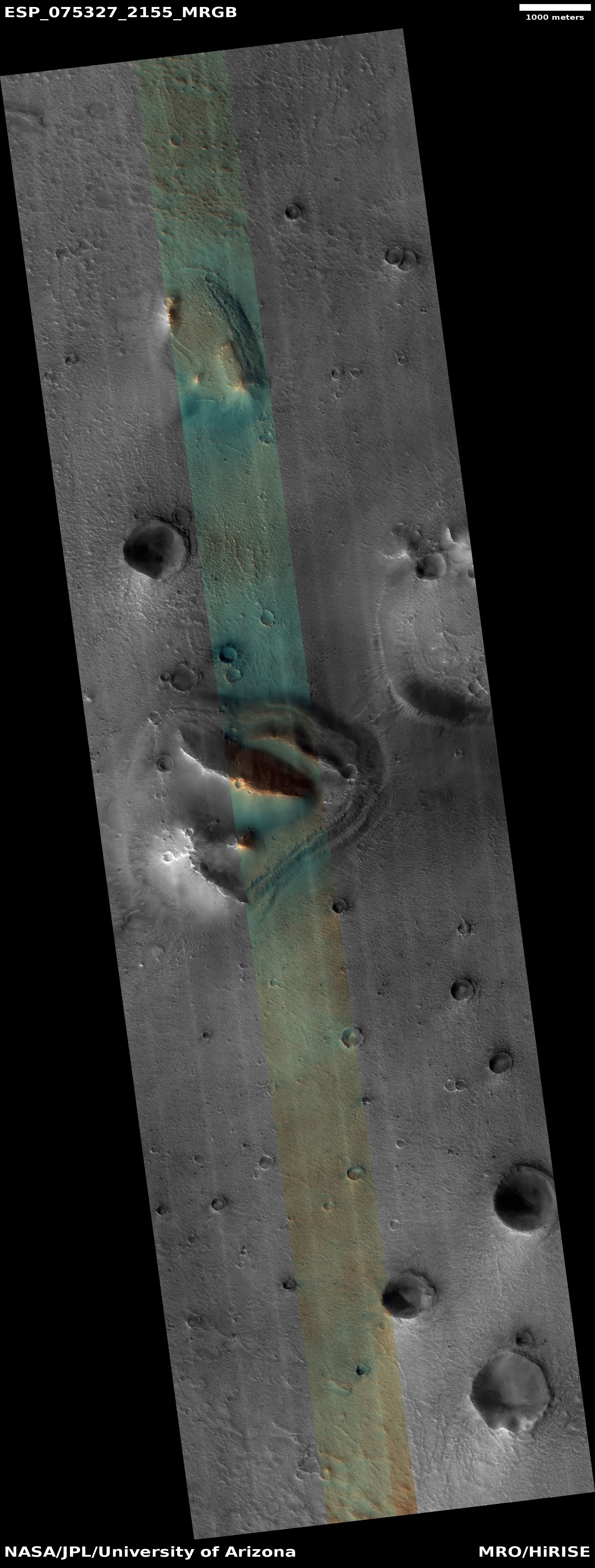
Though today’s cool image on the right, rotated, cropped, and reduced to post here, shows a small section on the floor of 96-mile-wide Gale Crater where Curiosity has been roving for the past decade, this picture looks at a different place. Curiosity landed in the northwest quadrant of the crater, and has been climbing the western slopes of Mount Sharp, which fills much of the crater’s interior. Today’s image looks at the crater’s floor on the east side of Mount Sharp.

The picture was taken on September 30, 2022 by the high resolution camera on Mars Reconnaissance Orbiter (MRO). The dark areas are likely dune seas, while the golden section near the top of the color strip is likely dust, though that is not certain. (This bright yellow is unusual for this particular color filter.) The greenish color suggests coarser materials, such as larger boulders and rocks, though this is also not certain.

The inset zooms into some unusual polygon lines that cut across the dunes and cratered terrain. Such lines suggest that once, in the far past, the ground here was wet. When it dried out (being now in the very dry equatorial regions of Mars) it formed these cracks, similar in nature to the polygon cracks one sees in drying mud on Earth. Since the data from Curiosity when it was on the crater floor also suggests a lake once existed inside the crater, these cracks add weight to that conclusion.

The overview map below places Gale Crater in the larger context of Mars.
» Read more

0 comments

Today’s blacklisted American: Judge orders Philadelphia to stop blacklisting Christopher Columbus

What Philadelphia thinks of Columbus
How Philadelphia wants Christopher Columbus honored

The modern dark age: A state judge has now ordered the city of Philadelphia to remove the plywood box that has covered its statue of Christopher Columbus for the past two years.

In her ruling, Judge Mary Hannah Leavitt said that if the city disagrees with the “message” the statue sends, it can add its own plaque with what it wants to convey. “More to the point, the City accepted the donation of the Columbus statue in 1876. It has a fiduciary duty to preserve that statue, which it designated an historic object in 2017. The Columbus statue is not City property as is, for example, a City snowblower,” the judge wrote.

On orders by the city’s Democratic Party mayor, Jim Kenny, the statue had been covered during the worst of the riots in 2020, with Kenny’s stated intention to remove it entirely at some point.
» Read more

2 comments

NOAA once again over-predicts the hurricane count

As it has done repeatedly in recent years, NOAA in 2022 once again over-predicted the hurricane count for this past hurricane season, predicting an above-normal season when it actually ended up to be well below-normal.

In late May and again in early August 2022 NOAA predicted that the year 2022 Atlantic Hurricane Season (between June to end November calendar period) would be an “above normal” season with 14-21 named storms, between 6-10 hurricanes including 3-6 major hurricanes (Category 3,4 and 5) as shown in NOAA’s diagram below.

Colorado State University’s Department of Atmospheric Science/Tropical Meteorology Project has compiled the year 2022 tropical storm data, establishing that, compared to its 30 year North Atlantic data records covering the Climatological period 1991-2020, the year 2022 hurricane season was below average in Named Storms, Named Storm Days, Hurricane Days, Major Hurricanes, Major Hurricane Days and Accumulated Cyclone Energy (ACE).

The many graphs at the link also demonstrate that the predictions that there will be an increase in extreme weather events due to increased use of fossil fuels is also proving false.

4 comments

New bill imposes new and odious regulation on private space stations and satellites

Congress and the FCC to private space: Nice business you got here.
Congress and the FCC to private space: “Nice business you
got here. Shame if something happened to it.”

On December 8, 2022, two bills, sponsored by both a Democrat and a Republican, were introduced in the House to give the Federal Communications Commission (FCC) the power to regulate and even block the launch of commercial private space stations, while also giving that agency the power to require companies to meet its arbitrary regulations on de-orbiting defunct satellites and stations.

House Energy and Commerce Committee Chairman Frank Pallone, Jr. (D-N.J.) and the ranking member, Rep. Cathy McMorris Rodgers (R-Wash.), said their legislation is needed to modernize the FCC for the rapidly changing space industry. Their two bills — the Satellite and Telecommunications Streamlining Act and Secure Space Act — seek to update regulations covering foreign ownership, space sustainability, license processing timelines, and satellite spectrum sharing.

The key language in the first bill [pdf] is this:
» Read more

12 comments

A wall of smoke, as seen by Hubble

A wall of smoke, as seen by Hubble
Click for full image.

Using the Hubble Space Telescope, astronomers have produced a magnificent image of an interstellar cloud, cropped and reduced to post here. From the caption:

A portion of the open cluster NGC 6530 appears as a roiling wall of smoke studded with stars in this image from the NASA/ESA Hubble Space Telescope. NGC 6530 is a collection of several thousand stars lying around 4350 light-years from Earth in the constellation Sagittarius. The cluster is set within the larger Lagoon Nebula, a gigantic interstellar cloud of gas and dust. It is the nebula that gives this image its distinctly smokey appearance; clouds of interstellar gas and dust stretch from one side of this image to the other.

Astronomers investigated NGC 6530 using Hubble’s Advanced Camera for Surveys and Wide Field Planetary Camera 2. They scoured the region in the hope of finding new examples of proplyds, a particular class of illuminated protoplanetary discs surrounding newborn stars. The vast majority of proplyds have been found in only one region, the nearby Orion Nebula. This makes understanding their origin and lifetimes in other astronomical environments challenging.

The first proplyds were seen in the very first images taken by Hubble after it was fixed and could finally take sharp pictures. That so few have been seen since is thus somewhat surprising.

2 comments

Remembering Apollo 17, fifty years after the last manned mission to the Moon

LRO oblique view of Apollo 17 landing site
Click for full image.

Link here.

The article comes from the Lunar Reconnaissance Orbiter (LRO) science team, and includes a number of LRO photos of the landing site, including the oblique annotated image to the right, reduced to post here. As the article notes:

The Apollo 17 crew was the last of an era in human space exploration and the last to set foot on the Moon. Fifty years later, the landing sites, hardware, and footsteps remain delicately preserved on the lunar surface. Join the LRO team as we commemorate their inspiring achievements with additional images, research, maps, interactive sites, and a dedicated video. LRO continues to image the Apollo sites whenever possible, under multiple lighting conditions, and combine these images into interactive sites, like the Apollo 17 Temporal Traverse. The Lunar QuickMap 3D tool can be used to preview the Apollo landing sites and search for LROC images of the areas. For downloadable maps of the Taurus-Littrow Valley, visit the Map Sheets section on our downloads page here. Finally, the Apollo 17 fiftieth anniversary video below presents highlights of the mission with landing site views reconstructed using LROC images and topography.

I have embedded that video below. It does a marvelous job summarizing this mission, which in many ways remains the most daring human exploration mission since Columbus dared cross an ocean in a tiny ship only slightly larger than many lifeboats.
» Read more

5 comments

Update on the ten cubesats launched by SLS

Link here.

At this moment six of the ten cubesats either accomplished their mission successfully or are still operating, while four cubesats failed entirely.

Of those still working, two will go into lunar orbit and try to find evidence of both hydrogen and ice on the Moon. A third is testing “solid iodine” thrusters, while a fourth will observe how yeast samples react to a long exposure in deep space. A fifth cubesat is a joint NASA-JAXA mission, and is testing how to fly a smallsat in the low gravity of a Lagrangian point.

Finally, an Italian cubesat was used to successfully take images of the Moon and Orion, and has completed its mission.

1 comment

China’s Long March 4C rocket launches two satellites

Long March 4C launch

China today launched two experimental technology satellites, using its Long March 4C rocket from an interior spaceport.

The launch pictures, as captured on the right, show what appear to be panels falling off the rocket as it lifts off. Note how some of these falling panels are red, while the Chinese flag at the top of the rocket appears to be partly broken off in the later picture. The fairing and shell of the upper stage in the second picture also appear changed.

The Chinese state-run press claims the satellites reached orbit as planned, but these pictures suggest otherwise. If part of the fairing and outside of the upper stage fell off, there is a good chance the payload was damaged during max-q, the period soon after launch when rockets undergo the greatest stress in the Earth’s thicker atmosphere.

UPDATE from stringer Jay: Video of the launch. The panels continue to drop off for a considerable time.

Assuming this launch was a success, however, the 2022 launch race continues to heat up, with China vying to beat SpaceX after trailing the American company for most of the year.

58 China
56 SpaceX
21 Russia
9 Rocket Lab
8 ULA

The U.S. still leads China 80 to 58 in the national rankings, but trails the entire world combined 88 to 80.

7 comments

Orion successfully splashes down in the Pacific

NASA’s Orion capsule today successfully returned from a three week trip around the Moon, splashing down in the Pacific where it was successfully recovered.

The next Artemis flight will be a manned one, using SLS and Orion to fly around the Moon. It will also be the first time Orion will use its full environmental system, with humans on board. Though presently scheduled for May 2024, it is almost certainly not going to fly before 2025.

The actual Artemis manned lunar landing will follow, no sooner than two years after that. As presently designed, that mission requires the establishment of the Lunar Gateway station — astronauts can be transferred from Orion to Starship and back again, and that station is likely not going to be ready in this time frame.

As I said yesterday, I predict the two already purchased private Starship missions around the Moon, paid for by Yusaku Maezawa and Jared Isaacman, will happen first. Both will certainly beat NASA’s planned landing on the Moon. I also expect both to beat that Orion manned fly-around in ’24-’25. And each will cost pennies compared to the entire SLS/Orion program, while actually making a profit that will be used to further development and more manned private flights.

2 comments

SpaceX successfully launches Ispace’s Hakuto-R private mission to Moon

Lunar map showing Hakuto-R's landing spot
Hakuto-R’s planned landing site is in Atlas Crater.

Using its Falcon 9 rocket, SpaceX tonight successfully launched Ispace’s Hakuto-R lunar lander, the first private mission attempting to softly land on the Moon.

The Falcon 9 first stage completed its fifth flight, landing successfully at Cape Canaveral.

Hakuto-R, which is actually the first of two missions, carries seven payloads, including two small rovers, Rashid, which is the United Arab Emirates first lunar mission, and a smaller rover built by Ispace. Both will operate for about a week, one lunar day. Hakuto-R will land on the Moon in April, 2023.

A second payload is a cubesat from JPL, called Lunar Flashlight. It will go into lunar orbit, testing new fuel technologies while also attempting to identify water in the permanently shadowed craters at the lunar south pole.

The leaders in the 2022 launch race:

57 China
56 SpaceX
21 Russia
9 Rocket Lab
8 ULA

The U.S. now leads China 80 to 57 in the national rankings, but trails the entire world combined 87 to 80.

9 comments

NASA extends Boeing’s contract to produce more SLS rockets

NASA yesterday announced that it will pay Boeing $3.2 billion for two more SLS rockets.

NASA has finalized its contract with Boeing of Huntsville, Alabama, for approximately $3.2 billion to continue manufacturing core and upper stages for future Space Launch System (SLS) rockets for Artemis missions to the Moon and beyond.

Under the SLS Stages Production and Evolution Contract action, Boeing will produce SLS core stages for Artemis III and IV, procure critical and long-lead material for the core stages for Artemis V and VI, provide the exploration upper stages (EUS) for Artemis V and VI, as well as tooling and related support and engineering services.

All this really means is that NASA is going depend on SLS and Orion to fly its astronauts to and from the Moon, and because of that its pace of flight will be — at best — slow and long-drawn out. For example, this new order extends the contract out to 2028. It will thus leave plenty of time for SpaceX and other nations to get there first.

I predict that the private Starship missions paid for by Yusaku Maezawa and Jared Isaacman will both fly before these two new Artemis missions. You heard it here first.

20 comments

Chinese upper stage disintegrates in orbit

A Chinese Long March 6 upper stage, launched in on November 11, 2022, has disintegrated into more than 350 in orbit and now pose a threat to other orbiting spacecraft.

The Long March 6A rocket launched from Taiyuan, north China, on Nov. 11, successfully inserting the Yunhai 3 environmental monitoring satellite into its intended orbit.

The upper stage of the rocket, however, apparently suffered a breakup event shortly thereafter. On Nov. 12, the U.S. Space Force’s 18th Space Defense Squadron (18SDS) reported that it was tracking at least 50 discrete pieces of orbital debris from the rocket body. Ongoing tracking from 18SDS, which focuses on space domain awareness, now states that the debris cloud has grown to 350 objects associated with the rocket stage.

Based on the data, it appears the break-up occurred because the stage had an explosive event. It could have been programed to fire its engine to quickly de-orbit it and something went wrong. Or not. The Chinese have not demonstrated much concern about such issues.

4 comments
1 10 11 12 13 14 192