Watch first flight of SpaceX’s fourth capsule, Freedom, carrying four NASA astronauts

The next launch of a NASA crew to ISS is scheduled to occur tonight at 3:52 am (Eastern) using SpaceX’s new capsule, Freedom, the fourth in the company’s fleet of manned spacecraft. Note too that the first stage of this Falcon 9 rocket will be making its fourth flight into space.

I have embedded the live stream below. As I write this, at 1:19 am (Eastern) the crew has just entered the capsule. Go here for details about the flight, which will be a five month mission.

Commander Kjell Lindgren, veteran of one previous expedition on the space station, leads the four-person crew awaiting liftoff Wednesday. He will be joined by pilot Bob Hines and mission specialist Jessica Watkins, two first-time fliers from NASA’s astronaut corps. European Space Agency astronaut Samantha Cristoforetti, a native of Italy who spent nearly 200 days in orbit in 2014 and 2015, rounds out the crew.

If the launch goes well, Freedom will dock with ISS about sixteen hours later.

If you watch, I must once again note that every person you see aiding the astronauts will be a SpaceX employee. Except for some of the announcers and NASA’s mission control for operating ISS, the launch mission control and everything else is run by this privately owned commercial company.

» Read more

1 comment

Pushback: Judge rules lawsuit from professor suspended for refusing to favor black students can proceed

King's dream banned at UCLA
King’s dream of equal treatment for all
called racist at UCLA

Don’t comply: The lawsuit of Gordon Klein, a professor at UCLA for 39 years who was suspended for three weeks in June of 2021 because he refused to favor black students in grading or exempt them from final exams, will proceed following a favorable ruling by a Los Angeles county judge.

On March 30, 2022, Los Angeles County Superior Court Judge H. Jay Ford III ruled against UCLA when it attempted to have Klein’s lawsuit dismissed. Ford ruled that Klein provided sufficient evidence to “support judgment in his favor” for several of his claims. The lawsuit is scheduled for a jury trial in April 2023.

I covered Klein’s story in a blacklist column in September ’21, describing how Klein was not only suspended but was also subjected to physical threats requiring a police presence at his home.

I also noted that Klein’s lawsuit, available to read here [pdf], specifically targets not just UCLA but “…the individual administrators at the Anderson School personally liable for their wrongful and slanderous actions.” With the lawsuit now proceeding those individuals, specifically Antonio Bernardo, the Dean of the Anderson School, and the entire 26-member Board of Regents of the University of California, are facing punishment for their slanders and bigoted policies.

As always, I strongly recommend my readers spend the time to read Klein’s complaint. Rather than depend on my shortened description, read the whole thing, in all its gory details. You will no longer look at modern academia in the same way. Once an oasis for open discussion, equal treatment, and intellectual thought, established academia has now become a haven for bigotry and hate, focused specifically in destroying anyone who does not support giving minorities favored treatment.

4 comments

Scientists: Dry ice glaciers at Mars’ south pole ice cap are active and moving

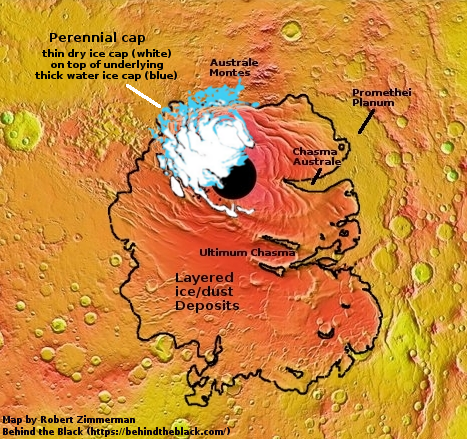
Map of Martian south pole ice cap
The moving glaciers are mostly thought to be in the dark troughs on
the edge of the dry ice topping the perennial cap, flowing down to
pond on the water ice below.

The uncertainty of science: According to a newly published paper, scientists have concluded that some of the dry ice glaciers at the Martian south pole ice cap are still active and moving, flowing into basins which allow them to survive longer during warm periods.

From the paper’s abstract:

Carbon dioxide (CO2) ice is found in a stack of deposits at Mars’ south pole. These deposits are situated in basins, where they reach more than 1 km thick. Previous work suggested that the CO2 ice should be deposited when the axial tilt of the planet was lower, making the poles colder than they are now; however, the thickness and distribution of this ice should be much thinner than observed if only atmospheric effects are working on the ice. Therefore, the CO2 ice deposit distribution cannot be explained by atmospheric deposition alone. In this paper, we use glacial modeling and feature analysis to demonstrate that glacial flow better explains the distribution of ice in its present state. In addition, we show that the slopes on the south polar cap act to focus glacial flow into the basins, where it can survive warm periods by sublimating only the uppermost sections when the tilt of the planet is larger than present day.

The scientists estimate that the motion of these glaciers began approximately 600,000 years ago. According to Isaac Smith of the Planetary Science Institute in Arizona, the paper’s lead author:
» Read more

0 comments

SpaceX’s signs up another airline to use Starlink Wi-Fi on its planes

Capitalism in space: Hawaiian Airlines has now become the second commercial airline company to agree to use SpaceX’s Starlink Wi-Fi on its airplanes.

Hawaiian Airlines said Monday that it will offer free wireless internet service from SpaceX’s Starlink satellite network on flights between Hawaii and the U.S. mainland, Asia and Oceania. The airline said it is in the early stages of putting the service in place on some aircraft next year.

Honolulu-based Hawaiian said it’s the first deal between Elon Musk’s space company and a major airline, although charter operator JSX announced a deal with SpaceX last week.

Expect all the American airlines to soon switch to Starlink. The low orbit of the satellites and its high speed make it superior to the other satellite options presently available.

0 comments

InSight scientists publish paper describing last year’s big Martian quakes

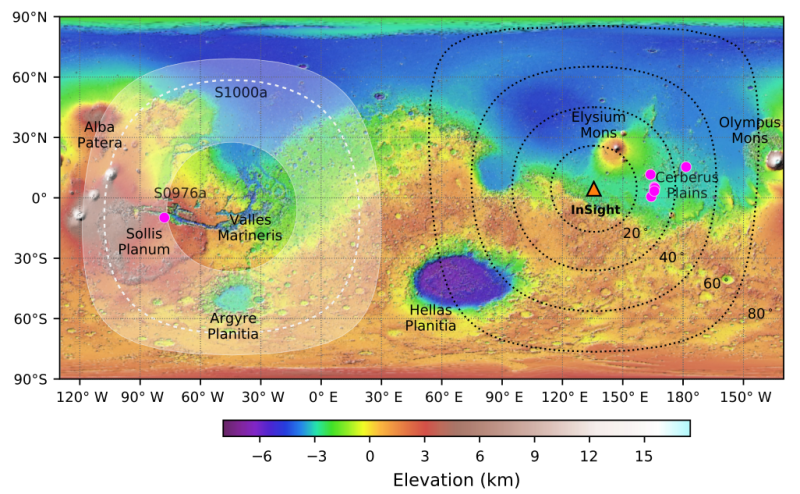
Figure 5: global map of located Martian quakes

The InSight science team has now published a paper [pdf] describing in detail what they gleaned from the two large earthquakes the lander detected on Mars last year, measuring 4.1 and 4.2 magnitudes.

The map above, figure 5 of their paper, marks their best estimate of the quakes’ locations, dubbed S0976a and S1000a. From the caption:

Mars surface relief map showing InSight’s location (orange triangle), the location of other located mars-quakes (magenta dots) that cluster around 30° distance, close to Cerberus Fossae, and S0976a, located within Valles Marineris just north of Sollis Planum. Because no back azimuth can be determined for S1000a, its location is predicted to be somewhere within the shaded region between 107° and 147° from InSight. The event’s preferred distance (116°) is marked with the white dashed line. The black dotted lines mark radii around InSight up to 80°.

A review of Mars Reconnaissance Orbiter (MRO) high resolution images of that part of Valles Marineris where S096a occurred will likely uncover a whole bunch taken since last August, all attempting to detect any actual surface changes produced by quake. I think I’ll do that review, and see if I can spot something.

The paper also notes the uniqueness of S1000a, which lasted 94 minutes, the longest so far detected on Mars. The complexity of its signal also makes locating it difficult, though the most likely possible locations — indicated by the white dashed line in the map above — crosses through the Tharsis Bulge where Mars’ biggest volcanoes are found.

Sadly, InSight will likely shut down before the end of this year due to loss of power, so until another seismometer is sent there no further Martian quakes will be detected.

0 comments

SLS rocket rolled back to VAB

NASA’s SLS rocket has now been rolled back to the vehicle assembly building (VAB) so that engineers can assess the various problems that prevented the agency from completing a full dress rehearsal countdown last week.

Over the next several days, the team will extend the work platforms to allow access to SLS and Orion. In the coming weeks, teams will work on replacing a faulty upper stage check valve and a small leak within the tail service mast umbilical ground plate housing, and perform additional checkouts before returning to the launch pad for the next wet dress rehearsal attempt.

More details about these problems can be found here.

The bottom line is that these engineering fixes are certain to take at least two months to fix. Then NASA must decide what next to do. If it decides to redo the dress rehearsal countdown, then an actual launch cannot happen sooner than July, and only if they proceed directly to launch after completing the rehearsal. If the rocket is rolled back to the VAB after the next rehearsal the launch will be delayed further, into August or September.

And all that assumes the next rehearsal goes perfect, something that seems unlikely based on what has happened so far.

The delays are a problem because the first stage’s two strap-on solid rocket boosters are already well past their “use-by” date of January ’22. The possibility that NASA will have to unstack this rocket and replace these boosters is growing. If that happens the launch cannot occur sooner than early ’23, if then.

Worse, these delays cause all other subsequent SLS launches to be delayed as well. Right now the manned mission to the Moon, presently scheduled for ’25, is likely going to be pushed back to ’26.

11 comments

NASA extends eight planetary missions, including sending OSIRIS-REx to the asteroid Apophis

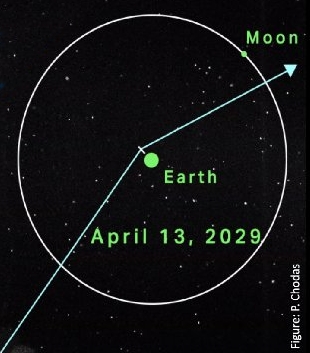
Apophis' path past the Earth in 2029
Apophis’ path past the Earth in 2029.

NASA today announced that it is extending the missions of eight different planetary probes.

The missions – Mars Odyssey, Mars Reconnaissance Orbiter, MAVEN, Mars Science Laboratory (Curiosity rover), InSight lander, Lunar Reconnaissance Orbiter, OSIRIS-REx, and New Horizons – have been selected for continuation, assuming their spacecraft remain healthy. Most of the missions will be extended for three years; however, OSIRIS-REx will be continued for nine years in order to reach a new destination, and InSight will be continued until the end of 2022, unless the spacecraft’s electrical power allows for longer operations.

The biggest news is the decision to extend OSIRS-REx so that it can rendezvous with the asteroid Apophis in 2029. The science team…

…will redirect the spacecraft to encounter Apophis, an asteroid roughly 1,200 feet (roughly 370 meters) in diameter that will come within 20,000 miles (32,000 kilometers) of Earth in 2029. OSIRIS-APEX will enter orbit around Apophis soon after the asteroid’s Earth flyby, providing an unprecedented close-up look at this S-type asteroid. It plans to study changes in the asteroid caused by its close flyby of Earth and use the spacecraft’s gas thrusters to attempt to dislodge and study the dust and small rocks on and below Apophis’ surface.

Apophis is a potentially dangerous asteroid, with a 1 in 150,000 chance it will hit the Earth in 2068. Getting as much information about it as soon as possible is crucial so that future generations will be prepared should its path eventually become a collision course.

9 comments

The icy Reull Valley of Mars

Eroded ice in crater near Reull Valles
Click for full image.

Cool image time! The photo to the right, cropped and reduced to post here, was taken on February 20, 2022 by the high resolution camera on Mars Reconnaissance Orbiter (MRO). It shows the eroded floor of a 10-mile-wide very obscured unnamed crater that sits above the northern wall of a canyon dubbed Reull Valles.

For reference the interior slope of the crater’s southern rim is labelled. The crater sits at 40 degrees south latitude. Thus, this crater is inside the 30 to 60 degree mid-latitude bands where scientists have found many glaciers on Mars. The eroded floor of this crater appears to confirm this conclusion. In the full photo the erosion is even more pronounced, as well as more chaotic, farther from that rim to the north.

Because Reull Valles sits inside that southern glacial band, it is home to much evidence of ice. The overview map below provides the context.
» Read more

1 comment

Today’s blacklisted American: The media knives are now out for Elon Musk

Musk: a target of the leftist press
Musk now a target of the leftist press.

They’re coming for you next: Elon Musk’s effort to buy purchase of Twitter to end the ability of its leftist management and employees to censor opinions they don’t like has apparently activated this same blacklisting effort against Musk and his companies across many media fronts, based on two stories yesterday.

First we have this story in a local Florida newspaper, describing a handful of letters of complaint to the Florida Department of Environmental Protection (FDEP) about SpaceX’s proposal to build an industrial wastewater treatment facility on its leased facility on Cape Canaveral.

The draft proposal was first filed back on February 2, 2022. It requests permission from the Florida Department of Environmental Protection (FDEP) to create a facility that would “discharge up to 3,000 gallons per day of non-process potable water to a stormwater management system that, under specific conditions, discharges to a ditch leading to the Indian River Lagoon.”

After notice of the draft proposal was published in Hometown News Brevard, it drew the attention of Titusville residents.

The article then proceeds to give us a detailed description of each complaint letter sent to FDEP, all five. Based on the similar language in all the letters, they appear to be part of a quickly organized campaign by local environmentalists to block any expansion of SpaceX’s Florida operations. Because of these letters, FDEP has been forced to hold a public meeting today to discuss SpaceX’s proposal.

Next, we have this story from Business Insider: » Read more

29 comments

Endeavour splashes down successfully

UPDATE: Endeavour has successfully splashed down, and crews are approaching to recover the capsule.

This by the way completes Endeavour’s third manned flight into space.

Original post:
——————-
The SpaceX capsule Endeavour, carrying Axiom’s first commercial passengers, undocked with ISS last night and is scheduled to splashdown off the coast of Florida shortly.

I have embedded the live stream below, scheduled to begin shortly.
» Read more

3 comments
1 135 136 137 138 139 192