Ispace secures first insurance deal for private lunar lander

Capitalism in space: The Japanese startup Ispace has now obtained the first insurance plan ever for a private lunar lander.

The startup has signed a Memorandum of Understanding with Mitsui Sumitomo Insurance (MSI), a Tokyo-based firm that started working with Ispace in 2019, to insure its first attempt to send a lander to the moon later this year. The agreement outlines intentions to finalize terms for the insurance in the months leading up to Ispace’s Mission 1 (M1), which is currently slated to fly on a Falcon 9 rocket no earlier than the fourth quarter of 2022.

According to Ispace, the insurance would cover any damage the lander takes between separating from the rocket in a trans-lunar orbit (TLO) and touching down on the moon. As well as covering a failed landing, the insurance would guard against issues stemming from radiation exposure as the lander travels through the Van Allen belts to its destination.

The insurance does not cover the payloads Ispace’s lander will carry, including a rover from the United Arab Emirates.

3 comments

Return of Axiom mission delayed again because of weather

Because of marginal winds at the splashdown points, SpaceX, Axiom, and NASA agreed today to delay the return of Axiom’s first private mission to ISS one more day.

The Axiom Mission 1 (Ax-1) crew is now targeting to undock from the International Space Station 8:55 p.m. EDT Sunday, April 23.

Weather permitting, the Ax-1 crew is targeted to close the hatch at about 6:45 p.m. Sunday, April 24, to begin the journey home in SpaceX Dragon Endeavour with splashdown off the coast of Florida approximately 1:00 p.m. Monday, April 25.

This delay will also delay the launch of NASA’s next crew to ISS on SpaceX’s new Dragon capsule, Freedom, now scheduled for launch no earlier than April 27th.

16 comments

Today’s blacklisted American: Rhode Island Democrats propose oppressing everyone who hasn’t gotten COVID shots

Key language in Democrats' oppressive law
Click for higher resolution screen capture.

Blacklists are back and the Democrats have got ’em: Proposed legislation by the Democrats who control Rhode Island’s government will both double the state income tax as well as impose a monthly $50 fine on anyone who has not yet gotten COVID shots.

Furthermore, employers will be subject to a monthly fine of $5,000 if they are found to be harboring any employees lacking shots.
» Read more

21 comments

Colliding galaxies

Merging galaxies

The string of amazing galaxy images coming from the Hubble Space Telescope continues. The photo to the right, cropped and reduced to post here, was released today and shows an object dubbed VV-689 that is believed to be two galaxies in the process of colliding and merging.

The angelic image comes from a set of Hubble observations that took a closer look at “Zoo Gems,” interesting galaxies from the Galaxy Zoo citizen science project. This crowdsourced program relies on hundreds of thousands of volunteers to classify galaxies and help astronomers wade through a deluge of data from robotic telescopes. In the process, volunteers discovered a gallery of weird and wonderful galaxy types, some not previously studied.

This image will lay the groundwork for more detailed research. Right now it appears no one has even estimated its distance.

4 comments

The gigantic lava flows off of the solar system’s biggest known volcano

Olympus Mons' gigantic lava flow
Click for full image.

Cool image time! The photo to the right, cropped, reduced, and annotated to post here, was taken on October 30, 2021 by the high resolution camera on Mars Reconnaissance Orbiter (MRO). The picture covers a very tiny section of the southeast flank of Olympus Mons, the largest known volcano in the solar system. The arrow indicates the direction of the downward slope.

Olympus Mons itself is about 400 miles wide with an actual height relative to Mars’ “sea level” of just under 70,000 feet, more than twice as high as Mount Everest on Earth. The mountain’s flanks, almost 200 miles long from caldera edge to base, drop about 54,000 feet. That average drop of about 270 feet every mile is not particular steep, but its continuous nature over such a very very long distance makes its quite daunting.

You can see evidence of that slope in the photo. The downward pointing lobes each indicate the volcano’s last separate lava flows that ceased moving when each froze in place, probably several tens of millions of years ago. These lobes were also placed on top of many earlier flows from the volcano’s past eruptions that probably continued for several billion years, beginning 3.5 billion years ago.

The overview map helps provide a sense of scale by placing this image on that mountain flank.
» Read more

2 comments

ULA begins stacking Atlas-5 rocket that will launch Starliner on demo mission

Capitalism in space: ULA has begin assembling the Atlas-5 rocket it will use in May to launch Boeing’s Starliner manned capsule on its second unmanned demo mission.

The article provides a detailed description of the status of both the rocket and the capsule, including this update on the valve issues that caused the August ’21 launch of this second demo mission to be scrubbed:

Engineers believe the valve components likely corroded from the interaction of nitrogen tetroxide propellant with moisture that seeped into the thrusters on the spacecraft’s service module, then permeated a Teflon seal inside the valve itself.

Technicians removed the service module from the Starliner’s crew module in January for shipment to a test facility in New Mexico, where teams are performing tests to better understand the valve problem. The OFT-2 [in May] mission will fly with a new service module, one originally assigned to the first Starliner mission with astronauts. Teams inside Boeing’s Starliner hangar mated the crew module with the new service module March 12. Filling of the service module with propellant is expected to occur this month, before the spacecraft rolls over to ULA’s rocket integration building for stacking atop the Atlas 5.

Boeing said the Starliner team designed a new purging system to help prevent moisture from getting into the valves during the upcoming launch campaign while the spacecraft is in the factory and at ULA’s launch site.

Boeing’s engineering failures with Starliner have been expensive to the company. Not only has Boeing had to pay out of its own pocket an extra $410 million for this second demo flight, it has had to write off the cost of that first service module. Furthermore, not being operational has probably meant it has lost business to SpaceX and its Dragon capsules. For example, when Axiom first announced it was going to fly commercial tourist flights in 2018, it was expected the company would use both Dragon and Starliner capsules. That might still happen, but at least for the first few years of operations all of Axiom’s business has gone to SpaceX. NASA has also had to throw all its manned flights to SpaceX for the next few years, some of which was originally aimed at Boeing.

Should this second demo flight succeed, however, the company will finally be in a position to launch passengers on Starliner and thus make money from the capsule.

5 comments

Blue Origin rethinking plans for landing its first stage?

Capitalism in space: Though the company has said little, according to this local Florida newspaper Blue Origin is rethinking its plans to use the cargo ship Jacklyn as a platform for landing its New Glenn first stages in the ocean.

The 600-foot former cargo ship has been docked at the Port of Pensacola since 2018 and undergoing a retrofit by the Pensacola company Offshore Inland to enable the ship to serve as a landing platform for the first stage of Blue Origin’s New Glenn rocket.

When contacted by the News Journal to ask if the retrofit project had been canceled, a Blue Origin spokesperson responded that no final decision had been made yet.

The company is looking at “different options” for recovery vessels that give the best chance for mission success while also being safe and cost-effective, the spokesperson said.

This could be good news or bad news. Either it means Blue Origin is now getting close to finally launching New Glenn, which is three years behind schedule, or it has suddenly realized that using this cargo ship never made sense, and it is scrambling to find a solution at this late date.

3 comments

Unintentional ASMR – Very Thorough Table Tennis Racket Tester

An evening pause: An example of the complexity of technology required to set fair standards in official competitive games — in this case ping pong — that no one ever thinks about.

I especially like the passion and dedication the tester brings to his work, to make sure all is right.

Hat tip Cotour.

3 comments

Lucy team schedules attempt to complete solar panel deployment

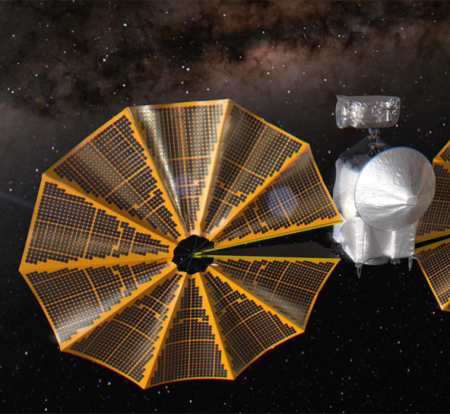
Lucy solar panel graphic
Artist’s impression of solar panel

After months of discussions, the engineering team of the Lucy asteroid probe have now scheduled the week of May 9th as when they will begin their attempt to complete the deployment of the spacecraft’ partly opened solar panel.

The team is now preparing to complete the solar array deployment in two steps. The first step, tentatively scheduled for the week of May 9, is intended to pull in most of the remaining lanyard and verify that flight results are consistent with ground testing. This step will also strengthen the array by bringing it closer to a fully tensioned state. Because this step is designed to be limited in duration, the array is not likely to latch at that point.

If this step goes as planned, the second step will continue the array deployment with the intent to fully latch. Information gleaned from the first part will help fine-tune the second. The second step is currently planned for a month after the initial one, giving engineers enough time to analyze the data seen in the first attempt.

When launched in October 2021 one of Lucy’s two large solar panels did not completely open and latch, as shown above. Though the spacecraft is presently getting 90% of its expected power, the scientists want to get the panel fully open and latched to insure it will function as planned once the spacecraft gets out to the asteroid belt, where sunlight is dimmer.

1 comment

Pushback: Baseball scout sues over COVID shot mandate that got him fired

1964 Civil Rights Act arbitrarily voided by the Washington Nationals
1964 Civil Rights Act: Arbitrarily voided by the Washington Nationals

Don’t comply: Bernard “Benny” Gallo, a major league baseball scout for the Washington Nationals has sued the baseball team for firing him when he refused for religious reasons to get COVID shots.

Gallo is being represented by the Thomas More Society, which has taken on a number of these cases and won. From the press release:

Serving his employers faithfully through the first 18 months of the pandemic, Gallo was terminated in late August 2021 after being denied a religious exemption by the baseball club. Gallo is seeking to have his firing reversed, his employment reinstated, backpay awarded, and restitution for the malicious deprivation of his rights. When dismissed by the Nationals, Gallo not only lost his livelihood and his life’s passion of working as a baseball scout, but also his elected position as Vice President of the Southern California Scouts Association, a distinction awarded him by his industry peers.

Thomas More Society Special Counsel Charles LiMandri, partner at LiMandri & Jonna LLP, explained that the Nationals instituted a mandatory COVID-19 vaccination policy on August 12, 2021. The mandate required them to have undergone vaccination by August 26. LiMandri pointed out that the Nationals’ team baseball players were not subject to this policy. MLB union members were encouraged to obtain COVID-19 vaccination, but not subject to the mandate.

“The dismissal of Mr. Gallo and the denial of his request for a religious exemption is discriminatory and unlawful,” detailed LiMandri. “The Nationals continued to employ others – including another scout – who requested and received similar accommodations for medical reasons.”

» Read more

7 comments
1 136 137 138 139 140 192