Today’s blacklisted American: Assistant principal harassed and forced to resign for rejecting school’s insistence that all whites are racists

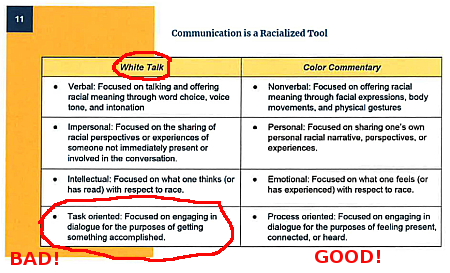
A view slide from the school's bigoted training
A view slide from the school’s bigoted training, annotated to
illustrate the program’s goals.

“Segregation today, segregation tomorrow, segregation forever!” When Emily Mais, assistant principal at Agnor-Hurt Elementary School in Virginia strongly objected to training materials being used by the Albemarle County school district that preached that only whites could be racists, and in fact all were, she found herself endlessly harassed, forced to make numerous public apologies, and eventually was forced to resign in the face of numerous insults and threats against her.

She has now enlisted the Alliance Defending Freedom to sue the Albemarle County School Board. From the first link above:
» Read more

14 comments

Planetary scientists propose next NASA boondoggle

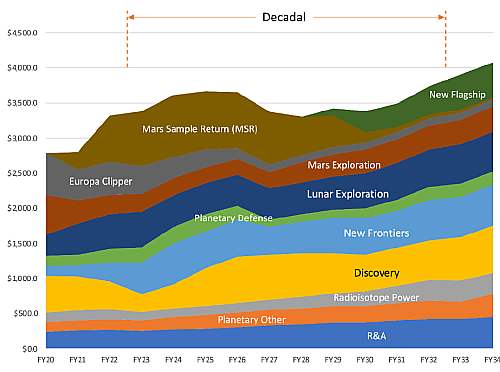
The decadal survey's fantasy about future budget allocations
Figure 22.2 from the decadal survey, outlining its fantasy about future
budget allocations.

Let me admit right off the bat that my headline above is a bit too cynical as well as a bit unfair. In releasing yesterday their decadal survey, outlining what they hope planetary missions NASA will do in the next decade, the planetary science community was mostly interested in recommending the planetary missions in the coming decade it thought would provide the best actual science.

The problem is that in recent decades, these decadal surveys, from both the astronomers and the planetary scientists, have evolved into documents designed to encourage a few big expensive missions, rather than a suite of many smaller probes to many different places. For examples, consider this quote from the article in Science describing yesterday’s announcement:
» Read more

12 comments

Spinlaunch releases video of its 7th test launch

Capitalism in space: Spinlaunch on April 18th released a video providing what it calls “an inside look” at the company’s procedures during its 7th test launch on March 22, 2022.

I have embedded the video below. Note that on this test launch, the projectile was lifted to only about 30,000 feet, which does not qualify it as a suborbital space flight. Still, the video also indicates that their test projectile not only survived the launch’s extremely high accelerations, reaching a speed of 1,200 miles per hour in mere seconds, but once it hit the ground it was in good enough shape to reuse.

The video also reveals one other interesting fact. Their mission control consisted of only two people, significantly less than the mission control staffs used by the commercial rocket companies, which are themselves significantly less that the mission control teams that NASA has used.
» Read more

9 comments

Delta testing Starlink use on its airplanes

Capitalism in space: The CEO of Delta has revealed that the airline company is testing Starlink as a method for providing its passengers internet access during flights.

Starlink officials have said they are also discussing this possibility with several airlines. It has also sought regulatory approval from the FCC, and will also need it from the FAA before officially proceeding.

The request to the FCC was made in March 2021, more than a year ago, and appears to have not yet been approved. Moreover, there have been signs that the FCC has been slow-walking other Starlink license requests. These facts, combined with the delays forced on SpaceX by the FAA, provides further circumstantial evidence that the federal bureaucracy under the Biden administration is working to block the success of Elon Musk’s space companies.

5 comments

Axiom again cancels return of manned mission due to weather

Capitalism in space: Because of continuing poor weather on Earth, SpaceX & Axiom once again canceled the planned return of manned mission yesterday.

At the moment there is no word on when SpaceX’s Endeavour capsule will undock and bring its passengers home. Since a NASA crew is preparing for launch on Saturday, April 23rd, we should expect that return to occur beforehand.

This article from Israel about the delay, which also focuses on the flight of Israeli businessman Eytan Stibbe, had this interesting tidbit:

Businessmen Stibbe, American Larry Connor of Ohio, and Canadian Mark Pathy have paid $55 million apiece for the rocket ride. The visitors’ tickets include access to all but the Russian portion of the space station. [emphasis mine]

When the Russians launched Dennis Tito and other tourists in 2000s, I am unsure if those tourists were allowed in the American portion of the station. My guess would be yes, but that would be a guess, and very easily wrong. During the two tourist flights to ISS in October and December it is also unclear if those passengers had access to the American half. Considering the competition for tourist flights that now exists, I would suspect no.

3 comments

Hubble looks at a tight cluster of five galaxies

Hickson Compact Group 40
Click for full image.

Cool image time! The photo to the right, cropped and reduced to post here, was taken by the Hubble Space Telescope to celebrate the telescope’s 32nd year in orbit. This cluster of five galaxies is dubbed Hickson Compact Group 40.

This menagerie includes three spiral-shaped galaxies, an elliptical galaxy, and a lenticular (lens-like) galaxy. Somehow, these different galaxies crossed paths in their evolution to create an exceptionally crowded and eclectic galaxy sampler.

Caught in a leisurely gravitational dance, the whole group is so crowded that it could fit within a region of space that is less than twice the diameter of our Milky Way’s stellar disk.

Though such cozy galaxy groupings can be found in the heart of huge galaxy clusters, these galaxies are notably isolated in their own small patch of the universe, in the direction of the constellation Hydra.

The red streaks in three galaxies is thought to be dust, suggesting that stars are still forming in these galaxies. The vertical galaxy on the right is seen edge on. Note too the tilted ring that appears to surround the galaxy on the left.

As for Hubble’s anniversary, the press release notes that since launch in 1990 the space telescope has made 1.5 million observations covering 50,000 heavenly objects, an archive of data available to anyone to access.

13 comments

Pushback: College that demanded professor use fake pronouns loses lawsuit, must pay him $400K

A victory for free speech

Don’t comply: When in 2018 the public college Shawnee State University in Ohio tried to force philosophy professor Nicholas Meriwether to use a student’s preferred female pronouns, even though the student was a biological male, Meriwether refused.

The school then performed “a formal investigation” which declared that Meriwether was creating “a hostile environment” for the student, simply because Meriwether refused to let that student force him to say things he disagreed with.

Shawnee State officials then placed a written warning in the professor’s file, demanding he change the way he addresses transgender students to avoid being fired or suspended without pay.

Rather than bow, Meriwether contacted the Alliance Defending Freedom (ADF), a free speech law firm focused on protecting the first amendment rights of Americans. They sued, and have now won a big victory for freedom of speech.
» Read more

3 comments

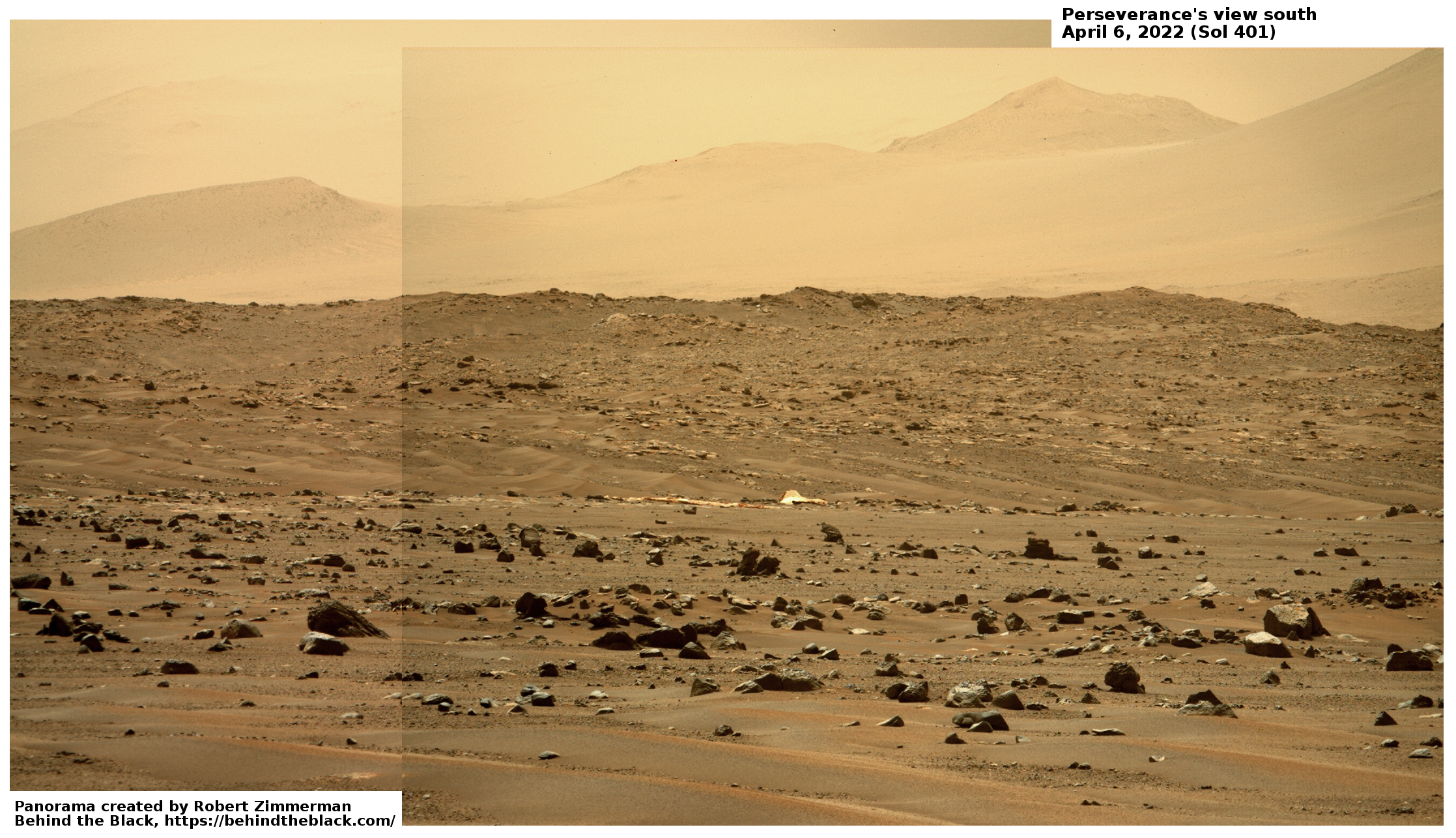
Perseverance spots its parachute

Perseverance spots its parachute
Click for full resolution. Original images found here and here.

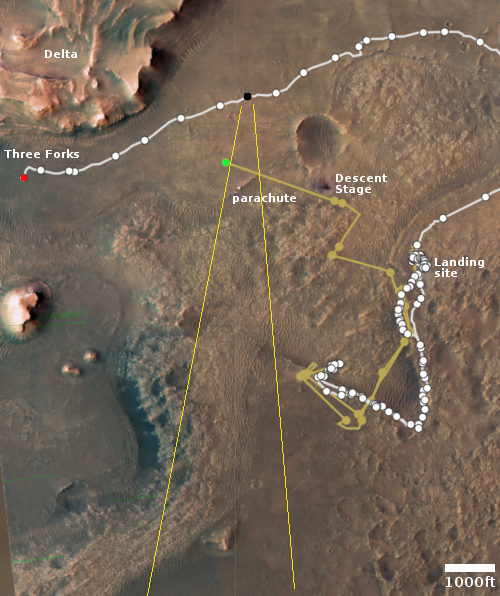
Overview map
Click for interactive map.

Cool image time! Today the Perseverance science team released two photos taken on April 6th that captured the parachute that the rover had used to land on Mars on February 18, 2021. The enhanced panorama above is from those images. The white feature near the center is the parachute. The mountains in the distance are the southern rim of Jezero Crater, about 40 miles away.

The overview map to the right gives the context. The red dot is Perserverance’s location as of yesterday, on sol 413. The black dot marks its location on April 6th, when it took the pictures. The green dot marks Ingenuity’s present position. The yellow lines indicate the approximate area covered by the panorama.

Ingenuity had not completed its 25th flight until April 8th, two days after these photos were taken, so it isn’t actually just off the edge of these photos, it is beyond the near ridgeline out of sight.

1 comment

Biden administration vows to cease anti-satellite tests

The Biden administration yesterday announced that it is prohibiting the military from conducting any further anti-satellite tests that would result in the destruction of an orbiting target satellite.

The ban is focused entirely on preventing further space junk produced by such tests.

It … is extremely limited in scope to testing of direct ascent destructive ASAT missiles — a formulation that leaves open the possibility of using such ASATs in conflict, not to mention testing and use of a host of other types of both destructive (think directed energy) weapons and those such as jammers that create temporary disruptions to functionality.

The goal appears to be to encourage other nations, such as China and Russia, to agree to their own bans. Considering the present state of world tensions, I think that is a pie-in-the-sky expectation. Both Russia and China have made it clear they are pursuing this space military capability aggressively. Neither has indicated the slightest interest in backing off.

The result? The U.S. under our bankrupt establishment leadership has once again unilaterally weakened its capabilities to protect itself, even as other hostile powers work to become stronger. And I say “once again” because this has been the pattern from Washington and Europe now for five decades. Except for outsider Trump, all western leaders have repeatedly acted as if they lived in a fantasy world of unicorns and rainbows. Consider for example Europe’s decision in the past decade to rely on Russia energy. They now find themselves at Russia’s aggressive mercy.

This decision is another example of this pie-in-the-sky approach. Since every previous American anti-satellite test had aimed at satellites already about to burn up in the atmosphere, those tests produced no space junk. Thus, banning the military’s ability to conduct such tests has done nothing to reduce future junk. All it has done is tied the U.S.’s hands, under a fantasy that acting nice will somehow get the Russians and Chinese to do the same.

12 comments

SLS launch now definitely delayed until July, at the earliest

NASA yesterday admitted that with the decision to return SLS to the vehicle assembly building (VAB) before completing its dress rehearsal countdown, it is now impossible to launch SLS in the June launch window as planned, and that the earliest the rocket could launch would be July.

This summary of the issues that dogged the rocket during the three attempts to complete that dress rehearsal illustrates the likelihood that SLS has many engineering loose ends still unresolved:

On April 3 it was malfunctioning fans on the Mobile Launcher needed to clear hazardous fumes. On April 4, it was a defective helium check valve on the Interim Cryogenic Propulsion Stage, ICPS, the Space Launch System’s second stage. On April 14, it was a hydrogen leak on the SLS first stage, or Core Stage.

Once again, having such problems during the first countdown of a new rocket is not unusual. What is questionable is only finding them now, at the very end of the rocket’s development.

I predict the launch will be further delayed until the fall, at which time NASA might face a much more serious issue regarding SLS’s two strap-on solid rocket boosters. During the shuttle era NASA had always placed a one year limit on their use once they were stacked, because it was believed that standing in a vertical position for too long could warp and distort the solid rocket fuel, thus causing it to burn improperly during launch.

These boosters were first stacked near the end of 2020, so their use-by date should have been January 2022, at the latest. Not launching until the fall will place them nine to eleven months past that date. And since these boosters are taller than the one’s used by the shuttle, they are heavier which makes extending that lifespan even riskier.

Thus, if NASA decides it must replace the boosters, that will likely delay the launch another three to six months, pushing it into ’23 at the earliest. If NASA decides to go with these boosters, it poses a real risk of failure during launch, a failure that will certainly destroy the rocket.

8 comments

Return of first Axiom commercial crew from ISS delayed

Capitalism in space: Because of iffy weather at their planned splashdown point, SpaceX and Axiom have delayed the return of Axiom’s first commercial crew at ISS so that they will splashdown tomorrow.

Weather permitting, the four-member private astronaut crew now is targeted to undock at about 10 p.m. Tuesday, April 19, to begin the journey home with splashdown off the coast of Florida no earlier than approximately 3:24 p.m. EDT Wednesday, April 20.

If weather remains an issue, the return to Earth of Endeavour could be delayed further.

4 comments
1 138 139 140 141 142 192