
Sheryl Crow – The First Cut is the Deepest
An evening pause: Performed live 2003.
Hat tip Dan Morris.
An evening pause: Performed live 2003.
Hat tip Dan Morris.
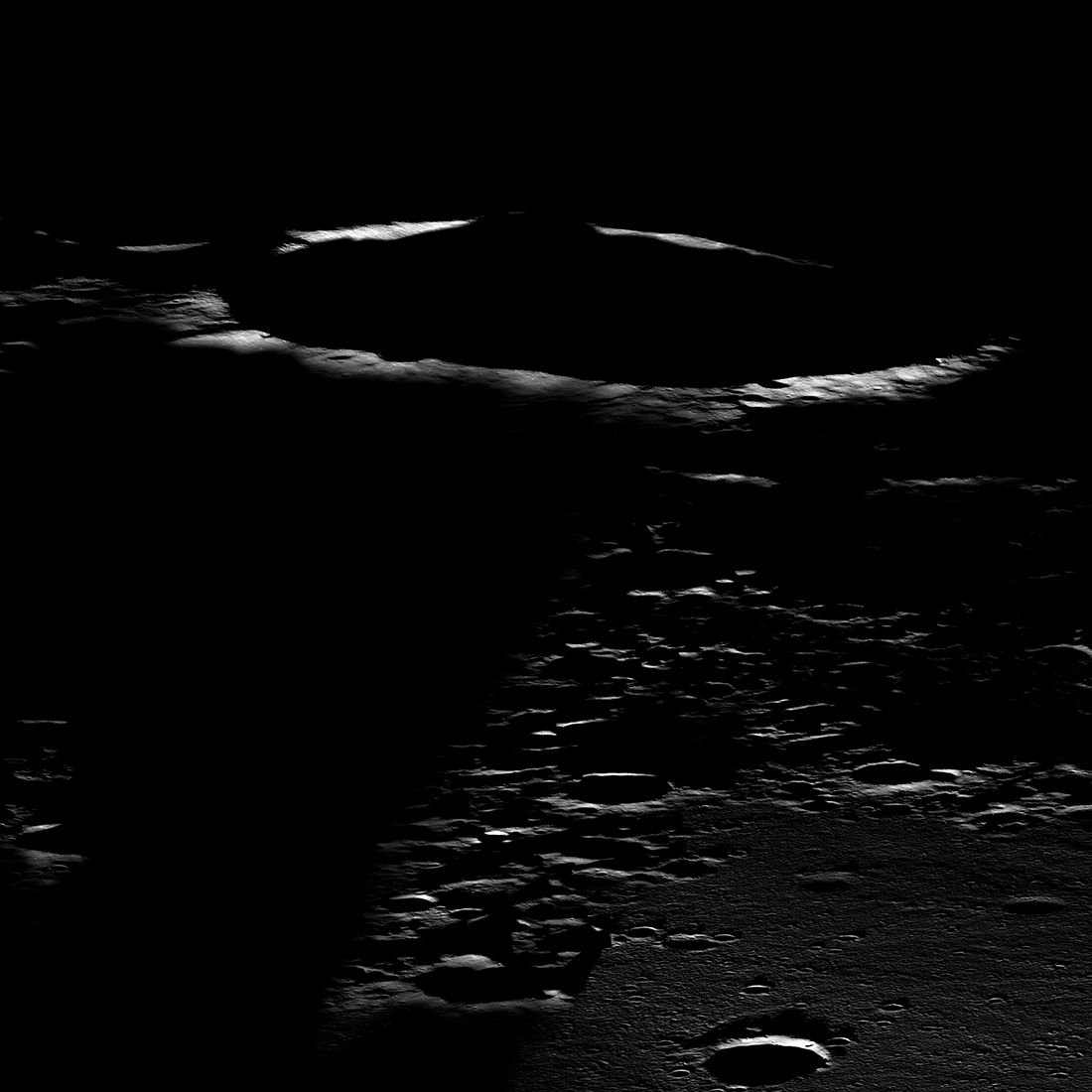
Click for full image.
Cool image time! The photo to the right, reduced to post here, was taken on August 25, 2019 by Lunar Reconnaissance Orbiter (LRO). It shows an oblique view looking west just after lunar dawn of an unnamed 13-mile-wide crater in Mare Moscoviense on the far side of the Moon. From the caption:
Mare Moscoviense is one of the few volcanic plains on the farside, which is largely comprised of ancient cratered highland terrain. The fact that the farside was strikingly different from the familiar nearside was a surprise when the Soviet Luna 3 spacecraft returned the first farside images in 1959. The highland crust is thicker on the farside than on the nearside, which is thought to have inhibited magmas from reaching the surface as frequently as they once did on the nearside.
As seen in the image above, Mare Moscoviense lies within a large impact basin, the formation of which thinned the local crust, perhaps making it easier for lavas to erupt that would have otherwise stalled below the surface. But why does this global asymmetry in crustal thickness exist? This is still a mystery, like the origins of the large-scale asymmetries observed on Mars and Mercury, though ideas like a giant impact event that stripped off a portion of the crust or asymmetric overturn of the mantle have been proposed.
Note the dark shadow obscuring the foreground on the left. It appears from the topography in the overhead map at the link that the ridgeline that marks the eastern border of Mare Moscoviense is just high enough at dawn to keep the mare in shadow while allowing the sun’s dawn light to peek over and illuminate the crater’s rim. That ridgeline however only extends so far to the north, thus allowing sunlight to hit the plains on the right sooner.

Gallegos is also participating in Wichita State’s
first Collegiate Leadership Competition
Don’t comply! In February I wrote a pushback story about Olivia Gallegos, an Hispanic conservative at Wichita State University who, when denied nomination as a candidate for the student government for daring to nominate a conservative for recognition, not only refused to take a racial sensitivity class, put together a write-in campaign and won election to the student government anyway.
Her victory also included getting the Wichita student supreme court to overturn the decision of the student government to deny her conservative student club from getting official status at the college.
It appears Gallegos did not take even these victories lying down. She followed them up by running for president of that student government, and then winning that election on April 6th. The election also saw the defeat of one of the main accusers against Gallegos who had led the charge to block the conservative student club.
As a result, Gallegos is now the leader of the student government that only six months earlier had been dedicated to censoring and blacklisting conservatives.
Gallegos did not campaign and win as a conservative, however, but as someone dedicated to “a four-point platform of transparency, financial literacy, mental health and safety.” As she said during a public town hall meeting during the campaign:
» Read more

Click for full image.
Yesterday’s Picture of the Day from the high resolution camera on Mars Reconnaissance Orbiter (MRO) revisited a captioned image first posted in February 2014 by the science team. That picture, cropped and enhanced, is to the right. From the 2014 caption:
There is a large channel system that flows into the basin, called Ladon Valles, and scientists think that the basin may have once filled with water before another channel to the north formed and drained it. These exposures of light-toned layered sediments provide clues about the environment that existed within Ladon Basin when water may have ponded and deposited these sediments.
Later research has generally concluded that these white sediments are iron and magnesium smectites, often appearing as white tuff material whose deposition is generally associated with precipitation of water or snow and its subsequent evaporation or sublimation.
» Read more
It appears that pieces of an old Long March 3B rocket, launched on February 4, 2021, have fallen in India earlier this month.
On April 2, locals of Sindewahi tehsil were shocked to see six metallic spheres, metal balls and a metallic ring falling from the sky. Similar objects fell from the sky simultaneously in parts of Maharashtra, Madhya Pradesh and Gujarat.
This is not an example of China dumping the expendable first stage of a rocket on the ground during launch. These pieces came from the rocket’s upper stage, which reached orbit in ’21 and only now fell to Earth when its orbit decayed. Usually, most of the upper stage of a rocket burns up upon re-entry. However, certain pieces, such as the inner helium tanks that keep the larger fuel and oxidizer tanks pressurized, are sometimes strong enough to survive re-entry. It is likely that these tanks are the metallic spheres.
To avoid this, the rocket’s upper stage engine needs to be fired one last time to aim the re-entry over the ocean. SpaceX does this routinely. It appears at least in this one case China did not.
Capitalism in space: SpaceX this morning successfully launched a National Reconnaissance Office surveillance satellite, using a first stage booster for the second time in only two months.
The booster successfully landed at Vandenberg Space Force base.
The leaders in the 2022 launch race:
14 SpaceX
11 China
5 Russia
2 ULA
2 Rocket Lab
The U.S. now leads China 21 to 11 in the national rankings.
UPDATE: NASA today decided to scrub a fourth attempt to complete a full dress rehearsal countdown of its SLS rocket on April 21 later this week, and roll the rocket back to the vehicle assembly building (VAB).
NASA said that its contractors, as well as its agency’s, will use the next several weeks to address problems that cropped up during the fueling tests when the SLS rocket returns to the large Vehicle Assembly Building. For example, gaseous nitrogen system supplier Air Liquide will upgrade its capabilities. NASA will also replace a faulty check valve on the upper stage of the rocket, as well as fix a leak on the mobile launch tower’s “tail service mast umbilical,” a 10-meter-tall structure that provides propellant and electricity lines to the rocket on the pad.
This situation is increasingly becoming a big problem for NASA, and the SLS rocket. After returning it to the VAB it will take several weeks to address the issues that caused the aborts on the previous attempts. If the agency then repeats the wet dress rehearsal to make sure all is well and then returns the rocket again to the VAB, it would delay the actual launch to late summer or early fall. At that point the two strap-on solid rocket boosters will have been stacked almost two years, almost twice as long as they are supposed to before launch.
The agency could attempt to roll out the rocket for a dress rehearsal, and then proceed directly to launch. That would allow the possibility of a launch in the early summer, but for that plan to work everything must work perfectly.
The many problems during the dress rehearsal were in themselves not bad marks against the rocket or program. This was a test to iron out kinks in the launch procedures, and such issues should be expected. The real problem is that these kinks during launch countdown are being worked out now, at the very end of development, rather at the beginning. They suggest that the rocket has a lot of engineering loose ends that were not thoroughly tested and worked out in development, thus increasing the likelihood of a complete failure during actual launch.
This rocket was first conceived in 2004. Its development, in fits and starts, has now been on-going for 18 years. The total cost exceeds $30 billion (not including the $20 billion or so spent on the Orion capsule). That it is not ready to launch is a striking condemnation of our entire government. The rocket was designed by Congress, and NASA’s program to build it has been costly, slow, and poorly managed, from the beginning.
As I wrote in 2011, it should have been scrapped more than a decade ago, replaced with rockets from the private sector. Had our incompetent federal government done that we would likely be launching humans to the Moon, now, and saved a lot of money in the process.
Original post:
—————-
NASA has now scheduled for no earlier than April 21, 2022 its fourth attempt to complete a SLS dress rehearsal countdown, stymied the last time by a hydrogen fuel leak.
Each delay puts further pressure on the agency’s hope of launching in June. And each launch delay puts the rocket’s solid rocket boosters farther and farther past their use-by date that officially arrived in January.
Late yesterday China’s Shenzhou descent capsule successfully brought home three astronauts from its Tiangong-3 space station after spending six months in space.return from Chinese station.
During their stay they completed two spacewalks and prepared the station for the arrival of two more large modules in the next six months.
China yesterday also used its Long March 4C rocket to launch a new radar satellite designed to observe the Earth’s atmosphere.
The leaders in the 2022 launch race:
13 SpaceX
11 China
5 Russia
2 ULA
2 Rocket Lab
The U.S. still leads China 20 to 11 in the national rankings. Note that at this moment the U.S. total is more than all other nations combined (19).
An evening pause: The animation is by Steve Cutts. It seems perfect for today, income tax day. Note that I post it as someone who does not own a smart phone and empathizes entirely with the film’s main character.
Hat tip Mike Nelson.

The Ukraine War as of April 7, 2022. Click for full map.
Since my last weekly report on the Ukraine War, so little has changed that I am not bothering posting a new map. The one to the right is from April 7th, and other than some minor changes, including the completion of Russia’s full withdrawal from the entire northern regions, the front line in the east remains essentially the same. The most recent map from the Institute for the Study of War (ISW) can be found here for comparison. In one place Russia appears to have pushed forward, while in another it has pulled back. Meanwhile, ISW reports increased Ukrainian resistance efforts in one large area.
Overall, the Russians appear bogged down, while the Ukrainians show renewed military strength.
The Institute today also published its weekly summary of the entire war situation. The most important takeaway is that it appears all negotiations between the two nations have collapsed.
Ukraine and Russia are both unlikely to advance ceasefire negotiations until the ongoing Russian campaign in eastern Ukraine develops further. The Kremlin likely seeks to capture at minimum the entirety of Donetsk and Luhansk oblasts, while Kyiv seeks to further degrade the Russian military and potentially conduct major counteroffensives.
This fact suggests strongly to me that the Ukraine has concluded its military situation is excellent, and that negotiations serve it no purpose. While Russia has been focusing its invasion effort entirely in the east in the hope it might make more gains that way, it has also made very little progress. While it continues to slowly take control of Mariupol street-by-street, the city has remained unconquered now many weeks longer than expected. This failure of Russia to quickly take the city not only ties up a large part of their military, it sows morale issues in its own army while the Ukraine resistance is enlivened by it.
The next few weeks will reveal whether Russia will be able to harness the necessary forces to make further gains in the east, or whether the Ukraine will begin to retake territory back from Russia. Right now it is difficult to predict which way the war will go.
In celebration of the fiftieth anniversary of the Apollo 16 mission to the Moon in April 1972, scientists using images from Lunar Reconnaissance Orbiter (LRO) have created a short digital visualization of the lunar surface where astronauts John Young and Charles Duke completed three different excursions across the lunar surface.
I have embedded that video below. The audio is the discussion between John Young and the capcom at mission control during the last excursion. The key moment is when John Young reaches the rim of North Ray crater, and realizes he cannot see its floor because the interior slopes are so steep.
» Read more

Click for full release image.
Cool image time! The image to the right, reduced to post here, was released today by the Space Telescope Science Institute as part of a regular program using the Hubble Space Telescope to photograph galaxies.
This observation is part of an effort to build a treasure trove of astronomical data exploring the connections between young stars and the clouds of cold gas in which they form. To do this, astronomers used Hubble to obtain ultraviolet and visible observations of galaxies already seen at radio wavelengths by the ground-based Atacama Large Millimeter/submillimeter Array.
The galaxy is estimated to be about 55 million light years away, and is thought to have a supermassive black hole at its center with a mass somewhere between 9 and 38 million times the mass of the Sun.