India buying land for new spaceport on India’s southern tip

Kulasekarapattinam

The Indian government has now acquired about 80% of the land it needs for new spaceport on that country’s southern tip.

The new spaceport will be built in Tamil Nadu’s southern region. The new spaceport at Kulasekarapattinam will have some advantages over India’s current and only spaceport at Sriharikota.

Rockets launching into polar orbit from Sriharikota, Andhra Pradesh, must perform a turn manoeuvre to avoid flying over Sri Lanka. This necessitates the use of fuel and reduces the mass that can be carried into orbit. While this has little effect on large rockets, it has a negative impact on the capacity of small rockets such as the SSLV (Small Satellite Launch Vehicle) and those built by Indian start-ups.

A launch from Kulasekarapattinam will allow for a direct flight path to the polar regions (without having to fly over and around Sri Lanka), saving fuel and payload capacity.

Sriharikota’s location is much farther north, beyond the top of the map to the right. It appears this new spaceport is aimed at attracting new private smallsat rocket companies.

0 comments

Perseverance deposits first core sample for pickup later

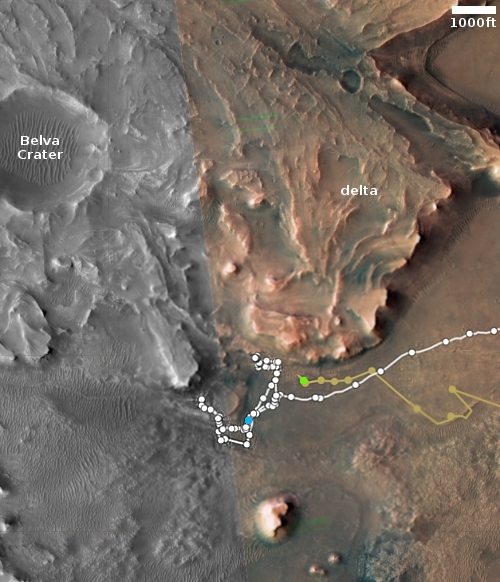
Perseverance's location December 21, 2022
Click for interactive map.

The Mars Perseverance rover has now deposited its first core sample on the floor of Jezero Crater for pickup later by a future Mars helicopter for eventual return to Earth.

A titanium tube containing a rock sample is resting on the Red Planet’s surface after being placed there on Dec. 21 by NASA’s Perseverance Mars rover. Over the next two months, the rover will deposit a total of 10 tubes at the location, called “Three Forks,” building humanity’s first sample depot on another planet. The depot marks a historic early step in the Mars Sample Return campaign.

The blue dot on the map to the right shows this location. The green dot shows Ingenuity’s present position. The red dotted line the rover’s future travel route.

0 comments

December 21, 2022 Quick space links

Courtesy of BtB’s stringer Jay.


12 comments

InSight mission ended

Location of InSight's largest quakes
The white patches mark the locations on Mars of the largest quakes
detected by InSight

NASA today announced that it has officially ended the mission of the InSight lander on Mars.

Mission controllers at the agency’s Jet Propulsion Laboratory (JPL) in Southern California were unable to contact the lander after two consecutive attempts, leading them to conclude the spacecraft’s solar-powered batteries have run out of energy – a state engineers refer to as “dead bus.”

NASA had previously decided to declare the mission over if the lander missed two communication attempts. The agency will continue to listen for a signal from the lander, just in case, but hearing from it at this point is considered unlikely. The last time InSight communicated with Earth was Dec. 15.

Other than the success of InSight’s seismometer, this project was mostly a failure. Its launch was delayed two years, from 2016 to 2018, because of problems with the original French seismometer, forcing JPL to take over. Then its German-made mole digger failed to drill into the Martian surface, causing the failure of the lander’s second instrument, a heat sensor designed to measure the interior temperature of Mars.

Fortunately the seismometer worked, or otherwise it would have been a total loss. That data has told us much about Mars and its interior.

12 comments

Webb in safe mode intermittently during the past two weeks

According to a short update today from the science team, the Webb Space Telescope went into safe mode on December 7, 2022 and was in that state “intermittently” through December 20, 2022 because of a software issue.

The James Webb Space Telescope resumed science operations Dec. 20, after Webb’s instruments intermittently went into safe mode beginning Dec. 7 due to a software fault triggered in the attitude control system, which controls the pointing of the observatory. During a safe mode, the observatory’s nonessential systems are automatically turned off, placing it in a protected state until the problem can be fixed. This event resulted in several pauses to science operations totaling a few days over that time period. Science proceeded otherwise during that time. The Webb team adjusted the commanding system, and science has now fully resumed.

It would be nice to have a more detailed description of that “software fault”, and how it affected the attitude control system. Such things can be very trivial, or they can be disastrous. NASA has a responsibility to tell the public which.

0 comments

The Wuhan panic underlines how scientists have abandoned the search for truth

Modern science
Modern science

For almost three years I have been documenting endlessly the utter failure of almost every policy imposed by politicians and government health officials in response to the COVID epidemic. From masks to social distancing to lockdowns to COVID shot mandates, none of their draconian rules have done anything to stop the spread of the Wuhan flu, which was always impossible anyway.

Even worse than these bad policies however has been the behavior of the scientific community the past three years. This community has increasingly put politics and narrative above the search for truth, a focus that signals a terrible cultural change that is so horrible its consequences can barely be measured.

To understand this tragedy we must first go back to what science and government once believed about epidemics. The traditional infectious disease policies that doctors and governments had successfully used for more than a century, based on real research and an honest appraisal of the facts by scientists, always recognized that it was impossible to “stop the spread” of a respiratory illness. What worked best was to protect the aged and sick, whom such diseases could kill, while allowing the virus to quickly spread through the rest of the healthy population in order to quickly create a herd immunity that would choke off the virus’s early most virulent strains. The disease would then mutate to milder forms — essentially a cold — that the aged and weak could fight off.

The virus of COVID-19 has done exactly this, but along the way it killed many more older and sick people then necessary, because today’s modern petty tyrants — encouraged by many scientists — decided instead to toss that past knowledge out. Herd immunity was delayed by the lockdown policies, and most governments did little to protect the aged and sick, with some governments even acting to introduce the virus to these threatened populations.

To underline the failure of these policies, here are just a small recent sampling of the growing research outlining the failures of masks, social distancing, and lockdowns:
» Read more

5 comments

The same region on Ganymede, as seen by Voyager-1 in 1979 and Juno in 2021

Ganymede compared between Voyager-1 and Juno
Click for full image.

When the Jupiter orbiter Juno did a close pass of the moon Ganymede on June 7, 2021, it took four pictures, covering regions mostly photographed for the first time by Voyager-1 in its close fly-by in 1979.

Scientists have now published the data from this new fly-by. Though Juno’s higher resolution pictures revealed many new details when compared with the Voyager-1 images from four decades earlier, the scientists found no changes. The comparison image, figure 2 of their paper, is to the right, reduced and sharpened to post here.

A flicker comparison between the registered JunoCam and Voyager reprojected mosaics revealed no apparent new impact features. Given the high albedo of fresh craters on Ganymede, with high albedo ejecta deposits two or three times the diameter of the craters themselves, we argue that new craters as small as 250 m diameter would be detectable in images at these 1 km per pixel scales. Extrapolating Ganymede cratering rates from Zahnle et al. (2003) below 1 km, the probability of JunoCam observing a new crater over 12.2 million km2 in 42 years is 1 in 1500, consistent with none being observed.

In other words, at these resolutions finding no new impacts is not a surprise.

Of the new features detected, the Juno images could see more details in the bright rays emanating from the crater Tros (in the lower center of both images), and thus found “…terrain boundaries previously mapped as ‘undivided’ or as ‘approximate’, several large craters, and 12 paterae newly identified in this region.”

Paterae resemble craters but are thought to be a some form of volcanic caldera. Their geological origin however is not yet completely understood.

The paper’s conclusion is actually the most exciting:

The insight gained from this handful of images makes it likely in our opinion that new observations from the upcoming JUICE and Europa Clipper missions will revolutionize our understanding of Ganymede.

3 comments

SpaceX and the Ukraine resolve funding issues for Starlink terminals

According to a Ukrainian official, the Ukraine has worked out a method to pay for another 10,000 Starlink terminals by obtaining funding from several European nations.

Ukraine’s deputy prime minister Mykhailo Fedorov has announced that over 10,000 additional Starlink terminals will be sent to Ukraine in the coming months, confirming that issues regarding how to fund the country’s critical satellite internet service have been resolved.

The governments of several European Union countries are ready to share payment said Fedorov (who is also Ukraine’s minister for digital transformation) in an interview with Bloomberg, affirming that “As of now all financial issues have been resolved.” Fedorov did not publicly identify which governments are contributing towards the payments but confirmed that there’s currently no contract in place and that Ukraine will need to find additional funding by spring 2023.

Elon Musk had threatened to end Starlink support without some form of payment. It appears his threat, which was almost immediately retracted, forced some action by these governments.

1 comment

Kepler’s first discovered exoplanet is spiraling into its aging star

Measurements of the orbit of first exoplanet discovered by the Kepler space telescope have determined that its orbit is very slowly shrinking, and that it will eventually spiral into its aging sun.

In the case of Kepler-1658b, according to the new study, its orbital period is decreasing at the miniscule rate of about 131 milliseconds (thousandths of a second) per year, with a shorter orbit indicating the planet has moved closer to its star.

Detecting this decline required multiple years of careful observation. The watch started with Kepler and then was picked up by the Palomar Observatory’s Hale Telescope in Southern California and finally the Transiting Exoplanet Survey Telescope, or TESS, which launched in 2018. All three instruments captured transits, the term for when an exoplanet crosses the face of its star and causes a very slight dimming of the star’s brightness. Over the past 13 years, the interval between Kepler-1658b’s transits has slightly but steadily decreased.

The scientists think tidal forces are causing the orbit to shrink. The star itself is old and beginning to expand as it evolves towards its own stellar death.

1 comment

ISS spacewalk postponed because controllers had to maneuver station to avoid space junk

An American spacewalk to install new solar panels to ISS yesterday was suddenly scrubbed when ground controllers identified a piece of space junk that was going to fly within a quarter mile of the station.

While flight control teams were preparing for today’s U.S. spacewalk, updated tracking data on a fragment of Russian Fregat-SB upper stage debris showed a close approach to station. Based on this new data, flight control teams directed the crew to stop spacewalk preparations as the ground team stepped into procedures to perform a Pre-Determined Debris Avoidance Maneuver (PDAM.)

Russian controllers successfully used the engines on a docked Progress freighter today to complete the avoidance maneuver, firing those engines for 10 minutes and 21 seconds.

It appears the station was never in any danger.

1 comment
1 3 4 5 6 7 192