Tom Jones & Helene Fischer – Sexbomb
An evening pause: Performed live 2020, probably early in the year before the Wuhan panic struck.
Hat tip Tom Wilson.
An evening pause: Performed live 2020, probably early in the year before the Wuhan panic struck.
Hat tip Tom Wilson.
Courtesy of Jay, BtB’s stringer. All the links today have to do with the Soyuz capsule that is leaking on ISS.
The data was conveying information about the Soyuz leak. The words used by Dmitry Strugovets, the former head of Roscosmos press service, to describe the failure are not safe for this website. :)
The second link provides a description of the cooling system that is leaking. It appears the leaking material could be water, or “Isooctan LZ-TK-2”.
That next Soyuz, dubbed MS-23, is scheduled for a March launch, with a crew. If the capsule is sent empty, Russia would use the next Soyuz, MS-24 for that mission.

Click for full image.
Cool image time! The photo to the right, cropped, reduced, and sharpened to post here, was taken on November 1, 2022 by the high resolution camera on Mars Reconnaissance Orbiter (MRO). It shows what the scientists label a “layered butte.” Like the mesas in the American southwest, those layers, or terraces, mark the geological history of this place, where over time layer upon layer was placed down, and then eroded away except for this mesa.
What makes the mesa even more intriguing and strange, however, are surrounding concentric cracks and the moat at the mesa’s base. These features suggest that at some point the ground below the mesa collapsed so that the entire mesa dropped, as a unit.
What could cause this? The overview map below provides a clue, though certainly not an answer.
» Read more

Today’s blacklisted American: When a chapter of the Federalist Society at the University of Kansas Law School scheduled an event featuring a speaker from the Alliance Defending Freedom (ADF), a pro-speech legal firm that has won many cases at the Supreme Court, the school’s “Diversity, Equity, Inclusion, and Belonging Committee” falsely claimed ADF promoted “hate speech”, and two members of the school’s faculty then tried to get the chapter to cancel the event.
The story of what happened are outlined in detail by a justice of the Kansas Supreme Court, Caleb Stegall, in his resignation letter [pdf] in protest of the college’s unwillingness to defend the principle of free speech and open debate. As he wrote, first the law school administrator called a meeting with chapter’s board of students:
» Read more
For the first time scientists have used the microphone on the Mars rover Perseverance to successfully record the sound of dust devil as it flowed overhead.
I have embedded a video of the recording below. The research paper can be read here.
Dust devils on Mars, while much less dense in its very thin atmosphere, are generally much larger than found on Earth.
The dust devil recently detected by Perseverance was 25 meters wide and 118 meters tall (82 feet by 387 feet), putting it squarely in the average zone in terms of size for Martian dust storms. But they can grow much bigger, too, as dust on Mars can be whipped up in huge global dust storms.
The data also picked up the sound of dust particles hitting the microphone, which will allow the scientists to measure the density of the devil.
» Read more
Arcom, the French television regulation agency, yesterday ordered the communication satellite company Eutelsat to stop allowing three Russian channels from broadcasting using the satellites.
In a news release, Arcom said the television stations’ coverage of Russia’s war in Ukraine “include repeated incitement to hatred and violence and numerous shortcomings to the honesty of the information.” Eutelsat said in a brief statement that “it will no longer be involved in the broadcasting of the three sanctioned channels within the prescribed time-frame.”
Arcom’s decision comes a week after France’s top administrative court, prompted by a request from the Paris-based Reporters Without Borders advocacy group, ordered Arcom to review an initial decision to permit Eutelsat to continue carrying the stations.
Arcom’s claim, that it made this order because of the content of the broadcasts, is another example of the blacklisting/censorship culture we now live in. The French regulators could have simply stated that, as an ally of the Ukraine in the Russian-Ukraine war, it does not want French-regulated satellites to provide aid to the Russian side. There is a war going on, and this alone is a rational reason to block the Russian channels.
Instead, Arcom uses censorship as its justification. It doesn’t like what the Russians are saying, and therefore has the right to censor them. Remember this argument, because in the future Arcom will likely use it again, but next time against any one of the other broadcast channels under its control that simply says something it doesn’t like.
Using its Long March 2D rocket, China last night successfully launched a classified remote sensing satellite into orbit.
The launch was from an interior spaceport. No word on where the first stage crash-landed.
The leaders in the 2022 launch race:
59 China
56 SpaceX
21 Russia
9 Rocket Lab
8 ULA
The U.S. still leads China 80 to 59 in the national rankings, but now trails the entire world combined 90 to 81.
Though SpaceX led China in successful launches for most of the year, China historically tends to do a lot of launches in the November-December time period. This is why it has surged ahead in the past month. SpaceX can still catch up, however, as it still has five launches planned for 2022. Either way, we will not know who comes out ahead until probably the end of the year.
That a private American company however has even a chance of beating out the entire world in annual launches is quite remarkable, whether or not SpaceX ends up ahead.
Embedded below the fold in two parts.
To listen to all of John Batchelor’s podcasts, go here.
» Read more
A spacewalk today was cancelled when it was suddenly noticed that some unknown substance was leaking from one of the Soyuz manned capsules docked to ISS.
During preparations for this evening’s planned spacewalk by Roscosmos cosmonauts Sergey Prokopyev and Dmitri Petelin, ground teams noticed significant leaking of an unknown substance from the aft portion of the Soyuz MS-22 spacecraft docked to the Rassvet module on the International Space Station. The spacewalk has been canceled, and ground teams in Moscow are evaluating the nature of the fluid and potential impacts to the integrity of the Soyuz spacecraft, which carried Prokopyev, Petelin, and NASA astronaut Frank Rubio into space after launching from the Baikonur Cosmodrome in Kazakhstan on Sept. 21.
The big question is whether this leak will impact the capsule’s function as a lifeboat or a return vehicle for the three astronauts it brought into space. If so, then an empty manned capsule needs to be launched, either by the Russians or SpaceX, though if the latter someone would have to pay the cost.
An evening pause: There are endless and wonderful ways to make a living. This is just another example.
Hat tip Cotour.
Courtesy of stringer Jay, whose help is making BtB much better.
This 747 (configured to be an astronomy telescope) was always too costly for the relatively small amount of research it could produce.
This increases the chance that this much delayed lunar lander will actually launch in 2023.
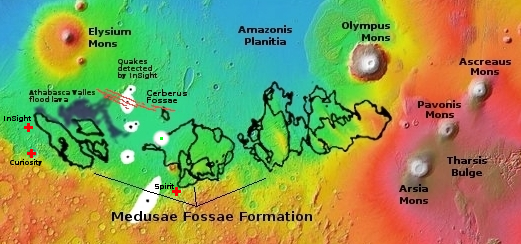
Though news of the largest quake so far detected by InSight on Mars, magnitude 4.7, was released in May, this week the science team published two papers describing the quake itself and what they have learned from it. From the press release:
The waves from the record-breaking quake lasted about 10 hours — quite a while, considering no previous Marsquakes exceeded an hour.
It was also curious because the epicenter was close to but outside the Cerberus Fossae region, which is the most seismically active region on the Red Planet. The epicenter did not appear to be obviously related to known geologic features, although a deep epicenter could be related to hidden features lower in the crust.
Marsquakes are often divided into two different types — those with high-frequency waves characterized by rapid but shorter vibrations, and those of low-frequency, when the surface moves slowly but with larger amplitude. This recent seismic event is rare in that it exhibited characteristics of both high- and low-frequency quakes. Further research might reveal that previously recorded low- and high-frequency quakes are merely two aspects of the same thing, Kawamura said.
The green-dotted white patch on the map above marks the approximate location of this quake, east of where most of the previous larger quakes have been detected and under the Medusa Fossae Formation of volcanic ash. That no surface features appear to correspond to this quake, it is thought it was the result of a shift of underground features.
The first launch of China’s Zhuque-2 rocket, built by the pseudo-private company Landspace, ended in failure today when the upper stage had problems after separation of the first stage.
Apparent spectator footage posted on Chinese social media showed the rocket ascending into clear skies, trailed by white exhaust. While the first stage is understood to have performed well, separate apparent leaked footage suggests that issues affecting the rocket’s second stage resulted in the failure of the mission.
Data suggest an expected burn of the stage’s vernier thrusters, intended to carry the stage and payloads into orbit after a burn by the main engine, did not occur as planned.
If this launch had been successful, it would have made the Zhuque-2 rocket the first rocket to reach orbit using methane as a fuel, beating three different American companies, SpaceX, Blue Origin, and Relativity.
Relativity has been preparing for the first launch of its Terran-1 rocket since October, with a goal of launching before the end of the year. At the moment however no launch date is set, though the company’s CEO seems confident it will launch soon.
In addition, SpaceX has also been targeting the first orbital launch of its Starship/Superheavy rocket by the end of this year. As with Relativity, no launch date has been set.
The first launch of Blue Origin’s New Glenn rocket meanwhile is nowhere in sight, as yet. It was originally supposed to launch in 2020, but even now has four launches scheduled on its manifest for 2023. None however have been scheduled, and the first launch will likely slip to late in the year, if that soon.

They’re coming for you next: Librarians across America — the same ones running drag queen storybook hours with little kids — are routinely blacklisting television actor Kirk Cameron from doing his own library event reading his own book, As You Grow, because it tries to teach children traditional Judeo-Christian values.
It is common for community libraries to run story-hour programs for kids and parents that correspond with the release of a new book. In recent years, libraries have come under fire for promoting drag queens and other LGBTQ+ centric story hours for young children. It now appears to be the case that those same libraries, which are largely funded by taxpayers, have decided there is no space in their programming lineups for more traditional and faith-based titles.
Cameron’s book, As You Grow, ‘teaches biblical wisdom and the value of producing the fruit of the spirit: love, joy, peace, patience, kindness, goodness, gentleness, faithfulness, self-control,’ according to the author.
You can buy Cameron’s book here.
» Read more

Click for original image.
Click for interactive map.
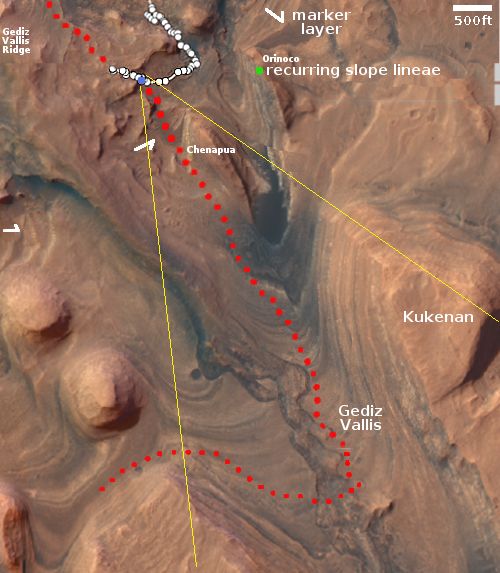
The panorama above was taken by Curiosity’s right navigation camera today, December 14, 2022, looking down into Gediz Vallis, the giant slot canyon that the rover will use as its route up Mount Sharp.
The red dotted lines above and on the overview map to the right indicate approximately the planned route for Curiosity. The yellow lines indicate the approximate area covered by the panorama above.
At present the scientists are attempting to drill into the marker band on which Curiosity sits. This marker layer is visible at many places at about the same elevation on all sides of Mount Sharp’s flanks. The white arrows indicate other examples of it in this overview map. It generally appears smooth and flat, which suggests it is made of a harder substance more resistant to erosion. That hardness was confirmed when Curiosity’s first drill attempt into it last week failed. The scientists are now trying again.

Click for full image.
The image to the right, cropped and reduced to post here, was taken on July 5, 2022 by one of the infrared instruments on the Jupiter orbiter Juno of the moon Io, known for having many many active volcanoes.
This infrared image was derived from data collected by the Jovian Infrared Auroral Mapper (JIRAM) instrument aboard Juno. In this image, the brighter the color the higher the temperature recorded by JIRAM.
Each bright spot is an active volcano, some of which have been in the past photographed during eruptions. In fact, the first such photo was taken in March 1979 by the Voyager-1 spacecraft just after its fly-by of Jupiter, and was the first time any active volcano outside of Earth had ever been identified.
What made that discovery more profound was that only a week earlier scientists had published a paper predicting active volcanoes on Io, caused by the strong tidal forces from Jupiter’s gravity.
Since then planetary scientists have been studying Io’s volcanism repeatedly, tracking the evolution of specific volcanoes over time as they erupt and then become dormant.
The U.S. Space Force has now partnered with a new South Korean Air Force space division to jointly monitor the space-based and military actions of North Korea, including its increasingly aggressive missile testing program.
From the first link:
[Brig. Gen. Anthony Mastalir, commander of the U.S. Space Forces Indo-Pacific.] later told reporters the unit will undergo analysis in the coming months to assess its mission capabilities and said it is interested in holding discussions with South Korea regarding specific future missions, like missile warning and defense.
The new unit is expected to help monitor, detect and trace projectiles from the North and elsewhere in an operation likely to reinforce overall deterrence capabilities of the South Korea-U.S. alliance, observers said.
This new office really isn’t anything new, simply the renaming and reshuffling of the military bureaucracy from the American Air Force to the Space Force. The military has been present in South Korea since the Korean War in the early 1950s, monitoring North Korea. All that has really changed is North Korea’s growing ability to launch missiles, thus changing the focus of that monitoring, combined with South Korea’s recent effort to accelerate its own space effort, both civilian and military.
According to press reports in the United Arab Emirates (UAE), that country is negotiating with NASA and Boeing on a partnership to build an airlock module for NASA’s Lunar Gateway Moon space station.
US aerospace company Boeing said it has held discussions with Emirates officials about the UAE providing an airlock module on the Lunar Gateway. This is an airtight room that astronauts would use to enter and exit the space station.
John Mulholland, vice president and International Space Station programme manager at Boeing, told The National that the company was “actively working” with the UAE on the concept and design.
It appears the UAE is offering to pay Boeing to build it for NASA, and would expect in exchange a larger share in the use of the station.
If this deal works out, the UAE will essentially replace Russia as a Gateway partner. Russia had signed an agreement with NASA in 2017 to build that airlock, but that deal is now null and void following the Russian invasion of the Ukraine and its desire to partner with China instead.
For the U.S., this is a win-win, since it will now be an American company building the airlock, not Russia.
Rwanda and Nigeria have become the first two African nations to sign te Artemis Accords, bringing the number of signatories to this American-led alliance to 23.
Neither Nigerian nor Rwandan officials described in detail any plans to participate in Artemis at the signing ceremony, but at the Secure World Foundation event, a State Department official said that is not a condition for signing the Accords.
“We continue to encourage all responsible spacefaring nations to sign the Accords, and we also encourage countries that are just developing their space sector to also consider signing,” said Kristina Leszczak of the State Department’s Office of Space Affairs. “We stress that interested countries do not need to come to the table with existing space capabilities or even near-term plans to contribute to Artemis. We find this opens the conversation up to a much more diverse group.”
The full list of signatories so far: Australia, Bahrain, Brazil, Canada, Columbia, France, Israel, Italy, Japan, Luxembourg, Mexico, New Zealand, Nigeria, Poland, Romania, Rwanda, Saudi Arabia, Singapore, South Korea, the United Kingdom, the United Arab Emirates, the Ukraine, and the United States.
The accords, bi-lateral agreements between each nation and the U.S., were designed during the Trump administration to emphasize the rights of private investors in space and thus do an end-around of the Outer Space Treaty. Under the Biden administration it is no longer clear if that remains the goal. The existence of a signed alliance led by the U.S. and the capitalistic west however gives the U.S. the political force to protect those rights, assuming the American government is interested in the future in doing so.
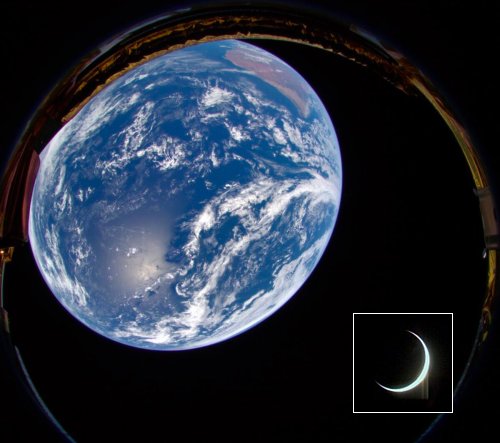
Go here and here for original images.
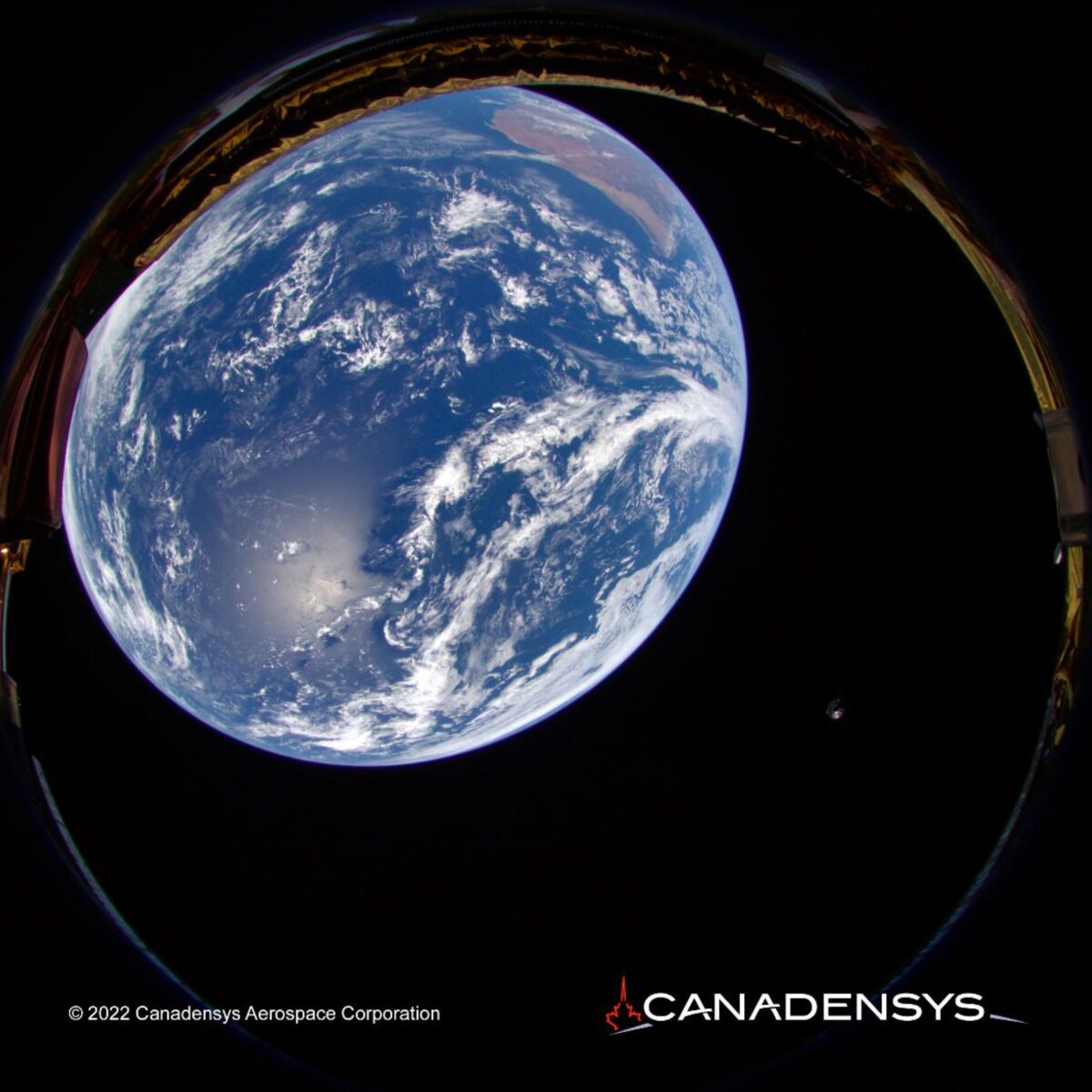
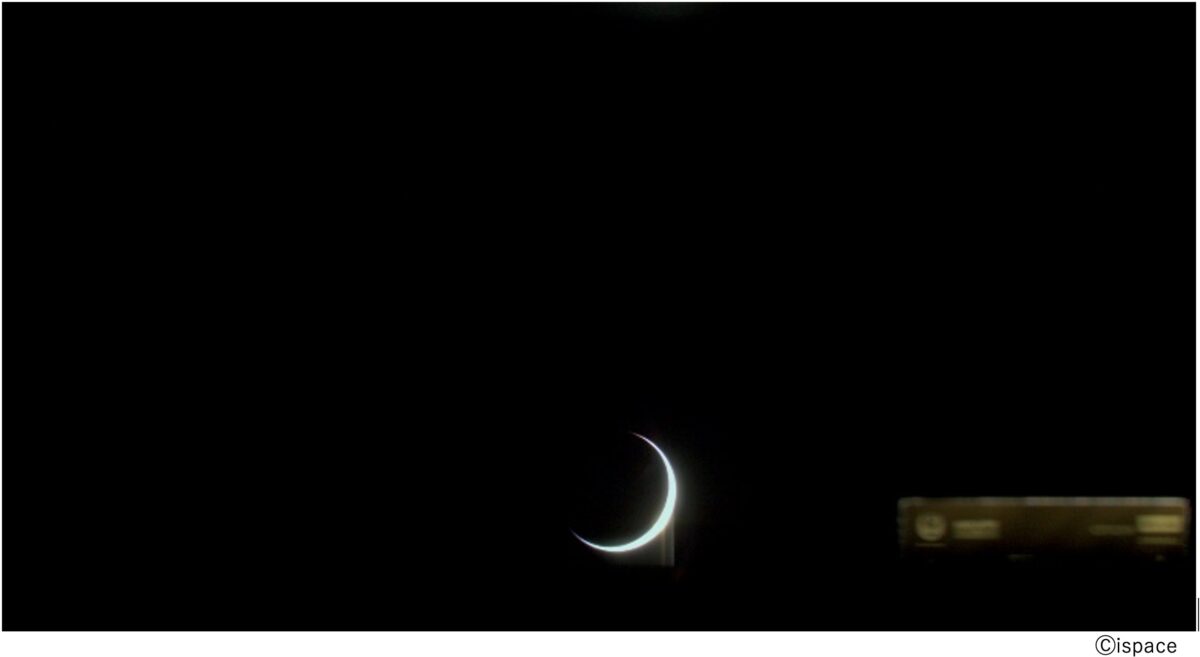
The private Hakuto-R lunar lander, owned and built by the Japanese-based company Ispace, is operating as planned and has sent back its first images from two different cameras.
The larger image to the right was taken by a camera on one of Canada’s payloads. It shows the Earth two minutes after launch, with the rocket’s upper stage acting as a frame. The inset, reduced to insert here, was taken 19 hours after launch by the lander’s main camera, and shows the Earth at night. Both images demonstrate that the spacecraft is stable and functioning perfectly.
The goals of the mission remain mostly engineering. Its focus is demonstrating first that Ispace’s lander can do what it says so that future customers will be confident buying payload space. Similarly, the payloads, such as the UAE’s Rashid rover, are doing the same thing.