Russia launches three astronauts to ISS; China launches Earth observation satellite

Russia today successfully used its Soyuz-2 rocket to launch three astronauts to ISS, two Russians and an American flying as part of the NASA-Roscosmos barter deal whereby each agency flies an astronaut from the other in order to make sure everyone knows how to use each other’s equipment.

China in turn today used its Long March 2D rocket to launch an Earth observations satellite into orbit.

The leaders in the 2022 launch race:

42 SpaceX
38 China
12 Russia
7 Rocket Lab
5 ULA

American private enterprise still leads China 58 to 38 in the national rankings, and is now tied with the entire world combined at 58.
0 comments

InSight’s power level holding steady

InSight's on-going power levels

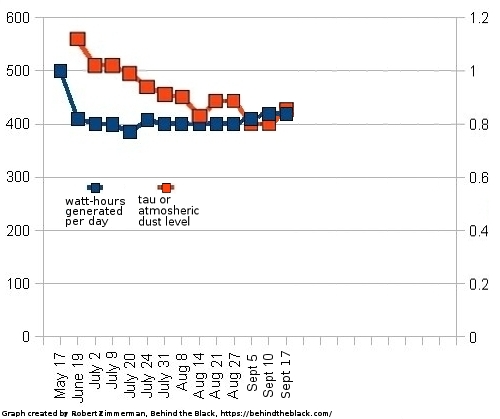
The Energizer bunny of Mars, the InSight lander, continues to hold on. The engineering team tonight issued another status report, as shown in the graph to the right. For the past week the lander continued to produce 420 watt-hours per day, even though the tau level of dust in the atmosphere increased from 0.8 to 0.85.

The tau level of dust outside of the winter dust season is normally between 0.6 and 0.7. Even though Mars is moving out of winter, that level has increased slightly above InSight. And yet, even with a higher dust content and thus less sunlight, the lander’s dust-covered solar panels are generating power, at a very slightly higher level.

The InSight team had expected the lander to die in early September, at the latest. Instead, it keeps running, thus allowing it to detect on September 5th an impact created by a cluster of three asteroids, the first time scientists have ever pinpointed exactly when such a new impact occurred on Mars.

For the lander to survive for even longer, all it needs is one gust of wind across the solar panels to clean them off. The science team had expected this to happen periodically, based on past experience with the Spirit and Opportunity rovers. Unfortunately for InSight, it has not yet happened even once since it arrived on Mars in 2018. Nonetheless, it only has to happen once to save the lander.

Stay tuned. All is not yet lost.

2 comments

September 20, 2022 Quick space links

Courtesy of BtB’s stringer Jay, trolling Twitter so I don’t have to.

0 comments

Jupiter’s endless interweaving storms

Jupiter's endless interweaving storms

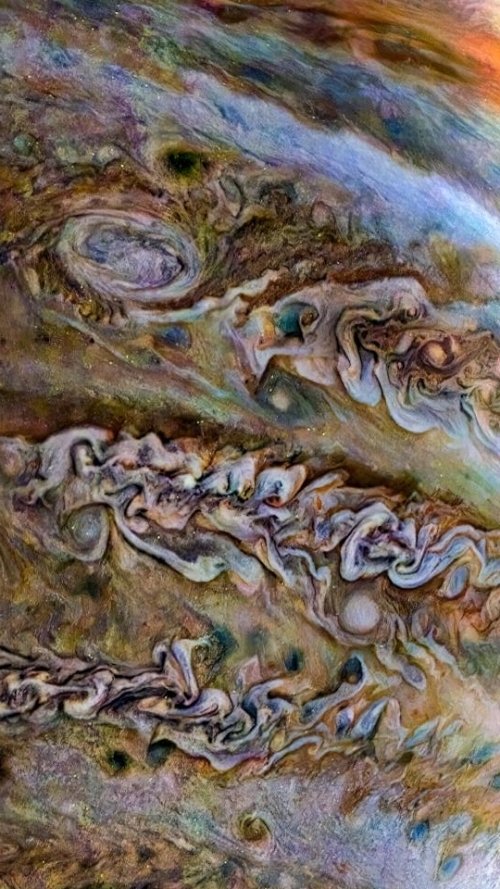
Cool image time! The photo to the right, rotated so that north is up and then reduced slightly to post here, was created by citizen scientist Thomas Thomopoulos from a raw photo taken by Juno during its 44th orbit of Jupiter.

To bring out the details Thomopoulos enhanced the colors, then enlarged the entire photo and cropped the area of interest.

Unfortunately, the Juno team that releases these photos does not provide information for easily establishing scale. In an email to me Thomopoulos noted that the largest circular storm in the northern half of the image is likely a vortex, which on Jupiter tend to range from 600 to 3,500 miles in diameter. He also noted that Juno was a little less than 27,000 miles away from Jupiter when this photo was snapped on August 17, 2022. Thus, I suspect this particular vortex sits on the larger end of that size range, which makes it a little less than half the size of the Earth.

As for the colors, as with many similar Juno images, the white clouds appear to almost always sit at the top of these storms and jets, almost like thunderheads.

Though the largest feature here is that large vortex to the north, most of the gigantic Jupiter storms visible seem instead to form as bands, the storms churning about madly as they are driven along the gas giant’s very fast ten hour rotation period.

2 comments

Today’s blacklisted American: Republicans and conservatives increasingly unwilling to talk to pollsters out of fear

Joe Biden's
Joe Biden’s anti-conservative rally on September 1, 2022

Blacklists are back and the Democrats have got ’em: According to pollsters, the vicious almost slanderous attacks by President Biden against Republicans and conservatives — following decades of similar harsh language from Democrats nationwide — is causing these voters to increasingly refuse to talk to pollsters about their opinions.

In a Twitter thread, Trafalgar Group chief pollster Robert C. Cahaly said that President Joe Biden’s recent attacks on so-called “MAGA Republicans” will make polling supporters of former President Donald Trump even harder to poll than in previous years. Cahaly pointed out that in the last two presidential election cycles, name-calling and threats from prominent Democrats contributed to the phenomenon of the “shy Trump voter.” But as the 2022 midterms have begun in earnest, Biden’s escalating rhetoric against Trump supporters, accusing them of embracing “semi-fascism” and being a threat to America, will make these voters even harder to reach in polling.
» Read more

22 comments

NASA releases new overall objectives for exploration of solar system

NASA today released a new roadmap for its goal of exploring the Moon, Mars, and the rest of the solar system, with the goal of providing an overarching strategy for everything it hopes to accomplish.

The resulting revised 63 final objectives reflect a matured strategy for NASA and its partners to develop a blueprint for sustained human presence and exploration throughout the solar system. They cover four broad areas: science; transportation and habitation; lunar and Martian infrastructure; and operations. The agency also added a set of recurring tenets to address common themes across objectives.

You can read the full document here [pdf].

The most astonishing thing about this roadmap is its utter lack of any mention of race or gender, especially when one considers how obsessed the Biden administration and its minions in federal bureaucracy have been over such things. The goals are entirely focused on exactly what they should be focused on, exploration and research, with the goal of partnering with as many private and governmental entities as possible to get it done in the most efficient way.

2 comments

The strange scattered rocks of Gediz Vallis on Mars

The strange rocks of Gediz Vallis
Click for full image.

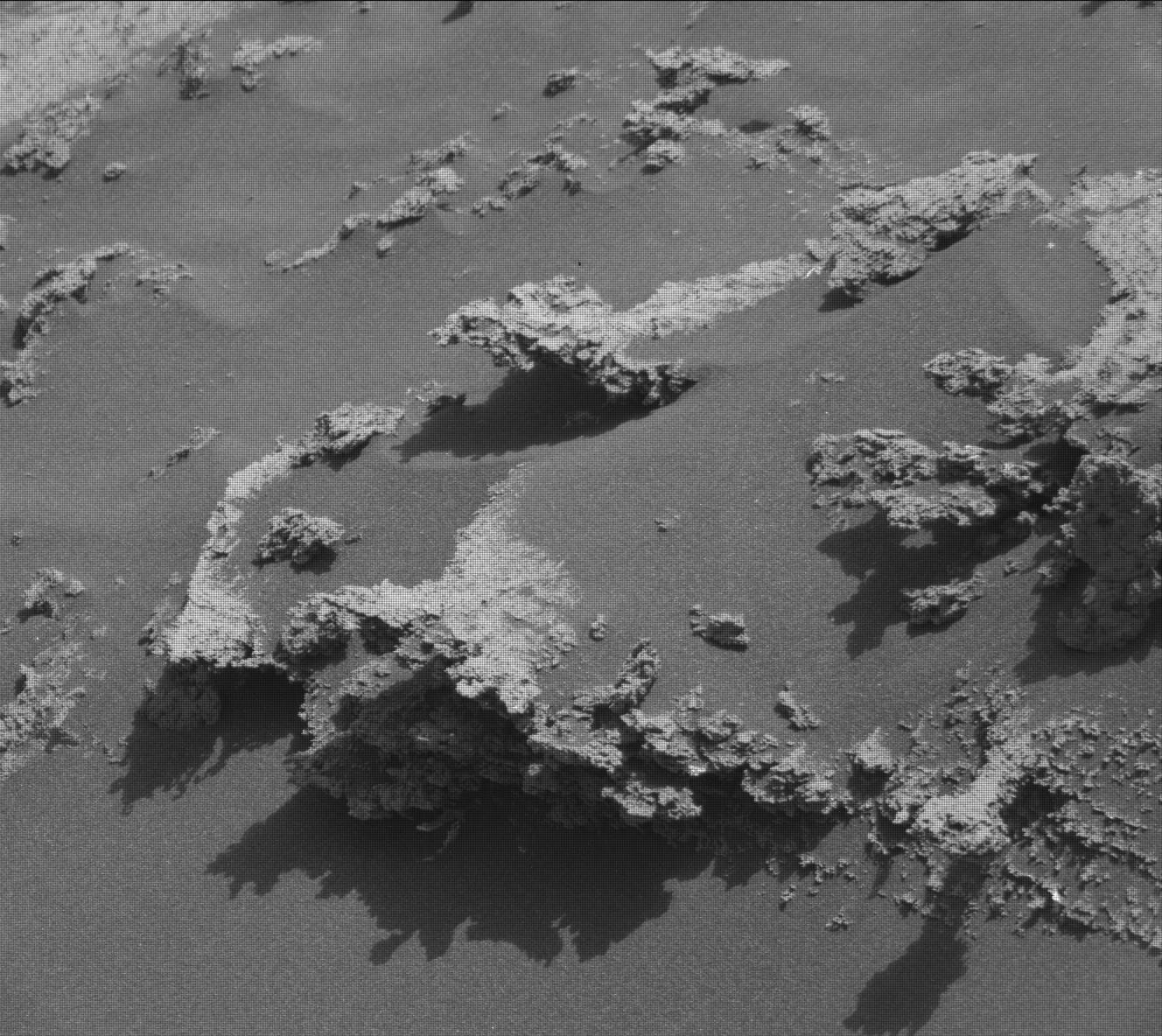
Cool image time! The photo to the right, reduced to post here, was taken on August 20, 2022 by Curiosity’s high resolution camera. It shows some of the scattered and very delicate rocks that it is finding on the floor of Gediz Vallis, the valley the rover had been striving for since landing more than a decade ago and finally entered in mid-August.

Because of Mars weak gravity, about 39% of Earth’s, and very thin atmosphere, about 1% of Earth’s, it is possible for surface rocks to erode into such delicate shapes. The shapes appear to be further encouraged by the many layers that exist in Mars, with each layer having different characteristics. In the case of the hanging flakes to the right, these layers were more resistant to erosion and thus remains intact while material above and below was slowly blown away.

0 comments

Researchers develop strongest-yet 3D printed titanium

Capitalism in space: Researchers at Monash University in Australia have successfully developed a 3D printed titanium alloy that has an internal strength exceeding that of normal commercially produced titanium.

In tests, the team demonstrated that the new titanium alloy had both elongation and tensile strengths (stretching and tension, respectively) of over 1,600 MPa. For reference, most commercial titanium alloys top out at around 1,000 MPa. This is also the highest specific strength for any other 3D-printed metal alloy, the team says.

Since 3D printing is going to be the main industrial manufacturing process in space, this process and the titanium it produces is certainly going to looked at with great interest by those who wish to build things in space. Imagine having a 3D printer that can make strong titanium parts in almost any needed shape. The possibilities are endless.

5 comments

First meeting of all 21 nations who have signed Artemis Accords

For the first time yesterday, the 21 nations who have signed the Artemis Accords gathered together in a single meeting during the International Astronautical Congress being held in Paris this week.

The article at the link comes from the UAE’s state-run press.

Sarah Al Amiri, Minister of State for Public Education and Advanced Technology and chairwoman of the UAE Space Agency, attended the signatories’ meeting on behalf of the UAE. “During this meeting, heads of space agencies discussed future plans in the industry to ensure the safety of humans and deconfliction of activities on the Moon, as well as the importance of the Accords to emerging space nations,” she said.

Since the U.S. is the lead nation in these accords — with all signatories becoming participating partners in its Artemis program to settle the solar system — U.S. government policies will dominate any discussion. When the Trump administration established the Artemis Accords, a major goal was to establish property rights in space for private companies. Under Trump, the U.S. would have thus certainly exercised its power to make sure that was the goal.

With the Biden administration in charge, it appears the focus has shifted — for good intentions — to promoting international cooperation, which means the goals of our other international partners appear more dominant. Under Biden, the U.S. appears willing to allow these other countries to propose policy. Should this happen, I guarantee the opportunities for private enterprise as well as the freedom for future space generations will not be as promising.

1 comment

Astrobotic to build solar power grid for use by others on Moon

Astrobotic's proposed lunar electric grid

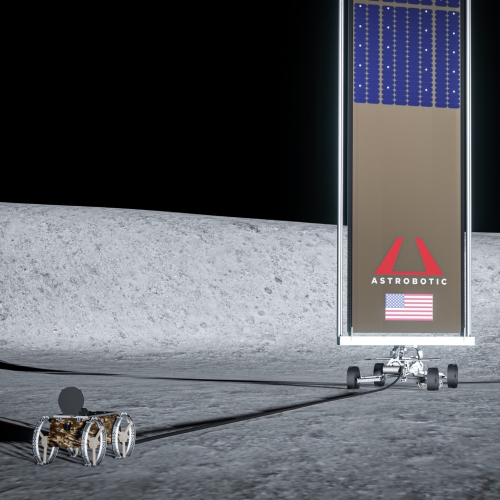
Capitalism in space: Astrobotic yesterday announced its plan to build a solar power system on the Moon, using its rovers, thus reducing the weight and cost of other projects.

The graphic to the right illustrates how the system will work. First, vertically deployed solar panels, attached to a small rover, will unfold to produce power. These can be placed in many locations, thus providing each location a source of electricity. Second, an additional rover will be linked to the panel, providing power storage and a moveable wireless charger for transferring power to a customer’s equipment.

Astrobotic plans to begin deploying and demonstrating LunaGrid elements as early as 2026 with the goal of the first operational LunaGrid by 2028 at the lunar south pole. With LunaGrid power service available, a host of science, exploration, and commercial activity can begin sustained and continuous operation.

The biggest advantage of this proposed grid concept is its scalability. To provide more power Astrobotic need only send more panels to a location. The more the merrier. And all can be built in an assembly-line manner, thus making construction very cheap and efficient.

1 comment

Some scientists make educated guess as to the number of ants on Earth

It’s time for junk science! By combing through thousands of research papers, a team of scientists have estimated the Earth’s population of ants numbers approximately 20 quadrillion.

So for the work, researchers combed through 12,000 reports from databases in many languages, including Bulgarian and Indonesian, finding 489 studies with rigorous enough methods of collecting and counting ants to be included. Most of the studies were not focused on ants per se but on larger questions of biodiversity and evolution and just happened to sample ants. The team was surprised to find how concentrated ants are in the tropics, being most plentiful there in savannas and moist forests.

This estimate is 2 to 20 times higher than previous guesses. It is also a somewhat pointless exercise, mostly because there is no way to check the number. It is simply an educated guess, from which little real knowledge can be gleaned.

4 comments
1 58 59 60 61 62 192