July 1, 2022 Zimmerman/Pratt on Texas podcast
I appeared on Robert Pratt’s Pratt on Texas podcast today, talking space. The podcast can be listened to here. I have also embedded it below. My segment is the second of four.
» Read more
I appeared on Robert Pratt’s Pratt on Texas podcast today, talking space. The podcast can be listened to here. I have also embedded it below. My segment is the second of four.
» Read more
Embedded below the fold in two parts.
To listen to all of John Batchelor’s podcasts, well worth your time, go here.
» Read more
An evening pause: Time for another industrial on how some things are made. And it is also no surprise that this factory is in South Korea.
Hat tip Cotour.
With 2022 now half over, we can now get a quick sense of the state of the world’s rocket industry by the number of launches that have so far been accomplished this year.
Last year was the most successful year in rocketry since the launch of Sputnik in 1957. Both nations and private companies managed to launch successfully 134 times, one more than the previous record in 1975. Similarly, with 48 launches in 2021, the U.S. completed the most launches since the height of the 1960s space race, 48 total.
These high numbers last year also suggested that the growth was not a one time thing, but based on a wider sustained growth that would continue.
It now appears that both these records will be smashed in 2022. Below is a graph showing the total number of successful launches year-by-year by the United States since Sputnik, as of June 30, 2022.
» Read more

Click for full image.
Cool image time! The photo to the right, rotated, cropped, and reduced to post here, was taken on February 17, 2012 by the wide-view context camera on Mars Reconnaissance Orbiter (MRO). It shows a section of the northern lowland plains of Mars, latitude 31 degrees north, where several very inexplicable and isolated ridges can be seen.
One ridge meanders mostly in a north-south direction, while a second instead meanders east-west. The shape of both says that neither has anything to do with any past impact crater. In fact, their random snakelike shape doesn’t really fit any obvious explanation. For example, they do not fit the look of the many fossil rivers found on Mars, where the hardened and dry riverbed channel resists erosion and becomes a ridge when the surrounding terrain erodes away.
What geological process caused them? In the decade since this photo was taken the scientists who use MRO have only been able to snap a handful of high resolution images of these ridges. The image below is the most recent, covering the area in the white rectangle above.
» Read more
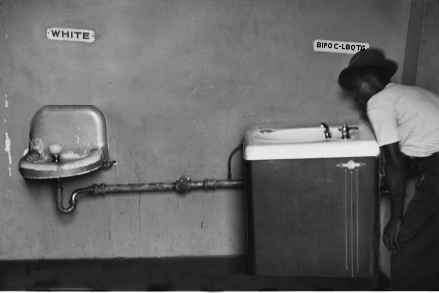
University of Arizona: dedicated to the new segregation!
“Segregation today, segregation tomorrow, segregation forever!” The University of Arizona has begun a new racist policy whereby anyone who is a member of one of 22 American Indian tribes that exist in the state will be excused from paying any tuition or fees while studying on campus.
Beginning in the fall, new and continuing full-time, degree-seeking, in-state undergraduates will be eligible for the Arizona Native Scholars Grant, the first program of its kind in Arizona. The program will be administered by UArizona Enrollment Management.
“Serving Arizona’s Native American tribes and tribal students is a crucial part of the University of Arizona’s land-grant mission, and the Arizona Native Scholars Grant program is another important step among many to do that,” said University of Arizona President Robert C. Robbins. “I am so proud that that this university has found a way to help hundreds of students more easily access and complete a college education, and I look forward to finding ways to take these efforts even further.”
To be eligible, students must complete the Free Application for Federal Student Aid, or FAFSA, and provide tribal identification. Native American tribes’ federal legal status allows universities to administer scholarships and grants to tribal members.
More than 400 students enrolled at UArizona last year meet the criteria for the new program.
Let me translate what UA president Robert C. Robbins is really saying:
» Read more
Capitalism in space: The Canadian company Kepler — which already has nineteen satellites in orbit providing data communications — will use the orbital tug developed by the start-up D-Orbit and dubbed ION on its next two satellites.
After separating from the launch vehicle, D-Orbit intends to use ION to drop Kepler’s satellites off at a sun-synchronous orbit (SSO) between 500 and 600 kilometers. Each satellite is the size of six cubesats, a standard smallsat form factor measuring 10 centimeters on each side.
Kepler previously had a deal to use Momentus’s Vigoride tug, but delays and further in-orbit technical problems with that tug has apparently forced it to switch to D-Orbit.
According to new research done on ISS, scientists have confirmed what Soviet-era scientists had learned back in the 20th century, that long term bone loss during long missions in weightlessness can take many months to recover once back on Earth.
The bone density lost by astronauts was equivalent to how much they would shed in several decades if they were back on Earth, said study co-author Dr Steven Boyd, of Canada’s University of Calgary and director of the McCaig Institute for Bone and Joint Health.
The researchers found that the shinbone density of nine of the astronauts had not fully recovered after a year on Earth – and they were still lacking about a decade’s worth of bone mass. The astronauts who went on the longest missions, which ranged from four to seven months on the ISS, were the slowest to recover. “The longer you spend in space, the more bone you lose,” Boyd said.
The study also confirmed that some exercises in space helped to mitigate the bone loss, which ranged from 1% to 2% per month. No exercises prevented it however.
For missions to Mars, the bone loss appears less of an issue than the loss of muscle strength. Even with extensive bone loss after six months to a year in space astronauts do not notice this loss when returning to Earth gravity. They will certainly not notice it on Mars, with a gravity field 39% that of Earth’s.
More concerning is the loss of muscle strength during long missions in weightlessness. After six months to a year in weightlessness astronauts struggle on Earth to walk after first landing. This is why they are helped immediately placed to chairs upon return. On Mars no such help will be available.
Capitalism in space: The rocket startup Relativity, which hopes to complete its first test launch of its small Terran-1 rocket before the end of the year, yesterday announced that it has won a launch contract with OneWeb to use its larger but not-yet-ready-for-launch Terran-R rocket to place future OneWeb satellites into orbit.
Under the agreement, Relativity will launch OneWeb’s low Earth orbit (LEO) satellites on Terran-R, the first fully reusable and entirely 3D printed rocket, starting in 2025. These launches will support OneWeb’s deployment of its Gen 2 satellite network, which will add capacity and fresh capabilities to build upon the initial constellation of 648 satellites the company is currently building out.
Since its launch contract with Arianespace using Russian Soyuz rockets fell apart due to Russia’s invasion of the Ukraine, OneWeb has been signing up a range of rocket companies, first SpaceX, then India, now Relativity. Apparently the satellite company realized it was a bad idea to depend on only one rocket, and is now lining up several to make sure its satellites can launch on schedule, no matter what.
For Relativity, this agreement solidifies its future, even before it has completed its first launch. It now has five customers for its Terran-R rocket, with contracts worth $1.2 billion. All it has to do now to become a major player in the global launch market is to get its rockets off the ground.
The new colonial movement: The head of India’s space agency ISRO revealed during a press conference following yesterday’s PSLV launch that he is delaying by one or two years Gaganyaan manned mission.
Indian Space Research Organisation (Isro) Chairman S Somanath on Thursday said the launch of the ambitious Gaganyaan mission, the country’s first manned space flight, cannot happen this year or next year as the agency is keen to ensure that all safety systems are in place.
Somanth’s comments confirm an earlier report. It appears he wants the agency to do at least two unmanned tests of the spacecraft’s crew abort system. He also want further tests of the GSLV rocket that will launch the manned capsule.
Somanth also indicated that India’s next attempt to land a rover on the Moon, Chandrayaan-3, might also be delayed from the presently scheduled August ’22 target launch as they review the lander’s systems.
The FCC made two decisions yesterday that were both favorable to SpaceX’s Starlink satellite constellation.
First, it gave Starlink permission to provide service on moving vehicles such as cars, trucks, boats, and aircraft. Second, it rejected a DISH network request to use a wavelength in its ground-based system that is presently being used by both Starlink and OneWeb satellites.
This decision will continue the shift in communications from high-orbit/ground-based to low-orbit satellite constellations.
An evening pause: Performed live 2005.
Hat tip Dan Morris.
Cool image time! The photo to the right, cropped and reduced to post here, was taken on January 2, 2022 by the high resolution camera on Mars Reconnaissance Orbiter (MRO). Simply labeled “slope features,” it was likely taken to monitor the gullies and streaks on the interior walls of this 4-mile-wide crater. Scientists have been using MRO to track the coming and going of frost on this crater’s interior walls since 2016.
Equally intriguing however are what appear to be squashed layers within the crater’s interior. These appear to be some form of glacial feature created by repeated climate cycles, similar to the glacial features routinely seen throughout the 30 to 60 degree mid-latitude strips north and south.
What makes the glacial features in this particular crater particularly intriguing is its location, as shown in the overview map below.
» Read more

The apparent goal of Amazon’s woke employees
Persecution is now cool! Hundreds of Amazon employees have apparently signed a company-wide open letter demanding that the company immediately blacklist everyone who is anti-abortion while also blackballing every state that passes anti-abortion laws.
“As part of Amazon’s wide-reaching efforts toward a more inclusive and diverse workforce, we believe that Amazon cannot let this recent decision go unanswered,” the letter said. “We ask Amazon, the world’s best employer, to actively defend against this assault on our liberty.”
Among other actions, the authors are requesting that Amazon “allow employees of all genders the space and time to grieve, express their frustrations, and protest against this assault on our rights.” In addition, they want the company to “donate and match donations to bail funds” to help “women and pregnant people” seeking abortions in states with protections for pre-born babies.
It also demanded Amazon organize pro-abortion protests and donate money to the political organizations the letter signatories endorse.
Essentially, the letter calls for Amazon to focus its business entirely on leftwing political action rather than its central purpose of providing retail products to its customers. That such actions will cost the company money and possibly harm its profit line apparently does not matter to these employees.
The letter however went much farther. The cropped image from the letter below shows this:
» Read more
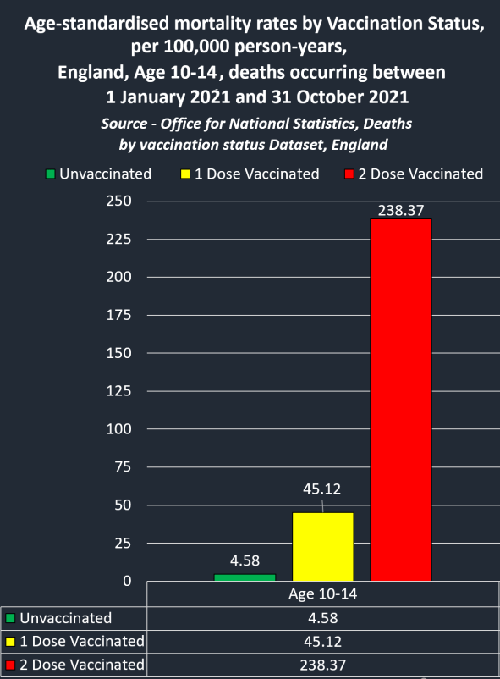
COVID mortality rates among children 10-14 in the United Kingdom,
comparing those who got the COVID shots versus those who did not
While stories about the ineffective and harmful consequences of the panic over the Wuhan flu continue to pour in on an almost daily basis, it is often better to step back and see these many stories in aggregate. By looking at the forest from a distance, a clearer picture frequently reveals itself that remains hidden if you only focus on studying the individual trees.
For example, the graph to the right, first published in January 2022, suggests strongly that giving young children the COVID shots only increased their mortality. This is just one story, however. Is it typical, or an outlier? You need to look at the larger picture to know.
Below I list and categorize the many science papers and news stories I have been collecting since my previous detailed two essays in May about the epidemic and its consequences (see: “The evidence keeps pouring in showing the utter failure of all COVID mandates” and “Are the COVID vaccines killing people over time? The data suggests yes.”). The totality of this data does appear shocking, especially because it makes evident the utter failure of almost every policy set by almost every government health official and elected politician since the Wuhan flu arrived in 2020.
First we must take another look at the new research about the mask mandates, policies that decades of research repeatedly showed would do nothing to protect anyone from COVID, and might even be unhealthy.
» Read more
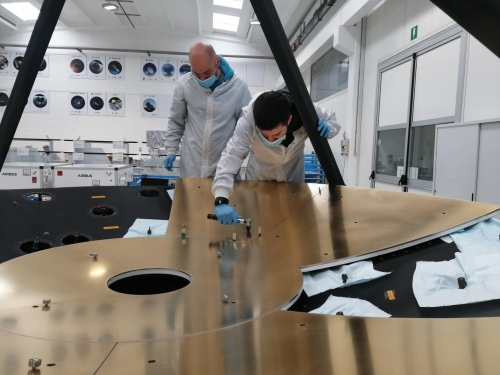
Engineers attach mirror panels to the mirror’s support structure.
An Italian optics company, Media Lario, has now completed construction of the primary mirror — at 2.5 meters width slightly larger than Hubble’s primary mirror — to be used on a JPL balloon astronomy mission dubbed ASTHROS, targeting a December 2023 launch.
The ASTHROS primary mirror features nine panels, which are significantly easier to fabricate than a one-piece mirror. The bulk of the mirror panels consist of lightweight aluminum, formed into a honeycomb structure that reduces its total mass. The panel surfaces are made of nickel and coated with gold, which improves the mirror’s reflectivity at far-infrared wavelengths.
Once launched, the balloon will circle the south pole for up to four weeks, taking data on the gas distribution in several galaxies.
While that data will be worthwhile, the mission’s real goal is to test these technologies for future space-based astronomy missions. If this mission works, it will reduce significantly the cost and time necessary to make big telescope mirrors, while enhancing the robotic capabilities of such telescopes.
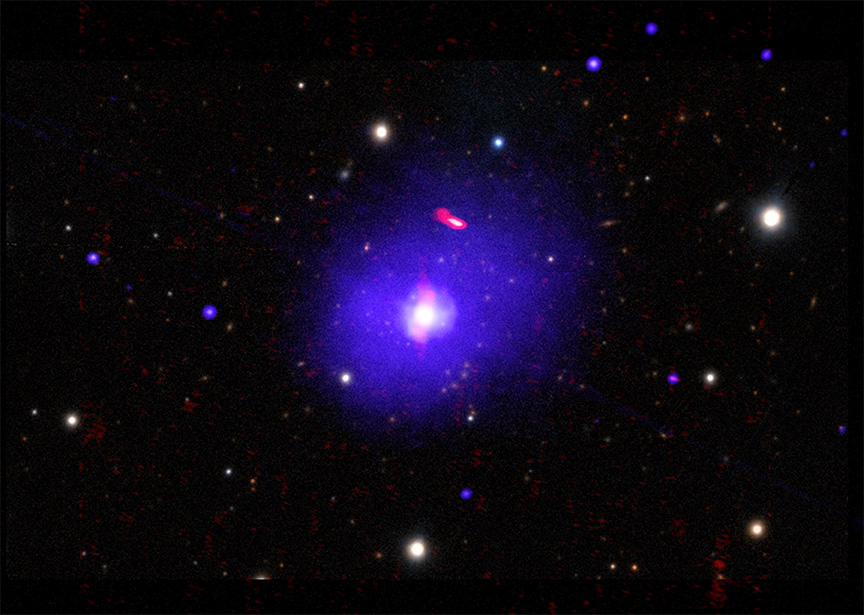
Click for full image.
The uncertainty of science: Using Chandra astronomers have measured the rotation of a supermassive black hole in a distant quasar about 3.4 billion light years away and found that it spins at about half the speed of other less massive black holes.
Because a spinning black hole drags space around with it and allows matter to orbit closer to it than is possible for a non-spinning one, the X-ray data can show how fast the black hole is spinning. The spectrum — that is, the amount of energy as a function wavelength — of H1821+643 indicates that the black hole is rotating at a modest rate compared to other, less massive ones that spin close to the speed of light. This is the most accurate spin measurement for such a massive black hole.
The black hole, thought to weigh between 3 to 30 billion times more than the Sun and is the heaviest such object measured in this way, rotates at about half the speed of light. Why that rotation is less than other smaller black holes remains a question not yet answered, though astronomers suspect it is related to its formation history.
The image above is a composite showing this quasar across multiply wavelengths. X-rays are shown in blue, radio in red, and optical in white.
Rocket Lab’s Photon upper stage has now successfully completed the third of seven planned engine burns designed to slowly raise the Earth orbit of NASA’s experimental lunar cubesat CAPSTONE so that it can eventually be sent towards the Moon.
Lunar Photon’s HyperCurie engine will perform a series of orbit raising maneuvers by igniting periodically to increase Photon’s velocity, stretching its orbit into a prominent ellipse around Earth. Six days after launch, HyperCurie will ignite one final time, accelerating Photon Lunar to 24,500 mph (39,500 km/h) and setting it on a ballistic lunar transfer. Within 20 minutes of this final burn, Photon will release CAPSTONE into space for the first leg of the CubeSat’s solo flight. CAPSTONE’s journey to NRHO is expected to take around four months from this point. Assisted by the Sun’s gravity, CAPSTONE will reach a distance of 963,000 miles from Earth – more than three times the distance between Earth and the Moon – before being pulled back towards the Earth-Moon system.
Once in lunar orbit, CAPSTONE will be used to both test operations in that orbit (similar to the one NASA’s Lunar Gateway space station will use) while also demonstrating the use of a cubesat on an interplanetary mission.
In a letter sent to the FCC last week, Amazon asked the agency to limit the size of SpaceX’s full constellation so that Amazon will be free to someday launch its own Kuiper constellation.
In the recent letter, Amazon recommends the FCC license a “subset of SpaceX’s proposed system” (as opposed to the whole fleet) to give the agency additional time to consider the “novel challenges” such a significant expansion might present. For example, Amazon believes hundreds to “more than 10,000” of SpaceX’s new satellites could be operating in the altitudes already approved for its Kuiper satellites, which could cause interference in the spectrum and “orbital overlap.” The company claims SpaceX has refused its requests for communication around these concerns as it has urged the FCC to approve its application. It also cites eight other satellite operations who have objected to the plan, including Dish Network, which is currently engaged in a public battle over radio frequencies with SpaceX.
Amazon’s concerns might carry more weight if the launch of its constellation was not so delayed. Both Amazon and SpaceX began development of their satellite constellations at about the same time. Yet, while SpaceX has already launched almost 3,000 satellites, and is providing its service to several hundred thousand customers, Amazon has yet to launch a single satellite.
Thus, though what Amazon is asking the FCC seems reasonable, it is also asking the FCC to block a competitor’s successful operation while it dilly-dallies along, accomplishing little.
This pattern from Amazon fits the pattern of all of Jeff Bezos’s space-related projects: Big promises, little action, and when competitors get things done sue or demand the government play favorites. Sure does not seem to me to be a good long-term business plan.
India’s PSLV rocket successfully placed nine satellites into orbit today, completing that country’s second launch in 2022.
Since the Wuhan panic arrived in 2020, India’s space program has slowed to a crawl. Beforehand, it had been averaging six launches per year with the expectation that in 2020 it might double that number. Furthermore, the PSLV rocket had been a major player in the emerging smallsat market, routinely putting one to three dozen smallsats into orbit with each launch, with one launch in 2017 putting a record 104 smallsats into orbit.
Then the Wuhan panic arrived and everything stopped. Today’s PSLV launch was only its fifth launch since 2019. With almost all launches canceled, India’s smallsat business moved to SpaceX, Rocket Lab, and other rocket companies that did not panic and continued to launch.
Today’s launch however might signal a renewal. It was not managed by India’s old space agency, ISRO, but a new government agency called NewSpace India Limited (NSIL), which is supposedly focused on encouraging the growth of India’s commercial aerospace sector, independent of the government. Whether a government agency can accomplish such a task in India remains entirely unknown.
The leader board in the 2022 launch race remains the same:
27 SpaceX
21 China
8 Russia
4 Rocket Lab
American private enterprise still leads China 37 to 21 in the national rankings, and the entire world combined 37 to 34.
A ULA Atlas-5 launch later today could change these numbers.