Frozen waves of lava on Mars

Frozen waves of lava on Mars

Cool image time! The picture to the right, cropped and reduced to post here, was taken on January 15, 2023 by the high resolution camera on Mars Reconnaissance Orbiter (MRO). It shows an area where the ground suddenly transitions from a crazy quilt of criss-crossing hollows and ridgelines to a very flat and smooth plain.

The location is at 21 degrees south latitude, so this is in the dry equatorial regions. Though it has a small resemblance to the chaos terrain that is found in many places on Mars, mostly in the mid-latitudes where glaciers are found, the scale here is too small and the ridges and canyons are not as sharply drawn. While chaos terrain usually forms sharply defined large flat-topped mesas with steep cliffs, here the ridges are small and the slopes to the peaked tops are somewhat gentle.
» Read more

0 comments

Experimental NASA high altitude balloon circles Antarctica in ten days

Overview map
Click for original image.

An experimental NASA high altitude balloon has successfully circled the continent of Antarctica in only ten days, flying at an average elevation of 107,000 feet.

The overview map to the right, annotated for posting here, shows its flight path so far.

“The balloon is performing exactly the way it was engineered to do, maintaining its shape and flying at a stable altitude despite the heating and cooling of the day-night cycle,” said Debbie Fairbrother, NASA’s Scientific Balloon Program chief. “As we continue to test, validate, and qualify this technology for future flights we’re also performing some cutting-edge science.”

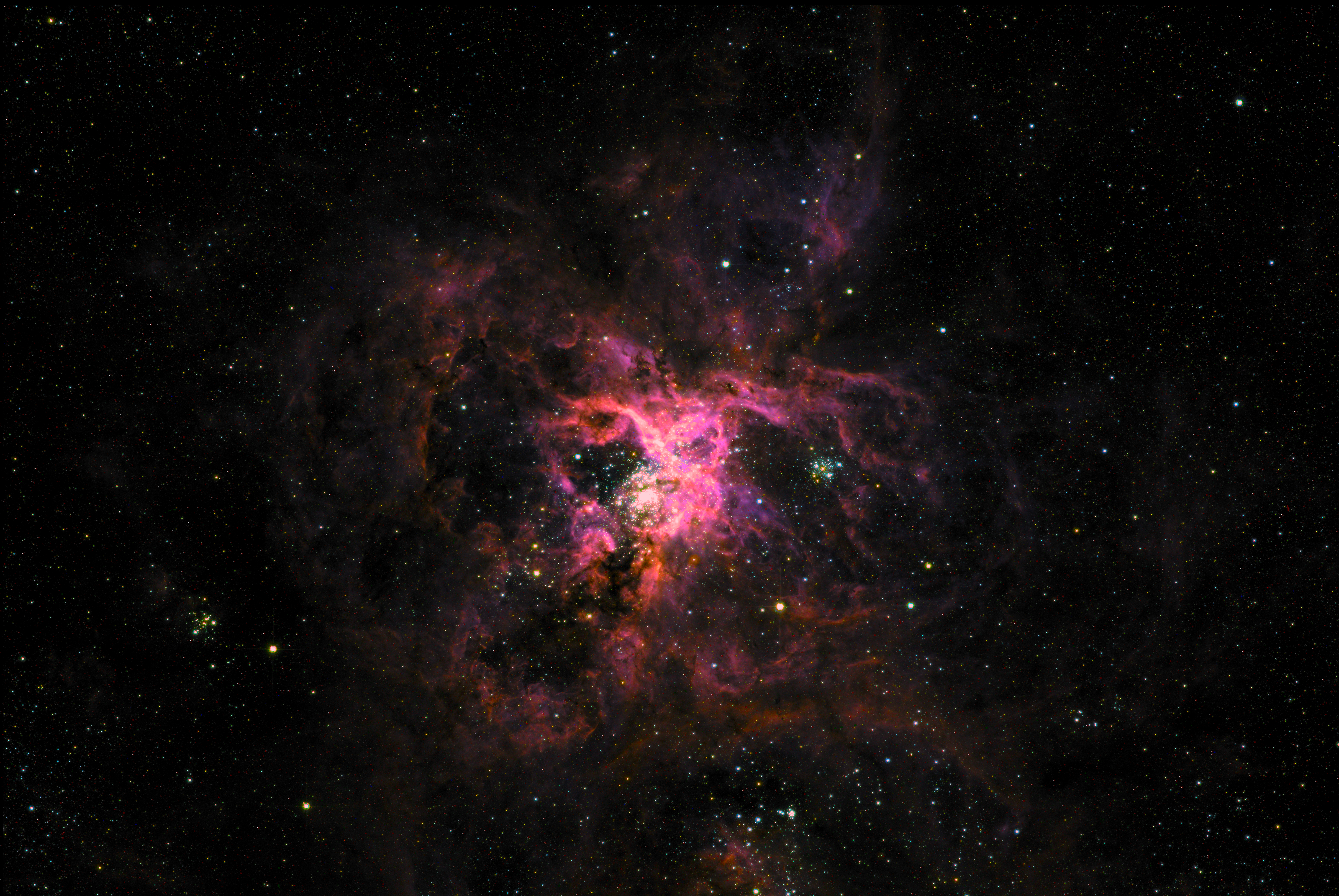
The balloon is flying the Super Pressure Balloon Imaging Telescope (SuperBIT) payload, which has already returned brilliant research images from this flight.

Weather permitting, the balloon can be seen from the ground, especially at sunrise and sunset, as it continues on its globetrotting journey. People can track the real-time location of NASA’s super pressure balloon at this website: https://www.csbf.nasa.gov/map/balloon10/flight728NT.htm

The images have so far been of astronomical objects, such as the Antennae galaxy and the Tarantula nebula. Being so high above the atmosphere, the pictures are sharper than ground-based telescopes and have a much wider field of view.

The press release did not state how long this flight will last, but it did mention a second balloon mission is planned, flying a European cosmic-ray detector.

4 comments

NASA announces winners in its annual school manned rover design competition

NASA today announced the winning teams in its annual competition for high schools and colleges to come up with the best new designs for manned rovers capable of operating on other worlds.

The annual engineering competition – one of NASA’s longest standing challenges – held its concluding event Friday, April 21 to Saturday, April 22, at the U.S. Space & Rocket Center in Huntsville, Alabama, near NASA’s Marshall Space Flight Center.

More than 500 students from around the world participated during HERC’s 29th anniversary competition. Student teams represented 16 states, the District of Columbia, and Puerto Rico, as well as the countries of Bolivia, Brazil, Colombia, Dominican Republic, India, Mexico, Peru, and Singapore. Teams were awarded points based on navigating a half-mile obstacle course, conducting mission-specific task challenges, and completing multiple safety and design reviews with NASA engineers.

The first place winners were teams from Escambia High School from Florida and the University of Alabama. NASA also listed winners in a whole range of other categories (“crash and burn”, “pit crew”, “social media”), many of which appear designed simply to make sure everyone got a participation award.

0 comments

The inexplicable tail of the asteroid Phaethon is from sodium, not dust

For years astronomers have puzzled over the strange behavior of the asteroid Phaethon, which though rocky would still produce a tail like a comet whenever its orbit took it close to the Sun.

New research by astronomers using several space telescopes designed to study the Sun has determined that this tail is made of sodium, not dust as previously believed, which also suggests that many of the other “comets” these solar telescopes have detected close to the Sun might instead be asteroids like Phaeton.

Hoping to find out what the tail is really made of, Zhang looked for it again during Phaethon’s latest perihelion in 2022. He used the Solar and Heliospheric Observatory (SOHO) spacecraft — a joint mission between NASA and the European Space Agency (ESA) – which has color filters that can detect sodium and dust. Zhang’s team also searched archival images from STEREO and SOHO, finding the tail during 18 of Phaethon’s close solar approaches between 1997 and 2022.

In SOHO’s observations, the asteroid’s tail appeared bright in the filter that detects sodium, but it did not appear in the filter that detects dust. In addition, the shape of the tail and the way it brightened as Phaethon passed the Sun matched exactly what scientists would expect if it were made of sodium, but not if it were made of dust.

Knowing these new facts, it might make it possible to map the asteroids that orbit very close to the Sun but are hard to detect optically using standard telescopes because of the Sun’s brightness. Instead, astronomers might be able to map them using these solar telescopes.

1 comment

NASA awards 12 companies small development contracts with total value $14.5 million

NASA today announced it has awarded twelve different space companies small development contracts, total value $14.5 million, for developing new technologies ranging from new welding techniques to new thermal protection systems to better lunar rover tires.

The companies are also a wide mix, from large well-established giants like Lockheed Martin and Boeing to new startups like Blue Origin and Sierra Space.

1 comment

SpaceX leases second launchpad at Vandenberg

SpaceX announced yesterday that it has leased a second launchpad at Vandenberg, taking over the pad that ULA previously leased for use by its Delta family of rockets, now being phased out.

The site will be used to launch “Falcon rockets”, which suggests both the Falcon 9 and the Falcon Heavy. All told, SpaceX now has six launchsites, three at Cape Canaveral, two at Vandenberg, and one at Boca Chica, with the Starship/Superheavy site at Kennedy presently under construction.

The launchpad at Vandenberg, dubbed SLC-6 (pronounced “slick-6”), was originally built to launch the space shuttle, something that never happened. When I got a tour of Vandenberg in 2015 I took some good pictures of it.

It is very likely SpaceX will make major changes, as it did to the shuttle launchsite it took over at Kennedy.

9 comments

Rocket engine company Ursa Major raises $100 million in private investment capital

The American rocket engine company Ursa Major recently raised an additional $100 million in private investment capital, on top of the $85 million it raised last year.

All told, the company has raised $234 million. Its Hadley engine presently has contracts with rocket startups Astra and Phantom, the hypersonic missile testing company Stratolaunch, and the Air Force. It is also developing two larger engines, the Ripley and the Arroway, the latter designed to replace Russian engines previously used by American companies.

0 comments

One instrument on Mars Reconnaissance Orbiter ends its mission

Because Mars Reconnaissance Orbiter’s (MRO) CRISM instrument needed to be cooled to low temperatures to use infrared wavelengths for detecting underground minerals and ice on Mars, and the cryocoolers have run out of coolant, the science team has shut the instrument down.

In order to study infrared light, which is radiated by warm objects and is invisible to the human eye, CRISM relied on cryocoolers to isolate one of its spectrometers from the warmth of the spacecraft. Three cryocoolers were used in succession, and the last completed its lifecycle in 2017.

All the remaining instruments on MRO, including its two cameras, continue to operate nominally.

In its final task, CRISM produced a global map showing water related minerals on Mars, released last year, and a global map showing iron deposits, to be released later this year.

1 comment

April 26, 2023 Quick space links

Courtesy of BtB’s stringer Jay.


0 comments

Today’s blacklisted American: Student destroyed because mob accepted false slanders against her

Morgan Bettinger, calling police when her car was surrounded by protesters in 2020
Morgan Bettinger, calling police when her car
was surrounded by protesters in 2020. Click
for original video, from UVA’s media outlet,
which includes the accusation that she
threatened the protesters but includes no
evidence.

They’re coming for you next: The entire future of Morgan Bettinger has apparently been destroyed because a leftist activist spread a false lie about her through social media, and the student population and many of the faculty and administration at the University of Virginia (UVA) quickly accepted it without question.

Bettinger, a student at UVA, was accused of saying that a group of “Black Women Matter” demonstrators blocking traffic in a 2020 protest would “make good speed bumps.” The accusation came from lefty activist Zyahna Bryant, also a student at UVA, who quickly organized a campaign to get Bettinger expelled. Though Bettinger was not expelled, a student panel found her guilty, and sentenced her to “50 hours of community service with a social justice organization, three meetings with an assigned professor to teach her about ‘police community relations,’ an apology letter to Bryant, and the expulsion in abeyance.”

In other words, she was to go to a political reeducation camp and get indoctrinated properly.

The problem is that Bettinger never said any such thing, and that Bryant’s claims were lies. These facts were unequivocally determined by a more careful investigation by the university’s Office for Equal Opportunity and Civil Rights (EOCR), which found that Bettinger was innocent of Bryant’s charges of racism. Bryant had never recorded the actual comment, and hadn’t even heard it herself. Instead, Bryant had extrapolated her own interpretation from hearsay told to her by others.

What Bettinger actually said, which was also confirmed by numerous witnesses, had a completely opposite meaning, and was initiated when she started a conversation with the driver of a dump truck that was blocking the road and thus protecting the protesters from being hit by cars.
» Read more

10 comments

The breakup of a Martian glacier

The breakup of a Martian glacier
Click for original image.

Cool image time! The picture to the right, cropped and reduced to post here, was taken on January 29, 2023 by the high resolution camera on Mars Reconnaissance Orbiter (MRO). It shows what the scientists label a “contact” in the glacier country in the northern mid-latitudes of Mars.

The contact is clearly the region of breakup in the middle of the picture. To the right the surface is whole and very smooth. As we move to the left that surface begins to show cracks and holes until those holes and cracks eliminate that surface entirely, revealing a lower layer that is soft-looking and stippled.

In other words, this is the edge of a glacier, and is the place in which it is breaking up. Unlike Earth glaciers however this breakup process is entirely different.
» Read more

0 comments
1 134 135 136 137 138 196