April 27, 2023 Quick space links

Courtesy of BtB’s stringer Jay.


4 comments

With the federal bureaucracy gleefully sharpening its knives to shut down Boca Chica, SpaceX should quickly shift Starship/Superheavy operations to Florida

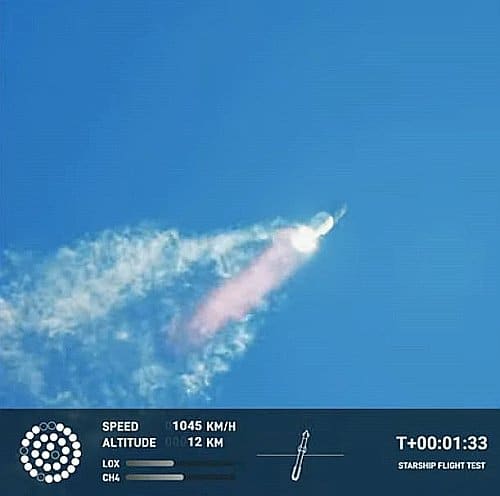
Superheavy still going strong, shortly after Max-Q

The results of the spectacular test launch last week of SpaceX’s Superheavy/Starship heavy lift rocket was predictable in almost all ways.

First, everyone knew that it was highly unlikely that the launch would do everything intended. This was the first time ever that SpaceX had fired all 33 Raptor-2 engines at the base of Superheavy, at full power. It was the first time ever that this firing took place with Starship stacked on top. It was the first time ever that the entire stack was fueled. It was the first time ever that this rocket — the world’s most powerful (twice as powerful as the Saturn-5 and about three times more powerful than SLS) — had every launched.

The number of unknowns were gigantic, which was exactly why SpaceX needed to do the launch. The company’s engineers needed to find out what they didn’t know about Superheavy in order to refine their engineering so that Superheavy will be more likely for success in its next launch. They also needed to find out what such a launch would do to their preliminary launchpad, in order to refine its engineering as well so that future launches could take place with little or no damage.

Thus, it is not surprising that there were surprises. The most significant was the actual amount of success. Superheavy functioned far better than anyone could have dreamed, retaining flight control through max-q and then flying for almost three minutes before Starship failed to separate and the entire stack lost control and had to be destroyed. Most of its engines worked, though discovering the reasons for the handful that failed will be a prime question in the subsequent investigation.

The second unsurprising thing about this launch is the reaction of the federal bureaucracy, run by Democrats and the Biden administration. It has quickly moved in to squelch any further launches at Boca Chica, likely for a considerable time. The FAA immediately initiated its own investigation while grounding all further launches from Boca Chica. The Fish & Wildlife Service has now begun detailing, almost gleefully, the amount of ground damage the launch caused, including ripping out the concrete base below the rocket and flinging chunks of debris hundreds of feet away as well as depositing a cloud of sand dust on everything up to 6.5 miles from the launchpad.

This quote however is significant, and tells us the real truth:
» Read more

29 comments

If global warming doesn’t kill us the fog will!

Shipping routes
Illustration showing the distance and time saved by going north
through the Arctic Ocean

A new report published by the American Geophysical Union, and touted by it though a press release today, says that while the melting Arctic Ocean icecap — caused by human-caused global warming — will make shipping more convenient, that shipping will be hindered by increased fog — caused by human-caused warming.

Arctic sea ice has been shrinking for decades. That loss has opened shipping channels in the Northwest Passage and the Northern Sea Route, allowing even non-icebreaker vessels to skip the time-consuming Panama and Suez Canals farther south. But as the ice recedes, cold air is exposed to more warm water, and warm vapor condenses into fog in those new passages. Hidden chunks of ice already pose risks to vessels making their way through foggy, low-visibility routes.
» Read more

59 comments

Astronomers discover 25 more repeating fast radio bursts, doubling the number known

Using a ground-based radio telescope in Canada that scans the northern sky each night, astronomers have discovered another 25 repeating fast radio bursts (FRBs), doubling the number that was previously known.

One surprising aspect of this new research is the discovery that many repeating FRBs are surprisingly inactive, producing under one burst per week during CHIME’s observing time. Pleunis believes that this could be because these FRBS haven’t yet been observed long enough for a second burst to be spotted.

The cause of FRBs still remains unsolved. The knowledge of specific repeating FRBs however will go a long way to figuring out this mystery, because other telescopes will be able to better observe later bursts, knowing when they are expected to occur.

0 comments

SpaceX and Canadian phone company Rogers sign deal

SpaceX and the Canadian phone company Rogers Communications yesterday announced that they have signed an agreement to provide satellite-to-phone communications to customers throughout Canada.

Rogers and SpaceX will offer satellite-to-phone technology in Canada using SpaceXโ€™s Starlink low earth orbit satellites and Rogers national wireless spectrum. The companies plan to start with satellite coverage for SMS text and will eventually provide voice and data across the countryโ€™s most remote wilderness, national parks and rural highways that are unconnected today.

This deal makes SpaceX now a direct competitor to OneWeb, as it is apparently structured comparable to how OneWeb operates. Up until now, SpaceX has been almost exclusively marketing to individuals, who connect up to Starlink directly. OneWeb meanwhile provides its service to large ground-based customers who then sell their network — enhanced by OneWeb capabilities — to individuals or small businesses. Because of this difference in approach, the two companies were selling their wares to different markets, making the competition less intense.

SpaceX with this deal is copying OneWeb’s approach almost exactly, which means the competition for satellite internet communications is now going to heat up considerably. For users of the internet, this is the best thing that could happen.

5 comments

Engineers extend Voyager-2’s life by tapping into reserve power supply

Engineers have begun using a backup power supply on the Voyager-2 spacecraft — launched in 1977 and presently traveling in interstellar space — in order to extend the life of one of its five instruments one additional year.

To help keep those instruments operating despite a diminishing power supply, the aging spacecraft has begun using a small reservoir of backup power set aside as part of an onboard safety mechanism. The move will enable the mission to postpone shutting down a science instrument until 2026, rather than this year.

The solution is only temporary, as the end of the mission is inevitable as its radioisotope thermoelectric generator (RTG) was only designed to provide power for about a half century (!). As time passes its power supply slowly declines, forcing engineers in recent years to shut down other systems to allow the science instruments to operate. That all the other systems on both Voyager-1 and Voyager-2 remained operational until the end of their RTGs tells us how well these spacecraft were built by their 1970s creators.

Assuming this works, engineers will do the same thing on Voyager-1 sometime next year. In both cases, however, power from the RTGs will likely run out entire sometime in the next 5-10 years, ending the missions.

11 comments

Czech Republic to sign Artemis Accords

In a press release today describing the planned signing ceremony, NASA today revealed that the Czech Republic is going to sign the Artemis Accords on May 3, 2023, becoming the 24th nation to join this American-led alliance in space.

The full list of signatories so far: Australia, Bahrain, Brazil, Canada, Columbia, Czech Republic, France, Israel, Italy, Japan, Luxembourg, Mexico, New Zealand, Nigeria, Poland, Romania, Rwanda, Saudi Arabia, Singapore, South Korea, the United Kingdom, the United Arab Emirates, the Ukraine, and the United States.

The accords, bi-lateral agreements between each nation and the U.S., were designed during the Trump administration to emphasize the rights of private investors in space and thus do an end-around of the Outer Space Treaty. Under the Biden administration it is no longer clear if that remains the goal. The existence of a signed alliance led by the U.S. and the capitalistic west however gives the U.S. the political force to protect those rights, assuming the American government is interested in the future in doing so.

It has also created a kind of bi-polar competition with the alliance of nations signing on to China’s projects in space. That alliance so far only includes China, Russia, and Venezuela, but we should expect several nations once part of the former Soviet Union, such as Kazakhstan, as well as other former communist block nations, such as North Korea, to sign up at some point. I would also expect Iran to join also.

0 comments

SpaceX successfully launched 46 upgraded Starlink satellites

SpaceX early this morning successfully launched 46 upgrades Starlink satellites, launching its Falcon 9 rocket from Vandenberg Space Force Base in California.

The first stage successfully completed its thirteenth flight, landing on a drone ship in the Pacific. The two fairings completed their sixth and seventh flights respectively.

The leaders in the 2023 launch race:

26 SpaceX (with a Falcon Heavy launch planned later today)
16 China
6 Russia
3 Rocket Lab
3 India

American private enterprise now leads China 29 to 16 in the national rankings, and the entire world combined 29 to 28.

I have embedded the live stream of the Falcon Heavy launch below, for those that wish to view it. It is scheduled for a 7:29 pm (Eastern) launch from Cape Canaveral.
» Read more

3 comments

April 26, 2023 Quick space links

Courtesy of BtB’s stringer Jay.


0 comments

Pushback: Student’s lawsuit against college officials for suppressing her First Amendment rights moves forward

Maggie DeJong
Maggie DeJong, willing fight back hard.

Bring a gun to a knife fight: Though she had quickly forced her school to back down from trying to blacklist her, as described in a previous blacklist story in 2022, Maggie DeJong has now won a major court decision with a ruling on March 20, 2023 by the U.S. District Court in the Southern District of Illinois that her lawsuit against three administrators at Southern Illinois University Edwardsville (SIUE) can go forward.

More important, the ruling stated [pdf] that these three administrators — Jamie Ball (director for Equal Opportunity, Access and Title IX Coordination), Randall Penbrook (school chancellor), and Megan Robb (her teacher) — do not qualify in almost all circumstances for qualified immunity. They are liable for their actions in violating DeJong’s constitutional rights, including her right to free speech.

This is what happened in 2022: These officials issued three “no contact” orders against DeJong, forbidding her to have any contact with three co-students in her program, simply because she had religious and political opinions they disagreed with and did not wish to hear. This orders essentially blacklisted her from the program, because of its small nature, and were literally a priori gag orders on her right to freely express her opinions. The officials also admitted that DeJong had violated no school policy, nor did they provide her any due process before issuing the orders. When challenged by DeJong’s lawyers, the university quickly realized the utter illegality of these orders, and cancelled them.

You can read DeJong’s lawsuit complaint here [pdf]. Its most important aspect is that it is not suing Southern Illinois University but the actual individuals who committed the oppressive acts. » Read more

7 comments
1 133 134 135 136 137 196