Peregrine still operational but expected to burn up in Earth’s atmosphere
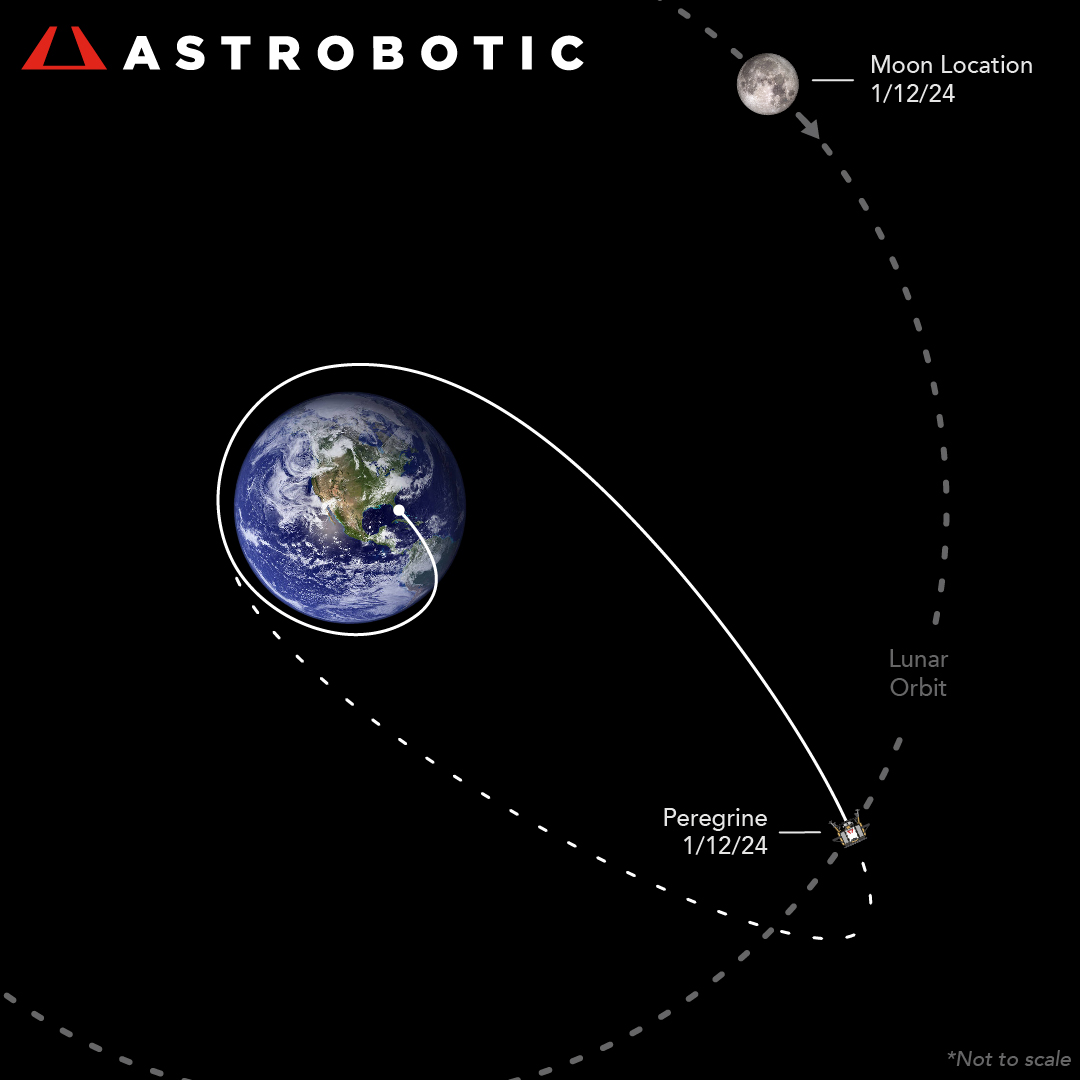
Peregrine flight path as of January 13, 2024
Click for original image.

According to an update yesterday from Astrobotic’s engineering team, the damaged lunar lander is likely to enter the atmosphere burn up when its orbit brings it back to Earth in about a week.

In an update the day before, the company released a graph of the spacecraft’s position in relation to the Earth and Moon, shown to the right. From that update:

Peregrine remains operational at about 238,000 miles from Earth, which means that we have reached lunar distance! As we posted in Update #10, the Moon is not where the spacecraft is now (see graphic). Our original trajectory had us arriving at the Moon on day 15 post launch. Our propellant estimates currently have us running out of fuel before this 15-day mark

The plan had apparently been to circle the Earth twice in this elongated orbit, with the second orbit (after some mid-course corrections) bringing Peregrine close enough to the Moon (after it had moved further in its orbit) to be captured by its sphere of influence. With the loss of fuel due to the leak, the spacecraft doesn’t have the fuel to do any of the required engine burns, including one that would avoid the Earth’s atmosphere upon return.
11 comments

Momentus delays next orbital tug mission due to lack of funds

The orbital tug startup Momentus has now delayed its next orbital tug mission, scheduled to launch in March on a SpaceX Falcon 9 rocket, due to shortage of cash in the bank.

In a filing with the U.S. Securities and Exchange Commission Jan. 12, Momentus announced it did not plan to fly its next tug, Vigoride-7, on SpaceX’s Transporter-10 rideshare launch in March. The company said it called off the flight because of its “inability to support continuing operations for the expected launch date as a result of the Company’s limited liquidity and cash balance.”

The company said in November that it has signed up seven customers who planned to deploy satellites on Vigoride-7 and two other customers who would operate hosted payloads on the vehicle, but did not identify then. Momentus also intended to fly a rendezvous and proximity operations demonstration on the vehicle as part of its long-term plans for reusable tugs.

Momentus also announced the layoff of 20% of its full-time workforce, on top of the 30% layoffs which occurred in the third quarter in 2023. It appears from the SEC filing that these layoffs are a result of not winning the military contract to build its Tranche-2 constellation, won by Rocket Lab earlier this week.

The company is presently seeking new investment capital.

6 comments

Another look at the increasing regulatory burden impacting commerical space

Link here. The author does a nice job summarizing the problems now becoming evident as the administration state strives to expand its power and control. Though he gives space to both sides, allowing the defenders of that administrative state to explain why strong regulations are good, he doesn’t bow to those defenders, as do too many modern journalists.

That he quotes me extensively (and has has told me personally that he is a regular reader of Behind the Black), might have something to do with this. He isn’t parroting my positions, however, in this essay, but giving his own perspective.

Definitely worth reading.

6 comments

A cluster of strange terrain in Martian glacier country

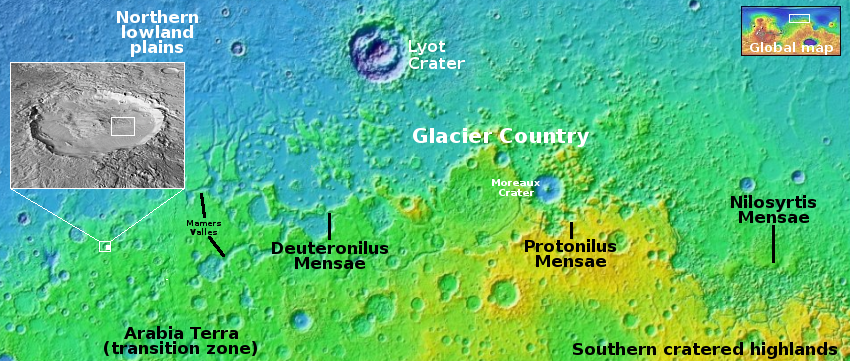
Overview map

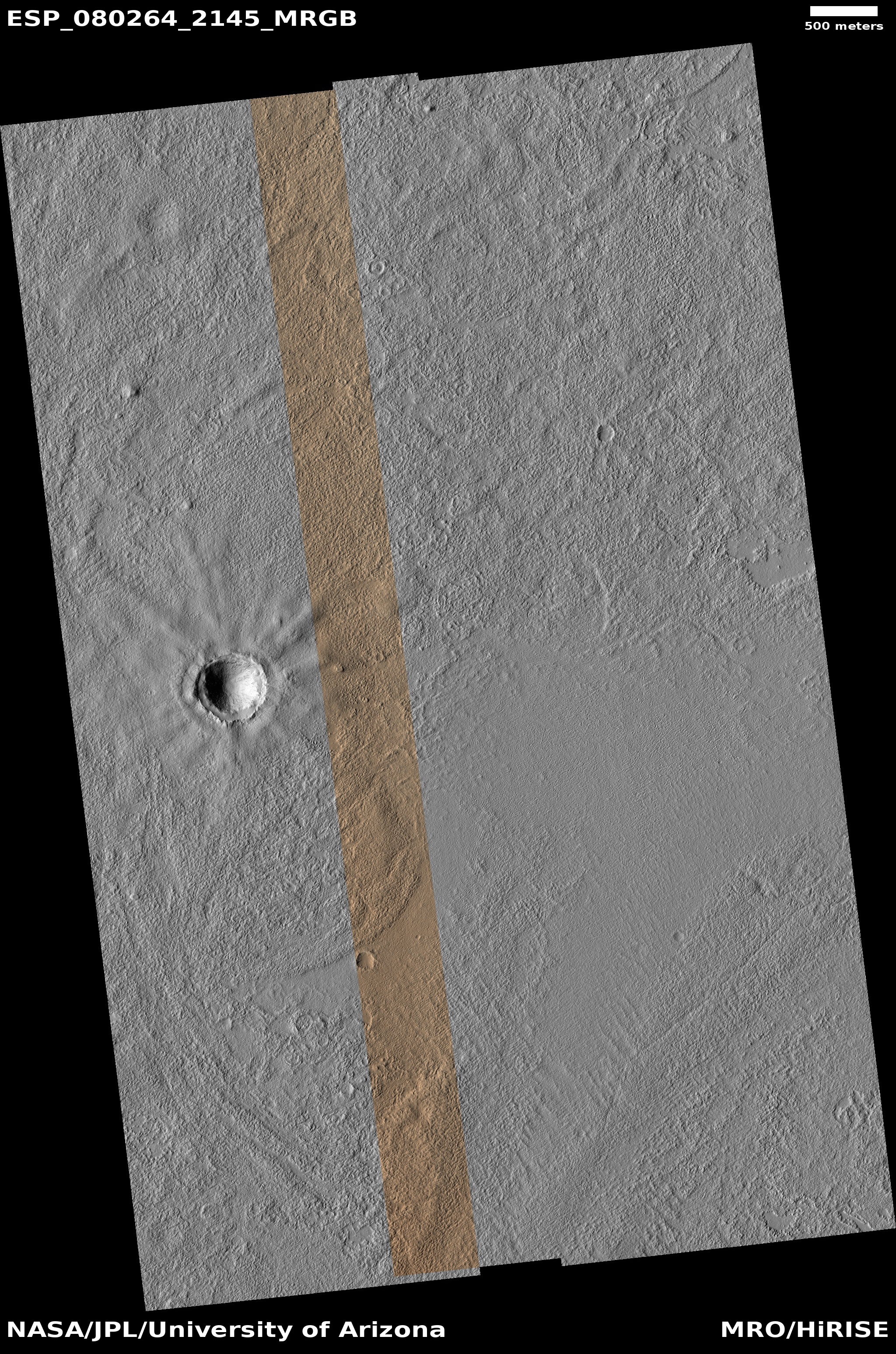
A cluster of strange terrain on Mars
Click for original image.

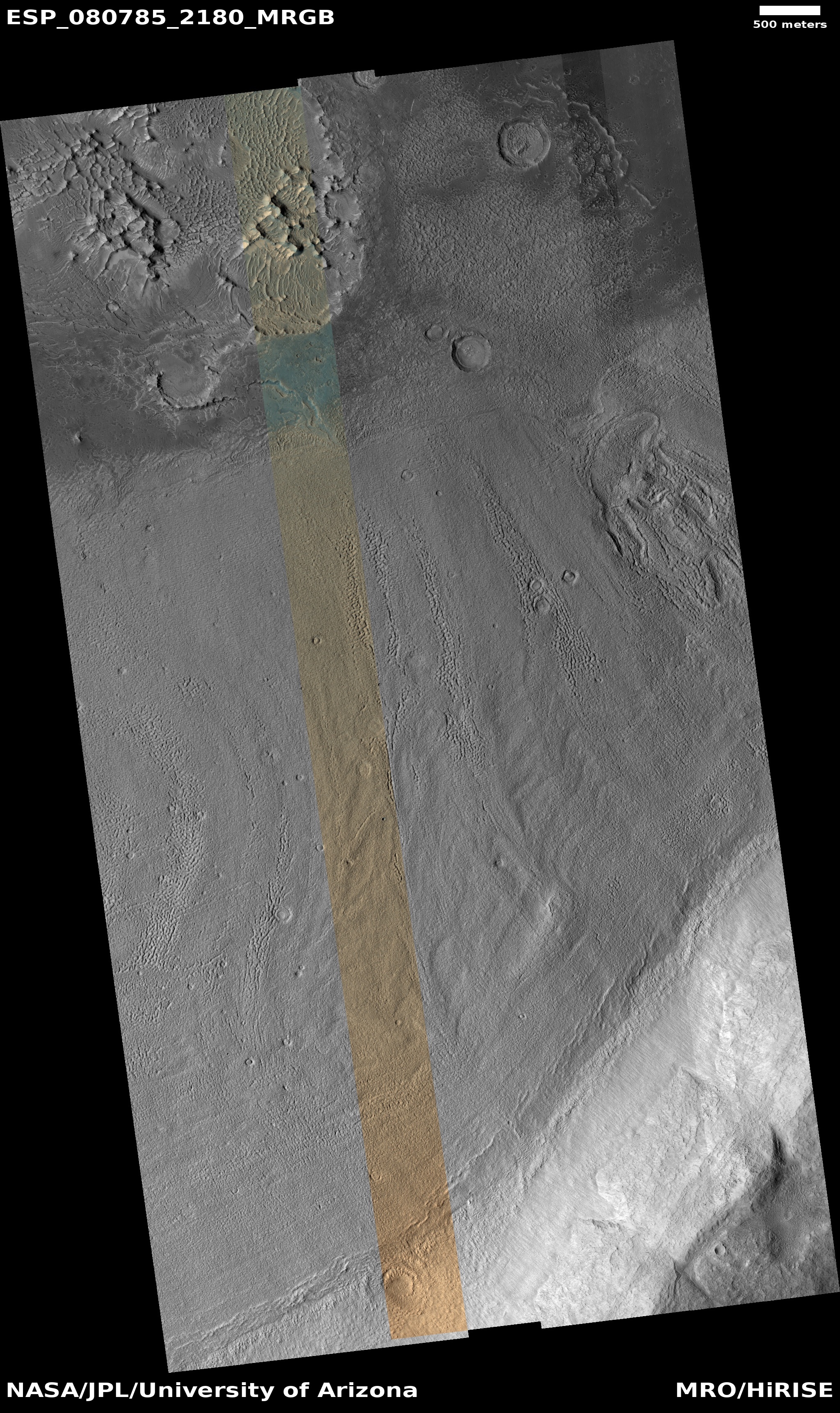
Cool image time! The picture to the right, rotated, cropped, reduced, and sharpened to post here, was taken on October 21, 2023 by the high resolution camera on Mars Reconnaissance Orbiter (MRO).

The science team labels this “patterned ground.” I see instead a whole range of inexplicable Martian geological features that, while each has been documented previously, each remains puzzling as to its formation process.

First there is the stucco-like peaks of all sizes on the upper left. This surface really looks like it had been wet plaster covered with Saran Wrap that had its peaks pulled up when that wrap was pulled off quickly.

Then there is brain terrain on the right. Always associated with glacier features on Mars, these convolutions are unique to Mars and as yet not entirely understood.

Next there is the circular arc on the middle left. It appears to be the remains of an impact crater now filled partly, but if so why has its northern rim disappeared so completely?

If you look close at the image above as well as the full image, you will find other mysterious features as well.

The location is the white dot on the overview map above. The rectangle in the inset shows the area covered by this picture, part of the floor of an unnamed eighteen-mile-wide and one-mile deep crater. The glacial material that appears to fill its interior as well as the splash apron that surrounds it all suggest the ground here is impregnated with water ice. Located as it is on the western end of the 2,000-mile-long north mid-latitude strip I dub glacier country — where practically every image shows glacial features — this conclusion is not surprising.

In fact, this photo illustrates well the alieness of Mars. We understand glaciers and ice, but on Mars, with its very cold temperatures, one-third Earth gravity, and thin atmosphere, those glaciers and ice are able to do things that we don’t yet understand. Untangling these geological processes will take decades of work, and likely will not be completed until people can walk the Martian surface and study it up close.

And won’t that be fun?

0 comments

A new plan to send a probe to interstellar object Oumuamua

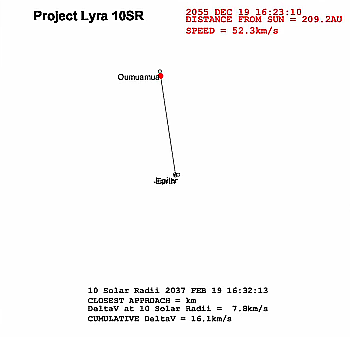
Project Lyra about to rendezvous with Oumuamua
Click to watch the animation.

Scientists have proposed a project to send an unmanned probe to Oumuamua, using the Earth, Jupiter, and then the Sun to slingshot onto a path that would catch up with the interstellar object on its journey leaving the solar system in the mid-2050s.

The project, dubbed Lyra, was first proposed in 2023. The scientists have now revised the plan to account for the greater speeds needed to catch up with Oumuamua as it continues to move away from us. It is still within the solar system, but it is moving away very fast.

The graphic to the right, a screen capture of an animation at the link, shows the spacecraft as it finally approaches the interstellar object in 2055. To get there it would launch in the early 2030s, slingshot past the Earth to reach Jupiter, which would then slow it down so that it would fall back to the Sun, passing it by less than 450,000 miles, which would slingshot it out to Oumuamua (with the help of an additional engine burn). To survive the close solar approach it would use the same technology used by the Parker Solar Probe, which has already successfully flown that close to the Sun.

It seems this is an entirely worthwhile project, since Oumuamua continues to baffle scientists as to its nature. While most belief it is a natural but very unusual interstellar asteroid, none can dismiss the possibility that it instead an alien spacecraft. The data precludes nothing. Getting close to it seems worthwhile, no matter what.

For me, that rendezvous will happen when I would be 102 years old. I don’t think I’ll be here to see it.

20 comments

Japan’s H2A rocket launches military surveillance satellite

Japan’s H2A rocket today successfully launched a new military surveillance satellite designed to observe North Korean’s missile launch sites.

The live stream of the launch is here, cued to T-10 seconds.

New reports had previously reported the last launch of the H2A occurred in September 2023, launching Japan’s SLIM lunar lander and XRISM X-ray telescope. This was obviously incorrect. Today’s launch appears to close out the H2A manifest, leaving Japan rocketless until it can get both its new H3 and grounded Epsilon rockets operational.

The 2024 launch race:

4 China
3 SpaceX
1 India
1 ULA
1 Japan

0 comments

Boeing completes Starliner parachute drop test

Boeing on January 9, 2023 successfully completed a parachute drop test of its Starliner capsule, testing whether the redesigned connection between the chutes and the capsule was now meeting proper safety specifications.

The drop test, which used a Starliner parachute system attached to a dart-shaped sled the same weight as a Starliner, was performed to confirm the functioning of a redesigned and strengthened soft link joint that is part of the network of lines connecting the parachutes to the spacecraft. The test also validated a change to strengthen one textile joint in the parachute, increasing overall parachute robustness. As with other capsules, Starliner relies on parachutes to land safely when it returns to Earth.

Engineers are still analyzing the results, though the parachutes worked as planned. The first manned mission of Boeing’s commercial capsule is now scheduled for April 2024, only four years late as well as four years after SpaceX accomplished the same thing. It still remains staggering that the company did not find out about that soft link joint when it was designing the capsule, instead of only months before the first manned mission last year. It is not as if the use of parachutes to land capsules is cutting edge technology.

3 comments

Dave Brubeck Quartet – Golden Brown

An evening pause: This video is not what it seems. The sax player, Lawrence Mason, has created a cover of this Dave Brubeck song by editing and playing over the Dave Brubeck quartet playing another song in 1965. As he notes on the youtube page, he did it as a tribute to “Paul Desmond (saxophonist with the Dave Brubeck quartet – the anniversary of his death is at the end of this month) [May 2020].”

Hat tip Alton Blevins.

0 comments

Double-ringed crater near the Starship landing zone on Mars

Double-ringed crater
Click for original image.

Cool image time! The picture to the right, rotated, cropped, reduced, and sharpened to post here, was taken on September 10, 2023 by the high resolution camera on Mars Reconnaissance Orbiter (MRO). It shows what the scientists label simply as a “double-rim crater.”

If you look close you might not be unreasonable to call this instead a triple-rim crater, as there appear to be two rings on each side of the highest crater rim.

Multple rings in craters are not rare. We see many on the Moon. Most however are associated with very large impacts, and are an expression of the ripples formed at impact, not unlike the ripples seen when you drop a pebble in water. Unlike water ripples, the ripples formed in rock are impact melt that quickly refreezes, thus capturing those ripples as concentric rings.

In this case, these rings likely signal not freezing rock but freezing ice.
» Read more

0 comments

Fauci: Now an admitted liar as well as incompetent scientist

Fauci: Washington's top liar
Anthony Fauci: the liar-in-chief during
the Wuhan panic

This week Anthony Fauci was brought before a committee in the House of Representatives for closed-door hearings on his actions during the COVID epidemic in 2020-2021. Though supposedly private, the committee has been providing detailed recaps of Fauci’s testimony.

What it has learned is that Fauci was not only a chronic liar during his time as director of the National Institute of Allergy and Infectious Diseases (NIAID), he was also utterly incompetent as both a scientist as well as an administrator.

None of this really is news. As early as December 2020 Fauci admitted publicly that he had purposely misstated facts and scientific data for political reasons. Repeatedly I have reported many other examples of his dishonesty and incompetence (see for example these posts from June ’21, April ’22, September ’22, November ’22, and September ’23).

Nonetheless, Fauci’s testimony now is worth reviewing, because it underlines starkly how he misled and misinformed the public, causing great harm for no gain.

First, he admitted in testimony that the demands by him and the government that everyone maintain a six-foot distance during the epidemic was utter garbage, based on no scientific data at all.

In Tuesday’s session, Fauci admitted that the six-foot social distancing recommendation “was likely not based on any data,” according to the committee. “It just sort of appeared,” it wrote, quoting Fauci.

In August 2020 I found evidence suggesting the only source for this absurd rule came from a high school science project. Fauci has now essentially confirmed this, admitting that there is no legitimate science behind the six-foot rule.
» Read more

19 comments
1 183 184 185 186 187 191