Long delayed ESA project to build a reusable first stage delayed again

The long delayed European Space Agency (ESA) project dubbed Themis to develop and test a reusable first stage for use in European rockets has been delayed again, with the first test hop now expected to occur next year instead of the fourth quarter of 2025.

Themis was first proposed by ESA in 2019, with the first hops expected in 2022. Three years later little has happened in the project. Instead, it appears the nations in the ESA as well as the new rocket startups on that continent have grown very disinterested in government-run projects like this. The closing paragraph at the article at the link illustrates this starkly:

While another delay to the start of the first Themis launch campaign is frustrating, the downstream consequences are likely to be minimal. The only direct application of the technology developed under the Themis programme is the first stage of the two-stage MaiaSpace rocket. However, the company appears to be continuing the development of its first stage largely independently of Themis, meaning the latest delay is unlikely to affect its progress.

In other words, this whole program is divorced entirely from any commercial application. We should therefore expect that once these test flights finally occur, the entire thing will vanish, like so many other similar government-run test programs by NASA and ESA.

1 comment

Ispace confirms that its Resilience lunar lander has failed, apparently crashing on the Moon

According to an update issued several hours after the planned landing, the Japanese lunar lander startup confirmed that its Resilience lunar lander apparently crashed in its attempt to soft land on the Moon.

Ispace engineers at the HAKUTO-R Mission Control Center in Nihonbashi, Tokyo, transmitted commands to execute the landing sequence at 3:13 a.m. on June 6, 2025. The RESILIENCE lander then began the descent phase. The lander descended from an altitude of approximately 100 km to approximately 20 km, and then successfully fired its main engine as planned to begin deceleration. While the landerโ€™s attitude was confirmed to be nearly vertical, telemetry was lost thereafter, and no data indicating a successful landing was received, even after the scheduled landing time had passed.

Based on the currently available data, the Mission Control Center has been able to confirm the following: The laser rangefinder used to measure the distance to the lunar surface experienced delays in obtaining valid measurement values. As a result, the lander was unable to decelerate sufficiently to reach the required speed for the planned lunar landing. Based on these circumstances, it is currently assumed that the lander likely performed a hard landing on the lunar surface.

After communication with the lander was lost, a command was sent to reboot the lander, but communication was unable to be re-established.

This explanation fits with the very high velocity numbers seen as the spacecraft approached the surface, much higher than intended.

Ispace has now attempted to land on the Moon twice, with both landers crashing upon approach. In this sense its record is not quite as good as the American startup Intuitive Machines, which had two landers touch down but immediately tip over, causing both to fail.

Ispace presently has three contracts to build landers with NASA, JAXA (Japan’s space agency), and the European Space Agency. The American lander is being built in partnership with the company Draper. Whether this second failure today will impact any of those contracts is uncertain at this time.

14 comments

China launches another set of satellites for one of its giant internet constellations

China earlier today successfully launched the sixth set of satellites for the Thousand Sails internet constellation, its Long March 6A rocket lifting off from its Taiyuan spaceport in northern China.

Very little information appears available about this specific payload. No word also was released about where the rocket’s lower stages and four strap-on boosters crashed inside China.

The leaders in the 2025 launch race:

69 SpaceX
33 China
7 Rocket Lab
6 Russia

SpaceX still leads the rest of the world in successful launches, 69 to 53.

0 comments

June 5, 2025 Quick space links

Courtesy of BtB’s stringer Jay. This post is also an open thread. I welcome my readers to post any comments or additional links relating to any space issues, even if unrelated to the links below.

12 comments

Landing of Ispace’s Resilience lander uncertain

Resilence landing

The landing of Ispace’s Resilience lander on the Moon at present appears uncertain, and could be a failure. Though the announcers of the live stream had warned beforehand that it might take awhile after the planned touchdown time to confirm a successful landing, the circumstances just before landing did not appear to go as expected.

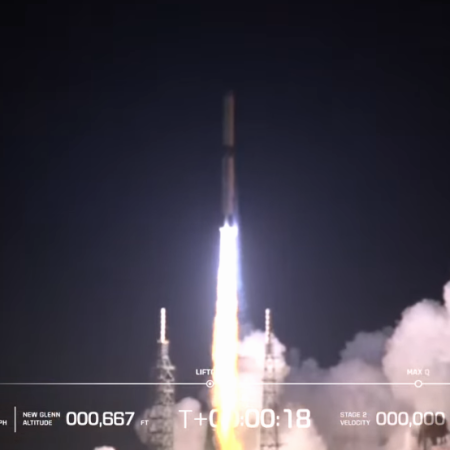
At T-1:45 minutes, with the spacecraft at an altitude of 32 feet and still moving at a speed of 116 miles per minute, all telemetry disappeared from the broadcast. Mission controllers did then indicate the spacecraft was “pitching up”, which means it was re-orienting itself for landing. At that point however no further updates were provided. Moments later we could see the engineer in mission control in the lower left of the screen capture to the right, obviously disturbed by something.

In ending the live stream a few minutes later, with no further information, the announcers added that a full report will be made during a press conference later today.

4 comments

Scientists discover another exoplanet that theories say should not exist

The uncertainty of science: Scientists using telescopes both in orbit and on the ground have discovered a small red dwarf star with only 20% the mass of our Sun with a gas giant exoplanet with about half the mass of Saturn but a bit larger in size.

The problem is that the theory for the formation of such gas giants predicts that they should not form around small red dwarfs such as this star.

The most widely held theory of planet formation is called the core accretion theory. A planetary core forms first through accretion (gradual accumulation of material) and as the core becomes more massive, it eventually attracts gases that form an atmosphere. It then gets massive enough to enter a runaway gas accretion process to become a gas giant.

In this theory, the formation of gas giants is harder around low-mass stars because the amount of gas and dust in a protoplanetary disc around the star (the raw material of planet formation) is too limited to allow a massive enough core to form, and the runaway process to occur.

Yet the existence of TOI-6894b (a giant planet orbiting an extremely low-mass star) suggests this model cannot be completely accurate and alternative theories are needed.

You can read the paper here. The exoplanet orbits the star every 3.37 days, and each transit across the face of the star has been easily detected by numerous telescopes. Further spectroscopic observations using the Webb Space Telescope will be able to characterize the exoplanet’s atmosphere more fully.

1 comment

Scientists release the first year’s data from the Pace orbiter

Pace global data, August 2024
Click for original movie.

Launched in early 2024, the Pace orbiter was designed to track the evolution of the leaves of trees globally throughout the entire year. NASA has now released the data from the first twelve months, showing the seasonal changes of trees as the Earth rotates the Sun and the seasons change globally.

The map to the right is a screen capture from one of many videos showing these changes. The green indicates the global spread of tree cover in the middle of August in the northern hemisphere as well as in the equatorial regions of South America and Africa. Other movies focusing on North America, South America, Europe, India, etc, can be viewed here.

PACE measurements have allowed NASA scientists and visualizers to show a complete year of global vegetation data using three pigments: chlorophyll, anthocyanins, and carotenoids. That multicolor imagery tells a clearer story about the health of land vegetation by detecting the smallest of variations in leaf colors.

…Anthocyanins are the red pigments in leaves, while carotenoids are the yellow pigments โ€“ both of which we see when autumn changes the colors of trees. Plants use these pigments to protect themselves from fluctuations in the weather, adapting to the environment through chemical changes in their leaves. For example, leaves can turn more yellow when they have too much sunlight but not enough of the other necessities, like water and nutrients. If they didnโ€™t adjust their color, it would damage the mechanisms they have to perform photosynthesis.

In the visualization, the data is highlighted in bright colors: magenta represents anthocyanins, green represents chlorophyll, and cyan represents carotenoids. The brighter the colors are, the more leaves there are in that area. The movement of these colors across the land areas show the seasonal changes over time.

You can read the full paper describing the first year’s data here.

The Trump budget presently funds Pace for two more years of observations, at about $26 million per year. This is an obvious example of a satellite whose life should be extended for as long as possible. This long term data would likely confirm other data that indicates the increase in CO2 in the atmosphere is greening the Earth, helping plant life that provides us oxygen to breath and food to eat.

To do so, however, other cuts in NASA will have to be found to pay for that extension. I once again wonder about the half a billion NASA spends for its “Mission Enabling Services”, which covers NASA’s human resources division, public relations department, and its equal opportunity division, as well as other more useful departments. Surely some money from these bureaucratic divisions could be found to finance this actual useful research.

1 comment

Watch the landing attempt of Ispace’s Resilience lunar lander

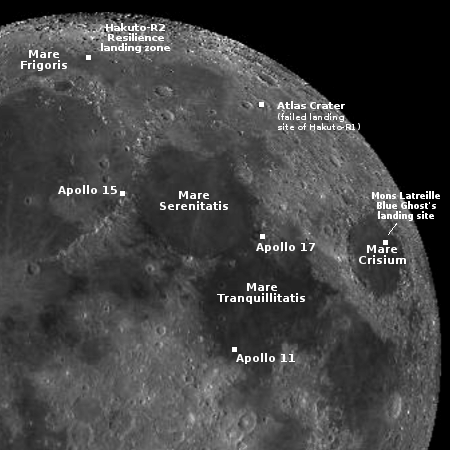
Map of lunar landing sites
Landing sites for both Firefly’s Blue Ghost and
Ispace’s Resilience

I have embedded the live stream below of the landing of the Japanese startup Ispace’s Resilience lunar lander, presently scheduled to occur at 3:17 pm (Eastern) today (June 6, 2025 in Japan).

The live stream goes live at about 2:00 pm (Eastern).

Resilience will attempt to land on the near side of the Moon at 60.5 degrees north latitude and 4.6 degrees west longitude, in the region dubbed Mare Frigoris (Latin for “the Sea of Cold”), as shown on the map to the right. That map also shows a number of other landings on this quadrant of the Moon, including Ispace’s previous failed attempt with its first lander, Hakuto-R1, in Atlas Crater in 2023.

For Ispace, today’s landing is critical for its future. It has contracts for future three landers with NASA, with Japan’s space agency JAXA, and with the European Space Agency, but a failure today could impact whether those contracts proceed to completion.
» Read more

2 comments

SpaceX launches more Starlink satellites

SpaceX this afternoon successfully launched another 27 Starlink satellites, its Falcon 9 lifting off from Vandenberg Space Force Base in California.

The first stage completed its 26th flight, landing on a drone ship in the Pacific. Also, as noted by regular reader Richard M, this was also the 500th orbital launch of a Falcon rocket, including the Falcon 1, the Falcon 9, and the Falcon Heavy. And the company has done this in only a bit over fifteen years. Quite amazing.

The leaders in the 2025 launch race:

69 SpaceX
32 China
7 Rocket Lab
6 Russia

SpaceX now leads the rest of the world in successful launches, 69 to 52.

4 comments
1 103 104 105 106 107 182