Two Japanese startups partner to fly the first private lunar sample return mission

Two Japanese startups, the lunar landing company Ispace and the orbital capsule startup ElevationSpace, have signed an agreement to develop the first private mission to bring samples back to Earth from the Moon.

Based on the agreement, Ispace and ElevationSpace will jointly pursue development to undertake a lunar return mission. Ispace has already demonstrated the technology to deploy a lander into lunar orbit through its two lunar missions operated in 2023 and 2025. The company is currently considering the development of an Orbital Transfer Vehicle (OTV), derived from its existing lunar lander development technology.

The collaboration aims to conduct a technology demonstration to verify the feasibility of missions utilizing an and the sample return re-entry capsule being developed by ElevationSpace, as well as to evaluate the overall system characteristics.

At the moment this project is only a PowerPoint proposal. Though Ispace has made two attempts to soft land an unmanned spacecraft on the Moon, neither was a success. It has three further contracts with NASA, ESA, and Japan’s space agency JAXA, but none has flown yet, and its orbital vehicle is only under development.

As for ElevationSpace, it has flown nothing yet as well. Its first demo satellite, designed to test re-entry and recovery, won’t fly until late next year, assuming its launch rocket, Isar’s new Spectrum, gets to orbit.

Nonetheless, this project illustrates the continuing shift to the private sector in space. The companies are doing this to demonstrate their capabilities in order to win contracts from both commercial and government customers.

1 comment

New study finds ice is better at dissolving iron than liquid water

In a result that could have a direct bearing on trying to understand the inexplicable geology of Mars, a new study has found that ice actually does a better job at releasing iron from mineral deposits than liquid water.

It was once believed that when iron-rich mineral deposits were locked in ice, the iron would stay put, but a new study from Sweden’s Umeå University shows that the ice itself is actually working better than permafrost melt to release the iron. The study showed that ice at -10 °C (14 °F) releases more iron from mineral deposits than liquid water at 4 °C (39.2 °F). “It may sound counterintuitive, but ice is not a passive frozen block,” says study co-author Jean-François Boily. “Freezing creates microscopic pockets of liquid water between ice crystals. These act like chemical reactors, where compounds become concentrated and extremely acidic. This means they can react with iron minerals even at temperatures as low as minus 30 degrees Celsius.”

The researchers also found that the seasonal freeze/thaw cycle helped this process, and that brackish fresh water did better in dissolving the iron than seawater.

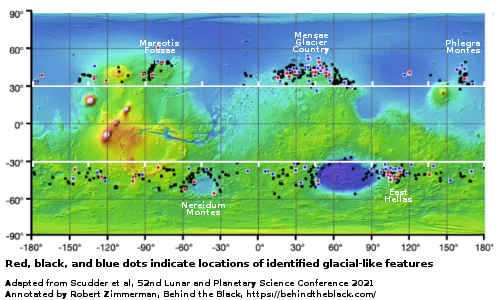
The significance for Mars geology is that this suggests glacial ice in the alien Mars climate might be the catalyst for creating its meandering canyons that so much resemble features on Earth produced by liquid water. On Mars however no model yet has been convincingly successful in creating past conditions where liquid water could flow on the surface. Mars has either been is too cold or its atmosphere too thin to allow it.

This study suggests ice however could do the work. It also fits with other Martian data that suggests the same, that at the base of the Martian glaciers pockets of liquid water could exist that act to shape the canyons.

All of this is speculation on my part, but it seems that the planetary scientists who are studying Mars should take a close look at this research.

0 comments

Avio wins $47 million study contract to build reusable upper stage rocket

Avio's proposed reusable upper stage
Click for original.

The Italian rocket company Avio has won $47 million study contract from the European Space Agency (ESA) to begin design work on a reusable upper stage rocket.

The contract runs for two years, with a goal to “assess and prepare the requirements, the design and the technologies for both the ground and flight segments required for an upper stage demonstrator that in the future could return to Earth and be reused on another flight.”

In other words, Avio is not yet building this upper stage, but will use this money to work up a design. The Avio graphic to the right suggests the lower stage will be based on the first stage of Avio’s solid-fueled Vega-C rocket. The upper stage concept appears to resemble Starship, which suggests Avio will be aiming for a vertical landing, using the methane-fueled engines it is developing for its not-yet-launched Vega-E rocket.

This ESA contract once again shows that agency’s shift to the capitalism model. Rather than develop this idea in-house, as it has done so poorly in the past, ESA has asked a private company to do it, and own what it develops.

0 comments

SpaceX launches 28 Starlink satellites

SpaceX this evening successfully placed another 28 Starlink satellites into orbit, its Falcon 9 rocket lifting off from Vandenberg Space Force Base in California.

The first stage, B1063, completed its 28th flight, landing on a drone ship in the Pacific. (This booster had been listed as the first stage on a launch two days ago, but it turns out the booster on that flight was B1082, completing its 16th flight.) The present rankings for the most reflights of a rocket:

39 Discovery space shuttle
33 Atlantis space shuttle
30 Falcon 9 booster B1067
28 Columbia space shuttle
28 Falcon 9 booster B1071
28 Falcon 9 booster B1063
27 Falcon 9 booster B1069

Sources here and here.

The leaders in the 2025 launch race:

126 SpaceX
57 China
13 Russia
12 Rocket Lab

SpaceX now leads the rest of the world in successful launches, 126 to 97. China has a launch scheduled for this evening, but nothing as yet has been published about its status as of this posting.

6 comments

China completes two launches

Since yesterday China successfully completed two launches from two of its interior spaceports.

First, it successfully launched what its state-run press described as a satellite that will “primarily support monitoring and research activities in weather forecasting, atmospheric chemistry and climate change”, its Long March 4C rocket lifting off yesterday from its Jiuquan spaceport in northwest China.

Then today China’s Long March 6A lifted off from its Taiyuan spaceport in north China, placing in orbit the eleventh set of satellites in the Guowang internet constellation, eventually aiming to be 13,000 satellites strong. China’s state-run press did not specify the exact number of satellites. Based on previous launches using the Long March 6A, the number was likely five, bringing the number of this constellation’s satellites now in orbit to 87.

No word on where the the lower stages of both rockets crashed inside China. This is even more critical with the Long March 4C, since it uses very toxic hypergolic fuels that can dissolve your skin if it touches you.

The leaders in the 2025 launch race:

125 SpaceX
57 China
13 Russia
12 Rocket Lab

SpaceX now leads the rest of the world in successful launches, 125 to 97.

0 comments

September 26, 2025 Quick space links

Courtesy of BtB’s stringer Jay. This post is also an open thread. I welcome my readers to post any comments or additional links relating to any space issues, even if unrelated to the links below.

4 comments

Leftist mob attacks conservatives at Tennessee State University

One member of the mob blocking the way
Click for full video

If you think the left is tamping down its violent rhetoric and terrorist murder attempts of conservatives, think again. Earlier this week an independent group of conservatives wearing MAGA hats decided to set up a table at Tennessee State University (TSU), inviting anyone to debate the merits or failures of DEI.

Very quickly a mob formed, stealing their signs and becoming increasingly threatening, with at least one carrying a screwdriver in a threatening manner. The police arrived, but did literally nothing to protect the students.

Eventually the students closed up their table and attempted to drive away, only to have their car surrounded by the mob and blocked from leaving. It took an extensive effort for the police to clear a path to let these students escape.

Watch for yourself below. And note, such mob violence against conservatives on campuses is not new. I have been reporting such events now for years. The only difference now is that the mobs appear to becoming more violent and aggressive.
» Read more

25 comments

Astronomers detect the spiral motion of the accretion disk surrounding a star 515 light years away

The changes to the spiral over seven years
Click for movie.

A team of Japanese astronomers have used the Atacama Large Millimeter/submillimeter Array (ALMA) in Chile to detect for the first time the rotation of the spiral accretion disk that surrounds a young star, rotation that showed the spiral was in the process of forming new planets.

Observations have revealed a spiral pattern in the disk of gas and dust around the young star IM Lup located 515 light-years away in the direction of the constellation Lupus. Spiral patterns are thought to be one of the signs that a new planet will form soon, but other things, such as an already formed planet, can also form spirals. These different types of spirals cannot be distinguished by visual inspection, but they are expected to move differently over time.

To determine the origin of the spirals around IM Lup, an international research team led by Tomohiro Yoshida, a graduate student at The Graduate University for Advanced Studies, SOKENDAI and the National Astronomical Observatory of Japan (NAOJ), created a stop-motion animation of the spiral pattern using four observations taken by ALMA over the course of seven years. The motion of the spirals in the stop-motion animation shows that they were not caused by an already formed planet, and instead the spirals might be helping to form a new planet.

The two images to the right, taken from the movie, show the spiral’s shift over seven years. I have added the vertical line down the center to help highlight that change.

This discovery once again illustrates the increasing sophistication of our astronomical tools, able to observe such changes at such a great distance.

0 comments

Canadian rocket startup Nordspace postpones first suborbital test launch

Proposed Canadian spaceports

After trying twice earlier this week to launch its first suborbital test rocket from its Atlantic Spaceport in Newfoundland, the rocket startup Nordspace has decided to postpone that launch for at least several weeks, while it investigates the fuel leaks on the launchpad that caused fires during both launch attempts.

From the company’s website:

After detailed review over the last 15 hours, the root cause has been discovered to be related to our propellant quality slightly differing between vehicle tests at our test facility in Ontario, compared to our first launch test in Newfoundland and Labrador at our spaceport. This led to a fuel-rich scenario. All systems on the rocket and ground performed nominally after careful review. Personnel, rocket and the launch pad are perfectly safe and secure, and our safety systems operated nominally. As our company’s manufacturing and testing facilities are located in Ontario, there’s no expedient way to make the necessary modification with the temporary infrastructure and suppliers we have in place at our launch site.

This company is only about three years old, so this delay is hardly systematic to its operations. In that time they have established their own private spaceport, have built their first demo satellite (set to launch in June 2026), and developed a test suborbital rocket, Taiga, that is on the cusp of its first launch. The company is also developing its own rocket engines, as well as an orbital rocket dubbed Tundra.

Its speed puts to shame Canada’s other proposed spaceport in Nova Scotia, which was first proposed in 2016, and has far accomplished little. Many of its problems stemmed from the Ukraine War, which lost it the rocket it had hoped to market. Even so, it only signed its first launch customer in August of this year.

0 comments

Germany’s military commits to spending $41 billion on space through 2030

In another sign that the member nations of the European Space Agency (ESA) are increasingly going their own way, Germany’s defense minister announced yesterday that his agency plans to spend $41 billion on space through 2030.

According to a 25 September Bundeswehr (German Armed Forces) release published following the minister’s address, the €35 billion investment will cover five main priorities: hardening against data disruptions and attacks, improved space situational awareness, redundancy through several networked satellite constellations, secure, diverse, and on-demand launch capabilities, and a dedicated military satellite operations centre.

This commitment is going to definitely benefit the three German rocket startups, Isar Aerospace, Rocket Factory Augsburg, and Hyimpulse. It will also likely benefit the North Sea launch platform — based in Germany — that is being built by a German consortium that has already received almost one million from the government.

While the European partners in ESA have generally kept their military spending separate from that agency, in the past a large bulk of this defense spending would have been committed to ESA joint projects, such as funding the agency’s commercial launch operation, Arianespace, to do the launches. No more.

1 comment
1 47 48 49 50 51 182