July 18, 2025 Quick space links

Courtesy of BtB’s stringer Jay. This post is also an open thread. I welcome my readers to post any comments or additional links relating to any space issues, even if unrelated to the links below.

8 comments

2016 documents now prove Obama and his top intelligence officials conspired to create the Russian collusion hoax

Evidence Obama conspired to overthrow Trump
Click for full graphic.

Treason: Documents now released from 2016, just after Trump’s election victory, prove without doubt that Obama and his top intelligence officials conspired to create Russian collusion hoax, despite having assessments by their intelligence agencies declaring Russian actions did not include Trump and had no impact at all on the 2016 election.

That assessment is nicely summarized by the screen capture to the right.

We assess that Russian and criminal actors did not impact recent US election results by conducting malicious cyber activities against election infrastructure.

After getting that negative assessment, Obama immediately called a meeting to rewrite the conclusions, in order to create a fake political issue aimed directly at destroying Trump’s presidency.
» Read more

24 comments

Update on eye research at ISS

Link here. The NASA update provides a nice overview of the research, beginning with this overview:

When astronauts began spending six months and more aboard the International Space Station, they started to notice changes in their vision. For example, many found that, as their mission progressed, they needed stronger reading glasses. Researchers studying this phenomenon identified swelling in the optic disc, which is where the optic nerve enters the retina, and flattening of the eye shape. These symptoms became known as Space-Associated Neuro-Ocular Syndrome (SANS).

The research suspects the changes are due to the fluid shifts in the body that take place due to weightlessness, with blood shifting from the legs to the head. Various projects have studied a number of solutions, including wearing leg cuffs, administering vitamin B, and possibly using centrifuge-created artificial gravity to mitigate the condition. The problem has also generated new work in developing better equipment for to studying the eye, including improved imaging and techniques for measuring the eye’s stiffness.

0 comments

Founder of Saxavord spaceport diagnosed with terminal cancer

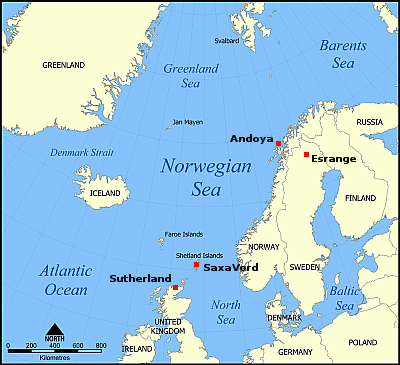
Proposed spaceports surrounding Norwegian Sea

Frank Strange, the founder and CEO of the Saxavord spaceport in the Shetland Islands, yesterday revealed that he has been diagnosed with terminal cancer and is given about six months to two years to live.

He said he was hopeful to be present for what could be the first orbital rocket launch from UK soil now expected to happen in November of this year.

Speaking to Shetland News on Thursday, the 67-year-old said the future of the spaceport was in good hands with a highly capable management team and very supportive investors.

Reflecting on his health, Strang said he had been struggling eating over past months. An endoscopy a few weeks ago discovered a tumour in his oesophagus (gullet) which was found to be cancerous and had also spread to the lungs. “I am going to step back but not down,” he said. “If I step down that would probably kill me before the cancer does.

“The spaceport has been my life; it has come at a high personal cost over the years.”

It would truly be a tragedy if this man dies before the first launch at Saxavord occurs. The German rocket startup Rocket Factory Augsburg had hoped to do a launch there last year, but an explosion during a prelaunch static fire test made that impossible. It hopes to try again in December, assuming the United Kingdom’s odious red tape does not get in the way.

6 comments

Polish rocket startup signs second spaceport deal this week

Santa Maria spaceport

The Polish rocket startup SpaceForest today announced that it has signed a deal to launch its Perun suborbital rocket with the Atlantic Spaceport Consortium that is developing a spaceport on the island of Santa Maria in the Atlantic.

The launch planned for early 2026 will allow for comprehensive testing of launch procedures and confirmation of the capabilities and compliance of the Polish platform for conducting space experiments and research outside Poland, fully aligned with international standards. The mission will also serve as an opportunity to verify the operation of the PERUN suborbital flight system under nominal mission parameters.

This is the second spaceport launch contract SpaceForest has signed this week, the first being with the Eurospaceport launch platform to be located in the North Sea. According to the press releases, the Santa Maria launch will likely occur first. SpaceForest has also signed an agreement to launch its rocket from Norway’s Andoya spaceport. All three contracts suggest the company is marketing its suborbital rocket to new proposed European spaceports as a way to demonstrate the spaceport’s viability as a launch location.

The Santa Maria spaceport was first proposed by the Atlantic Spaceport Consortium in August 2024, and has already done two suborbital test launches, both using what appeared to be large model rockets. This contract gives it is first customer.

0 comments

July 17, 2025 Quick space links

Courtesy of BtB’s stringer Jay. This post is also an open thread. I welcome my readers to post any comments or additional links relating to any space issues, even if unrelated to the links below.

21 comments

Musk: 10th Starship/Superheavy launch in “about three weeks”

According to a very short tweet Elon Musk posted on July 15, 2025, SpaceX will attempt the 10th orbital test flight of Starship/Superheavy in “about three weeks.”

Musk however provided little information. This is the full text of his tweet:

Launching again in ~3 weeks

The lack of information raises more questions than it answers. For example, how is SpaceX replacing the destroyed Starship that blew up during a static fire test in June on its Massey test stand at Boca Chica? I assume it is using another prototype already in the assembly line, but will it be a version 2 prototype that the company has flown on the past three flights that failed each time after stage separation from Superheavy? Or has SpaceX dumped the prototypes of version 2 and shifted directly to version 3 because of those failures?

How is it going to do its Starship prelaunch static fire tests? Has it gotten its Massey test stand repaired that quickly, or has it found other options? Earlier reports suggested fixing the stand would take much longer. Furthermore, there was the question of fixing it for version 2 or version 3, which require different configurations. Fixing it for version 2 suggested this would delay bringing version 3 on line.

This tweet raises more questions than it answers. However, if Musk is even close to correct than many of these questions will be answered in only a week or two, since that is when prelaunch static fire test must begin.

6 comments

Astronomers detect first evidence of gas condensing to molecular solids in baby solar system

Baby star with jets of new material
Click for original image.

Using a combination of ground- and space-based telescopes, astronomers have detected the first evidence of the gas and dust surrounding a young star condensing to molecular solids, thus beginning the initial stages of planet formation.

This newborn planetary system is emerging around HOPS-315, a ‘proto’ or baby star that sits some 1300 light-years away from us and is an analogue of the nascent Sun. Around such baby stars, astronomers often see discs of gas and dust known as ‘protoplanetary discs’, which are the birthplaces of new planets. … Their results show that SiO [silicon monoxide] is present around the baby star in its gaseous state, as well as within these crystalline minerals, suggesting it is only just beginning to solidify. “This process has never been seen before in a protoplanetary disc — or anywhere outside our Solar System,” says co-author Edwin Bergin, a professor at the University of Michigan, USA.

…With these data, the team determined that the chemical signals were coming from a small region of the disc around the star equivalent to the orbit of the asteroid belt around the Sun.

The false-color picture to the right, cropped, reduced, and sharpened to post here, was taken by the Atacama Large Millimeter/submillimeter Array (ALMA) telescope in Chile. It shows jets blowing out from the central baby star. Orange indicates carbon monoxide, while blue is the silicon monoxide. Initially the astronomers detected these molecules using spectroscopy from the Webb Space Telescope. This ALMA image was then used to identify where these molecules were located in the system.

1 comment

Proposed North Sea offshore launch platform gets ESA okay

Launch platforms proposed for North Sea

The proposed North Sea offshore launch platform of the startup Eurospaceport has now signed an agreement with the European Space Agency to support a test launch of a suborbital test rocket by Polish rocket startup SpaceForest.

The map to the right shows approximately where Eurospaceport’s launch platform will be located for this launch. The map also shows the locations of the two proposed spaceports in the United Kingdom, as well as a second German-based launch platform, Offshore Spaceport Alliance, based out of Bremen.

The SpaceForest launch is targeting a 2026 launch, with the ESA contract covering some of the expenses. As it will be suborbital, the rocket will likely not cross over any nearby habitable land.

The Offshore Spaceport was first proposed in 2020, and has received financial support from the German government, and announced earlier this year that it would be ready to host launches by September 2025. As of yet no launches have been scheduled.

Both of these launch platforms will need to travel farther to the west in the North Sea to provide any orbital rockets a path north that will not fly over other nations. Even so, launches for both will likely be limited to polar orbits, making their value less appealing to rocket companies.

At the same time, their proximity to Europe and the ability of the launch platforms to dock in Europe gives them other advantages that will be of interest to the German rocket startups.

1 comment

South Korea to push for a lunar base and Mars missions by 2045

South Korea’s new space agency today announced a long term space exploration road map that hopes to have the nation establish by 2045 a small base on the Moon as well as a Mars orbiter and lander.

The Korea Aerospace Administration (KASA) categorizes the exploration areas into Earth, the Moon, the heliosphere, and deep space, dividing them into five major programs: low orbit and microgravity exploration, lunar exploration, solar and space science exploration, planetary system exploration, and astrophysical exploration. The roadmap presents scientific missions for each program and engineering tasks to realize them.

When South Korea established this space agency in 2024, its chief emphasized the need to encourage private enterprise. I however had doubts, noting:

If KASA maintains this approach, then South Korea’s future as a space power is bright. If instead KASA moves to control all space development, including the design and ownership of its rockets and spacecraft, then that program will be stifled, as America’s was by NASA for forty years after the 1960s space race.

In January 2025 that space agency announced policies that it said would encourage the private sector, but in reviewing the language of those policies I concluded it sounded more like a power-play by that agency to run everything.

KASA’s new road map today unfortunately confirms that analysis. Over the next two decades South Korea will have a government-controlled “space program,” not a competitive space industry.

0 comments

New Space Force policy will encourage a robust private industry to build the capabilities it needs

Capitalism in space: The U.S. Space Force (USSF) today released what it calls an “annex,” outlining its “Principles for Space Access Resourcing Decisions,” that will act as an over-arching guidance to its general space policy. The nine principles listed are expressly focused on encouraging redundancy in launch and satellite military capabilities by using the robust private and competitive aerospace industry that now exists.

The annex details how the service will consider and prioritize commercial space sector requests for government resources, as well as government investment decisions. The annex features nine principles, rooted in law, that will guide the Assured Access to Space Enterprise’s decision-making on a variety of resourcing decisions including acquisition strategies, investment priorities and property allocation. … “These principles reflect our understanding that a strong commercial space industry is a force multiplier for the U.S. Space Force. We are committed to working alongside our industry and allied partners to ensure safe, reliable and resilient access to space for decades to come,” [said Deputy Chief of Space Operations for Strategy, Plans, Programs and Requirements Lt. Gen. Shawn N. Bratton.]

The annex signals an acknowledgment of the evolution of the space access landscape from the 1950s, in which the government was the primary customer, to today where commercial space activities account for the preponderance of launch manifest activities.

You can read the full “annex” here [pdf]. The principles clearly emphasize the need to use the private sector for the military’s needs. It also underlines the Space Force’s responsibility to serve the needs of this growing private sector by making its launch ranges as available as possible to that industry.

The principles however also recognize that strain caused that increased use, and adds this last principle as a caveat:

Launch rates at Cape Canaveral Space Force Station and Vandenberg Space Force Base have increased to the point where commercial and hybrid launches comprise the vast majority of operations. The demand for operational support and infrastructure sustainment and modernization exceeds USSF resources. Therefore, the USSF transparently engages with stakeholders to arrange equitable cost-sharing of multi-use resources and balanced input on public/private infrastructure investment.

It makes excellent sense for the military to re-negotiate its fees with the launch companies that use its facilities to cover costs. In fact, this is a much better way to cover these costs than the launch taxes proposed by Senator Ted Cruz’s budget bill in June. Cruz’s proposal is a legal tax that allows no room for negotiation. The Space Force’s policy will allow it flexibility to negotiate fees as needed and with much greater efficiency and speed.

Sadly, expect Cruz’s taxes to win out, as this kind of heavy-handed overuse of government power has been the default for decades.

0 comments
1 82 83 84 85 86 182