
Crater impact in the ice sheets of the northern Martian lowlands

Click for original image.
Cool image time! The picture to the right, cropped and reduced to post here, was taken on June 1, 2026 by the high resolution camera on Mars Reconnaissance Orbiter (MRO).
The science team labels this a crater with “layered deposits,” referring to the terraced glacial debris inside the crater. Researchers have found so many craters on Mars with similar features that they have given it a name, concentric crater fill. Thousands of craters in both the north and south mid-latitudes have this fill, thought to be buried glaciers protected by a mantle of dirt and dust.
The image however reveals a lot more about the ubiquitous presence of ice on Mars. Note the splash apron around the crater. Note also the gaps in the crater rim. The impact that created this crater hit a surface that had a lot of near surface ice, which immediately vaporized and melted to form the splash apron and allow the crater rim to from so unevenly.
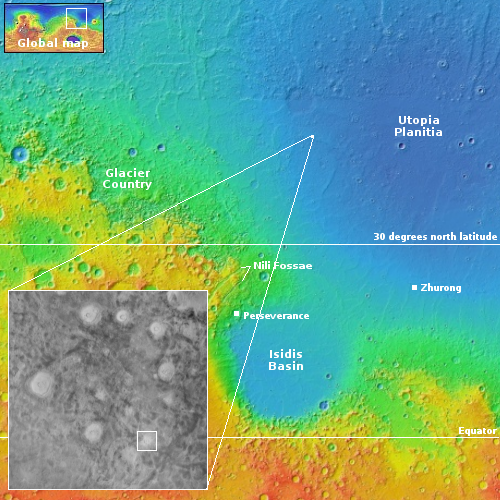
The white dot on the overview map to the right marks the location, in the northern lowland plains and inside the ancient giant impact basin Utopia Planitia.
This unnamed crater, only about 0.6 miles across, sits at 44 degrees north latitude, well above the 30 degree latitude that delineates the outer edge of Mars’ dry equatorial region. Orbital data over the past two decades has shown that the geology of practically everything above 30 degrees is strongly influenced by the presence of near surface ice.
This image reinforces that conclusion. Moreover the inset on the map shows that this crater is hardly unique. Every nearby impact shows similar splash and melt features. A near surface ice sheet almost certainly exists in these northern lowlands, quite close to the surface and across many thousands of square miles. It is for this reason that SpaceX is favoring landing Starship in similar northern lowlands on the other side of the planet.
Future colonists are going to have no trouble finding water on Mars. Their biggest problem might actually be dealing with it, as the ground they will live on will be ice-filled and thus eager to melt at temperatures humans prefer.

On Christmas Eve 1968 three Americans became the first humans to visit another world. What they did to celebrate was unexpected and profound, and will be remembered throughout all human history. Genesis: the Story of Apollo 8, Robert Zimmerman's classic history of humanity's first journey to another world, tells that story, and it is now available as both an ebook and an audiobook, both with a foreword by Valerie Anders and a new introduction by Robert Zimmerman.
The print edition can be purchased at Amazon or from any other book seller. If you want an autographed copy the price is $60 for the hardback and $45 for the paperback, plus $8 shipping for each. Go here for purchasing details. The ebook is available everywhere for $5.99 (before discount) at amazon, or direct from my ebook publisher, ebookit. If you buy it from ebookit you don't support the big tech companies and the author gets a bigger cut much sooner.
The audiobook is also available at all these vendors, and is also free with a 30-day trial membership to Audible.
"Not simply about one mission, [Genesis] is also the history of America's quest for the moon... Zimmerman has done a masterful job of tying disparate events together into a solid account of one of America's greatest human triumphs."--San Antonio Express-News