Jóhann Jóhannsson – A Sparrow Alighted Upon Our Shoulder
An evening pause: Seems appropriately contemplative following the holiday season.
Hat tip Ferris.
An evening pause: Seems appropriately contemplative following the holiday season.
Hat tip Ferris.
Courtesy of BtB’s stringer Jay.
They might be good buddies, but the Russian half is likely not going to contribute much to this partnership. And China knows it.
That first module will be only eight tons, less than half the mass of most station modules, because India doesn’t yet have a rocket capable of putting up more tonnage. The plan is to develop that rocket for later modules, using the first as a test bed.
The telescope was expected to operate for fifteen years, but instead is now in its 33rd year of operation.
The SpaceX Falcon 9 first stage booster that launched on December 23, 2023 for a record-setting nineteenth time was damaged beyond repair when, after landing on its drone ship successfully, experienced rough seas that caused it to fall over.
The picture at the link shows the crushed booster on its side on the drone ship. SpaceX noted the spectacular history of this booster in a separate tweet:
This one reusable rocket booster alone launched to orbit 2 astronauts and more than 860 satellites — totaling 260+ metric tons — in ~3.5 years.
In a sense, it actually put more mass into orbit that a Saturn 5 rocket, for significant less money though over a much longer period of time.
For SpaceX the loss of this booster is hardly a set back, because it has several other boosters with only a few less total launches in its fleet. Expect one to exceed twenty launches in the near future.
Hat tip to out stringer Jay as well as several readers.

Hamas protesters threaten blind children
I am in no mood this day to be polite or diplomatic. The ugliness exhibited in the past week by pro-Hamas demonstrators — using the violent techniques of Antifa and BLM and copying Nazi storm-trooper tactics — deserve no politeness. They are no longer acting like civilized rational human beings, but mere animals eager to kill and only held back from that goal by the last few shreds remaining of civilization’s rule of law.
Thus, at this moment they only attack innocent people in ugly ways, not intending to kill but clearly hoping to intimidate and strike fear into the hearts of everyone else. Some examples from the past three days:
The last story in this list is especially egregious. The screen capture above shows two demonstrators on stage. In the video at the link they are screaming and yelling, with the one on the right charging at the children in a threatening manner. Remember, this is a fund-raiser for blind children. Those kids cannot see, so all they know is that someone unexpected has appeared on the stage and is screaming at them, and their helpers are desperately trying to get them to safety.
This behavior illustrates perfectly the hatred and viciousness of all these pro-Hamas demonstrators. » Read more
Cool image for the day after Christmas! The picture to the right, reduced and sharpened to post here, was taken by the Hubble Space Telescope, and shows a cluster of galaxies that all seem near each other. However, as the caption notes,
[W]hilst NGC 1356 [the largest spiral] and LEDA 95415 [close by its left] appear to be so close that they must surely be interacting, the former is about 550 million light-years from Earth and the latter is roughly 840 million light-years away, so there is nearly a whopping 300 million light-year separation between them. That also means that LEDA 95415 is likely nowhere near as [small] as it appears to be.
On the other hand, whilst NGC 1356 and IC 1947 [farthest to the left] seem to be separated by a relative gulf in this image, IC 1947 is only about 500 million light-years from Earth. The angular distance apparent between them in this image only works out to less than four hundred thousand light-years, so they are actually much much closer neighbours in three-dimensional space than NGC 1356 and LEDA 95415!
The two galaxies farthest apart in this image are actually close enough together to interact significantly. Though this picture doesn’t have the resolution to see it, there is likely a stream of stars between the two.
Note also the numerous tiny other galaxies scatterered throughout the picture. In fact, except for three stars (the objects with the north-south-east-west spikes), every object is a galaxy holding stars too numerous to count.
China today successfully placed two more of its BeiDou GPS-type satellites into orbit, its Long March 3B rocket lifting off from its Xichang spaceport in the southwest of China.
This footage shows that the rocket’s core stage crashed near homes in China. No word on where the four strap-on boosters and second stage crashed. All use very toxic hypergolic fuels.
This launch continues China’s annual rush of launches at the end of the year. Since everything is owned and run by the Chinese government, one wonders if this pattern is because of the typical government mentality that requires agencies to rush to spend a lot at the end of each year so as to make sure their budgets are not cut.
The leaders in the 2023 launch race:
94 SpaceX
64 China
18 Russia
8 Rocket Lab
7 India
American private enterprise still leads China in successful launches 108 to 64, and the entire world combined 108 to 100. SpaceX in turn trails the rest of the world (excluding other American companies) 94 to 100.
According to the Chinese government, the core stage of Long March 5 that China launched on December 15th will hit the Earth tomorrow, somewhere in the South China Sea.
China warned that remnants of a rocket would hit an area in the South China Sea on Tuesday, following the sixth deployment of its most powerful launch vehicle eleven days ago.
Rocket debris, which generally burns up in the atmosphere on re-entry, is expected to fall off the coast of China’s island province of Hainan between 11:00 a.m. (0300 GMT) and noon (0400 GMT), said the China Maritime Safety Administration.
I have not been able to find out any further information about this rocket body from sources like the Aerospace Corporation that normally track such things. However, that China is predicting a landing spot suggests they have upgraded the engines on the Long March 5’s core stage so that they can be restarted and used to control the stage’s descent over the ocean. If so, this is excellent news, as China has stated that it intends to ramp up launches of this rocket as well as its Long March 5B variation. Prevous launches produced the threat of impacts anywhere on Earth, with one launch in 2020 missing the New York metropolitan area by only a few minutes.
That China wants to bring this down so close to China suggests it also wants to salvage the material.
China today successfully launched three classified satellites into orbit, its Long March 11 rocket lifting off from a barge off the coast of China in the South China Sea.
No information at all was released about the three satellites, other than they were “experimental.”
The leaders in the 2023 launch race:
94 SpaceX
63 China
18 Russia
8 Rocket Lab
7 India
American private enterprise still leads China in successful launches 108 to 63, and the entire world combined 108 to 99. SpaceX in turn trails the rest of the world (excluding other American companies) 94 to 99.
Last week, on December 19, 2023, I appeared on the Space Show with David Livingston. You can listen or download it here. I am posting the link to the podcast now, almost a week later, because both of us forgot to do so, David to send me the link and I to ask him for it.
Twas a good show. For me the highlight was the conversation with Charles Lurio of the Lurio Report, who admitted he had finally come around to my way of thinking in connection with delays to SpaceX caused by the abuse of power by the FAA, Fish & Wildlife, and likely the White House. He like too many journalists covering the space industry had thought I was being paranoid. Charles however kept an open mind. He watched what was happening rather than look the other way, and now recognizes that politics and mindless bureaucracy is certainly playing a part in these delays. It must not be ignored.
An evening pause: We started the Christmas holiday season with this carol. We shall now end with it. As always, all the best to our Christian brethren on this day, one of their most sacred holidays.
Hat tip Judd Clark.
According to the Japanese press, Japanese and American government officials are negotiating a plan to include a Japanese astronaut on one of the later Artemis Moon landing missions, presently hoping to fly in the late 2020s.
Japan has been negotiating with the United States, aiming for its first landing on the moon in the late 2020s. Tokyo and Washington will establish and sign an agreement on the activities of Japanese astronauts on the moon as early as next month, according to several government sources.
These stories are likely linked to the blather from Vice President Harris last week saying the U.S. will fly an international astronaut to the Moon before the end of the decade. At the time NASA officials would not confirm her statement, other than to say that NASA had agreed to fly European, Canadian, and Japanese astronauts to its Lunar Gateway station as part of its Artemis lunar program.
Several important details must be noted. First, the schedule for Artemis, as designed by NASA using SLS, Orion, Lunar Gateway, and Starship, is incredibly optimistic. The first manned mission is presently scheduled for 2025, but no one believes that date, including many at NASA. It will likely slip to 2026 or even 2027.
Second, the program is very fluid, and could undergo major changes with a new administration, especially because of the high cost of SLS. Once Starship/Superheavy is flying, at a cost expected to less than 1% of SLS, with an ability to fly frequently instead of once every two or three years, a new government might scrap the entire Artemis program as designed. A shift from SLS to Starship entirely might actually increase the number of astronauts going to the Moon, both from the U.S. and the entire Artemis Accords alliance.

Map showing SLIM landing zone on the Moon.
Click for interactive map.
After almost four months of orbital maneuvers since its launch on September 7, 2023, Japan’s SLIM lunar lander entered lunar orbit today, with a targeted landing date of January 20, 2024.
The landing site is indicated by the map to the right near Shioli Crater. SLIM is mostly an engineering test mission, with its primary goal to test an autonomous unmanned landing system capable of putting a lander down within a small target zone of less than 300 feet across. It has some science instruments on board, but any data obtained from them will be an added bonus, since the lander is only designed to operate for about two weeks, during the first lunar day. It is not expected to survive the two-week long lunar night to follow.
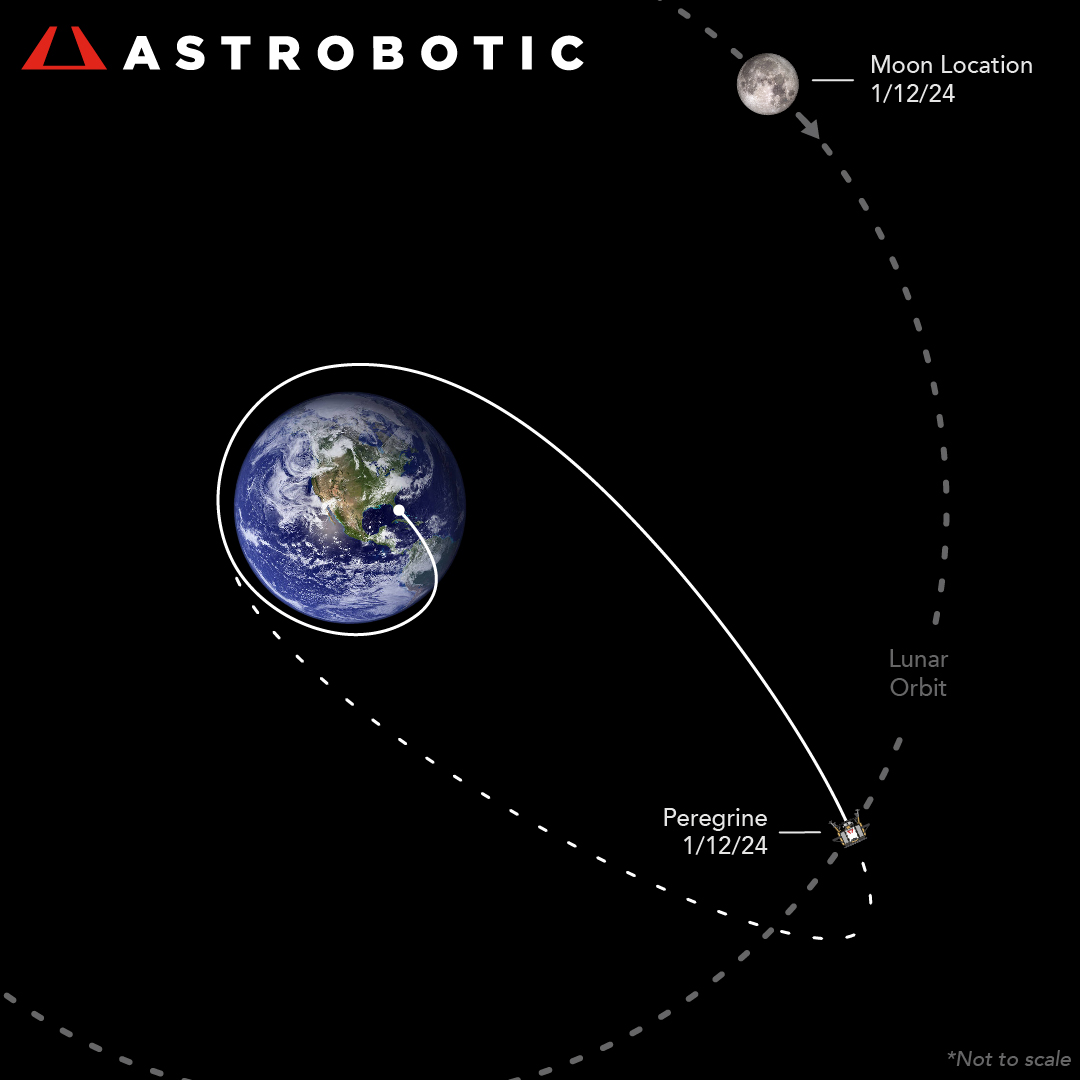
Because of launch delays for both of the American landers, Intuitive Machine’s Nova-C and Astrobotic’s Peregrine, SLIM will make its attempt first.
A Christmas pause: As I have done now for several years on Christmas day, I bring you the classic 1951 version of Charles Dickens’ A Christmas Carol, starring Alastair Sim. Still by far the best adaption of the book and a truly wonderful movie.
And as I noted in a previous year:
Dickens did not demand the modern version of charity, where it is imposed by governmental force on everyone. Instead, he was advocating the older wiser concept of western civilization, that charity begins at home, that we as individuals are obliged as humans to exercise good will and generosity to others, by choice.
It is always a matter of choice. And when we take that choice away from people, we destroy the good will that makes true charity possible.
It is also most important that we all heed the words of Christmas Present: ‘This boy is ignorance, this girl is want. Beware them both, but most of all beware this boy.’”
China late today used its Kuaizhou-1A solid-fueled rocket to place four weather satellites into orbit, lifting off from its Jiuquan spaceport in the northwest of China.
No word on where the rocket’s lower stages crashed within China. This launch is the first of four Chinese launches known to be scheduled in the next few days, part of China’s typical rush of launches that seems to happen at the end of every year.
The leaders in the 2023 launch race:
94 SpaceX
62 China
18 Russia
8 Rocket Lab
7 India
American private enterprise still leads China in successful launches 108 to 62, and the entire world combined 108 to 98. SpaceX in turn trails the rest of the world (excluding other American companies) 94 to 98.
I wrote this essay in 2018, to celebrate the fiftieth anniversary of the Apollo 8 mission to the Moon. I think it worth reposting again, especially because stories about Apollo 8 still refuse to show the Earthrise image as Bill Anders took it.
———————————————

Earthrise, as seen by a space-farer
Today is the fiftieth anniversary of the moment when the three astronauts on Apollo 8 witnessed their first Earthrise while in orbit around the Moon, and Bill Anders snapped the picture of that Earthrise that has been been called “the most influential environmental picture ever taken.”
The last few days have seen numerous articles celebrating this iconic image. While all have captured in varying degrees the significance and influence of that picture on human society on Earth, all have failed to depict this image as Bill Anders, the photographer, took it. He did not frame the shot, in his mind, with the horizon on the bottom of the frame, as it has been depicted repeatedly in practically every article about this image, since the day it was published back in 1968.
Instead, Anders saw himself as an spaceman in a capsule orbiting the waist of the Moon. He also saw the Earth as merely another space object, now appearing from behind the waist of that Moon. As a result, he framed the shot with the horizon to the right, with the Earth moving from right to left as it moved out from behind the Moon, as shown on the right.
His perspective was that of a spacefarer, an explorer of the universe that sees the planets around him as objects within that universe in which he floats.
When we here are on Earth frame the image with the horizon on the bottom, we immediately reveal our limited planet-bound perspective. We automatically see ourselves on a planet’s surface, watching another planet rise above the distant horizon line.
This difference in perspective is to me the real meaning of this picture. On one hand we see the perspective of the past. On the other we see the perspective the future, for as long humanity can remain alive.
I prefer the future perspective, which is why I framed this image on the cover of Genesis: the Story of Apollo 8 the way Bill Anders took it. I prefer to align myself with that space-faring future.
And it was that space-faring future that spoke when they read from Genesis that evening. They had made the first human leap to another world, and they wished to describe and capture the majesty of that leap to the world. They succeeded beyond their wildest dreams.
Yet, they were also still mostly Earth-bound in mind, which is why Frank Borman’s concluding words during that Christmas eve telecast were so heartfelt. He was a spaceman in a delicate vehicle talking to his home of Earth, 240,000 miles away. “And from the crew of Apollo 8, we close with good night, good luck, a Merry Christmas, and God bless all of you — all of you on the good Earth.” They longed deeply to return, a wish that at that moment, in that vehicle, was quite reasonable.
Someday that desire to return to Earth will be gone. People will live and work and grow up in space, and see the Earth as Bill Anders saw it in his photograph fifty years ago.
And it is for that time that I long. It will be a future of majesty we can only imagine.
Merry Christmas to all, all of us still pinned down here on “the good Earth.”
SpaceX today successfully launched two German military radar surveillance satellites, completing a planned three-satellite constellation, with its Falcon 9 rocket lifting off from Vandenberg Space Force Base in California.
The first stage completed its eighth flight, landing back at Vandenberg.
This launch almost certainly in the past would have launched on a Arianespace rocket, but Arianespace presently has no operational rocket, its Ariane-5 rocket retired and its Ariane-6 rocket not yet operational. Furthermore, its Vega and Vega-C rockets are grounded due to launch failures, and its partnership with Russia ended with Russia’s invasion of the Ukraine. Thus, SpaceX gets the business, being less expensive than ULA (which also has no rockets available right now to handle this launch) and there being no other company capable of launching such a payload.
The leaders in the 2023 launch race:
94 SpaceX
61 China
18 Russia
8 Rocket Lab
7 India
American private enterprise now leads China in successful launches 108 to 61, and the entire world combined 108 to 97. SpaceX now trails the rest of the world (excluding other American companies) 94 to 97.
Early on December 23, 2023 SpaceX successfully launched another 23 Starlink satellites, its Falcon 9 rocket lifting off from Cape Canaveral.
The first stage successfully completed its 19th flight, landing on a drone ship in the Atlantic. This reuse was new record. In fact, the reuse numbers of SpaceX’s fleet Falcon 9 first stages are beginning to resemble the reuse numbers of NASA’s shuttle fleet, and are doing so in a significantly shorter period of time and for a lot less money.
The leaders in the 2023 launch race remain the same:
93 SpaceX
61 China
18 Russia
8 Rocket Lab
7 India
American private enterprise now leads China in successful launches 107 to 61, and the entire world combined 107 to 97. SpaceX now trails the rest of the world (excluding other American companies) 93 to 97.
Embedded below the fold in two parts.
To listen to all of John Batchelor’s podcasts, go here.
» Read more
An evening pause: Makes me think of Disney’s Peter Pan (1953) and Miyazaki’s My Neighbor Totoro (1988), about how some things only children can see.
Hat tip Judd Clark.
Courtesy of BtB’s stringer Jay. Early today because Diane and I have a social event this afternoon and I want this posted before we leave. It is the holiday season, which has made it hard for me to write any political essays yesterday or today.
Years late, it does look like Vulcan will finally launch in early January. Let us all pray all goes well.
Jonathan McDowell, who tweets this, has been tracking objects launched and in orbit for decades, so his suppositions carry weight.
It appears to me that these test legs are not full scale. It is also interesting how they bounce when they come down.
This post provides no video of the test, and is merely a tease for the video’s release next month. Why they can’t release it now suggests they want to do some clean-up and editing beforehand, which raises other questions.
Gee, maybe invading the Ukraine and cancelling its deal with OneWeb and Arianespace might not have been such a good idea, eh? The lost revenue, in the billions, might have helped pay for this.
This was hardly one of the most important firsts achieved during Apollo 8, but the imagery, as Jay notes, is cool. For the full history of Apollo 8’s 1968 manned Christmas mission to the Moon, read Genesis, the Story of Apollo 8.