Scientists: Suspended iron minerals floating in Venus’s atmosphere explain dark UV streaks
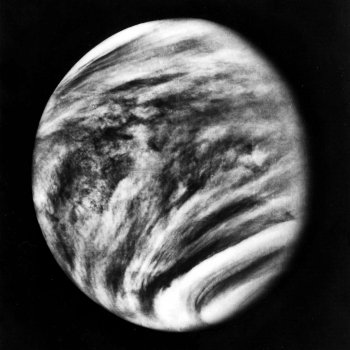
Venus as seen in ultraviolet by Mariner 10, February 5, 1974
Venus as seen in ultraviolet by Mariner 10,
February 5, 1974

The uncertainty of science: Since the mid-1970s scientists have been trying to figure out the cause of the dark streaks seen in the atmosphere of Venus when photographed in ultraviolet. The image to the right was the first such UV image, taken by Mariner 10 during its fly-by on its way to Mercury. These streaks are caused by some unknown material that absorbs the UV light.

Researchers have now proposed that two different iron-bearing minerals, floating in Venus’s atmosphere, are what cause these dark UV streaks. From the absract:

Our results demonstrate that ferric iron can react with sulfuric acid to form two mineral phases: rhomboclase [(H5O2)Fe(SO4)2Β·3H2O] and acid ferric sulfate [(H3O)Fe(SO4)2]. A combination of these two mineral phases and dissolved Fe3+ in varying concentrations of sulfuric acid are shown to be good candidates for explaining the 200- to 300-nm and 300- to 500-nm features of the reported unknown UV absorber.

Iron has been detected in the atmosphere previously, and is theorized could come from volcanic eruptions on the planet’s million-plus volcanoes.

This new hypothesis explaining the dark UV absorber however remains unconfirmed, and joins a list of other candidates for that absorber, many of which propose either iron or sulfur in different combinations. Because so little data really exists about the atmosphere of Venus, with what is known also uncertain, it is presently impossible to solve this mystery with confidence. The problem is made even more difficult in that scientists understand almost nothing about the chemistry of materials under the conditions seen in Venus’s atmosphere, which is extremely hot (800 degrees Fahrenheit) and very thick and dense (100 times that of Earth).

1 comment

ULA’s Vulcan rocket successfully places payload in orbit on first launch

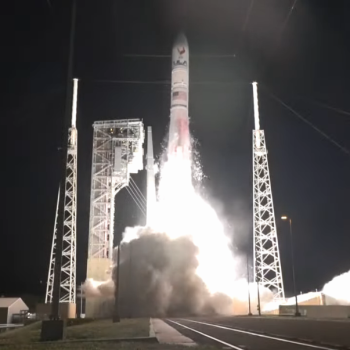
Vulcan at liftoff.
Vulcan at liftoff.

After four years of delay, mostly caused by delays at Blue Origin in delivering the two BE-4 engines used in the first stage, ULA’s Vulcan rocket finally completed its first launch early on January 8, 2024, lifting off from Cape Canaveral and successfully placing Astrobotic’s Peregrine lunar lander into orbit.

As of posting the upper stage had just deployed Peregrine, which will leave Earth orbit in about four days using its own engines. The upper stage has one more burn to send it into solar orbit, carrying the ashes of numerous people for the company Celestis.

The 2024 launch race:

3 SpaceX
1 India
1 China
1 ULA

For ULA, this launch is a very big deal. It is the first of two required in order for the Space Force to certify the rocket for future military launches. It also positions the company to begin the many launches that Amazon has awarded it to place into orbit a large percentage of that company’s Kuiper internet satellite constellation, assuming of course Blue Origin can deliver on schedule the many BE-4 engines that ULA will require.

This launch will also likely lead to the sale of ULA. » Read more

10 comments

NASA: UAE to build airlock module for lunar station plus have astronaut fly there

According to a press release from NASA today, the United Arab Emirates (UAE) will build the airlock module for the Lunar Gateway space station plus have one astronaut fly a mission to the station after it is built.

Under a new implementing arrangement expanding their human spaceflight collaboration with NASA through Gateway, MBRSC will provide Gateway’s Crew and Science Airlock module, as well as a UAE astronaut to fly to the lunar space station on a future Artemis mission.

I strongly suspect that the UAE will mostly pay for this module to be built, hiring outside contractors from either the U.S. or Europe to do the work.

4 comments

January 5, 2023 Quick space links

Courtesy of BtB’s stringer Jay.


1 comment

Canyons formed from the giant crack that splits Mars

Canyons formed by the giant crack that splits Mars
Click for original image.

Cool image time! The photo to the right, cropped, reduced, and sharpened to post here, was taken on September 22, 2023 by the high resolution camera on Mars Reconnaissance Orbiter (MRO). It shows a complex of north-south trending canyons, with easternmost cliff about 400 feet high (though the full drop to the large canyon on its east is closer to 800 feet).

These canyons however have nothing to do with ice or water flow. They were formed by underground tectonic forces that pushed the ground upward, forced it to split and form cracks. Those cracks in turn produced these canyons. In some cases, such as the depression on top of the central ridge, the formation process probably occurred because fissures formed below ground, causing the surface to sag.

As always, the hiker in me wants to walk up the nose of that ridge and then along its western edge, with the western canyon on my left and that smaller depression on my right.

The larger context of this location is in itself even more spectacular.
» Read more

0 comments

SpaceX sues to have NLRB complaint dismissed

SpaceX yesterday filed a lawsuit in the federal courts to have the employee complaint filed by the National Labor Relations Board (NLRB) dismissed as a violation of the company’s fifth and seventh amendment rights as well as article II of the Constitution.

You can read SpaceX’s lawsuit here [pdf]. It specifically lists as defendants the board members of the NLRB, as well as the unnamed administrative judge who will run the NLRB’s case, once it begins.

The SpaceX lawsuit is interesting in that it challenges the very legal structure that has established the NLRB, stating that its actions are illegal because that structure forbids the President from having full control over its actions, as required by article II of the Constitution.

Whether this lawsuit succeeds is of course unknown, but its quick filing tells us that SpaceX was prepared for this NLRB action, even before it was filed. It also tells us that the company now recognizes the overall threat to it by the Biden administration, which appears to be trying to weaponize every agency in the federal government to destroy the company, and is prepared to fight long and hard against this abuse of power.

6 comments

Japan’s XRISM X-ray space telescope releases first data

Supernova remnant N132D, as seen in X-rays
Click for original image.

Japan’s XRISM X-ray space telescope, which launched in September, has now released first data and images.

One image showed the wide field view of the telescope’s Xtend imager, capable of viewing in X-rays an area of the sky 60% larger than the Moon. The second, shown to the right, provided a false color image of a supernova remnant in the Large Magellanic Cloud along with spectroscopy that data provided. According to the caption, “the spectrum reveals peaks associated with silicon, sulfur, argon, calcium, and iron.”

These pictures were produced during the telescope’s check-out period since launch. The mission, though Japanese-led, is being managed by NASA’s Goddard Space Flight Center, which is now accepting observation proposals for a full science schedule of observations to begin in the summer of this year.

1 comment

Researchers propose method for removing toxic perchlorates from Martian water

Of the twelve research grants just awarded by NASA to develop a variety of new technologies for astronomy and future space exploration, one proposes a new method for removing the toxic perchlorates that are thought to exist in all Martian water.

What if we could make the perchlorates just vanish? This is the innovative solution we propose here, taking advantage of the reduction of chlorate and perchlorate to chloride and oxygen being thermodynamically favorable, if kinetically slow. This is the promise of our regenerative perchlorate reduction system, leveraging synthetic biology to take advantage of and improve upon natural perchlorate reducing bacteria.

These terrestrial microbes are not directly suitable for off-world use, but their key genes pcrAB and cld, which catalyze the reduction of perchlorates to chloride and oxygen, have been previously identified and well-studied. This proposed work exploits the prior work studying perchlorate-reducing bacteria by engineering this perchlorate reduction pathway into the spaceflight proven Bacillus subtilis strain 168, under the control of a robust, active promoter. This solution is highly sustainable and scalable, and unlike traditional water purification approaches, outright eliminates perchlorates rather than filtering them to dump somewhere nearby.

Essentially the researchers will try to engineer bacteria known to be able to survive space so that it carries genes from another microbe able of changing the perchlorate into chloride and oxygen.

This study as well as the other eleven are only in phase one of their contracts, with the award of later phases determined by their initial successes or failures.

3 comments

Japan delays launch of Mars sample return mission due to problems with its H3 rocket

Japan’s space agency JAXA last week officially delayed the launch of its MMX Mars sample return mission, from later this year until the next Mars launch window in 2026.

A September 2024 launch would have seen MMX reach the Red Planet in August 2025 and return to Earth with around 0.35 oz (10 grams) of samples of the Mars moon Phobos in 2029. But the mission now must wait until the next Mars launch window opens in late 2026; its samples are slated to reach Earth in 2031.

The delay is because of JAXA’s ongoing problems getting its new H3 rocket off the ground. The first test launch last year failed, and though the next launch attempt is now scheduled for February, the agency decided it wanted more time to prove out the rocket before putting the Mars mission on it.

This decision once again highlights the overall failure of JAXA to produce for Japan a viable space effort. It is long past time for the Japanese government to take control from this agency, and allow the private sector to compete freely for business. Right now Japan’s continuing failures in space are downright embarrassing, compared to its Asian neighbors of China, India, and South Korea.

0 comments

NASA and one private company respond to Navaho nation’s demand to cancel lunar mission

Both NASA and one of the private companies involved in ULA’s first Vulcan rocket launch on January 8, 2023 that will carry the Astrobotic’s Peregrine lunar lander to the Moon have now responded to the Navaho nation, which has stated its religion gives it the unlimited right to decide what can go there.

Navaho President Buu Nygren had claimed earlier this week that the β€œMoon is sacred to numerous Indigenous cultures” and the payloads of human ashes being sent to the Moon was “tantamount to desecration.” He demanded the mission be delayed or canceled.
» Read more

16 comments

China’s Kuaizhou-1A solid-fueled rocket launches four weather satellites

China today successfully completed its first launch in 2024, its Kuaizhou-1A solid-fueled rocket lifting off from its Jiuquan spaceport in northwest China carrying four weather satellites.

No information was released about where the rocket’s lower stages crashed inside China. Nor did China’s state run press provide any information on the payloads, other than to say they will most be “used to provide commercial meteorological data services.”

The 2024 launch race:

2 SpaceX
1 India
1 China

2 comments

Jara – Tiempo y Silencio

An evening pause: In English the song is “Time and Silence.” Lyrics:

A house in the sky
A garden in the sea
A lark in your chest
a return of the begin

A wish of stars
A sparrow’s heartbeat
An island in your bed
A sunset

Time and silence
Screams and songs
Heaven and kisses
Voice and grief

To be born in your laugh
To grow in your weeping
To live on your shoulder
To die in your arms

Hat tip Judd Clark

0 comments

January 4, 2024 Quick space links

Courtesy of BtB’s stringer Jay.


0 comments

Can the Democrats offend enough people to make even their aggressive election tampering impossible?

Are Americans finally waking up and emulating their country's founders?

I normally pay little attention to polls, since for the last two decades they have not only been unreliable but generally weighted unfairly against Republicans. More often than not they have been used not to give us a sense of the state of the political campaign but to make us all believe a Democratic Party victory was inevitable.

However, a poll this week was so astonishing that I think it deserves some discussion. According to a national USA Today-Suffolk University poll published on January 2, 2023 by USA Today, large numbers of blacks, Hispanics, and young voters are now willing to abandon the Democratic Party, and do so in numbers that are shocking and unprecedented. As noted in this article about the poll,
» Read more

23 comments

John Batchelor highlights Genesis: The Story of Apollo 8

At 11 pm (Eastern) during the third hour of John Batchelor’s show tonight and tomorrow he will air a long two hour interview with me discussing my book Genesis: The Story of Apollo 8. After many years he finally decided his listeners deserved a full discussion of what is to many the most historically important Apollo mission to the Moon. It might not have landed on the Moon but what the astronauts accomplished and said changed the nation, and will likely be remembered forever.

Tune in if you are interested. Even better, consider reading the book. In fact, the best thing of all would be to give the book to any high school students in your family. They will learn more about American history and the Cold War by reading it than they get nowadays from their entire public school education.

I will also embed the podcasts here when they become available.

4 comments

The mining potential on Mars

The mining potential on Mars
Click for original image.

Cool image time! The picture to the right, cropped, reduced, and sharpened to post here, was taken on October 30, 2023 by the high resolution camera on Mars Reconnaissance Orbiter (MRO). Labeled simply as a “terrain sample,” it was probably taken not as part of any specific research project but to fill a gap in the schedule in order to properly maintain the camera’s temperature.

Nonetheless, the larger region where this photo is located is one of great interest to scientists as well as to future explorers. First note the colors. The wide variations between the bright orange of that peak (only a few tens of feet high) and the light orange and aqua-green of the bedrock to the north and south suggest a terrain with a lot of different materials within it.

The location is in the dry equatorial regions, so the swirls visible on the plateaus north and south of that small peak are not related to near surface ice. Instead, this is warped bedrock, with those swirls also suggesting material of a varied nature, exposed to the surface by erosion processes.
» Read more

1 comment
1 273 274 275 276 277 1,765