
Glacier country on Mars
Click for full image.
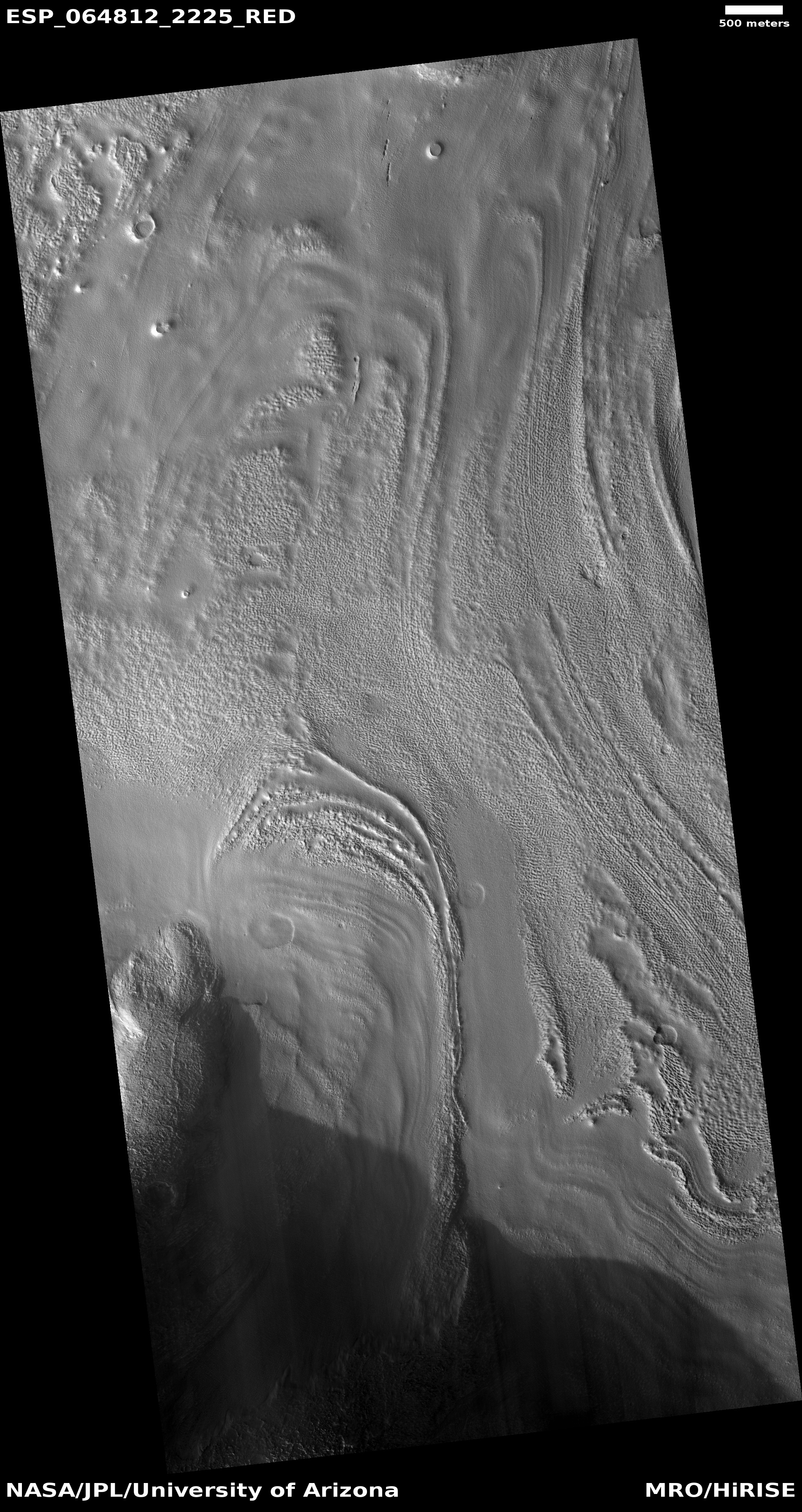
Cool image time! The photo to the right, rotated, cropped, and reduced to post here, was taken on May 24, 2020 by the high resolution camera on Mars Reconnaissance Orbiter (MRO), and provides a wonderful example of the kind of evidence of buried glaciers found extensively in the mid-latitudes of Mars.
This particular region, called Protonilus Mensae, is a region of chaos terrain at the transition zone between the southern cratered highlands and the northern lowland plains. I have featured a number of cool images in Protonilus, all of which show some form of buried glacial flow, now inactive.
- 1. Buried glaciers flowing off of Martian mesa
- 2. Brain Terrain on Mars
- 3. How to spot a glacier on Mars
The last cool image above was one that the MRO science team had picked to illustrate how to spot a glacier on Mars.
In this particular image are several obvious glacier features. First, we can see a series of moraines at the foot of each glacier in the photo, each moraine indicating the farthest extent of the glacier when it was active and growing. It also appears that there are two major layers of buried ice, the younger-smaller layer near the image’s bottom and sitting on top of a larger more extensive glacier flow sheet. This suggests that there was more ice in the past here, and with each succeeding ice age the glaciers grew less extensive.
Second, at the edges of the flows can be seen parallel ridges, suggestive also of repeated flows, each pushing to the side a new layer of debris.
Third, the interior of the glacier has parallel fractures in many places, similar to what is seen on Earth glaciers.
Protonilus Mensae, as well as the neighboring chaos regions Deuteronilus to the west and Nilosyrtis to the east, could very well be called Mars’ glacier country. Do a search on Behind the Black for all three regions and you will come up with numerous images showing glacial features.
Below is an overview of Protonilus, the red box showing the location of this image. Also highlighted by number are the locations of the three features previously posted and listed above.
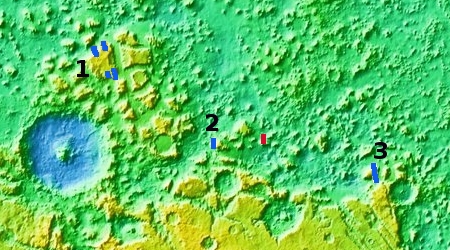
If you go to the MRO archive of images from its high resolution camera and go specifically to this location (link here), you will get access to all the high resolution photos so far taken of Protonilus. Click on any red box at this archive and you will see a different MRO image that invokes the same glacial features. If I wanted to, I could post a cool glacier image for practically every single one.
It truly appears that buried inactive glaciers are flowing down the sides of all the mesas, buttes, and hills in Protonilus. I suspect that in the future, when Mars is well settled, the colonists will come here in large numbers to mine for water. It will amply available.
I also suspect that many will stay gladly, because this terrain of buttes, mesas, and canyons is also dramatic and beautiful. And from here, at the transition zone, it will be a short journey north to the lowland plains, or south to the cratered highlands.

On Christmas Eve 1968 three Americans became the first humans to visit another world. What they did to celebrate was unexpected and profound, and will be remembered throughout all human history. Genesis: the Story of Apollo 8, Robert Zimmerman's classic history of humanity's first journey to another world, tells that story, and it is now available as both an ebook and an audiobook, both with a foreword by Valerie Anders and a new introduction by Robert Zimmerman.
The print edition can be purchased at Amazon or from any other book seller. If you want an autographed copy the price is $60 for the hardback and $45 for the paperback, plus $8 shipping for each. Go here for purchasing details. The ebook is available everywhere for $5.99 (before discount) at amazon, or direct from my ebook publisher, ebookit. If you buy it from ebookit you don't support the big tech companies and the author gets a bigger cut much sooner.
The audiobook is also available at all these vendors, and is also free with a 30-day trial membership to Audible.
"Not simply about one mission, [Genesis] is also the history of America's quest for the moon... Zimmerman has done a masterful job of tying disparate events together into a solid account of one of America's greatest human triumphs."--San Antonio Express-News