
Martian glacier flowing around a recent small crater impact

Click for original image.
Cool image time! The picture to the right, cropped, reduced, and enhanced to post here, was taken on May 3, 2026 by the high resolution camera on Mars Reconnaissance Orbiter (MRO).
The science team labels this a “crater on debris covered glacier.” The crater, the dark spot in the upper center, is only about 450 feet across. The impact apparently took place onto this glacial slope, and since then the glacier has continued to flow downhill (as indicated by the arrows), flowing around the denser material pounded down by the impact.
The elevation loss within this image is about 300 feet, along a distance of just under two miles. How long it took this glacial material to flow this much however is unknown. Nor is it known when this happened. The orbital data so far of all Martian glaciers suggests they are at this time inactive, neither growing or shrinking.
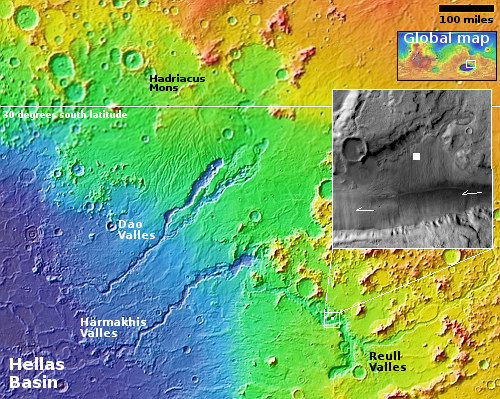
The white dot in the rectangle on the overview map to the right marks the location, on the northern interior slope of the long Reull Valles, one of several glacial filled canyons that flow down the eastern slopes of Hellas Basin, the death valley of Mars.
Though the downhill grade is to the south in the picture above, in the canyon itself the flow is from east to west. It appears that this east-west flow has acted over the eons to wear away at the northern canyon wall, causing it to flow downward to the south, where its glacial material and surface debris merges with the main glacier.
Why the glacier appears to flow around this particular impact crater, but appears undisturbed by several other craters and protruding peaks, is a question I cannot answer. It suggests to me that maybe this particular bolide was more dense than the others (maybe a metal asteroid?), and thus able to block the glacial flow more effectively. This however is an utter guess, not to be taken very seriously.

On Christmas Eve 1968 three Americans became the first humans to visit another world. What they did to celebrate was unexpected and profound, and will be remembered throughout all human history. Genesis: the Story of Apollo 8, Robert Zimmerman's classic history of humanity's first journey to another world, tells that story, and it is now available as both an ebook and an audiobook, both with a foreword by Valerie Anders and a new introduction by Robert Zimmerman.
The print edition can be purchased at Amazon or from any other book seller. If you want an autographed copy the price is $60 for the hardback and $45 for the paperback, plus $8 shipping for each. Go here for purchasing details. The ebook is available everywhere for $5.99 (before discount) at amazon, or direct from my ebook publisher, ebookit. If you buy it from ebookit you don't support the big tech companies and the author gets a bigger cut much sooner.
The audiobook is also available at all these vendors, and is also free with a 30-day trial membership to Audible.
"Not simply about one mission, [Genesis] is also the history of America's quest for the moon... Zimmerman has done a masterful job of tying disparate events together into a solid account of one of America's greatest human triumphs."--San Antonio Express-News