
Strange flows on the flanks of a small isolated Martian mound

Click for original image.
Cool image time! The picture to the right, cropped, enhanced, and rotated so that north is to the top, was taken on May 30, 2026 by the high resolution camera on Mars Reconnaissance Orbiter (MRO).
This mound is small, only about 150 to 600 feet high, depending on where you mark the base. The science team labels the curved black arcs that cover the mound’s northern slopes as “small scale lobes,” suggesting they think these curves mark the foot of multiple small landslides, or more accurately described as “mass-wasting events,” as instead of an avalanche of discreet boulders and rocks, the slide is comprised of mud-like material sliding downhill en masse.
The black material at the foot of these slides as well as on the mound’s peak and south and eastern flanks is a bit more puzzling. The overview map below provides one possible explanation, but leaves us with other more tantalizing possibilities.
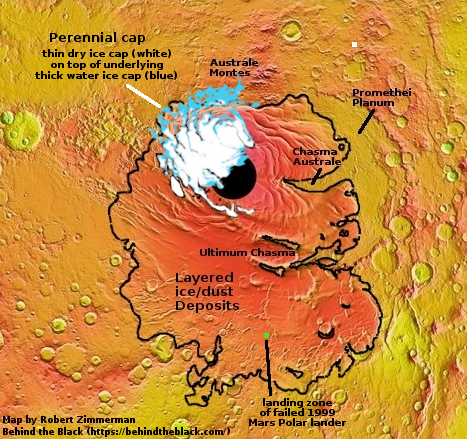
The white dot in the upper right marks the location, at about 75 degrees south latitude about 540 miles from the Martian south pole.
At this latitude orbital data has found ample evidence of near-surface ice. Similar black stains as seen here are often caused when the dry ice mantle that falls as snow in the high latitudes during winter sublimates into gas in the spring. The dry ice sublimates from the bottom up, with the gas bursting out at weak spots in the mantle, the gas pressure causing it to crack. With each burst the gas spreads such stains on adjacent ground. As it was spring at this location when the photo was taken, it is quite likely we are looking at such a process.
However, there is another possibility that must be considered, though unlikely. Orbital data has also found similar dark stains in the dry equatorial regions of Mars, in what I call volcano country because the dominant geological feature is flood lava that covers the surface for thousands of miles. Those stains however were not caused by CO2 sublimation. Located around fissures resembling volcanic vents, scientists instead think they are the evidence of a small volcanic event some 50,000 to 210,000 years ago.
Thus, it is also possible this mound is a small volcano, and the dark splotches and curves are evidence of vented lava from below.
Finally, the answer could actually be both. This mound might be a volcano, but instead of lava it is venting sublimated CO2 and water.

On Christmas Eve 1968 three Americans became the first humans to visit another world. What they did to celebrate was unexpected and profound, and will be remembered throughout all human history. Genesis: the Story of Apollo 8, Robert Zimmerman's classic history of humanity's first journey to another world, tells that story, and it is now available as both an ebook and an audiobook, both with a foreword by Valerie Anders and a new introduction by Robert Zimmerman.
The print edition can be purchased at Amazon or from any other book seller. If you want an autographed copy the price is $60 for the hardback and $45 for the paperback, plus $8 shipping for each. Go here for purchasing details. The ebook is available everywhere for $5.99 (before discount) at amazon, or direct from my ebook publisher, ebookit. If you buy it from ebookit you don't support the big tech companies and the author gets a bigger cut much sooner.
The audiobook is also available at all these vendors, and is also free with a 30-day trial membership to Audible.
"Not simply about one mission, [Genesis] is also the history of America's quest for the moon... Zimmerman has done a masterful job of tying disparate events together into a solid account of one of America's greatest human triumphs."--San Antonio Express-News