
Webb detects methane being released by interstellar comet 3I/Atlas
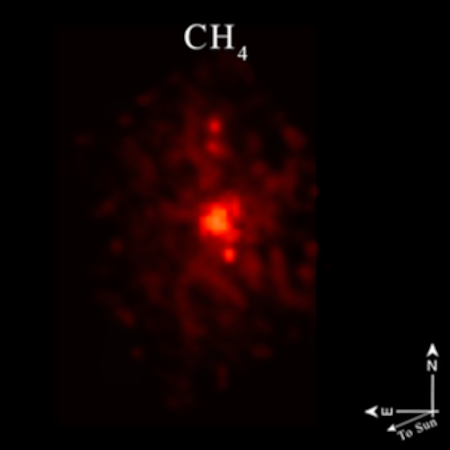
Comet 3I/Atlas’s methane as seen by Webb.
Click for full image.
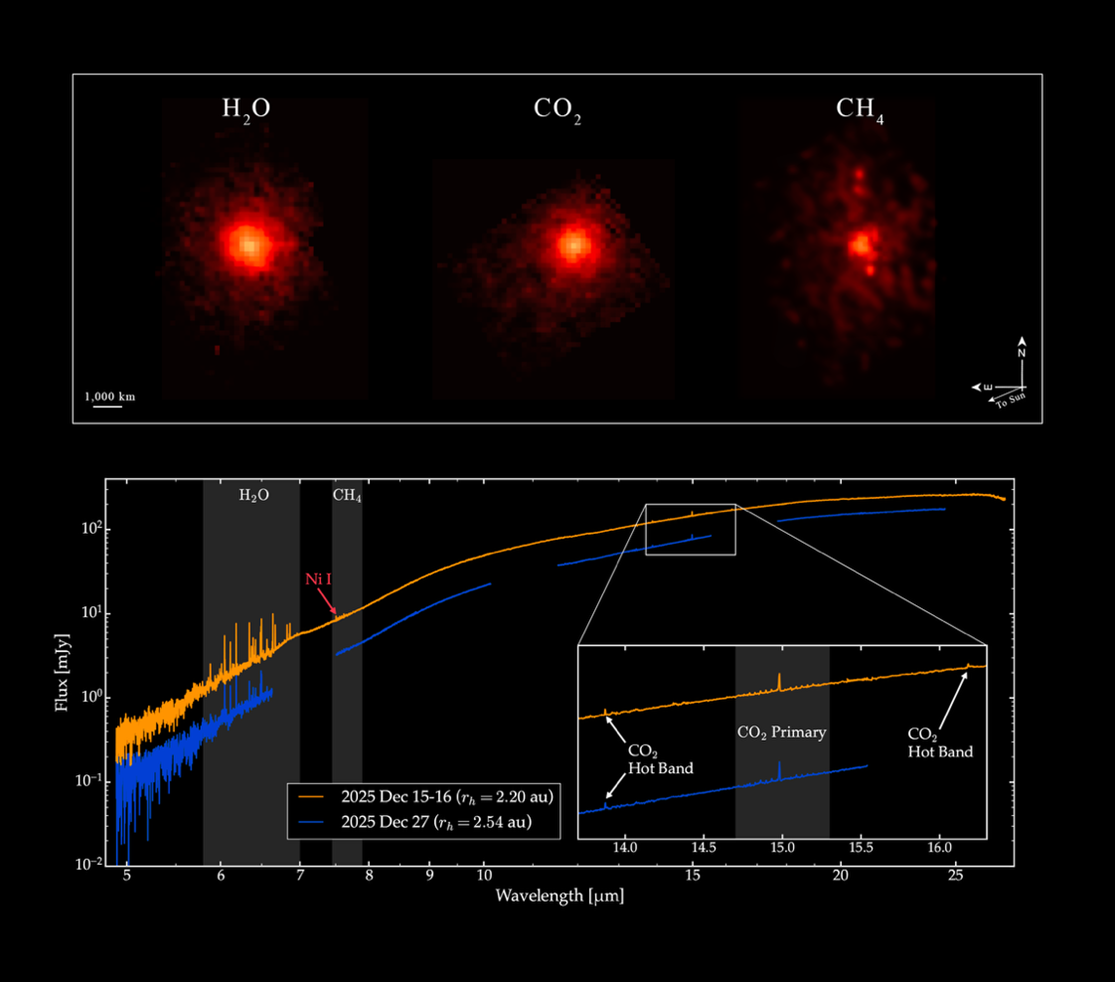
Using the Webb Space Telescope, astronomers have now detected methane in the cloud of material released by the interstellar comet 3I/Atlas as it zipped past the Sun last fall.
The observations were taken using Webb’s MIRI (Mid-Infrared Instrument) on two separate dates as the comet traveled back out of our solar system after whipping around the Sun (post-perihelion). The first observation occurred Dec. 15 to 16, when the comet was about 205 million miles from the Sun. This was followed by a second observation Dec. 27, when the comet was about 236 million miles from the Sun.
For the first time on an interstellar visitor, Webb directly detected methane gas. Methane is highly volatile, meaning it sublimates from solid ice into a gas very easily. Its delayed appearance in comet 3I/ATLAS suggests it was buried below the comet’s top surface layer and protected from sublimation until heat from the comet’s close pass to the Sun reached deeper parts of the icy subsurface. The amount of methane relative to water found is surprisingly high, with few similar analogs in our own solar system.
Webb’s observations also confirmed that comet 3I/ATLAS remains unusually rich in carbon dioxide, releasing far more carbon dioxide relative to water when compared to typical solar system comets.
You can read their peer-reviewed paper here [pdf]. This new data confirms that Comet 3I/Atlas is not from our solar system, as its make-up is sufficiently different from solar system comets to show this. It also gives us a hint as to the solar system it came from. At the same time, the comet’s behavior is remarkably similar to solar system comets, suggesting our solar system evolved much like others.

On Christmas Eve 1968 three Americans became the first humans to visit another world. What they did to celebrate was unexpected and profound, and will be remembered throughout all human history. Genesis: the Story of Apollo 8, Robert Zimmerman's classic history of humanity's first journey to another world, tells that story, and it is now available as both an ebook and an audiobook, both with a foreword by Valerie Anders and a new introduction by Robert Zimmerman.
The print edition can be purchased at Amazon or from any other book seller. If you want an autographed copy the price is $60 for the hardback and $45 for the paperback, plus $8 shipping for each. Go here for purchasing details. The ebook is available everywhere for $5.99 (before discount) at amazon, or direct from my ebook publisher, ebookit. If you buy it from ebookit you don't support the big tech companies and the author gets a bigger cut much sooner.
The audiobook is also available at all these vendors, and is also free with a 30-day trial membership to Audible.
"Not simply about one mission, [Genesis] is also the history of America's quest for the moon... Zimmerman has done a masterful job of tying disparate events together into a solid account of one of America's greatest human triumphs."--San Antonio Express-News