More rumors about a year-long mission on ISS

The possibility that NASA might finally agree with Russia’s repeated request to fly a year-long mission to ISS grew stronger this morning with two stories:

The first, by James Oberg, digs into the underworld of NASA politics to find that plans might very well be more advanced than NASA is letting on:
» Read more

1 comment

Cave exploration the astronaut way

How not to go cave exploring:

An international crew of six astronauts will start training for a caving adventure designed to prepare them for spaceflight. CAVES, an abbreviation of Cooperative Adventure for Valuing and Exercising human behaviour and performance Skills, prepares astronauts to work safely and effectively and solve problems as a multicultural team while exploring uncharted areas using space procedures.

Or to put it more bluntly, overly complicated, bureaucratically organized, and not very efficient. For example:
» Read more

2 comments

Armstrong and the world

In space, science, and technology, there really is very little new news to report today. Instead, almost all the stories are about the passing of Neil Armstrong. On spacetoday.net alone I count almost seventy stories on Armstrong, practically everything posted since yesterday, And that is only a sampling.

This response tells us several things.
» Read more

1 comment

Neil Armstrong

I think the gracious statement by Neil Armstrong’s family sums up his life quite well.

We are heartbroken to share the news that Neil Armstrong has passed away following complications resulting from cardiovascular procedures.

Neil was our loving husband, father, grandfather, brother and friend.

Neil Armstrong was also a reluctant American hero who always believed he was just doing his job. He served his Nation proudly, as a navy fighter pilot, test pilot, and astronaut. He also found success back home in his native Ohio in business and academia, and became a community leader in Cincinnati.

He remained an advocate of aviation and exploration throughout his life and never lost his boyhood wonder of these pursuits.

As much as Neil cherished his privacy, he always appreciated the expressions of good will from people around the world and from all walks of life.

While we mourn the loss of a very good man, we also celebrate his remarkable life and hope that it serves as an example to young people around the world to work hard to make their dreams come true, to be willing to explore and push the limits, and to selflessly serve a cause greater than themselves.

For those who may ask what they can do to honor Neil, we have a simple request. Honor his example of service, accomplishment and modesty, and the next time you walk outside on a clear night and see the moon smiling down at you, think of Neil Armstrong and give him a wink.

6 comments

Sunspots and climate

Scientists have found new evidence that the solar sunspot cycle has influenced the Earth’s climate in the recent past.

Sirocko and his colleagues found that between 1780 and 1963, the Rhine froze in multiple places fourteen different times. The sheer size of the river means it takes extremely cold temperatures to freeze over making freezing episodes a good proxy for very cold winters in the region, Sirocko said.

Mapping the freezing episodes against the solar activity’s 11-year cycle β€” a cycle of the Sun’s varying magnetic strength and thus total radiation output β€” Sirocko and his colleagues determined that ten of the fourteen freezes occurred during years when the Sun had minimal sunspots. Using statistical methods, the scientists calculated that there is a 99 percent chance that extremely cold Central European winters and low solar activity are inherently linked.

Also this:
» Read more

4 comments

The mysterious dark streaks on Vesta

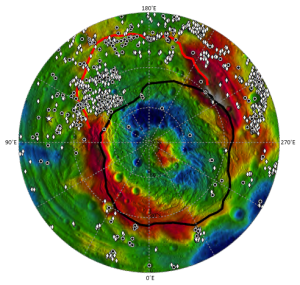
dark material on Vesta

In a preprint paper published today at the Los Alamos astro-ph website, scientists have taken a detailed look at the mysterious dark streaks seen by Dawn on the surface of the asteroid Vesta and have concluded that the material comes from impacts, not from volcanic activity.

The scientists also concluded that

the majority of the spectra of [dark material] are similar to carbonaceous chondrite meteorites mixed with materials indigenous to Vesta.

Carbonaceous chondrite meteorites are considered to be the most primeval material in the solar system. This means that Vesta has the potential to give scientists a convenient laboratory for studying that primeval material and the early formation of the solar system. Ideally, the best way to do this would of course be to go there.

The scientists also theorize that much of this material was brought to Vesta by a single large impact.
» Read more

0 comments

Politicians who don’t want to do their job

The Houston Chronicle today has an editorial entitled “Let’s bring logic to NASA’s budget process” which describes and supports a bill introduced by two Republican Congressmen which would

model NASA’s budget process after that used by the Federal Bureau of Investigation. Doing so would make the agency less political and more professional. It calls for the president to appoint the NASA director to a 10-year term and would make the budget cycle multiyear rather than annual.

The editorial also quotes sponsor Congressman Frank Wolf (R-Virginia) as explaining the goal of the bill is ” to take the politics out of NASA … and create continuity in the space agency.”

Bah. The last thing I want is to take the politics out of NASA’s operations.
» Read more

4 comments

The Sun continues to fizzle

Yesterday NOAA posted its monthly update of the ongoing sunspot cycle of the Sun. You can see this latest graph, covering the month of July, below the fold.

As we have seen now for almost four years, the Sun continues to under-perform the predictions of solar scientists when it comes to the number of sunspots it is producing. In fact, that the sunspot number did not rise in July is surprising, as July had appeared to be a very active month for sunspots, with some of the strongest solar flares and coronal mass ejections seen in years. Instead, the number declined ever so slightly.
» Read more

3 comments

The new Mars rover…

Tonight at 10:30 pm (Pacific), the new Martian rover Curiosity will hopefully touch down safely on the Martian surface to begin several years of research in the crater Gale.

What has been most amazing to me is the amount of interest in this landing by the press, especially the mainstream press. Normally these outlets don’t care that much for space exploration, a trend that began after the Apollo 11 landing in 1969 when it became trendy in liberal circles to down play space exploration so that “the money could instead be spent solving our problems here on Earth.”

Today, however, I count more than forty news articles on this upcoming landing, most of which come from mainstream sources. It seems that these outlets have finally discovered something that has been obvious from the beginning: the American public is fascinated with space exploration, and if you want to attract readers, it is better to provide coverage of what interests them rather than push a political agenda that few agree with.

Anyway, if you want to follow the landing live, go here for a full outline of options. Or go directly to NASA TV. Most of what you will see will the control room at JPL, with many engineers staring at computer screens waiting to find out if the landing was a success, about twenty minutes after it took place. This is because it will take that long for the communications signals to travel from Mars to the Earth. Essentially, Curiosity is on its own in this landing.

2 comments

Have astronomers found a future supernova?

A press release from the Carnegie Institute today described a recent paper by astronomers that might have identified a star in the Milky Way that might go supernova sometime in the future. The star QU Carinae, is a cataclysmic variable, a binary system in which material dumped from one star onto another periodically causes an outburst of X-rays.

I emailed Stella Kafka, the lead scientist of the research paper, to find out how far away QU Carinae is and how soon it might go supernova. She responded as follows:
» Read more

0 comments

A journalist takes objective look at global warming

For the past week there has been a new spat of articles written about human caused global warming, instigated by an op-ed (subscription required) written by scientist Richard Muller in the New York Times, where he wrote:

Three years ago I identified problems in previous climate studies that, in my mind, threw doubt on the very existence of global warming. Last year, following an intensive research effort involving a dozen scientists, I concluded that global warming was real and that the prior estimates of the rate of warming were correct. I’m now going a step further: Humans are almost entirely the cause.

Not surprisingly, the mainstream press has jumped on this op-ed and the public release of new data by Muller’s team as further proof that the debate over global warming is settled and we should all bow to our governmental overlords and agree to any regulations they propose to save the planet.

Not so fast.
» Read more

3 comments

Water Ice in Shackleton Crater?

Ice in Shackleton?

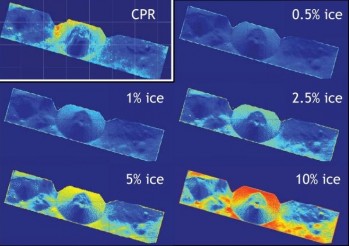
New results from the radar instrument on Lunar Reconnaissance Orbiter (LRO) has found evidence of water-ice on the slopes of Shackleton Crater, located at the Moon’s south pole. The paper, published on Saturday in Geophysical Research Letters – Planets, suggested that about 5 to 10 percent of the weight of the material on the slopes of the crater is comprised of water ice, to depths of 6 to 10 feet.

The box on the upper left in the image to the right shows the data from a radar sweep of the crater taken on April 18, 2010, and compares that to five computer models. As you can see, the data here most closely matches the 5% ice model. Two other sweeps showed similar results.

The water-ice, if there, is not in slabs of ice, as sometimes portrayed in the press, but would be mixed into the Moon’s regolith, or “topsoil”, and would have to be processed out like ore to be useful. Or to quote the paper’s conclusion:

The fundamental conclusions made with high resolution, ground based radar of Shackleton remain unaltered — that no large-scale, meters thick ice deposits are evident within the crater. Rather, Mini-RF data are consistent with roughness effects or with a small percentage of water-ice deposits admixed into the uppermost 1-2 meters of silicate regolith within Shackleton, possibly accounting for the observations made by the Clementine bistatic experiment.

Several points:
» Read more

0 comments
1 102 103 104 105 106 139