
Caving in Nevada

I finally have an hour free here in Nevada.

For the past three days we have been intensely hiking up mountains over a vast area of Nevada. The goal has been to locate and map caves for the Forest Service in some of the most remote areas of the state. So far we have focused on mapping known caves, putting the possible discoveries aside for later work.
» Read more
2 comments

Off to Nevada

Nevada

For the next seven days my daytime posting is going to be spotty, as I will be in some remote areas of Nevada working on an on-going Forest Service project to inventory and survey caves in an area in the northeastern area of the state. The project is mostly over, but as I have surveyed, sketched, and done the cartography for many eastern U.S. caves, the guy running the project asked if I would be interested in participating. Interested? I was thrilled.

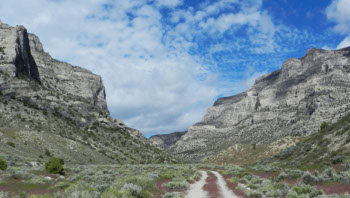
Though we will be in a somewhat remote area, I still hope to post periodically during the week, not only about the usual topics but also about some of the caves we will have surveyed, some of which are rarely visited. I will also try to post some pictures of the spectacular country we expect to visit. (The photo on the right was provided to me by Tom Gilleland, who is running the project.) Stay tuned.

3 comments

A failed public works project — from the year 1350 AD

Casa Grande

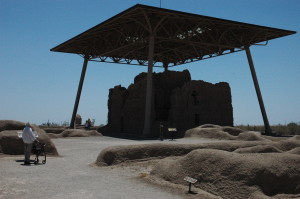
Yesterday my wife Diane and I took my 94-year-old mother on a sightseeing trip to see the Casa Grande ruins southeast of Phoenix, “the largest known structure left of the Ancestral People of the Sonoran Desert.”

This four story high structure was built around 1350 AD from bricks made of concrete-like caliche mud, with the floors and roofs supported by beams of pine, fir, and juniper brought from as far away as fifty miles. (The rooflike structure above the ruins was built by the National Park Service in order to protect it from rain.)

Though impressive, I must admit I’ve seen far more impressive American Indian ruins elsewhere. Casa Grande, which means “Great House” in Spanish, suffered as a tourist attraction from two faults:
» Read more

1 comment

Shut it down

Our government in action: An NIH nationwide study to track hundreds of thousands of children from birth to age 21 is wracked with budget and management problems.

All told, this study has already cost the taxpayers almost a billion dollars for the enrollment of only 4,000 children, not the 100,000 envisioned. That’s about $250,000 per child, an amount that seems incredibly high.

In addition to the above problems, it appears there are scientific ones as well:
» Read more

0 comments
1 104 105 106 107 108 139