A wish list of spectacular future planetary missions

Steve Squyres of Cornell University and the project scientist of the Mars rovers Spirit and Opportunity spoke today at an astrobiology symposium in Arlington, Virginia. He described several spectacular planetary missions that might be flown in the coming decade. All are being considered. None have yet been chosen or funded.

  • A mission to grab a sample from a comet and return it to Earth.

  • A mission to put a rover or lander on one of the poles of Mars to study the frozen layers of water under the icecap.

  • Mars sample return mission. This mission is so difficult and expensive that it probably would be broken down into three parts:
    • Two rovers on the surface to gather and cache sample material.

    • A lander/rover mission to grab the samples and bring them up to Mars orbit. “Putting into orbit a precious cargo the size of a coconut,” Squyres said.

    • A mission to grab the sample cargo in Martian orbit and return it to Earth.

  • An orbiter to study both Jupiter and its moon Europa.

  • An orbiter to Enceladus, the moon of Saturn, to study the water and organic chemistry in its mysterious plumes.

  • An orbiter to Titan, with balloon to probe the atmosphere as well as a “lake lander, a boat” to study Titan’s lakes.

  • A variety of landers and rovers to go to Venus. One of the more astonishing mission concepts would land, then take off again to visit different places on the surface.

Squyres is the co-chair of a committee of the National Science Foundation that is right now putting together a decadal survey for outlining unmanned planetary research for the next decade. This survey is expected to be released in March, which is when we will find out which of the above missions the planetary science community prefers.
1 comment

Climate Talks in China Limp Toward Deadlock

Thank god for small blessings. The climate talks in China this past week are limping towards a deadlock, with no new agreements. It appears that the biggest problem are disagreements between China and the U.S.

Personally, I love how this quote from the article so nicely illustrates the totalitarian nature of many climate activists and their organizations:

Currently, the World Resources Institute is proposing the White House abandon legislative means and rely on the existing Clean Air Act to make emissions reductions administratively.

In other words, if the elected Congress of the United States is unwilling to pass restrictions (because a majority of the people of the United States oppose them), then the government should ignore the people’s wishes and impose those restrictions, without permission.

Ugh. The less power these environmental dictators have, the better for everyone else.

1 comment

Hubble tracks the aftermath of a possible asteroid collision

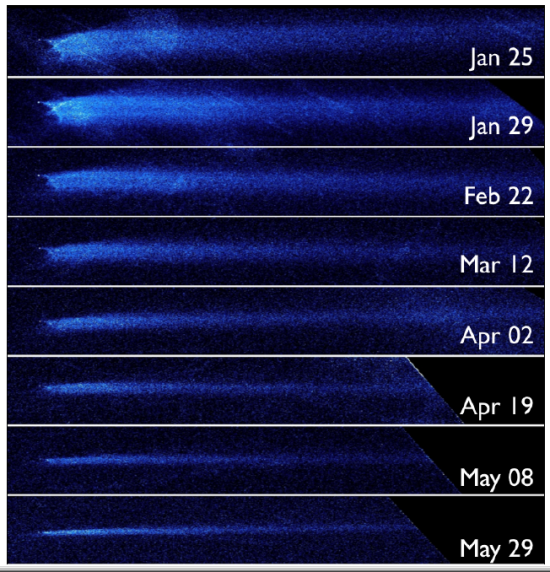
Using the Hubble Space Telescope over the last ten months, astronomers have tracked the decaying aftermath of a possible asteroid collision. Key quote:

Astronomers think a smaller rock, perhaps 10 to 15 feet wide, slammed into the larger one. The pair probably collided at high speed, about 11,000 mph, which smashed and vaporized the small asteroid and stripped material from the larger one. Jewitt estimates that the violent encounter happened in February or March 2009 and was as powerful as the detonation of a small atomic bomb.

The image sequence below, taken from the original paper describing the discovery [pdf], shows the slow changes that have occurred since January. At the moment scientists do not have an satisfactory explanation for the nucleus’s X-shaped pattern in the earliest images.

sequence of images of disrupted asteroid

0 comments

We won’t release our contributors because the adminstration will then harass them

Is this how a government in a free society functions? The Chamber of Commerce won’t release its contributors because they fear the administration will harass and threaten them. And they have experience to back that fear up. Key quote:

What this administration wants is a list of who the companies are who are contributors, and we saw last year . . .when we very publicly ran ads against the Patients Protections and Affordable Care Act . . . there was an attempt to try and find out who were the corporations that were contributing to that effort. When some of those corporate names were divulged, not by us, by others, what did they receive? They received protests, they received threats, they were intimidated, they were harassed, they had to hire additional security, they were recipients of a host of proxies leveled at those companies that had nothing to do with the purpose of those companies. So we know what the purpose here is. It’s to harass and intimidate. [emphasis mine]

That the White House and President Obama are right now willing to accuse their opponents of all manner of evils (taking money from foreign governments) without any evidence is further evidence that there are reasons to fear them.

1 comment

APS responds to Harold Lewis’s resignation letter

The American Physical Society has responded to Harold Lewis’s resignation letter.

It appears from their response that they are feeling some pressure about their past position, which stated “The evidence is incontrovertible: Global warming is occurring.” Compare that with what they say now, in their response to Lewis:

APS continues to recognize that climate models are far from adequate, and the extent of global warming and climatic disruptions produced by sustained increases in atmospheric carbon loading remain uncertain.

How nice. A science organization recognizing the uncertainty of science!

1 comment

Obama signs the NASA authorization bill

Obama signed the NASA authorization bill today.

Update and bumped: This Spaceflight Now article includes this quote from Senator Bill Nelson (D-Florida):

“What is in this bill is $11.5 billion over the next six years, anticipated, even though it’s a three-year authorization, for development and testing of a heavy lift rocket. Now if we can’t develop a new rocket for $11.5 billion, building on a lot of the technologies that were already developed in spending $9 billion (on the Constellation program’s Ares rockets), if we can’t do it for that, then we ought to question whether or not we can build a rocket.”

Based on NASA’s track record in trying to build a replacement to the shuttle, I remain very skeptical indeed whether NASA can build this rocket. I do hope, however, that my skepticism is proven wrong.

Note also that the funding for this authorization bill is as yet not appropriated. Plans to do so during the lame duck session of Congress after the elections remain fraught with problems.

0 comments

Asteroids of note

At today’s press conference at the 42nd meeting of the AAS Division for Planetary Sciences, the topic was asteroids, including one which holds the possibility of hitting the Earth.

  • 65 Cybele has been found to have water ice and organic molecules on its surface, the second such asteroid so found. Key quote from the abstract:

    We conclude that 65 Cybele is covered by fine anhydrous silicate grains, with a small amount of water-ice and complex organic solids. This is similar to comets where non-equilibrium phases coexist, e.g. water-ice and anhydrous silicates; thus we conclude that this is a very primitive object.

    According to Humberto Campins of the University of Central Florida, this combination of water and organics could become hospitable to life should some form of energy be added, such as an impact to the asteroid.

  • The origin of the asteroid Phaethon, cause of the Geminids meteor shower, has been traced to the Pallas family of asteroids, a family created by the debris thrown out during a crater impact on the large asteroid Pallas. Campins also noted that this proves Phaethon is an asteroid and not a comet, a question that astronomers had been debating beforehand. Read the abstract here.
  • Asteroid 1999 RQ36, which has a 1 in a 1000 chance hitting the Earth in 2182 and is also the prime target of a proposed NASA sample return mission, has now been determined to be a member of the Polana family of asteroids. This makes 1999 RQ36 a very primitive asteroid from the very beginnings of the solar system. Moreover, this suggests that the Polana family could be the “most important” source of many near Earth asteroids. The abstract can be found here.
1 comment

A Tea Party in Maryland

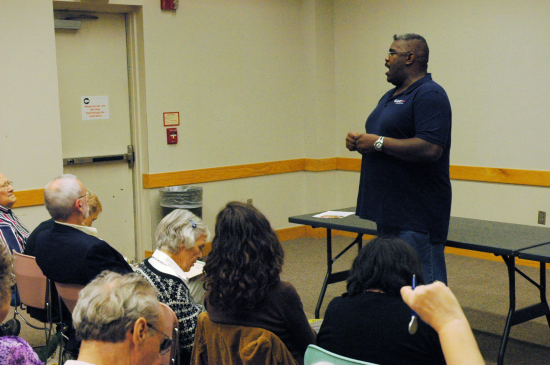
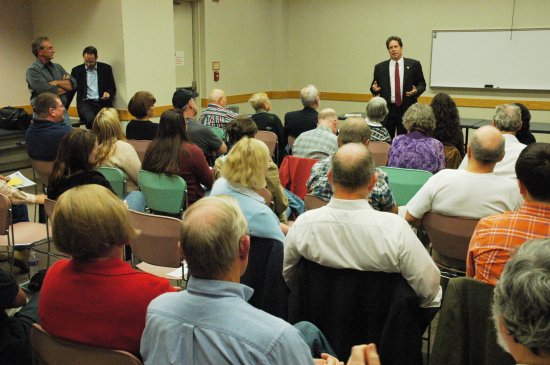
Last night I attended the most recent meeting of the Maryland Society of Patriots, a tea party group that was founded back in 2009. Attendance was pretty typical, with about fifty people filling the meeting room of the local library in Burtonsville, Maryland. As usual, Sam Hale, the founder of the group, had garnered a range of candidates to speak to us, including Eric Wargotz, the Republican candidate for the Senator, running against Barbara Mikulski (D-Maryland).

Eric Wargotz speaking at MSOP meeting

For Wargotz, the questions got a bit heated at one point, as one member of the audience wanted to know his commitment to defending the Constitution.

What makes this group significant is that the majority of its members come from very Democratic districts. Yet, not only has attendance been high at almost every meeting, the membership has including a wide range of ordinary people, most of whom have never done politicial activitism in their lives.

Eric Cary, State Senator candidate

This is Eric Cary, who is running for the Maryland State Senate. I’ve included more pictures below the fold. » Read more

0 comments

The basic ingredients of life might exist in Titan’s atmosphere

Big news! In a simulation of the upper atmosphere of Titan at about 600 miles altitude, scientists have discovered the basic ingredients of life are quickly synthesized when exposed to the kind of hard radiation found there. Key quote from the press release, issued today at the 42nd meeting of the AAS Division for Planetary Sciences:

The molecules discovered include the five nucleotide bases used by life on Earth (cytosine, adenine, thymine, guanine and uracil) and the two smallest amino acids, glycine and alanine.

For those who don’t remember their high school biology, these nucleotides are the building blocks of DNA.

The abstract of the scientist’s work can be found here.

What the scientists did was recreate the basic ingredients of Titan’s upper atmosphere, comprised of nitrogen, methane and carbon monoxide. Cassini data has shown that within this atmosphere are very large molecules, as yet unidentified.

The scientists then bathed their recreation in the kind of intense radiation expected at that altitude, and amazingly produced the complex organic molecules that are basic to life. Moreover, the experiment was the first to produce these complex molecules without the presence of water, something that scientists have previously thought was required. These results suggest that in addition to forming in the oceans, life could also form in the upper atmospheres of planets.

This result also suggests strongly that it is incredibly easy to produce the basic building blocks of life, almost anywhere in the universe where organic molecules are present.

0 comments

White House arbitrarily gives healthcare law waivers to some companies

The law for some but not for others: Threatened with a firestorm of protest just prior to the election because a number of large corporations were going to drop millions from healthcare coverage because of the new Obamacare regulations, the White House today arbitrarily waived for one year those provisions for 30 large companies.

This action raises three obvious points:

  • If the healthcare law was so wonderful, why is the White House suspending its inception?
  • Why should these companies get a break, and not others? In fact, if I was the owner of a company that did not get a waiver, I would sue.
  • This once again proves false the claim by Obama that the law would force no one to lose their healthcare plan. To me, the words “You lie!” come quickly to mind.

Ed Morrissey at hotair.com makes some additional good points about this absurd situation.

0 comments

Geert Wilder’s words make Muslims uncomfortable

How sad. The harsh words that Dutch politician Geert Wilder has for Islam (now facing prison for saying those words) is making Muslims in the Netherlands feel unsafe. Key quote:

β€œMy family and I no longer feel safe in the Netherlands because Mr. Wilders is continually making hateful remarks about Islamic Dutch people,” said one complaint read out by the judge.

Gee. What about the more than 16,000 violent attacks committed by Islamic terrorists since September 11, 2001, leaving tens of thousands of people dead or maimed? How does this violence make these Dutch Muslims feel?

4 comments
1 128 129 130 131 132 139