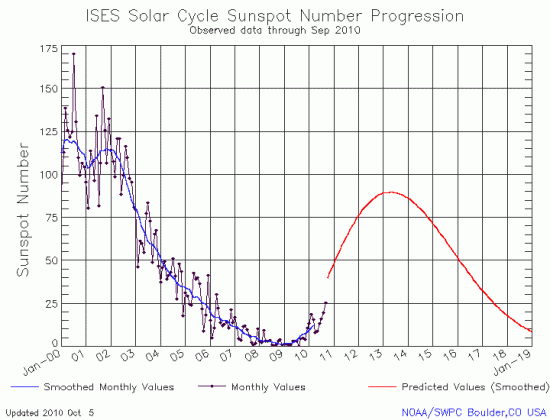
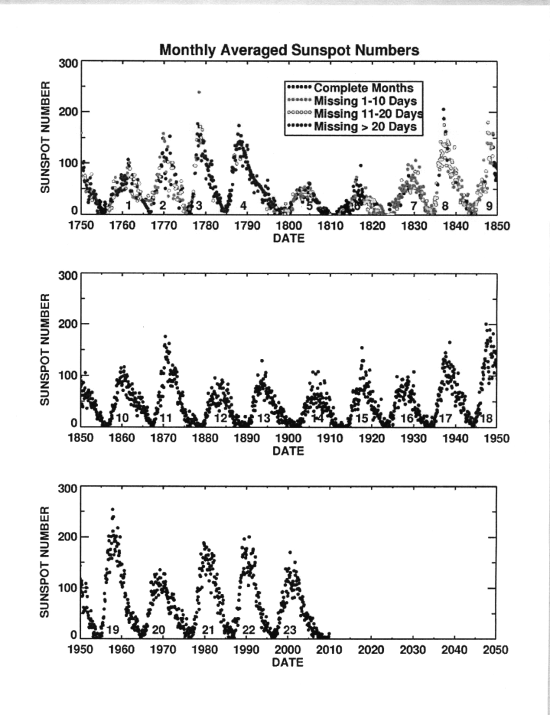
The October 2010 sunspot graph

Yesterday NOAA’s Space Weather Prediction Center published its October monthly graph, showing the sun’s developing sunspot cycle in comparison with the consensis prediction made by the solar science community in May 2009.

October Sunspot graph

Sunspot activity in September clearly jumped, though it still remains far below predictions. Prepare for the weakest solar maximum since the 1810s!

Note also that today the Sun is blank, with no sunspots, the first time this has happened since August. At that time I speculated that this might “be the last time the Sun will be blank for years as it continues to ramp up to its next solar maximum.” Obviously not. The question now is whether today will be the finale in blankness for this minimum.

0 comments

Murder for the sake of climate idealogy

Bumped. Scroll down to see the update.

This video has been making the rounds on the web. Though I warn you that is somewhat graphic, it is essential that you watch it.

When I first saw this about a week ago, I didn’t quite know what to make of it. It was so vile and offensive I could not believe that it was legitimate. It obviously wants to pay some homage to Monty Python, but even Monty Python never went this far. How could anyone possibly think that killing small children in the name of environmentalism was in any way funny? And how could anyone ever believe that this video would persuade anyone to go along with the 1010 environmental campaign? If anything, the video does an excellent job of discrediting this organization and everyone involved with it.

Thus, despite what some bloggers were saying, I held back commenting, just to make sure the video was real and not a terrible prank meant to sabotage.

There is now no reason to hold back. Late last week, the 1010 organization itself issued an apology, admitting that this video was their handiwork. Before I continue, I think it is worthwhile for you to also read their apology, in all its venal glory. In many ways, it condemns them and their allies far more than the video did:
» Read more

7 comments

WISE telescope moves into final phase of mission

Having run out hydrogen coolant for its infrared cameras and with only a few more months of usable life, the Wide-Field Infrared Survey Explorer (WISE) has shifted its work from deep space astronomy to completing its last sweep of the solar system in a search for asteroids and comets.

Update: At a press conference going on right now at the 42nd meeting of the AAS Division for Planetary Sciences, WISE scientists note that the mission extension will continue for one month. If that month is successful, the mission will continue until the end of January 2011 in order to complete its solar system sweep. After this the spacecraft will be put in hibernation, available for future work.

Summary of solar system results so far:

  • 33,576 asteroids discovered of which 120 were Near Earth Asteroids.
  • 19 new comets.
0 comments

Liquid on Titan

The Cassini image below, released today at the 42nd meeting of the AAS Division for Planetary Sciences, shows light reflecting off a lake on Titan’s northern hemisphere. According to the scientists who took the image, this is the first definitive confirmation of the presence of liquid in those lakes.

Liquid reflection on Titan

0 comments

The wind-blown dunes of Mars

The HiRise Camera on Mars Reconnaissance Orbiter has released some wonderful new pictures, showing what are called barchan dunes on Mars.

Barchans are crescent-shaped, with the horns of the crescents pointing downwind. One barchan is visible in the upper part of the image, with the Southeast (lower right) horns longer than the other. This trend, along with the position of the steep face of the dune on the South side, indicates that the predominant winds which formed the dunes came from the North.

There are a lot more great images on the websites above.

Wind-blown dunes

0 comments

The layoffs at NASA

More layoffs yesterday at NASA, this time at the Marshall Space Flight Center. Also, this report gives a good overview of all the layoffs so far.

One question: The authorization bill that passed Congress on Wednesday night specifically required NASA to continue construction of a heavy-lift vehicle, quite similar in concept to Constellation. Why then is NASA management laying off all these Constellation workers? Granted, the authorization did not provide Constellation with as much money as previously budgeted, but the layoffs seem greater than necessary at this time, considering the budget differences. Also, the lack of a final budget from Congress might require these layoffs to occur temporarily, pending a new budget, but NASA is not making it clear that this is the case. Instead, they are letting a lot of people go without giving them any guidance about NASA’s future plans.

If the Obama administration was serious about fulfilling Congress’s legal requirement to build a heavy-lift vehicle (as deputy administration Lori Garver said they were on Thursday), I would have expected them to be more forthcoming to these NASA employees, if only to encourage them to remain available for rehiring, for at least a short time. That they have not is very telling.

Do not expect this heavy-lift vehicle to be built.

1 comment

Watch out for those toxic paper clips!

The bureaucracy marches on! The Consumer Product Safety Commission wants the manufacturers of kids’ science kits to test the paper clips in those kits for lead and other toxic chemicals, even if the paper clips were purchased in an ordinary office supply store. Key quote

“It is crazy that the Hands-On Science Partnership needs to be concerned about doing lead tests on products purchased at an office supply store and then packaged into a science teaching kit for use with children,” Commissioner Nancy Nord wrote on her blog. “Even crazier is the fact that if a teacher buys the same paper clip at the same store and uses it for the same science teaching project, it’s okay.”

To me, this quote is even more disturbing:

Commissioners insist the regulations will not ban science kits and would be applied on a case-by-case basis. [emphasis mine]

In other words, the regulation will not be applied objectively, but subjective, at the whim of the regulators. Every product of every manufacturer will have to get the Commission’s approval before it can be sold.

If that isn’t a mandate for mischief, I don’t know what is.

0 comments

The state of the Sun, September 30, 2010

Time to update the state of the Sun, as seen by satellite data (the last update was in July). The graph below, posted today by Physikalisch- Meteorologisches Observatorium Davos (PMOD), shows the variation in the Sun’s Total Solar Irradiance since 1978. I have added a blue horizontal line to show that even now, two years after the Sun reached the lowest point in its most recent solar minimum, it has still not brightened enough to equal the lowest point in the two previous minimums. (Note that if we included the minimum from 1976, the Sun would still be below that as well.)

solar cycle as of Sept 30, 2010

Once again, the evidence is building that the Sun might be heading towards the weakest maximum seen to two centuries. And when that happened, things got very cold on Earth.

the sunspot cycle

0 comments

This NASA bill is nothing more than pork

A sampling of headlines today, describing the passage last night in the House of the NASA authorization bill:

Unfortunately, none of these headlines are correct. All of them are examples of what I call “press release journalism”, where the press writes its stories based on what elected officials and public relations people tell them, rather than what’s in the bill itself.

Though the bill that passed last night does authorize significant additional funds for the subsidized development of new private rockets, it unfortunately does not send NASA on a “new path” or “new policy.”

First and foremost, the plan very specifically requires NASA to build a spacecraft and launch capability very similar to what was being built under Constellation. To quote:

It is the policy of the United States that NASA develop a Space Launch System as a follow-on to the Space Shuttle that can access cis-lunar space and the regions of space beyond low-Earth orbit in order to enable the United States to participate in global efforts to access and develop this increasingly strategic region.

This system is to have a launch capability of no less than 130 tons, which would exceed the Saturn V and is about what was planned for Ares V.

Also:

The Administrator shall continue the development of a multi-purpose crew vehicle to be available as soon as practicable, and no later than for use with the Space Launch System. The vehicle shall continue to advance development of the human safety features, designs, and systems in the Orion project.

This essentially means that Orion, as designed under Constellation, will go on.

Thus, the only real changes to Constellation the bill provides are less money, a faster timetable (finished by the end of 2016) and the freedom to pick a new name for the system, so as to not embarass the current administration with a Bush space rocket.

Of course, NASA has the freedom to redesign Constellation, but given the short time schedule and limited budgets, I wonder if that will be possible. (There are those who think this is a victory for the Direct approach, whereby the new launch system is almost entirely based on the shuttle system, but even that concept is probably not doable, given the money and time frame.)

Thus, has anything at NASA actually changed? I don’t think so. In the end, what we are going to get from this new plan is the same failures we’ve gotten from NASA in its repeated efforts over the last twenty-five years to build a shuttle follow-on. To quote a column I wrote for USAToday back in 2004:

  • The National Aerospace Plane was proposed by President Reagan in 1986 during his State of the Union address. This cutting-edge technology, Reagan proclaimed, would “by the end of the decade take off from Dulles Airport, accelerate up to 25 times the speed of sound, attaining low-Earth orbit, or fly to Tokyo within two hours.” After spending $1.7 billion, and building nothing, the program was canceled in 1992.
  • The X-33 was announced with much fanfare by Vice President Al Gore on July 4, 1996. The program was going to produce a single-stage-to-orbit reusable spacecraft. “This is the craft that can carry America’s dreams aloft and launch our nation into a sparkling new century,” Gore enthused. After five years and $1.2 billion, the X-33 was canceled when cracks were found in the spacecraft’s experimental fuel tanks.
  • During the same years as the X-33, NASA pursued the X-34, a smaller two-stage reusable rocket launched from a belly of a L-1011 jet, and the X-38, a reusable lifeboat for the International Space Station. After four years, more than $1 billion but little hardware production, both were scrubbed. [Note that the X-37 did come back to life under the auspices of the Air Force, who saw its value if NASA did not.]
  • In 2000, even as the previous projects were being put to the torch, NASA came up with another program, the Space Launch Initiative. For two years, the agency spent $800 million drawing blueprints for a plethora of proposed shuttle replacements. Nothing was built. In 2002, the Space Launch Initiative was scrapped like the rest.

In every case, NASA came up with plans that could not be built for the money available. Now, Congress has ordered NASA to build an updated Saturn V rocket, practically overnight and without sufficient funds. And it has asked this to be done by an administration that is uninterested in doing it, and has even shown a willingness to sabotage this project, when it can.

The result? I do expect NASA to spend all the money that Congress is giving them, passing it out to various aerospace companies, as it has done for the last few decades. Whether anything will get accomplished with all that spending, however, is very doubtful.

In other words, the bill passed last night is nothing more than the worst form of pork. At least with most pork projects, a new school or a better road system is built. Here, the taxpayer will spend a lot of money, and get very little for it.

The one glimmer of hope is the money authorized to subsidize the development of new private space rockets. Unfortunately, the bill requires NASA to strictly supervise the construction of these new rockets, to make sure they meet NASA’s safety standards and government rules. Such supervision cannot encourage the kind of innovation and creativity necessary to produce new rockets cheaply and efficiently.

Fortunately, the increasing demand for new and inexpensive launch services is going to counter this governmental interference. SpaceX’s amazing success with its Falcon rockets is evidence of this increased demand. So is the fact that Boeing has decided to dive into this market with its own manned spaceship. With increased demand comes increased profit, which — far more than government subsidizes — will pay for the new rockets.

Still, on the government side I suspect the end result of NASA’s new commercial development program will once again be a lot of money wasted. The new rockets will get built, but the American taxpayer is going to get screwed in the process.

Personally, if I had my druthers I would get the U.S. government entirely out of the civilian rocket building business. Let the private companies finance and build their rockets themselves (as SpaceX did with the Falcon 1), and when completed, let NASA then buy the services. The less say the government has in the design and construction of these rockets, the better.

Unfortunately, this fantasy is not going to happen. Instead, I expect the American space program to limp along for the next decade or so, dependent on the Russians (and eventually the Chinese) to get its astronauts to its own space station.

How sad.

5 comments

First planet discovered that might harbor life!

Big news! Scientists have discovered the first rocky terrestrial planet orbiting its sun at a distance where life as we know it could form. The planet itself has a mass three to four times Earth, so no matter what, conditions on its surface would be very different than here. Nonetheless, this is a major discovery, and is only the first of many. Key quote:

The discovery suggests habitable planets must be common, with 10 to 20 per cent of red dwarfs and sun-like stars boasting them, the team says. That’s because Gliese 581 is one of just nine stars out to its distance that have been searched with high enough precision to reveal a planet in the habitable zone.

2 comments

Hoyer says Americans are “conflicted”

At a press briefing today my congressman, Steny Hoyer, said that he thinks Americans are “conflicted”, have “a lot of angst and anxiousness”, and are “not sure” which party will move the country forward. Steny is partly right about the first two points, but quite wrong about the third, considering his party’s dismal poll numbers.

I also suspect that Steny has a lot of his own angst and anxiousness, considering the momentum his opponent, Charles Lollar, is building.

0 comments
1 129 130 131 132 133 139