Sinkholes on Mars

Caver alert! Releases this week from both the Mars Express orbiter and the Mars Reconnaissance Orbiter show a variety of sinkholes and collapse features on Mars, which in turn suggest the possibility of underground passages.

First, there is this picture from Mars Express, showing the area called Phoenicis Lacus (Latin for Phoenix Lake).

Phoenicis Lacus

The large and long canyon in box 1 is actually a collapse feature, almost two miles deep and formed as this region was stretched, warped, and cracked by the powerful volcanic activity of the nearby giant volcanoes of the Tharsis plateau, including Olympus Mons, the solar system’s largest volcano. You can also see how this activity causes several sinkholes and craters in all three boxes to become elongated and distorted.

In places where the surface is deformed in this way on Earth, you often find tectonic caves, underground cracks produced as the ground is pulled apart. The large collapse feature suggests the possibility that there are voids below it.

Then there is this subimage from this release of Mars Reconnaissance Orbiter, showing the central peak and southern slope of an old crater in the Terra Sirenum region of the Martian southern hemisphere.

central crater peak

Down that south slope can be seen what look like fluvial-like flows. In the center of these flows as well as near the top of the peak are what appear to be a string of collapse features. Below is the close-up as indicated by the box above:

inset closeup of sinkholes

From the caption: “It is possible that these pits are evidence of subsurface piping or hydrothermal activity. Piping occurs when subsurface water flows through soil, takes some soil with it, and causes the overlying ground to collapse. These fluvial-like features and the connected pits may have formed during a late stage of crater formation when temperatures were suitable for liquid water.”

On Earth, this is one of the geological processes that forms sinkholes on the surface as well as caves underground. When cavers go out to look or dig for new caves, we often head for just this kind of string of sinkholes, as they are excellent evidence that an unentered cave lies hidden below, ripe for exploration.

2 comments

Pat Condell on the death of free speech in Europe

Pat Condell, whose never minces words in his commentary on youtube, has decided to speak out about Elisabeth Sabaditsch-Wolff’s upcoming trial in Austria, where she is threatened with three years imprisonment because she expressed an opinion about Islam and the Koran. It is worth watching.

The purpose [of these trials] is to silence dissent, by example. To show everyone else that they too will be treated as a common criminal if they dare to express a negative opinion about the world’s most backward, intolerant and violent religion. This is where we are in Europe today. It’s like something out of the old Soviet Union.

By the way, Elisabeth Sabaditsch-Wolff’s legal defense fund can be found at http://english.savefreespeech.org/ .

1 comment

The space program is dead, long live the space industry!

The news following the midterm election results have not sounded good for NASA. Two stories on Monday alone signaled the bad news:

Earlier stories last week were no more encouraging:

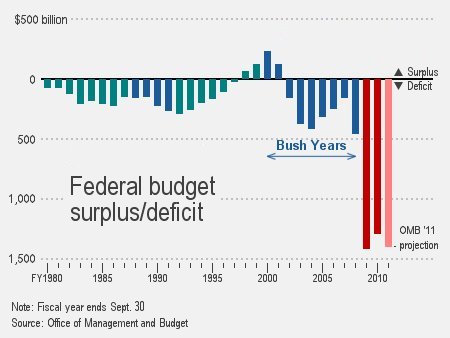
While Republicans have, since the 1970s, generally been more enthusiastic than Democrats about NASA and manned space exploration, the new Republican Congress has a tone that seems decidedly different from past years. Above all, it appears the public is finally becoming aware of the recent explosion in the federal debt, as illustrated by the graph below. (hat tip to Gateway Pundit and The Captain’s Comments.)

Federal deficit

The public’s growing concern about these numbers was clearly reflected in the election results. First, there was the success of many tea party candidates advocating fiscal responsibility and a radical shrinking of government. Even in cases where conservatives lost, the closeness of the election in districts or states where liberals have rarely in the past been challenged suggests the mood of the electorate is decidedly shifting in a direction against federal spending.

Second, the electorate seemed surprisingly hostile to pork, expressing little interest in being brought off with baubles for their home districts. Thus, candidates who ran against pork seemed to get far more enthusiastic attention and positive publicity than those elected officials famous for “bringing home the bacon.”

In such an atmosphere, the priorities of Congress will be forced to change. The outlook therefore does not look good for the type of pork funding represented by the NASA authorization bill passed on September 29, with its billions of subsidies for the aerospace industry.

We can see an indication of this new tone by some of the initial plans announced by the Republican leadership. As a first step, the Republicans have proposed cutting the federal budget back 2008 levels. This change alone would reduce NASA’s annual budget by about $2 billion, or 10%.

This solution, however, will not close the budget gap, only shrink it slightly. The Republicans will still be faced with massive amounts of red ink and a public demanding that they deal with it. To prove they mean what they say, the new House leadership will be forced to propose some additional draconian cuts.

Unfortunately, the circumstances at this moment has made NASA a prime budget-cutting target. » Read more

4 comments

Showing how the country is polarized . . . with a t-shirt

Want to find out how polarized our county is? Then wear this shirt (which can be purchased here) and watch the reaction.

Reagan is right t-shirt

How do I know this? Well, yesterday on my flight home from California after giving a lecture to the Orange County section of the American Institute of Aeronautics and Astronautics, I tried it. Nor was this the first time I’ve worn this shirt and seen the reactions. People always seem to notice it, often doing a doubletake because at first they think it is the Obama image with the word “Hope” underneath. Then they realize what it really is, and either laugh in amusement or frown in annoyance.

Yesterday was no different. As I stepped out of the elevator and into the lobby of my California hotel, I passed a woman whose eyes immediately widened when she saw the shirt, and then scowled as she walked past. Then, I went into a local Subway to pick up something to eat during the long flight home. The woman who made my sub as well as the clerk who took my cash both looked at my shirt and glowered. Though they did nothing outright rude, I really think they would have preferred to tell me to leave and not sell me my sub.

At the airport things were interestingly different. Two guys in front of me on line to check bags immediately wanted to know where they could buy the shirt. Then, on the airplane, a steward as well as the passenger sitting next to me asked me the same question. When I said I’d forward them the webpage if they’d give me their email addresses, they all complied eagerly. The steward then went out of his way for the rest of the flight to make sure I was happy, to which I remain grateful.

Though I do find these reactions both amusing and intriguing, I also find them disturbing. How can a free nation survive if people get so emotional over something so silly as a t-shirt?

0 comments

Space and the election results

Yesterday’s elections will clearly force changes again to NASA’s future. Below are a few links from some other space experts expressing their thoughts on the matter. I will follow with my own essay sometime next week, after the election results have some time to shake out.

From SpacePolicyOnline, an overview of the results in relation to space policy.

From Rand Simberg: Great election news for space.

From Space Politics: Brooks wins, Giffords with a narrow lead.

See also this Space.com article: Election Brings New Leadership to NASA Oversight Committees.

Overall, the defeat of Congressmen like Oberstar and Grayson, both of whom loved to regulate, can only be good for the future of private space.

0 comments

The updated monthly sunspot graph, as of November 2, 2010

NOAA’s Space Weather Prediction Center today published its monthly update of the Sun’s developing sunspot cycle, showing the slow rise in sunspots in comparison with the consensis prediction made by the solar science community in May 2009.

November 2, 2010 sunspot graph

Unlike October graph, which showed a clear jump in sunspot activity, this November update shows that the rise in sunspot numbers has once again slowed down. As I’ve noted repeatedly, these numbers suggest that we are heading for the weakest solar maximum in two hundred years, far below predictions. And when that last happened, around 1810, it was called the Dalton minimum and the Earth experienced one of its coldest periods in many many decades.

1 comment

UN conference passes broad ban on “geoengineering”

A UN conference in Japan today approved the extremely broad language that I had noted earlier this week, banning all “climate-related geoengineering activities that may affect biodiversity . . . until there is an adequate scientific basis on which to justify such activities.” You can read some reactions here. Key quote from the ETC group, a Canadian non-profit organization which supports the language:

The agreement, reached during the ministerial portion of the two-week meeting which included 110 environment ministers, asks governments to ensure that no geoengineering activities take place until risks to the environment and biodiversity and associated social, cultural and economic impacts have been appropriately considered. The CBD secretariat was also instructed to report back on various geoengineering proposals and potential intergovernmental regulatory measures.

If the broad language of this policy is accepted by the United States government, it will effectively shut down almost all new construction and development, as practically anything people do “may affect biodiversity.”

0 comments

Squeal like a pig

Let’s take a trip into the future, looking past Tuesday’s midterm election.

For the sake of argument, let’s assume that, come Tuesday, the Republicans take both houses, in a stunning landslide not seen in more than a century. Let’s also assume that the changes in Congress are going to point decidedly away from the recent liberal policies of large government (by both parties). Instead, every indication suggests that the new Congress will lean heavily towards a return to the principles of small government, low taxes, and less regulation.

These assumptions are not unreasonable. Not only do the polls indicate that one or both of the houses of Congress will switch from Democratic to Republican control, the numerous and unexpected primary upsets of established incumbents from both parties — as well the many protests over the past year by large numbers of ordinary citizens — make it clear that the public is not interested in half measures. Come January, the tone and direction of Congress is going to undergo a shocking change.

Anyway, based on these assumptions, we should then expect next year’s Congress to propose unprecedented cuts to the federal budget, including the elimination of many hallowed programs. The recent calls to defund NPR and the Corporation for Public Broadcastings are only one example.

When Congress attempts this, however, the vested interests that have depended on this funding for decades are not going to take the cuts lightly. Or to put it more bluntly, they are going to squeal like pigs, throwing temper tantrums so loud and insane that they will make the complaints of a typical three-year-old seem truly statesman-like. And they will do so in the hope that they will garner sympathy and support from the general voting public, thereby making the cuts difficult to carry out.

The real question then is not whether the new Congress will propose the cuts required to bring the federal government under control, but whether they, as well as the public, will have the courage to follow through, to defy the howls from these spoiled brats, and do what must be done. » Read more

4 comments

Demonstration on October 30 to protest the trial of Elisabeth Sabaditsch-Wolff

There will be a demonstration on October 30 in support Elisabeth Sabaditsch-Wolff, who is facing prison in Austria for publicly quoting the Koran and then criticizing what it says. The video below explains the disgusting nature of the charges against her, and how freedom of speech is under direct attack in Austria. Key quote:

“It seems that some people do not appreciate a non-Muslim quoting verbatim from the Koran. . . . Apparently you have to convert to Islam in order to quote from the Koran and not be accused of hate speech.”

You can offer support to her legal defense fund by going here. This fund is not controlled by her, and will only be used to pay her legal fees.

1 comment

UN treaty language threatens to ban all “climate-related geoengineering”

Treaty language being written at a United Nations conference on biodiversity is so vague it threatens to bar almost all new development. Here is the language, via Science:

8 (w) Ensure, in line and consistent with decision IX/16 C, on ocean
fertilisation and biodiversity and climate change, in the absence of science-based, global, transparent and effective control and regulatory mechanisms for geo-engineering, and in accordance with the precautionary approach and Article 14 of the Convention, that no climate-related geoengineering activities (1) that may affect biodiversity take place, until there is an adequate scientific basis on which to justify such activities and appropriate consideration of the associated risks for the environment and biodiversity and associated social, economic and cultural impacts, with the exception of small scale scientific research studies that would be conducted in a controlled setting in accordance with Article 3 of the Convention, and only if they are justified by the need to gather specific scientific data and are subject to a thorough prior assessment of the potential impacts on the environment.

(1) Without prejudice to future deliberations on the definition of geo-engineering activities, understanding that any technologies that deliberately reduce solar insolation or increase carbon sequestration from the atmosphere on a large scale that may affect biodiversity (excluding carbon capture and storage from fossil fuels when it captures carbon dioxide before it is released to the atmosphere) should be considered as forms of geoengineering which are relevant to the Convention on Biological Diversity until a more precise definition can be developed. Noting that solar insolation is defined as a measure of solar radiation energy received on a given surface area in a given hour and that carbon sequestration is defined as the process of increasing the carbon contact of a reservoir/pool other than the atmosphere. [emphasis mine]

This language is so broad that, if agreed to by the United States, it could easily put almost any activity that affects the environment, including technology, business, property, recreation, or practically anything at all, under the control of UN regulators.

But wait, there’s more. The goal of this UN conference, to quote their own webpage, is to achieve “a significant reduction of the current rate of biodiversity loss at the global, regional and national level as a contribution to poverty alleviation and to the benefit of all life on Earth.” Obviously, this UN group is not merely interested in protecting the biodiversity of life on Earth, but to also redistribute the wealth so as to help poorer nations.

God help us if our government agrees to this.

0 comments
1 126 127 128 129 130 139