One of Australia’s proposed spaceports moves

Australia's spaceports
Australia’s spaceports

“I’m from the government and I’m here to help!” Because of its inability to get the proper permissions from a local council, the management of Equatorial Launch Australia (ELA) has abandoned its original spaceport location on the Gove peninsula in the Northwest Territory of Australia and shifted east to a new location on the York peninsula in Queensland.

On the map to the right the “X” shows the old location, with the new location near the town of Weipa on the west coast of the peninsula. The change was forced on the company when it could not get proper approvals from the Northern Land Council (NLC), which manages the Arnhem Land Aboriginal Land Trust where the original site was located.

In a statement late on Monday, ELA said its most recent attempt to finalise a lease for the expansion of the ASC in October had been unsuccessful, following three other failed attempts in the last 12 months. In each case, it said the NLC had “failed to meet its own specified deadline for the approval of the Head Lease” or “provide any official reason for the delay”, despite pleas from the NT government and the Gumatj Aboriginal Corporation.

Because ELA has a launch contract with a South Korea rocket startup Innospace that intends to launch next year, it decided the switch had to occur now to make sure it could meet its obligations under this launch contract.

2 comments

Panama and Austria to sign Artemis Accords

NASA yesterday announced that both Panama and Austria will sign Artemis Accords tomorrow, bringing the total number of nations in the alliance to fifty.

The full list of nations now part of this American space alliance: Angola, Argentina, Armenia, Australia, Austria, Bahrain, Belgium, Brazil, Bulgaria, Canada, Chile, Colombia, Cyprus, Czech Republic, Denmark, Dominican Republic, Ecuador, Estonia, France, Germany, Greece, Iceland, India, Israel, Italy, Japan, Lithuania, Luxembourg, Mexico, the Netherlands, New Zealand, Nigeria, Panama, Peru, Poland, Romania, Rwanda, Saudi Arabia, Singapore, Slovakia, Slovenia, South Korea, Spain, Sweden, Switzerland, the United Kingdom, the United Arab Emirates, the Ukraine, the United States and Uruguay.

The accords were created by the first Trump administration with the goal to create an alliance with enough clout to overcome the Outer Space Treaty’s restrictions on private property. Under the Biden administration, the goal has been rewritten to accomplish the exact opposite, as noted by NASA yesterday:

The Artemis Accords are grounded in the Outer Space Treaty and other agreements including the Registration Convention, the Rescue and Return Agreement, as well as best practices and norms of responsible behavior that NASA and its partners have supported, including the public release of scientific data.

With Trump back in charge, expect him to bring the accords back to its original goal. Unlike his first term, the alliance is now large, and he can use it to quickly apply pressure on the international community to overcome the Outer Space Treaty’s limitations on private property.

0 comments

Kamila Valieva – Avatar

An evening pause: Performed live in 2022, which explains the stupidity of her putting on a mask at the very end of the video.

Hat tip Judd Clark, who notes her sad history: “A real tragedy, an exceptional skater, her coaches gave her trimetazidine, a medication used for heart problems, which apparently makes the heart more efficient at using oxygen. Failing a drug test at 15, most of her medals and records were rescinded.”

See this page for more details. She had finished first during this competition in 2022. All for naught.

0 comments

December 9, 2024 Quick space links

Courtesy of BtB’s stringer Jay. This post is also an open thread. I welcome my readers to post any comments or additional links relating to any space issues, even if unrelated to the links below.

As Jay noted to me in his email, not much news today. I have been working on a long essay outlining my recommendations for NASA and Jared Isaacman, should he cancel SLS and Orion as I expect he will. Hopefully it will be finished by tomorrow. I might post it here, or see if some other venue might be interested.

  • Blue Origin’s CEO touts its prep work on New Glenn on the launchpad
    Blue Origin also sent out an email today saying the Blue Ring demo payload for the launch is also ready. Yet, the key quote from the tweet above was this:: “While we wait for regulatory approvals for hotfire and launch…” Why the hell is the FAA holding up this launch? For what reason? Or is it simply that the agency wants to be an equal opportunity red tape destroyer of everyone?
11 comments

“Thar’s ice in them hills!”

Overview map

Thar's ice in them hills!
Click for original image.

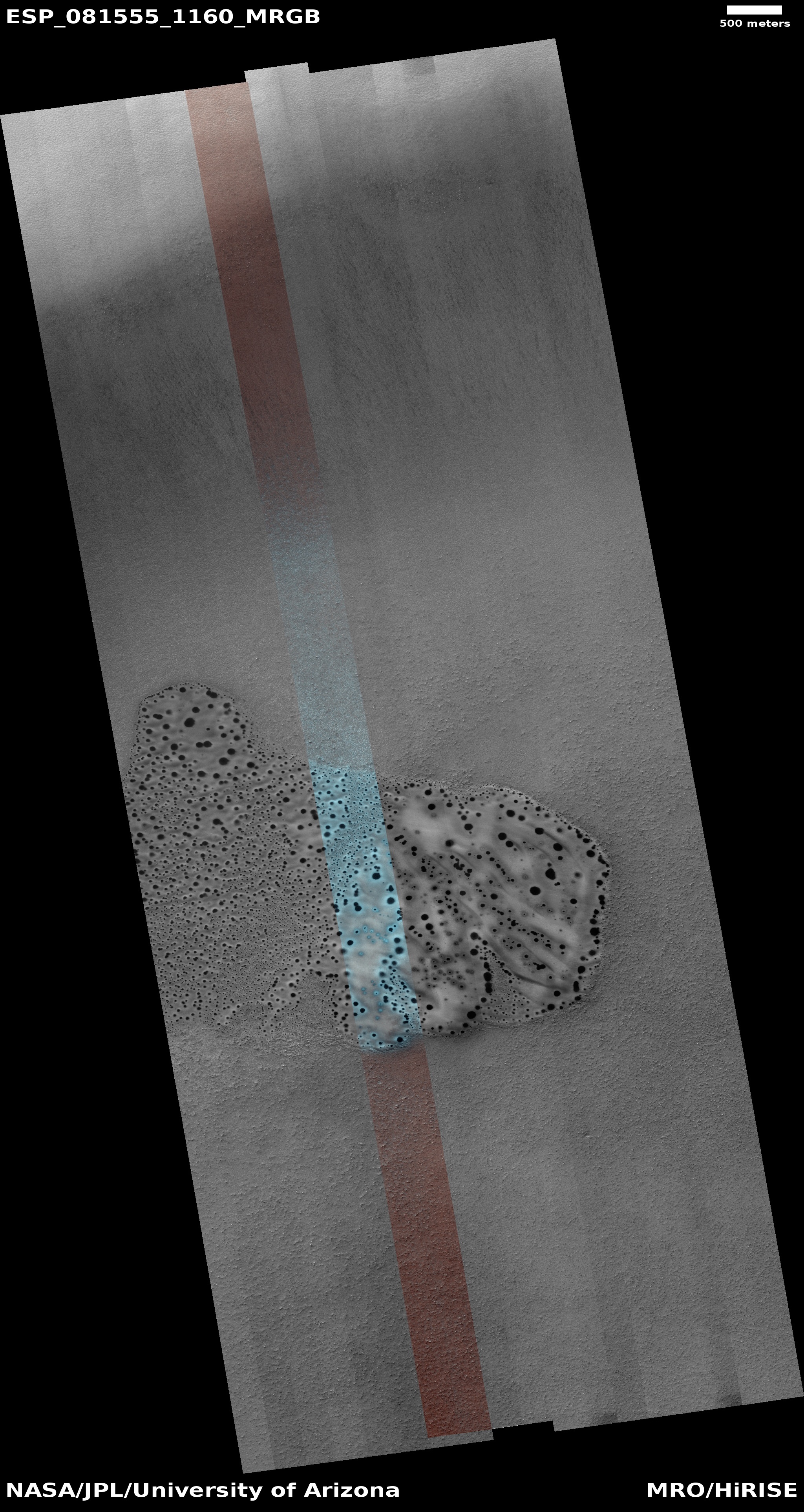
Cool image time! The picture to the right, cropped, reduced, and sharpened to post here, was taken on September 25, 2024 by the high resolution camera on Mars Reconnaissance Orbiter (MRO). It shows what the camera team labels as a “mound in the southern highlands.”

The mound in question sits in the center of the sunken depression, and at the highest resolution shows its top to be cracked and broken, as if something is attempting to break out by pushing up from below.

Everything about this picture screams near-surface ice. The cracked mound suggests ice sublimating into gas, which applies pressure to the surface and thus the cracks. The depression suggest that much of the near-surface ice at this location has already disappeared, causing the ground to sag. All the craters lack upraised rims. If caused by impacts, the ground here was soft enough that the impactor simply sank into the ground. Imagine dropping a rock you’ve heated into snow. It would simply leave a hole.

But there’s more. The white dot in the overview map above marks the location. In the inset, the lighter area surrounding this depression resembles an ice sheet that is slowly sublimating away. There are also other similar depressions in that lighter area. The lighter area also has fewer craters than the darker regions nearby, suggesting that this ice sheet covers the older impacts.

The location is in the southern cratered highlands in a mid-latitude region where many images indicate the existence of layers of ice deep below ground. This picture is more evidence of the same, but it also indicates the presence of ice very close to the surface as well.

The orbital data continues to tell us that Mars is not a dry desert like the Sahara, but an icy desert like Antarctica. There will be plenty of water for future colonists. All they will have to do is stick a shovel in the ground, dig it up, and process it.

0 comments

Ten stupid academic studies funded by the federal government

Campus Reform last week posted a list of ten academic studies funded by federal government that any sane person would not only consider stupid, but an utter waste of money.

Number 1 on the list was a grant of almost a half million dollars to researchers at Reed College in Oregon to study the gambling habits of pigeons. The researchers claimed the study would shed light on human gambling behaviors, but if you believe that then you would likely also fork over your life savings to buy the Brooklyn Bridge.

Of the ten studies listed, the National Institute of Health (NIH) and the National Science Foundation (NSF) funded four each, while the National Endowment for the Humanities and the National Cancer Institute funded one each.

National Cancer Institute’s study is surely going to help cure cancer, as it gave $7 million to the con artists faking as researchers at Stanford University to build an AI toilet equipped with cameras to scan the user’s waste and backside.

The studies were done at a range of other major universities, including Cornell, the University of California, the University of Illinois, and the University of Connecticut. Most are publicly funded institutions.

This list demonstrates clearly the bankruptcy of the government agencies involved and justifies any effort to slash their budgets by significant amounts. It does more however. It shows us the bankruptcy of the academic community as well. If scientists at major universities think this drivel is valid research, then we know they are teaching their students garbage as well. The public funding to these colleges should be slashed also.

7 comments

SpaceX launches 23 Starlink satellites

SpaceX just after midnight (Eastern) tonight successfully launched another 23 Starlink satellites, its Falcon 9 rocket lifting off from Cape Canaveral in Florida.

The first stage completed its second flight, landing on a drone ship in the Atlantic.

The leaders in the 2024 launch race:

128 SpaceX
59 China
16 Russia
13 Rocket Lab

American private enterprise now leads the rest of the world combined in successful launches 147 to 91, while SpaceX by itself leads the entire world, including American companies, 128 to 110.

3 comments

Tim McLaughlin – NYC&C Scale Model Railroad

An evening pause: The view from the front cab during runs of four elevated & subway lines, filmed October 14, 2012.

Hypnotic, and epic in its own way. There are times where it looks and sounds exactly as I remember it, riding on the front car of a NYC subway train, looking out that front window. Nice way to start the weekend.

Hat tip Wayne DeVette.

10 comments

Strange flat layers on Mars

Strange layers on Mars

Cool image time! The picture to the right, rotated, cropped, reduced, and enhanced to post here, was taken on July 16, 2024 by the high resolution camera on Mars Reconnaissance Orbiter (MRO). It shows what MRO’s camera team labels as “layers near ridge in Argyre Planitia.”

The layers are strange because there is so little topographic difference between them. Though the ground slopes downward from the south to the north, dropping about 1,300 feet, it does so almost smoothly. The layers show relatively little topographic relief.

And what caused the circular shape? Is it evidence of a buried crater? And if so, why so little relief at its rim?

As always, the overview map provides some answers.
» Read more

0 comments

Iran launches its Simorgh orbital rocket

Iran today announced it has successfully placed several small payloads into orbit, its Simorgh rocket lifting off from its interior Semnan spaceport.

The Simorgh carried what Iran described as an “orbital propulsion system,” as well as two research systems to a 400-kilometer (250-mile) orbit above the Earth. A system that could change the orbit of a spacecraft would allow Iran to geo-synchronize the orbits of its satellites, a capability Tehran has long sought.

It also carried the Fakhr-1 satellite for Iran’s military, the first time Iran’s civilian program is known to have carried a military payload.

This was Iran’s fourth launch in 2024, doubling the launch record it had set in 2023.

The leader board for the 2024 launch race remains unchanged:

127 SpaceX
59 China
16 Russia
13 Rocket Lab

American private enterprise still leads the rest of the world combined in successful launches 146 to 91, while SpaceX by itself leads the entire world, including American companies, 127 to 110.

1 comment

Hubble takes a different look at quasar 3C 273

Hubble's different views of 3C 273
Click for original image.

One of the most studied objects in the sky is the quasar 3C 273, located about 2.5 billion light years away and the first quasar ever to be identified, in 1963. What makes it especially interesting is the 300,000-light-year-long jet that shoots out from it.

Astronomers have now used the Hubble Space Telescope to take a different view of 3C 273, using the telescope’s coronograph to block the central bright light so that the surrounding dimmer features can be seen. The two images to the right, reduced and sharpened to post here, show what this new image (bottom) reveals when compared to an earlier Hubble image (top).

The new Hubble views of the environment around the quasar show a lot of “weird things,” according to Bin Ren of the Côte d’Azur Observatory and Université Côte d’Azur in Nice, France. “We’ve got a few blobs of different sizes, and a mysterious L-shaped filamentary structure. This is all within 16,000 light-years of the black hole.”

Some of the objects could be small satellite galaxies falling into the black hole, and so they could offer the materials that will accrete onto the central supermassive black hole, powering the bright lighthouse.

What makes this observation even more outstanding is that the image was produced by using Hubble’s Space Telescope Imaging Spectrograph (STIS) as the coronograph to block the bright center of 3C 273. This improvisation of STIS has been done many times before, but it remains a great example of clever thinking by the astronomers who use Hubble.

4 comments
1 266 267 268 269 270 2,915