Perseverance looks uphill

Perseverance looks uphill
Click for full resolution. The original images can be found here and here.

Cool image time! The panorama above was created by me from two pictures taken today by the left navigation camera on the Mars rover Perseverance (found here and here). The haziness in the air is the left over from a local dust storm in Jezero Crater during the past month.

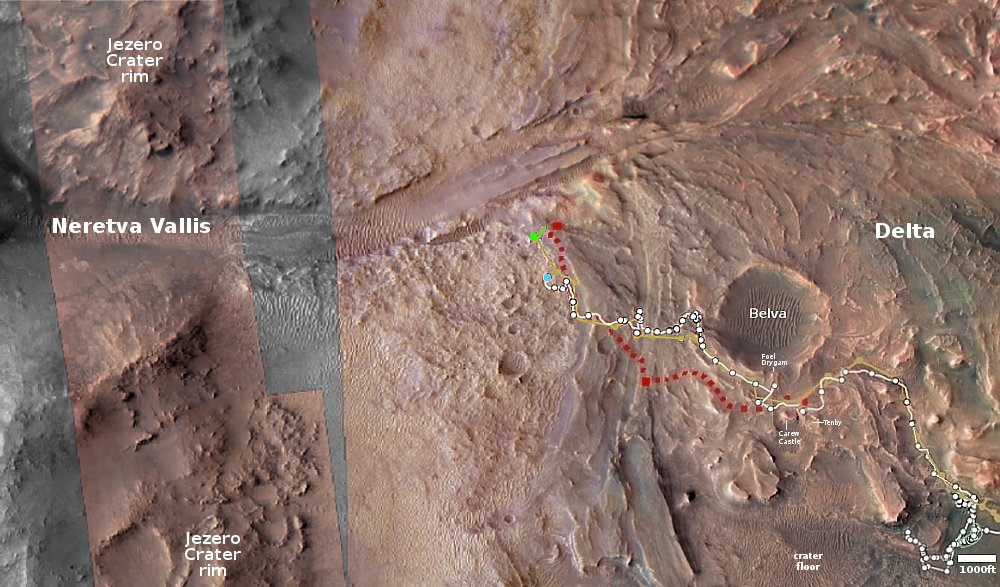
On the overview map below, the blue dot marks Perseverance’s present position, with the red dotted line indicating the approximate planned route of the rover uphill. The yellow lines are my guess as to the area covered by the panorama above. That guess could be wrong, as not all the features in the picture match the overview map. The view could be much closer, with the hill and ridgeline nothing more than the small outcrops close to the rover.

Nonetheless, these navigation pictures show us the kind of terrain the rover will be climbing as it works its way up the rim of Jezero Crater. The ground is relative smooth, though steep. My guess is that this is about a 25% grade, which on Earth would be a problem but on Mars it is a grade that NASA’s other rover, Curiosity, has routinely traversed. Perseverance has not yet traveled this kind of steepness, but there is no reason to expect it to have any difficulties doing so.

Overview map
Click for interactive map.

1 comment

Curiosity spots a corroded weathered rock

a weathered and corroded rock
Click for original image.

Cool image time! The picture to the right, cropped, reduced, and sharpened to post here, was taken on September 29, 2024 by the close-up camera mounted at the end of the robot arm of the rover Curiosity on Mars.

This is a small rock, less than three inches across. It is embedded in the sand and soil of Mars, its surface clearly weathered and smoothed by some process. The holes and gaps in the rock could have occurred prior to that smoothing, getting exposed by it. Or possibly the holes developed during the smoothing, with sections breaking off because the material was like sandstone, easily friable.

What caused the smoothing? The data from Curiosity as it climbs Mount Sharp suggests some water process, either flowing water or glacial ice. The scientists at present tend to prefer the liquid explanation, but that requires the Martian atmosphere to have once been much thicker and warmer, conditions that no model has yet demonstrated convincingly was ever possible.

The rock is also likely another example of sulfur, part of the sulfate-bearing unit of geology that Curiosity is presently traversing.

2 comments

Proposed commercial spaceport in Azores launches two suborbital demonstration rockets

Santa Maria spaceport

A spaceport startup, the Atlantic Spaceport Consortium (ASC), has successfully launched two small suborbital demonstration rockets from the island of Santa Maria in the Azores of Portugal, where it hopes to eventually establish a spaceport.

The first of the two flights was launched from a mobile platform at 13:04 UTC on 27 September. The rocket reached an altitude of 5,596 metres. The second was launched at 11:49 UTC on 28 September 2024. According to the company, the second launch โ€˜was not perfect,โ€™ but it did not provide any further details on what occurred during the flight.

The rocket was developed and built by ASC, and was intended to demonstrate its own rocket capabilities as well as provide information to the Portuguese government for establishing its own regulatory guidelines, as per an agreement signed in August.

0 comments

China unveils proposed spacesuit for its planned manned lunar landings

China's proposed moonsuit
Click for original image.

China’s Manned Space Agency (CMSA) yesterday unveiled its proposed spacesuit for the planned manned lunar landings it hopes to achieve by 2030.

As shown on the left, the suit draws its design from the Russian Orlan suit. The large backpack-like unit is also a hatch. The astronaut opens it, drops into the suit, and then a partner closes the unit, locking it shut. The rest of the suit is a single piece, with the central body unit rigid and the arms and legs flexible.

The Russian’s Orlan suit has been upgraded a number of times over the years, but the basic design has proved to be practical, efficient, and reliable, generally the oppose of the unwieldy and complex American suits NASA has been using since the start of the shuttle era.

The announcement was made to initiate a contest for the public to pick a name for the suit. Like all such contests, the real goal is to provide bread-and-circuses to the public so that they can think they have some say in what is happening. In the end the government will pick the name, and find someone who made the same suggestion to “award” for the idea.

7 comments

SpaceX pauses launches after de-orbit of Falcon 9’s second stage misfires

SpaceX today announced that, after its Falcon 9 rocket had successfully placed two astronauts in orbit in its Freedom capsule, the engine burn designed to de-orbit the rocket’s upper stage in a safe zone in the ocean misfired, and for this reason the company was scrubbing a planned launch today until the root cause was found.

After todayโ€™s successful launch of Crew-9, Falcon 9โ€™s second stage was disposed in the ocean as planned, but experienced an off-nominal deorbit burn. As a result, the second stage safely landed in the ocean, but outside of the targeted area.

We will resume launching after we better understand root cause

The company provided no further details on exactly what happened. We know the engine fired, and the stage was successfully de-orbited safely over the ocean, but we do not know how far outside its target zone. Nor do we know the extent of the “off-nominal deorbit burn.”

At present today’s scrubbed launch, placing three satellites of Starlink’s competitor OneWeb into orbit, is scheduled for tomorrow, but that is likely a contigency scheduling. SpaceX’s launch teams have gotten very good at rescheduling launches day-to-day, so that as soon as it gets the go-ahead it can go ahead.

8 comments

SpaceX launches two astronauts to ISS, setting new annual launch record for the U.S.

SpaceX this morning launched two astronauts to ISS in the fourth flight of the Freedom Dragon capsule, the Falcon 9 rocket lifting off from Cape Canaveral.

The first stage completed its second flight, landing back at Cape Canaveral. Freedom will dock with ISS tomorrow.

While most news stories will focus on the rescue aspect of this mission, its crew reduced by two so that the two astronauts launched in June on Boeing’s Starliner capsule can come home on it in February, the real news story is that with this launch the United States set a new record for the number of launches in a single year. With this launch the U.S. has completed 111 successful launches in 2024, exceeding the record set last year’s of 110 launches. And this record was achieved in less than three quarters of the year. At this rate is it very likely the U.S. will double the record of 70 set in 1966 that lasted until 2022.

China meanwhile completed its own launch late yesterday, its Long March 2D rocket placing what China’s state-run press described as “its first reusable and returnable test satellite,” designed to do orbital operations and experiments, return to Earth with those materials, and then later relaunch again. This is very similar to the commercial capsules that the startup Varda is flying and using to produce pharmaceuticals for sale.

The rocket lifted off from China’s Jiquan spaceport in northwest China. No word where its lower stages, using toxic hypergolic fuels, crashed inside China.

The leaders in the 2024 launch race:

95 SpaceX
44 China
11 Russia
11 Rocket Lab

American private enterprise now leads the rest of the world combined in successful launches 111 to 67, while SpaceX by itself now leads the entire world, including American companies, 95 to 83.

12 comments

September 27, 2024 Quick space links

Courtesy of BtB’s stringer Jay. This post is also an open thread. I welcome my readers to post any comments or additional links relating to any space issues, even if unrelated to the links below.


16 comments

Crazy swirling Martian landscape

Crazy swirling Martian landscape
Click for original image.

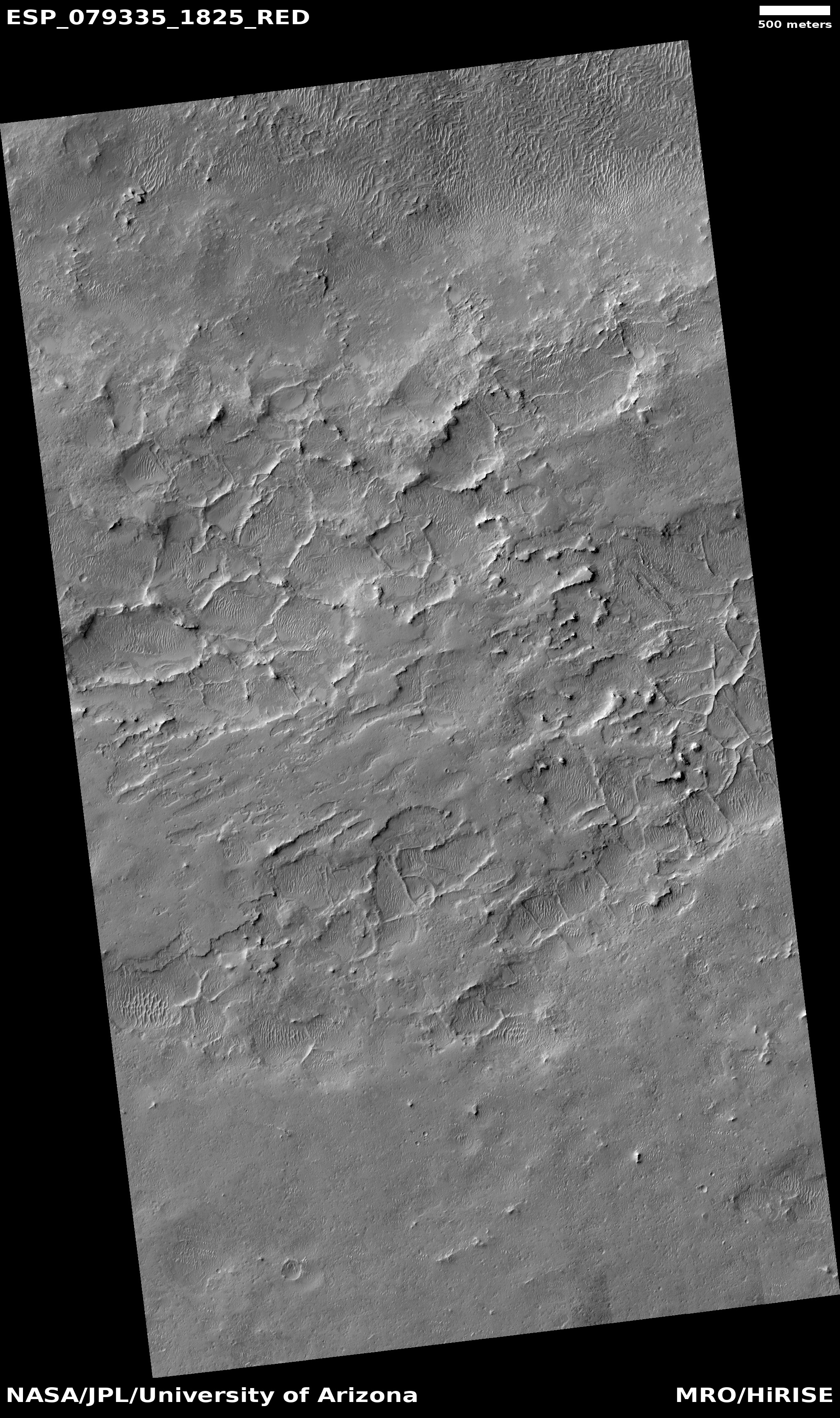
Cool image time! The picture to the right, cropped, reduced, sharpened, and annotated to post here, was taken on July 1, 2024 by the high resolution camera on Mars Reconnaissance Orbiter (MRO).

The science team labels this “Contacts between Likely Sulfates and Chaos Blocks.” That contact I have indicated with the dotted line. To the west the lighter terrain is likely the sulfate-bearing unit, similar to the sulfate-bearing unit that Curiosity has been traversing on Mount Sharp for the past year or so.

To the east are the chaos blocks, but I think that description is wholly inadequate. In truth, I haven’t the faintest idea how this terrain got to be the way it is. It is evident that a lot of dust and sand has gotten trapped in the hollows, leaving behind ripple dunes in some places, but why the higher ridges swirl and curve about as they do is utterly baffling.
» Read more

0 comments

Scientists locate lunar impact crater produced by LCROSS in 2009

Figure 2 of research paper
Taken from figure 2 of the paper. Click for
original image.

Using orbital radar and opitcal images scientists finally believe they have identified the small crater on the Moon produced when — as part of the 2009 LCROSS mission — an abandoned rocket stage crashed in a permanently shadowed section of Cabeus crater near the lunar south pole.

LCROSS was designed to study the ejecta thrown up by that impact, and found “a significant amount of water, estimated at 5.6 ยฑ 2.9% by mass, as well as minor amounts of other volatile species.” Because the impact was in that permanently shadowed region, however, locating the new crater required new instrumentation.

Using a radar instrument on Lunar Reconnaissance Orbiter (LRO) as well as the Shadowcam instrument on South Korea’s Danuri orbiter — designed to take optical images in very low light — the scientists pinpointed that impact crater, as shown in the image to the right, overlaying both the radar and optical images. The crater is estimated to be about 22 meters across, about 25% smaller than predicted. From this the scientists conclude that the water in the ejecta plume came from close to the surface, and thus could only have been placed there in the past billion years. Before that, the location was not in shadow, and volatiles like water could not have survived if they were near the surface.

From this data the scientists believe the water was likely placed there by the “recent delivery by comets or the solar wind, rather than as a paleo-reservoir from an early volcanic atmosphere.” If so, the amount of material can be reasonably predicted, and is likely less than hoped for because it only exists in the top two meters.

3 comments

Rocket Lab completes new capsule for Varda

Varda's space capsule, on the ground in Utah
Varda’s first capsule on the ground in Utah.

Rocket Lab today announced it has completed testing and intergration of a new recoverable capsule for the in-space manufacturing company Varda, to be used in orbit to produce pharmaceuticals that can only be created in weightlessness.

No launch date was announced. This was the second of four capsules Rocket Lab is building for Varda, with the first having already completed its flight, where it returned to Earth after successfully crystallizng the HIV drug Ritonavir.

The most important tidbit in the press release however was this:

Varda received permission from the FAA under a Part 450 license earlier this month, making them the only company to ever secure a second reentry license.

With the first capsule, the capsule’s return was delayed almost six months because the FAA and the military couldn’t get their paperwork together to approve the return license. Varda now has that return license in hand before launch, meaning it will get the capsule back when it wants.

1 comment
1 303 304 305 306 307 2,916