Manon – Act I, ‘Bedroom’

An evening pause: Written by Kenneth MacMillan and performed by Marianela Nuñez as Manon and Federico Bonelli as Des Grieux of the Royal Ballet.

Contrast the gentility and elegance of this dance of two, of which Astaire and Rogers were of the same class, with that of the raw modern gymnastic routines of large groups. Both have their merits, but to me there is something more civilized and thoughtful about the former.

Hat tip Judd Clark.

1 comment

September 25, 2023 Quick space links

Courtesy of BtB’s stringer Jay.


2 comments

Pushback: Pennsylvania HS students stage walk-out protesting rule allowing boys inside girls’ bathrooms

A little child shall lead them, by James Johnson
“A little child shall lead them,” painting by James L. Johnson.

Bring a gun to a knife fight: On September 22, 2023 hundreds of students attending high school in Pennsylvania’s Perkiomen Valley School District walked out of classes in protest when the local school board refused to pass a new rule that would forbid boys from using the girls’ bathroom.

The school board had voted against the rule earlier in the week. According to superintendent Dr Barbara Russell it rejected the rule because of its own “anti-discrimination code which states gender identity is a protected class.”

To put it in plain English, the law now allows transvestites or cross-dressing boys to leer at young girls while they go to the bathroom, and no one can do anything about it.

The students in these high schools however did not agree, and made that disagreement quite clear in their protest. I strongly suspect that even when they return to class, there is going to be an organized effort to protect the girls from such perversion. Note this quote:
» Read more

5 comments

SpaceX launches 21 Starlink satellites from Vandenberg

SpaceX early this morning successfully launched another 21 Starlink satellites, its Falcon 9 rocket lifting off from Vandenberg in California shortly after midnight.

The first stage successfully completed its sixth flight, landing on a drone ship in the Pacific.

The leaders in the 2023 launch race:

68 SpaceX
43 China
13 Russia
7 Rocket Lab
7 India

American private enterprise now leads China in successful launches 79 to 43, and the entire world combined 79 to 69. SpaceX by itself now trails the rest of the world combined (excluding American companies) by only 68 to 69.

Hat tip to BtB’s stringer Jay. I had missed this launch last night, until he reminded me of it.

6 comments

Almost all of Mars’ geological mysteries in one spot

Almost all of Mars' geological history in one spot

Cool image time! The picture to the right, rotated, cropped, reduced, and sharpened to post here, was taken on June 30, 2023 by the high resolution camera on Mars Reconnaissance Orbiter (MRO). The scientists label it “Mesas in shallow trough,” but that is only describes a small part of what can be seen here, as I interpret it.

The picture itself shows a small portion of the floor of an unnamed 32-mile-wide crater, with the crater’s southeast interior rim beginning its rise in the lower right. First, note the meandering hollow in the upper left, suggesting some past flow. Second, note the pattern of small ridges on the flat crater floor, suggesting some past drying process that left cracks that later filled with material that formed the ridges at a later time. Third, the mesas themselves suggest chaos terrain, often formed on Mars in connection with glacial flows. Fourth, note that the trough which holds the mesas is on the edge of the crater floor, suggesting the trough and mesas mark the erosion that once occurred at the edge of some material, possibly ice, that once filled that floor.

The trough and small meander also signify something far larger that can only be seen when we zoom out.
» Read more

0 comments

OSIRIS-REx Sample from Bennu successfully recovered

Engineers today successfully recovered the asteroid sample capsule from the probe OSIRIS-REx, carrying several grams of material from the potentially dangerous asteroid Bennu.

The samples will be shipped to special facilities to protect the material from being exposed to Earth’s environment when the capsule is opened. It will take several months at least before the first research results are announced.

OSIRIS-REx, now renamed OSIRIS-APEX, now heads for the potentially dangeous asteroid Apophis, where it will orbit that asteroid beginning in 2029, shortly after Apophis makes its next close fly-by of Earth.

13 comments

SpaceX launches 22 Starlink satellites, flying its second booster for a 17th time

SpaceX tonight successfully launched 22 Starlink satellites, its Falcon 9 rocket lifting off from Cape Canaveral using a first stage booster flying for the seventeenth time.

The booster landed successfully on a drone ship in the Atlantic. The company now has two boosters that have flown that many times, plus at least one that has flown fifteen times.

The leaders in the 2023 launch race:

67 SpaceX
43 China
13 Russia
7 Rocket Lab
7 India

American private enterprise now leads China in successful launches 78 to 43, and the entire world combined 78 to 69. SpaceX by itself now trails the rest of the world combined (excluding American companies) by only 67 to 69.

9 comments

September 22, 2023 Quick space links

Courtesy of BtB’s stringer Jay.


1 comment

Strange wormlike tube features on slopes of Martian shield volcano

Strange tubes on Mars
Click for original image.

Cool image time! The picture to the right, cropped to post here, was taken on June 21, 2023 by the high resolution camera on Mars Reconnaissance Orbiter (MRO).

The scientists label the strange tubelike features that are scattered throughout this picture as “landforms,” which is correctly vague because their origin is utterly inexplicable. The ground here is on the eastern slope of a small 20-mile-wide very flat shield volcano located about 150 miles northwest of the giant volcano Ascraeus Mons. The dark wind streaks point down that grade to the east, away from the shield volcano’s peak about 1,000 feet away. (If you look at the full image this indistinct peak is at dead center, with a linear depression (the volcano’s vent) beginning there and heading to the northeast for about four miles.)

Why these many tubes are all oriented in a northwest-southwest direction, at right angles to the slope, is baffling, especially because they hold to that same orientation all across the shield volcano, no matter the downward direction of the slope.
» Read more

6 comments

Pushback: California county sued for using cellphones to track movements of church-goers

Santa Clara seal

They’re coming for you next: Santa Clara county in California is now being sued by Calvary Chapel San Jose and its pastor Mike McClure for using without warrant the GPS data from the cellphones of the church’s members to track their movements without their knowledge.

On August 22, 2023, a lawsuit was filed by Advocates for Faith and Freedom on behalf of Calvary Chapel San Jose against Santa Clara County, California, for utilizing geofencing methods to spy on church members during the COVID-19 pandemic. Earlier this year, Santa Clara County imposed a $1.2 million fine against the church for not abiding by the State’s and County’s COVID-19 restrictions.

Santa Clara County utilized an investigative method known as geofencing. Geofencing is a technological tool the government uses to track people relative to their location and likely locations. This tool is typically used in police investigations of criminal activity and, in these instances, requires a warrant– which is not always granted.

The lawsuit complaint can be read here [pdf]. As it notes:
» Read more

24 comments

House speaker Kevin McCarthy proposes bill to extend “learning period” for rocketry

The speaker of the House, Kevin McCarthy (R- California) today introduced what he calls the STAR act, which would extend the learning period that exempts the new human commercial space industry from heavy regulation from its impended expiration this year for eight more years, to 2031. From his statement:

The STAR Act would extend the learning period by 8 years to provide sufficient time for the FAA and commercial space industry to develop consensus standards for human safety in space flight. The bill’s proposed 8-year extension corresponds with the lengths of the original learning period — from 2004 to 2012—and the extension by Rep. McCarthy’s SPACE Act (P.L. 114-90) — from 2015 to 2023.

More information here. That McCarthy has introduced this bill suggests its chances of passage are high, assuming a very divided and partisan Congress can manage to pass anything in the coming weeks.

8 comments

Webb infrared data suggests Europa’s C02 comes from within

Europa as seen by Webb's near-infrared camera
Europa as seen by Webb’s near-infrared camera.
Click for original image.

Two different research papers, using infrared data from the Webb Space Telescope, have independently concluded that the carbon dioxide previously detected on the surface of Europa is found concentrated in the same region, and has the earmarks of coming from beneath the surface.

In one study, Samantha Trumbo and Michael Brown used the JWST [Webb] data to map the distribution of CO2 on Europa and found the highest abundance of CO2 is located in Tara Regio – a ~1,800 square kilometer region dominated by “chaos terrain,” geologically disrupted resurfaced materials. According to Tumbo and Brown, the amount of CO2 identified within this recently resurfaced region – some of the youngest terrain on Europa’s surface – indicates that it was derived from an internal source of carbon. This implies that the CO2 formed within Europa’s subsurface ocean and was brought to the surface on a geologically recent timescale. However, the authors say that formation of CO2 on the surface from ocean-derived organics or carbonates cannot be entirely ruled out. In either interpretation, the subsurface ocean contains carbon.

In an independent study of the same JWST data, Geronimo Villanueva and colleagues found that the CO2 on Europa’s surface is mixed with other compounds. Villanueva et al. also find the CO2 is concentrated in Tara Regio and interpret that as demonstrating that the carbon on the moon’s surface was sourced from within. The authors measured the ice’s 12C/13C isotopic ratio, but could not distinguish between an abiotic or biogenic source. Moreover, Villanueva et al. searched for plumes of volatile material breaching moon’s icy crust. Although previous studies have reported evidence of these features, the authors did not detect any plume activity during the JWST observations. They argue that plume activity on Europa could be infrequent, or sometimes does not contain the volatile gasses they included in their search.

As always, these conclusion must be viewed with some skepticism, as the data is somewhat sparse and coarse. Webb’s resolution is not enough to truly pinpoint the source location with great accuracy, and the conclusion that the CO2 comes from underground depends on many assumptions. For example, in the image above, the white area roughly corresponds to Tara Regio, but with very large margins.

1 comment

Independent review: NASA’s Mars sample return mission is in big trouble

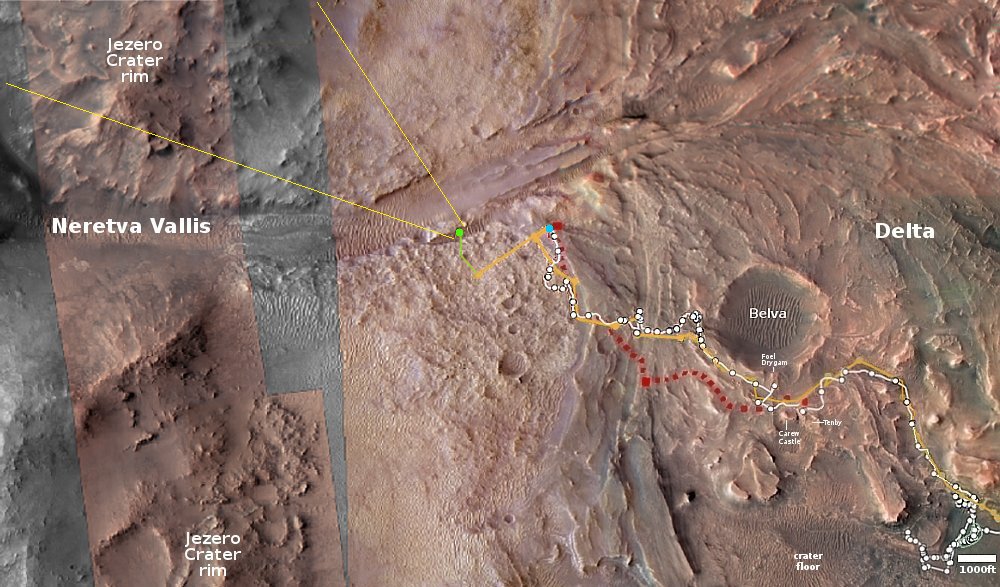
Perseverance's first set of core samples, placed on the floor of Jezero Crater
Perseverance’s first set of core samples,
placed on the floor of Jezero Crater

An independent review of NASA’s Mars sample return mission (MSR) to pick up the core samples being collected by the rover Perseverance has concluded that the project has serious fundamental problems that will likely cause it to be years late and billions over-budget, assuming it ever flies at all.

You can read the report here [pdf]. After thirteen pages touting the wonders and importance of the mission to get those samples back to Earth, the report finally gets to its main point:

However, MSR was established with unrealistic budget and schedule expectations from the beginning. MSR was also organized under an unwieldy structure. As a result, there is currently no credible, congruent technical, nor properly margined schedule, cost, and technical baseline that can be accomplished with the likely available funding.

Technical issues, risks, and performance-to-date indicate a near zero probability of [the European Mars orbiter intended to bring the sample back to Earth] or [the Earth sample facility] or [the Mars ascent vehicle] meeting the 2027/2028 Launch Readiness Dates (LRDs). Potential LRDs exist in 2030, given adequate funding and timely resolution of issues.

• The projected overall budget for MSR in the FY24 President’s Budget Request is not adequate to accomplish the current program of record.

• A 2030 LRD for both [the sample return lander] and [the Mars orbiter] is estimated to require ~$8.0-9.6B, with funding in excess of $1B per year to be required for three or more years starting in 2025.

Based on this report, a mission launch in 2030 is only “potentially” possible, but only wild-eyed dreamers would believe that. It also indicates that the budget for each component listed above requires several billion dollars, suggesting the total amount needed to achieve this mission could easily exceed in the $30 to $40 billion, far more than the initial proposed total budget for the U.S. of $3 billion.

None of this is really a surprise. Since 2022 I have been reporting the confused, haphazard, and ever changing design of the mission as well as its ballooning budgets. This report underlines the problems, and also suggests, if one reads between the lines, that the mission won’t happen, at least as presently designed.

The report does suggest NASA consider “alternate architectures in combination with later [launch readiness dates].” Can you guess what might be an alternate architecture? I can, and its called Starship. Unlike the proposed helicopters and ascent rocket and Mars Orbiter, all of which are only in their initial design phases, Starship is already doing flight tests (or would be if the government would get out of the way). It is designed with Mars in mind, and can be adapted relatively quickly for getting those Perservance core samples back.

Otherwise, expect nothing to happen for years, even decades. In February 2022 I predicted this mission would be delayed from five to ten years from its then proposed ’26 launch date. A more realistic prediction, based on this new report, is ten to twenty years, unless NASA takes drastic action, and the Biden administration stops blocking Starship testing.

8 comments

September 21, 2023 Quick space links

Courtesy of BtB’s stringer Jay.


2 comments

Pushback: Professor blacklisted by North Texas U wins in Federal court

North Texas University: where censorship and blacklisting is celebrated

Bring a gun to a knife fight: Today’s blacklist story follows up on the case of professor Timothy Jackson, who was dismissed in 2021 by the University of North Texas (UNT) as the editor of a history of music journal he had founded because he and his student editors had organized an issue dedicated to disproving the anti-white and racist accusations of a different professor against a well known musical figure.

From his lawyer’s most recent press release:

The Journal of Schenkerian Studies is dedicated to a late 19th/early 20th-century Austrian-Jewish music theorist, Heinrich Schenker, and his systematic, graphic methods of music analysis. In July 2020, Timothy Jackson defended Schenker in the pages of the Journal from an attack by Hunter College Professor Philip Ewell. Professor Ewell labeled Schenker a “racist” and, indeed, the entire tradition of Western classical music as “systemically racist.” This dispute would have remained a typical academic tempest in a teapot, but the University of North Texas swiftly condemned Jackson’s defense of Schenker and classical music. At UNT, defending classical music and its theory against charges of “racism” is a “thought crime.”

Graduate students quickly condemned Professor Jackson for “racist actions” and various other derelictions that they claimed hurt their feelings. Calls for Professor Jackson to be fired quickly escalated, and the vast majority of Jackson’s fellow faculty members jumped on the bandwagon. Sixteen of them signed a graduate student petition calling for his ouster and for censorship of the Journal. Discovery revealed that at least one did so without even reading or understanding what the petition said.

Officials at the university subsequently removed Jackson as editor of the journal, apparently because he had freely expressed his first amendment rights to dissent publicly from Ewell’s false accusations against Schenker. As I noted in 2021,
» Read more

2 comments

SpaceX shows off a Raptor-2 engine during local Texas parade

During the annual Founders Day parade in McGregor, Texas, SpaceX participated by including on its float a Raptor-2 engine, used by Starship and Superheavy.

Outside of an unannounced display of an engine in town one day, SpaceX, known for it’s secrecy, hasn’t had a public showing like this before. Residents waved as the engine passed by while SpaceX employees and their families waved and tossed candy from the trailer hauling the engine.

McGregor, whose population is only 6,000, is the location of SpaceX’s engine facility, where it builds and tests its rocket engines. Very clearly this parade proves this evil capitalist company is doing harm to these poor rural Texans and the environment that surrounds them. The hate that emanates from these citizens is truly overwhelming!

Hat tip to Robert Pratt of Pratt on Texas.

4 comments

A close-up of the giant crack that almost splits Mars

A close-up of the crack that splits Mars
Click for original image.

Cool image time! The picture to the right, rotated, cropped, reduced, and sharpened to post here, was taken on June 28, 2023 by the high resolution camera on Mars Reconnaissance Orbiter (MRO). The intended science focus of the image is likely the floor of this canyon on the lower right, showing what appears to be a patch of uprised topography surrounded by what looks like glacial debris, which at this latitude of 39 degrees north is expected on Mars.

The grade at this location is downhill to the southwest, so if this is a glacier it is flowing in that direction.

The cliff is about 3,000 feet high, dropping that distance in about a mile and a half. Thus, this is only slightly less steep than the very steep cliff wall of the caldera of Olympus Mons, highlighted as a cool image two days ago.

What makes this canyon interesting — besides its spectacular scenery — is its larger context, recognized when one looks at this location from afar and thus sees how it shaped a vast portion of the global surface of Mars.
» Read more

0 comments
1 301 302 303 304 305 1,752