Bad consequences from the medical profession’s panic/lies over COVID continue to build

The results of COVID policy decisions of our medical community
The results of COVID policy decisions
for our medical community

Several stories in the past week illustrate how the medical community dug itself a deep hole with its dishonest panic and over-reaction to COVID and its response to it.

First the background from 2020: Rather than follow past very successful policies involving new epidemics, whereby only the sick and aged were quarantined while everyone else went about their normal lives, intentionally spreading the new respiratory virus to those with which it was relatively harmless so that the entire population could quickly get herd immunity and thus quickly choke the virus out, our modern medical community, in conjunction with government health officials who had political motives, chose to quarantine everyone, destroying the economy and the livelihoods of millions while actually allowing the disease time to spread to the aged and sick, killing many more than were necessary.

Numerous studies have confirmed the failure of the lockdown and mandate policies during COVID. Sweden for example essentially followed those traditional policies, never locking down or mandating masks or shots. It was blasted for that decision, with many in the health community predicting massive deaths from COVID. Instead, studies have now proven that Sweden had the lowest mortality in Europe from 2020–2022.

That’s the background. The new stories this week illustrate the consequences. First, a recent peer-reviewed study found that trust in doctors has crashed since 2020. The numbers are quite shocking:
» Read more

24 comments

Perservance looks back from on high

Perservance's view looking back down Neretva Vallis
Click for original image.

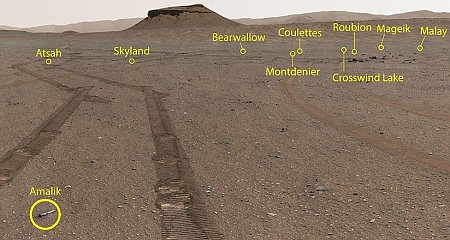
Cool image time! The picture above, cropped to post here, was taken on September 9, 2024 by the left navigation camera on the Mars rover Perseverance, looking east and back along the route from which the rover had come.

The view is somewhat more spectacular than most Perseverance images because the rover took it during its on-going climb up unto the rim of Jezero Crater, as shown by the overview map below. The blue dot marks Perseverance’s present position, while the yellow lines indicate the area covered by the picture above, taken several days earlier.

The haze in the picture also suggests that the local dust storm first noted in late August might be clearing somewhat. This isn’t certain, however, as the previous picture was using the rover’s high resolution camera to look at distant hills (thus more obscured), while the picture above was taken by the left navigation camera looking more widely and at nearer objects.

Overview map
Click for interactive map.

1 comment

Intuitive Machines targeting January 2025 for launch of its next lunar lander

The landers either at or targeting the Moon's south pole
The landers either at or targeting the Moon’s south pole

The company Intuitive Machines is now aiming to launch its second Nova-C lunar lander, dubbed Athena, during a January 1-5, 2025 launch window.

The landing site is indicated on the map to the right, on the rim of Shackleton crater and almost on top of the south pole. While Chang’e-7 is targeting the same crater rim, it is not scheduled for launch until 2026.

The lander will not only include a drill for studying the surface below it, it will release a small secondary payload, the Micro-Nova Hopper, which will hopefully hop down into the permanently shadowed craters nearby.

The launch will also carry a lunar orbiter, dubbed Lunar Trailblazar, which will not only do spectroscopy of the lunar surface, looking for water, it will also be used as a communications relay satellite with Athena. That orbiter, designed to demonstrate the ability to build a smallsat at low cost, was previously threatened with cancellation because its builder, Lockheed Martin, went way over budget.

0 comments

New gravity map of Mars released

New global map of Mars gravity field
Click for original image.
Using both seismological data compiled over four years by the InSight Mars lander as well tiny changes in the orbits of Martian satellites, scientists have now created a global gravity map of the red planet, indicating the regions below the surface that are either low or high density.

That map is above, annotated by me to indicate some of Mars’ major surface features.

The density map shows that the northern polar features are approximately 300-400 kg/m3 denser than their surroundings. However, the study also revealed new insights into the structures underlying the huge volcanic region of Tharsis Rise, which includes the colossal volcano, Olympus Mons.

Although volcanoes are very dense, the Tharsis area is much higher than the average surface of Mars, and is ringed by a region of comparatively weak gravity. This gravity anomaly is hard to explain by looking at differences in the martian crust and upper mantle alone. The study by Dr Root and his team suggests that a light mass around 1750 kilometres across and at a depth of 1100 kilometres is giving the entire Tharsis region a boost upwards. This could be explained by huge plume of lava, deep within the martian interior, travelling up towards the surface.

I once again note that the largest impact basin on Mars, Hellas Basin, sits almost exactly on the planet’s far side from Tharsis, and appears to have a light density. This contrast once again makes me wonder if the origin of that impact and the Tharsis Bulge are linked.

13 comments

Boeing employees reject deal of union and company and go on strike

In another blow to the company, Boeing’s employees have gone on strike after overwhelming voting to reject a new deal their union officials had negotiated with the company that had called for a 25% salary increase across the board.

Members of the International Association of Machinists District 751, which represents about 33,000 Boeing workers in Washington state, walked off the job when their contract expired at midnight on Thursday night. Almost 95 per cent rejected the deal endorsed by their bargaining team on Sunday and 96 per cent voted to strike, easily exceeding the two-thirds majority needed to trigger a walkout.

Many of the union’s members expressed anger on social media, criticising the deal and accusing IAM leaders of settling for too little. Many had been ready to strike, partly fuelled by residual anger from a 2014 deal that eliminated defined-benefit pensions.

Boeing on Thursday said it was ready to renegotiate a deal to halt a crippling strike.

Right now Boeing’s credit rating is “one notch above junk” and if the strike isn’t settled quickly that rating could drop more. It will also prevent the company from taking any action to recover from its numerous problems that are limiting sales of its airplanes and its military and space products.

10 comments

SpaceX launches 21 more Starlink satellites

SpaceX last evening successfully placed another 21 Starlink satellites into orbit, its Falcon 9 rocket lifting off from Vandenberg in California.

The first stage completed its eighteenth flight, landing on a drone ship in the Pacific.

The leaders in the 2024 launch race:

91 SpaceX
38 China
10 Rocket Lab
10 Russia

American private enterprise now leads the rest of the world combined in successful launches 106 to 58, while SpaceX by itself leads the entire world, including American companies, 91 to 73.

4 comments

Leonid & Friends – One Fine Morning

An evening pause: This Russian band does a fine cover of the Lighthouse hit. It is also the third different Leonid & Friends cover that I have posted over the years, all suggested by different people (see here and here for the previous two).

Hat tip Alex Gimarc.

1 comment

September 12, 2024 Quick space links

Like yesterday, reader Gary has stepped in to cover for BtB’s stringer Jay, who is off on a work trip this week. This post is also an open thread. I welcome my readers to post any comments or additional links relating to any space issues, even if unrelated to the links below.


  • ArianeSpace CEO Stéphane Israël criticizes billionaires in space
  • But then, Israel has generally been a head-in-the-sand fool for more than a decade when it comes to reusability and commercial space. His insistence ten years ago that it made no financial sense to make Ariane-6 reusable resulted in that rocket being overpriced in today’s market, which is why Europe is right now pushing Arianespace and Stephen Israel out and replacing both with private commercial rocket companies competing for business. All he does here is provide proof that getting him out of the way is the best thing the European Space Agency has done in years.

10 comments

Heritage Foundation releases guide to colleges that teach instead of indoctrinate

Heritage map of good and bad colleges
Click for interactive map.

In an effort to find at least two universities in every state that are focused not on leftist and queer indoctrination but instead on free expression and open inquiry, the conservative Heritage Foundation has now put together an interactive map and guide that parents and high school students can use to choose a quality college to attend.

The image to the right is a screen capture of that map, located here. You can click on each dot to get more detailed information about why Heritage recommends or not recommends it. For example, for Thomas Aquinas College in California the guide says the following in explaining why it lists it as a “great option.”

The mission of Thomas Aquinas College (TAC) is to renew “what is best in the Western intellectual heritage and to [conduct] liberal education under the guiding light of the Catholic faith.” TAC has an impressive “A+” rating from the American Council of Trustees and Alumni. It does not have a bias response team, nor does it require diversity statements for hiring. It has an impressive 80 percent four-year graduation rate. Thomas Aquinas College also accepts the Classical Learning Test for admission.

Meanwhile, the guide says the following in giving Cornell University, Duke, Brown, Harvard, and Tufts a “not recommended” status:
» Read more

12 comments

A fluted mesa on Mars

A fluted mesa on Mars
Click for original image.

Cool image time! The picture to the right, cropped, reduced, and sharpened to post here, was taken on July 9, 2024 by the high resolution camera on Mars Reconnaissance Orbiter (MRO). It shows what the science team labels a “silica-rich mound”, as indicated by the bright streaks on all the high ridge points.

The flat-topped mesa on the right drops about 200 feet to the valley floor. The rims of that depression to the west rise about 50+ feet higher, while mesa nose in the upper left rising another 50+ feet more.

Was the depression caused by an impact? If so, the landscape has changed radically since that impact occurred, with most of the surrounding terrain eroded away. The two flat-topped mesas hint at the ancient surface when that impact occurred.

A wider view however raises questions about this impact theory.
» Read more

1 comment

Scientists re-create on Earth the sublimation of Mars’s winter mantle of dry ice

Spiders created on Earth
Click for original image.

Scientists have successfully re-created on Earth the process on Mars that creates the unique “spider” formations seen in the the Martian south pole region, produced when the winter mantle of dry ice begins to sublimate away into a gas.

The study confirms several formation processes described by what’s called the Kieffer model: Sunlight heats the soil when it shines through transparent slabs of carbon dioxide ice that built up on the Martian surface each winter. Being darker than the ice above it, the soil absorbs the heat and causes the ice closest to it to turn directly into carbon dioxide gas — without turning to liquid first — in a process called sublimation (the same process that sends clouds of “smoke” billowing up from dry ice). As the gas builds in pressure, the Martian ice cracks, allowing the gas to escape. As it seeps upward, the gas takes with it a stream of dark dust and sand from the soil that lands on the surface of the ice.

At the south pole, the ground below the mantle is stable enough that each winter the trapped CO2 gas follows the same path to the same points where the dry ice cracks, slowly creating “tributaries” that combine to form the spider formations.

The picture to the right, cropped, reduced, and sharpened to post here, comes from figure 9 of the paper [pdf]. It shows the lab-created spiders formed by this simulated process, thereby confirming this hypothesis about how the spiders form.

0 comments

Italian rocket company Avio outlines its future rocket plans

Link here. The plans include steady upgrades to its Vega-C rocket, including replacing the upper stage engine presently provided by a Ukrainian company with an engine built by Avio itself.

The bigger development will be a more powerful rocket, the Vega-E, to replace the Vega-C in 2027.

This version of the rocket will retain the first and second stages of the Vega C+ rocket and substitute the third and fourth stages for a single liquid fuel stage powered by the company’s new M10 methalox rocket engine.

The company is also hoping to begin test flights in 2026 of a Grasshopper-type small-scale demonstration rocket leading to the development of a reusable two-stage rocket that would eventually replace Vega-E.

3 comments
1 312 313 314 315 316 2,916