Rocket Lab completes in-space commissioning of two Escapade Mars orbiters

Built by Rocket Lab for NASA and launched in November 2025, the company has now completed the in-space commissioning of two Escapade Mars orbiters and is about to hand operations over to the University of California Berkeley Space Sciences Laboratory (UC-Berkeley).

With both spacecraft now fully commissioned and successfully operating at the Earth–Sun Lagrange Point 2 (L2), Rocket Lab is preparing to hand over operational control to [UC-Berkeley], who will lead science operations at L2 and prepare the mission for its cruise to Mars.

Under contract from [UC-Berkeley], Rocket Lab was selected to design, build, and provide commissioning operations of the two high delta-V Explorer-class interplanetary spacecraft for ESCAPADE. Rocket Lab moved from concept to launch readiness in just over three years, proving commercial collaboration can deliver important science key to supporting future human and robotic exploration of Mars on ambitious schedules and for significantly smaller budgets than typical interplanetary missions. This speed was made possible through Rocket Lab’s vertically integrated spacecraft production, with key components including solar arrays, reaction wheels, propellant tanks, star trackers, radios, avionics, and flight software designed and built in-house.

Launched from Cape Canaveral Space Force Station in November 2025, the twin ESCAPADE spacecraft, known as Blue and Gold, completed spacecraft commissioning and executed two precise trajectory correction maneuvers, placing both spacecraft into their loiter trajectory near L2, approximately 1.5 million kilometers from Earth.

Both spacecraft will be sent on their way to Mars in December 2026 when orbital mechanics between the Red Planet and Earth are right for the journey. Once in Mars orbit the two orbiters will allow for a three-dimensional study of the interaction between the solar wind and Mars’ atmosphere.

Though this is a NASA-funded mission, note that it was built a commercial company and operated not by NASA but by a university. For this reason, it was not only built fast and at a low cost, it uses an innovative flight path that allowed it to be launched anytime and wait in orbit for the right moment to go to Mars. This last innovation provides for a lot more flexibility.

1 comment

SpaceX completes its second Starlink launch today; Firefly scrubs launch

SpaceX successfully placed another 29 Starlink satellites in orbit this evening during its second launch today, its Falcon 9 rocket lifting off from Cape Canaveral Space Force Station in Florida.

The first stage completed its 26th launch, landing on a drone ship in the Atlantic.

Firefly meanwhile scrubbed its launch of its Alpha rocket due to high winds. No new launch date as yet been scheduled. This would be Firefly’s first launch since it had a launch failure in April 2025, followed by a static fire test explosion in September 2025. According to the company, this Alpha launch will be the last of this version before it begins flying an upgraded rocket.

The 2026 launch race:

27 SpaceX
8 China
2 Rocket Lab
2 Russia
1 ULA
1 Europe (Arianespace)

As it did in both ’24 and ’25, SpaceX in ’26 so far has more launches than the entire rest of the world combined.

0 comments

SpaceX launches 25 more Starlink satellites

SpaceX early this morning successfully placed another 25 Starlink satellites in orbit, its Falcon 9 rocket lifting off from Vandenberg Space Force Base in California.

The first stage completed its 20th flight, landing on a drone ship in the Pacific.

The 2026 launch race:

26 SpaceX
8 China
2 Rocket Lab
2 Russia
1 ULA
1 Europe (Arianespace)

As it did in both ’24 and ’25, SpaceX in ’26 so far has more launches than the entire rest of the world combined.

Both SpaceX and Firefly have launches scheduled for later today. The Japanese rocket startup Space One has now rescheduled the third launch attempt of its Kairos rocket for March 3, 2026.

2 comments

Cargo Dragon successfully returns to Earth

A cargo Dragon capsule successfully splashed down in the Pacific late Thursday, February 26, 2026, bringing back several thousand pounds of hardware and experiments.

The ship had been docked at ISS for the past six months, during which it used its engines six different times to raise the station’s orbit. That capability has traditionally been done by Russian Progress freighters, but NASA has been testing other options as they are unsure Russia will remain with the station after 2028. Furthermore, there are risks using Progress to do these reboosts, as the burns take place when Progress is docked to its Zvezda module port, and the hull of the Zvezda module has been developing stress fractures in the past five years that could catastrophically fail.

Not only has Dragon now demonstrated this boost capability, so has Northrop Grumman’s Cygnus capsule.

I strongly expect Russia to stick with ISS for as long as it can, mainly because its own proposed new space station is not likely to launch as presently scheduled later this decade. Since the fall of the Soviet Union, Roscosmos has consistently been unable to complete almost any new proposed projects, and the few it has completed launched literally decades late.

Figure 3 from September Inspector General report
Figure 3 from September 2024 Inspector General report, showing Zvezda’s location on ISS, as well as the station’s leak rate at that time. The leaks in Zvezda now appear to have been sealed, but there is no guarantee more stress fractures will not appear as dockings continue at its port.

16 comments

Rocket Lab completes another HASTE suborbital mission

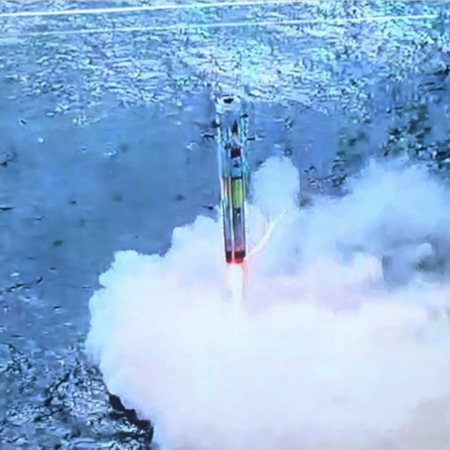
Rocket Lab late yesterday successfully completed its seventh HASTE suborbital mission, using the first stage of its Electron rocket to do a hypersonic test mission for the War Department.

In this case, the test vehicle was from the Australian company Hypersonix, and it lifted off from Rocket Lab’s Electron launchpad at Wallops Island in Virginia.

This was Rocket Lab’s second flight for this particular military agency in the past three months, and its eleventh overall launch from Wallops Island. The company’s quick reconfiguration of Electron for hypersonic suborbital testing made it possible for it to capture a bulk of the military’s suborbital hypersonic testing business that others, such as Stratolaunch, had hoped to win.

2 comments

February 27, 2026 Quick space links

Courtesy of BtB’s stringer Jay. This post is also an open thread. I welcome my readers to post any comments or additional links relating to any space issues, even if unrelated to the links below.

17 comments

Mars’ fast moving gigantic lava floods

A Martian crater broken by flowing lava
Click for original image.

Cool image time! The picture to the right, rotated, cropped, and reduced to post here, was taken on December 12, 2025 by the high resolution camera on Mars Reconnaissance Orbiter (MRO).

The science team labels this a “crater interrupted by flow.” And what a flow! This unnamed 1.4-mile wide crater was not only filled and partly buried by the flow, that flow was so strong it cut through the crater’s rim at two points, refusing to let that rim block it in any way.

The flow in this case is lava, coming down from the Tharsis Bulge where four of Mars’ biggest volcanoes arose. And that flow was quite vast, as the nearest of those volcanoes, Arsia Mons, is almost 800 miles away. Because of Mars’ relative light gravity, about 39% that of Earth’s, lava on Mars can flow across large distances in a very short time. It might have only taken a few weeks for that flow to cover that 800 miles.
» Read more

7 comments

Early notes of Galileo discovered in margins of Ptolemy’s most famous book

A researcher reviewing the text of a 16th century printing of Claudius Ptolemy’s most famous book, The Almagest (in which he outlined his theory that the Earth stood at the center of the universe), was astonished this January to discover previously unidentified notes in the handwriting of Galileo in the book’s margins.

As [historian Ivan Malara flipped through the pages, he spotted something out of place. Someone had transcribed Psalm 145 on an otherwise blank pageβ€”in handwriting reminiscent of a very, very famous Tuscan astronomer.

That book, Malara came to realize, had been extensively annotated by none other than Galileo Galilei. Malara’s discovery, described in a paper now under review at the Journal for the History of Astronomy, promises new insights into one of the most famous ideological transitions in the history of science: the moment when Earth was thrust from the center of our universe.

The article at the link tries to makes the absurd and false claim that “many historians’ typical portrayal of Galileo as being motivated by philosophy or even political savvy, not careful math. ‘He has been presented as a big-picture sort of guyβ€”not interested in the nitty-gritty technical details of astronomy,’ says James Evans, a historian of astronomy at the University of Puget Sound.” The article does this to suggest these newly discovered notes will profoundly change that interpretation.

That interpretation is wrong however. Anyone who has read any histories or biographies of Galileo (as I have) knows this portrayal is false. It is very clear from all his work that Galileo was very evidence-based, focused on the data and facts — the nitty-gritty technical details — to determine the larger picture. And these newly discovered notes confirm this:

Galileo’s notes, perhaps written around 1590, or roughly 2 decades before his groundbreaking telescope observations of the Moon and Jupiter, reveal someone who both revered and critically dissected Ptolemy’s work. And they imply, Malara argues, that Galileo ultimately broke with Ptolemy’s cosmos because his mastery of the traditional paradigm’s reasoning convinced him that a heliocentric system would better fulfill Ptolemy’s own mathematical logic.

Fascinating stuff. I can’t wait to read the final paper.

0 comments

Japanese rocket startup Space One to attempt third orbital launch this weekend

Japanese spaceports
Japanese spaceports indicated by red dots

UPDATE: Launch scrubbed due to weather. No new launch date as yet been announced.

The Japanese rocket startup Space One has now scheduled the third launch attempt of its Kairos rocket for this coming Sunday, March 1, 2026, lifting off from its private Spaceport Kii launchpad.

Space One said Friday that it would launch the No. 3 unit of its Kairos small rocket carrying artificial satellites on Sunday morning. The Tokyo-based space development startup canceled the initially scheduled launch on Wednesday, citing a forecast for unfavorable weather conditions.

According to Space One, the Kairos No. 3 unit is set to lift off from the company’s Spaceport Kii launch site in the town of Kushimoto, Wakayama Prefecture, between around 11 a.m. and 11:20 a.m. on Sunday. The rocket will carry five satellites, including one developed by the Taiwan Space Agency.

The two previous launch attempts, in March and December 2024, both failed almost immediately after launch.

A success now by this private company is crucial for Japan, as its government-owned H3 and Epsilon rockets are both grounded due to launch failures.

0 comments

China outlines plans for manned space program

China’s state-run press today outlined a short update on the status of its manned space station program as well as its planned manned lunar landing, still targeting a 2030 launch.

For the space station, these are its upcoming plans:

China is scheduled to launch two crewed missions and one cargo spacecraft mission for its space station operation in 2026, according to the China Manned Space Agency (CMSA). An astronaut from the Hong Kong or Macao special administrative region is expected to carry out a space station flight mission as early as this year, the CMSA noted.

One astronaut from the Shenzhou-23 crew will conduct a year-long in-orbit stay experiment, the CMSA said.

I am willing to bet that China is planning an even longer station mission that will break Valeri Polyakov’s 14.5 month record mission, set in the 1990s on Mir.

As for China’s lunar landing plans, nothing new was announced:

China is targeting a crewed lunar landing by 2030. The development of major flight products, including the Long March-10 carrier rocket, the Mengzhou crewed spacecraft, and the Lanyue lunar lander, is proceeding smoothly. Key tests have been completed, including the zero-height abort test for the Mengzhou spacecraft, the landing and takeoff test for the Lanyue lunar lander, the static fire test and the low-altitude demonstration and validation test for the Long March-10 rocket system, and the maximum dynamic pressure escape test for the Mengzhou spacecraft system.

In 2026, the country will intensify efforts to advance the construction of supporting facilities and equipment for the lunar mission at the Wenchang Spacecraft Launch Site in southern Hainan Province, as well as the development of ground support systems.

China has not yet outlined a program of missions leading up to that lunar landing. Like Apollo and now Artemis, it makes sense to do low orbit rendezvous and docking tests of these various spacecraft before heading to the Moon. It also makes sense to do these same tests first in lunar orbit, before landing. Expect China to announce such a program soon, for launch in the 2027-2029 timeframe.

2 comments
1 43 44 45 46 47 2,914