
Atomik Harmonik – Turbo Polka
An evening pause: An ABBA-inspired group from Slovenia doing a very modern version of the polka. The song might be in English, but it doesn’t really matter. Yee-hah!
Hat tip Jim Mallamace.
An evening pause: An ABBA-inspired group from Slovenia doing a very modern version of the polka. The song might be in English, but it doesn’t really matter. Yee-hah!
Hat tip Jim Mallamace.
The first meeting of the National Space Council just wrapped up. You can see highlights here. I have several thoughts.
The entire event was very carefully staged, with the planned outcomes determined beforehand. The three panels of speakers were organized to match up with the three main actions the council intended to pursue, with the questions from the various high level Trump cabinet members clearly arranged to line up with each panel. Moreover, the fact that all these panel members were there and participating in this staged event suggests that Trump himself is directly interested, and insisted they do so.
The first action was a decision to rework the country’s overall space policy, including its future goals for exploring the solar system. This action item was linked with statements by officials from Lockheed Martin, Boeing, and Orbital ATK, and was clearly intended to placate their desire to keep what they all called “sustained” and “reliable” funding. It was also clearly linked to Pence’s opening remarks, which insisted that the U.S. should return to the Moon, permanently, and use that as a jumping off point for exploring Mars and the rest of the solar system.
The second action was a commitment to review, in the next 45 days, the entire regulatory bureaucracy that private companies must face. This was linked to the testimony from officials from SpaceX, Blue Origin, and Sierra Nevada.
The third action was a focus on the military and national security aspects of space, focused on the development of a “space strategic framework” that will apparently link the military needs with the growing commercial space industry. This framework has been under development for several months. The council actually spent the most time questioning the national security witnesses on this issue. This focus also aligns with the main interest in space held by Trump’s nominee for NASA administrator, Congressman Jim Bridenstine (R-Oklahoma). Interestingly, Bridenstine was in the audience, but was given no speaking opportunity, unlike the NASA acting administrator, Robert Lightfoot, who Pence specifically provided a moment to speak.
Overall, this meeting indicates that the Trump administration is likely not going to do much to drain the swamp that presently dominates our space effort. Trump’s interest in reducing regulation remains strong, but it also appears he and his administration is also strongly committed to continuing the crony capitalism that is wasting literally billions of dollars in space and helping to put the nation into unrecoverable debt.
Imran Awan, the computer expert hired by Democrat who is now charged with bank fraud, is saying that the Democratic representatives with whom he worked systematically falsified records to encourage theft.
If members or senior staff instructed IT aides to misrepresent how budgets were spent, that could potentially explain why officials have not charged the Awans with crimes related to procurement, even a full year after House authorities gathered documentation showing invoices that claimed expensive technological items cost $499 instead of their true price: potentially an open-and-shut violation. “The only reason you’re not seeing charges is because the Democrats who employed him are not cooperating,” a senior Republican congressional official with direct knowledge of the probe told TheDCNF last month.
The scale of this scandal continues to grow.
The Federalist has published another op-ed by me today: How Trump Can Drain The Space Swamp That Wants To Engulf Him. The key paragraphs:
Right now it appears, based on these news stories, that the Trump administration is gearing up to do the same, with Trump’s grand achievement being a lunar space station, to be built by the mid-2020s, with a possible specific goal of 2026, the 250th anniversary of the Declaration of Independence.
Whether this lunar space station concept makes sense is a subject for a different column. The point here is that it appears that the international community and the big space contractors are all converging on this concept, and are making a big push to convince the Trump administration to endorse it.
Based on this pressure, I fully expect Trump to make this endorsement. However, the key to understanding whether Trump is the revolutionary figure he and many of his supporters claim him to be will be how he frames such a declaration.
If he ties it to continuing funding for SLS, he will prove that he is part of the problem, not the solution. SLS is simply too expensive and unwieldy. No nation can seriously mount the manned exploration and settlement of the solar system upon it.
For Trump to adopt it as the core of his lunar space station proposal would mean that his goal has nothing to do with making America great again. Instead, the goal will be the continuing distribution of pork to Congressional districts and to our international partners, as we have seen now for the past twelve years since SLS/Orion was first proposed in 2004. Nothing has flown, but each year Congress has made sure that about $4 billion was distributed to these players.
Trump does have other options, however, even if they include building a space station orbiting the Moon….
Read it all. The first meeting of the National Space Council is about to begin. From the speaker list, it appears that the Trump administration just might be entertaining those other options.
Note: Rand Simberg makes some similar points in his own op-ed yesterday.
The last few days have been a horror show of hate. While most decent people were appalled by the murderous attack in Las Vegas and horrified by the evil of the man who did it, it appears the thing that offended the left most of all was not the murderer, but the guns he used and the nerve of conservatives and Republicans to defend the 2nd amendment of the Constitution in defying their non-stop efforts to repeal it. That outrage against conservatives often bordered on insane and outright hate, completely divorced from facts or reality.
This list of stories is only a small sampling. The hateful attacks the past few days on conservatives and anyone connected with Trump and the Republican Party by Democrats and leftists have been non-stop and repeatedly vicious.
The last story above however reveals clearly where these attacks are going. The left, and the Democratic Party that supports the left’s ideology, wants to end freedom and obtain unrivaled and unopposed power. Anything that stands in their way must be destroyed, including the Bill of Rights. Moore’s proposal to repeal the 2nd amendment is not the only proposal put forth by Democrats in recent years trying to repeal parts of the Bill of Rights. For example, in June Democratic Congressmen held a sit-in in the House, protesting the due process clause in the 5th amendment. Then, in 2014 the Democrats proposed repealing the 1st amendment. We already know that the left has worked tirelessly for the past century to make the 9th and 10th amendments moot so the federal government will rule over areas of law that were reserved to the states, or the people.
That’s 5 of the Bill of Right’s 10 amendments that leftists and the Democratic Party oppose. If I was dig a bit deeper I am sure I can find examples where they have worked to repeal the other five as well.
I want make it clear where this Democratic Party and its supporters in academia and Hollywood now stands. They hate all opposition, and want to repeal the constitutional protections created to protect ordinary people from tyranny. If you stand for freedom, you cannot stand with them.
And if you don’t believe me, watch this video and the hate coming from this woman against someone who was merely wearing a “Make America Great Again” hat. She steals it, then says his free speech and property rights should be suspended, merely because she hates him. Others might say it is because she disagrees with him, but what I see is unbridled hate, pure and vicious.
We need to recognize this hate for what it is. It is what caused so many liberals in the past two days to attack conservatives, not the murderer who killed dozens in Las Vegas. And it is this kind of hate that always leads to oppression, mass murder, and tyranny.
Embedded below the fold.
» Read more
An evening pause: From the youtube webpage: “On a remote island hours away from Key West lies the largest masonry structure in the Americas: Fort Jefferson. Built with 16 million bricks, but never finished, the fort served as a prison during Civil War. In 1935, President Franklin D. Roosevelt, upon visiting the island, named it a National Monument, and in 1992 it became part of Dry Tortugas National Park.”
Hat tip Wayne DeVette.
A new Government Accountability Office (GAO) report has found that though the Department of Energy has made good progress in re-establishing a domestic capability for providing NASA with Plutonium-238 as a nuclear power source for its deep space missions, the management of the program has continuing problems.
The report’s [pdf] introduction described the issues so vaguely I was left somewhat baffled. Here’s just part of it:
Moreover, while DOE has adopted a new approach for managing the Supply Project and RPS production—based on a constant production approach—the agency has not developed an implementation plan that identifies milestones and interim steps that can be used to demonstrate progress in meeting production goals and addressing previously identified challenges. GAO’s prior work shows that plans that include milestones and interim steps help an agency to set priorities, use resources efficiently, and monitor progress in achieving agency goals. By developing a plan with milestones and interim steps for DOE’s approach to managing Pu-238 and RPS production, DOE can show progress in implementing its approach and make adjustments when necessary. Lastly, DOE’s new approach to managing the Supply Project does not improve its ability to assess the potential long-term effects of challenges DOE identified, such as chemical processing and reactor availability, or to communicate these effects to NASA.
It sounds like DOE has taken a very lax approach to getting this done, and the GAO is noting this, but doing so in as gentle a way as possible.
Sixteen years after entering Mars orbit Mars Odyssey finally made its first observations of the Martian moon Phobos last week.
Since Odyssey began orbiting the Red Planet in 2001, THEMIS has provided compositional and thermal-properties information from all over Mars, but never before imaged either Martian moon. The Sept. 29 observation was completed to validate that the spacecraft could safely do so, as the start of a possible series of observations of Phobos and Deimos in coming months.
In normal operating mode, Odyssey keeps the THEMIS camera pointed straight down as the spacecraft orbits Mars. In 2014, the spacecraft team at Lockheed Martin Space Systems, Denver; and NASA’s Jet Propulsion Laboratory, Pasadena, California; and the THEMIS team at Arizona State University, Tempe, developed procedures to rotate the spacecraft for upward-looking imaging of a comet passing near Mars. The teams have adapted those procedures for imaging the Martian moons.
The data from this particular observation is less significant than the fact that the spacecraft can now do it. Expect some new results about the Martian moons in the coming months.
Government in action! In building its new gold-plated Washington headquarters, officials at Fannie Mae made sure they had the best, spending about $32 million in questionable expenses, including a chandelier that cost $250,000, according to an inspector general report.
The inspector general for the Federal Housing Finance Agency (FHFA), which acts as a conservator for the mortgage lender, recently noted $32 million in questionable costs in an audit for Fannie Mae’s new headquarters in downtown Washington, D.C. Fannie Mae will be the flagship of Midtown Center, which is scheduled to complete construction in June 2018. The inspector general reported that costs for the new headquarters have “risen dramatically,” to $171 million, up from $115 million when the consolidated headquarters was announced in 2015.
The inspector general blamed expensive upgrades for cost overruns, such as a third glass walkway costing $2 million to connect Fannie Mae buildings, $1.2 million for “decorative wood slatted ceilings,” decorative wood “lunch huts,” and pergolas, or garden-style pavilions, in elevator lobbies. FHFA officials have had poor oversight of the project, according to the inspector general, because they “did not review whether any of the major upgrades were cost-effective or whether lower cost alternatives were available.”
Among the upgrades: a $250,000 chandelier that no one was quite sure what it was for.
Read the whole article. It outlines some disgusting corruption in Washington that is unfortunately now the norm.
This detailed analysis of the police radio traffic during the Las Vegas shooting dispels many of the absurd rumors about what happened, based on actual data.
I spent some time today listening to the audio feed of the police radio traffic for about 90 minutes following the start of the active killer event on Sunday night. If you are interested in active killer response, either from the police or armed citizen perspective, this audio is pure gold. In general, the police had a stellar response. Being able to hear how it played out is an incredible resource for anyone studying the topic.
This article is primarily written for my police readers, but has some very important insights for my armed citizen readers as well.
The post includes the full audio if you wish to hear it yourself. One tidbit that news reports are not covering: “It appears that the shooter had stopped firing by the time the officers isolated him to his room. Most likely, patrol officers would have forced entry into the room if the killer had been firing on their arrival.” This is only about eleven minutes after the first 911 call.
On this, the 60th anniversary of the Soviet Union’s successful launch of Sputnik, the first human-made satellite, Anatoly Zak has posted a detailed history of that launch, written from a Russian perspective.
Astronomers reviewing past data of KIC 8462852, known as Tabby’s Star to the public, have discovered that not only has it been dimming in a variety of inexplicable ways, it also has brightened twice in a manner that eliminates all past theories for its behavior, including alien megastructures.
The latest findings from Carnegie’s Josh Simon and Benjamin Shappee and collaborators take a longer look at the star, going back to 2006—before its strange behavior was detected by Kepler. Astronomers had thought that the star was only getting fainter with time, but the new study shows that it also brightened significantly in 2007 and 2014. These unexpected episodes complicate or rule out nearly all the proposed ideas to explain the star’s observed strangeness.
Up until now, all the changes to the star had involved dimming, though in ways that did not fit any present theory of stellar evolution. Thus, astronomers theorized that the dimming was caused by something moving in front of the star, from comets to dust to alien structures. This new data of two significant brightening events makes all those theories invalid.
Update: More news about Tabby’s Star: Using two space telescopes as well as amateur telescopes on the ground scientists have determined that the dimming must come from an uneven dust cloud.
Keith Cowing of NASAWatch has located details about the time and video viewing opportunities for Thursday’s first public meeting of the National Space Council.
The event will be streamed online on NASA TV and via Whiteouse.gov starting around 10:00 am. The event itself is only 2 to 2.5 hours long (not mentioned on the advisory).
…There is nothing online anywhere to suggest that the public can attend this event so it looks like it is going to be an expensive photo op with only a select few actually in attendance listening to pre-written statements being read before the cameras. The expense of taking over a large portion of a busy museum seems to be for the purpose of providing impressive backdrops for a meeting that is mostly show and little substance.
The advisory still provides no details about speakers.
The last part in Doug Messier’s series on the commercial aviation/space history, First Flight, is now available.
Messier brings his history of Virgin Galactic up to the present, and then compares their efforts to build a reusable suborbital spacecraft with that of Blue Origin and its New Shepard design. For Virgin Galactic, the comparison does not reflect well upon them. While fourteen years have passed since the company began its so far unsuccessful effort to reach suborbital space, Blue Origin has already done it multiple times, with a reusable ship. And it took Blue Origin about half the time to make that happen.
An evening pause: The song is by George Jones. It speaks of those who died and are remembered at the Vietnam Veterans Memorial in Washington. Even though that particular war was somewhat misguided, the courage and bravery of those who fought it, and the fact that in the end it did serve to halt for a time the spread of communism and tyranny, should not be forgotten.
There’s stars of David and rosary beads
and crucifixion figurines
and flowers of all colors large and small
There’s a Boy Scout badge and a merit pin
Little American flags waving in the wind
and there’s 50,000 names carved in the wall.
Sadly, there are a lot of very wealthy athletes today who have forgotten this.
Capitalism in space: Sierra Nevada has signed an agreement with the Canadian Space Agency (CSA) to study ways in which Canada might utilize the company’s reusable Dream Chaser spacecraft.
This agreement is very preliminary, with no apparent specific plans announced nor any exchange of money. It is however another signal of the strong interest that foreign governments have in buying time on Dream Chaser, once it is operational.
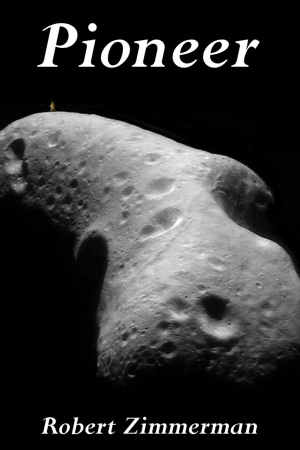
I am today announcing the publication of Pioneer, a science fiction book I first wrote back in 1982 that has languished in my files now for more than three decades. As I note in the introduction,
It was never published because at the time I could not find an agent to market it to book publishers, and was then too naive and shy to attempt to do such things myself.
In viewing several recent science fiction movies, however, I was motivated to pull the final draft of Pioneer from my files, wondering if it might be marketable. I hadn’t read it in decades, and had literally forgotten the story. I started reading expecting a typical first novel, somewhat incoherent and emotionally immature.
Instead I was quite surprised and enthralled. I couldn’t put the book down. Moreover, I was astonished at the coherence of the story and characters. “This is a good book!” I exclaimed to my wife Diane. Nor am I bragging when I say this, since the person who wrote it is someone from many decades ago and who essentially no longer exists.
Thus, I decided it was time to get Pioneer published, especially since this is now a very easy thing to do, no longer requiring either an agent or a book publisher.
The press release announcing the book’s publication provides the story’s premise:
» Read more
The 2017 Nobel Prize for Physics has been awarded to three scientists involved in the development of the Laser Interferometer Gravitational-wave Observatory (LIGO), which detected the first gravitational waves in 2015.
While some of the recent Nobel Prizes have been absurd (such as the Peace award to Obama), this award is absolutely deserved and appropriate. Until LIGO detected that gravitational wave they were merely a theory. The detection proved the theory to be real.
Part 4 of Doug Messier’s series on commercial space history, A Niche in Time, is now available. It is entitled “One Chute” and focuses on the long and sad history of Virgin Galactic.
One new detail that Messier notes struck me:
At the time of the accident, Virgin Galactic had about 700 customers signed up to fly on SpaceShipTwo. Officials now say the number is around 650. Assuming full ships with six passengers aboard, Virgin Galactic would need 109 flights just to fly out its current manifest. The figure doesn’t include flight tests and missions filled with microgravity experiments. That’s a lot of launches to make without expecting at least one catastrophic failure, possibly involving prominent wealthy passengers.
It increasingly appears that this will be a total loss for the investors who poured money into Virgin Galactic.