March 25, 2025 Quick space links

Courtesy of BtB’s stringer Jay. This post is also an open thread. I welcome my readers to post any comments or additional links relating to any space issues, even if unrelated to the links below.

4 comments

NASA confirms DOGE contract cancellations totaling about $420 million

According to Space News, NASA officials have now confirmed a DOGE post that described contract cancellations totaling about $420 million.

In a statement to SpaceNews late March 24, NASA press secretary Bethany Stevens confirmed a post by the Department of Government Efficiency (DOGE) that NASA had terminated about $420 million in “unneeded” contracts. “NASA is committed to optimizing its workforce and resources in alignment with the Department of Government Efficiency’s initiatives. As part of this effort, NASA has identified and phased out $420 million in contracts that were determined to be redundant or misaligned with our core mission priorities,” Stevens said in the statement.

…NASA did not answer questions about specific contracts selected for termination or details about how it determined those contracts were redundant or misaligned. The DOGE post, published just before midnight March 21, said only that it included three contracts worth $15 million each to consultancies for “Change Management Support Services.”

Though it is not yet clear what specific contracts were cancelled, the statements from both NASA and DOGE, as well as the research by Space News‘s own reporter, suggest strongly these contracts had nothing to do with space or aviation engineering, but were related to management and DEI related projects, all of which have nothing to do with NASA’s “core mission priorities.”

As always, the Space News genuflects to the swamp, implying these cuts are the precursor to the utter destruction of NASA’s science research. In truth, NASA — like all government agencies in the 21st century — is bloated and wasteful. There is plenty of room for cuts, without doing any harm to the work the agency does. If anything, by getting rid of the waste the agency will be more efficient, able to do science and engineering research more effectively.

1 comment

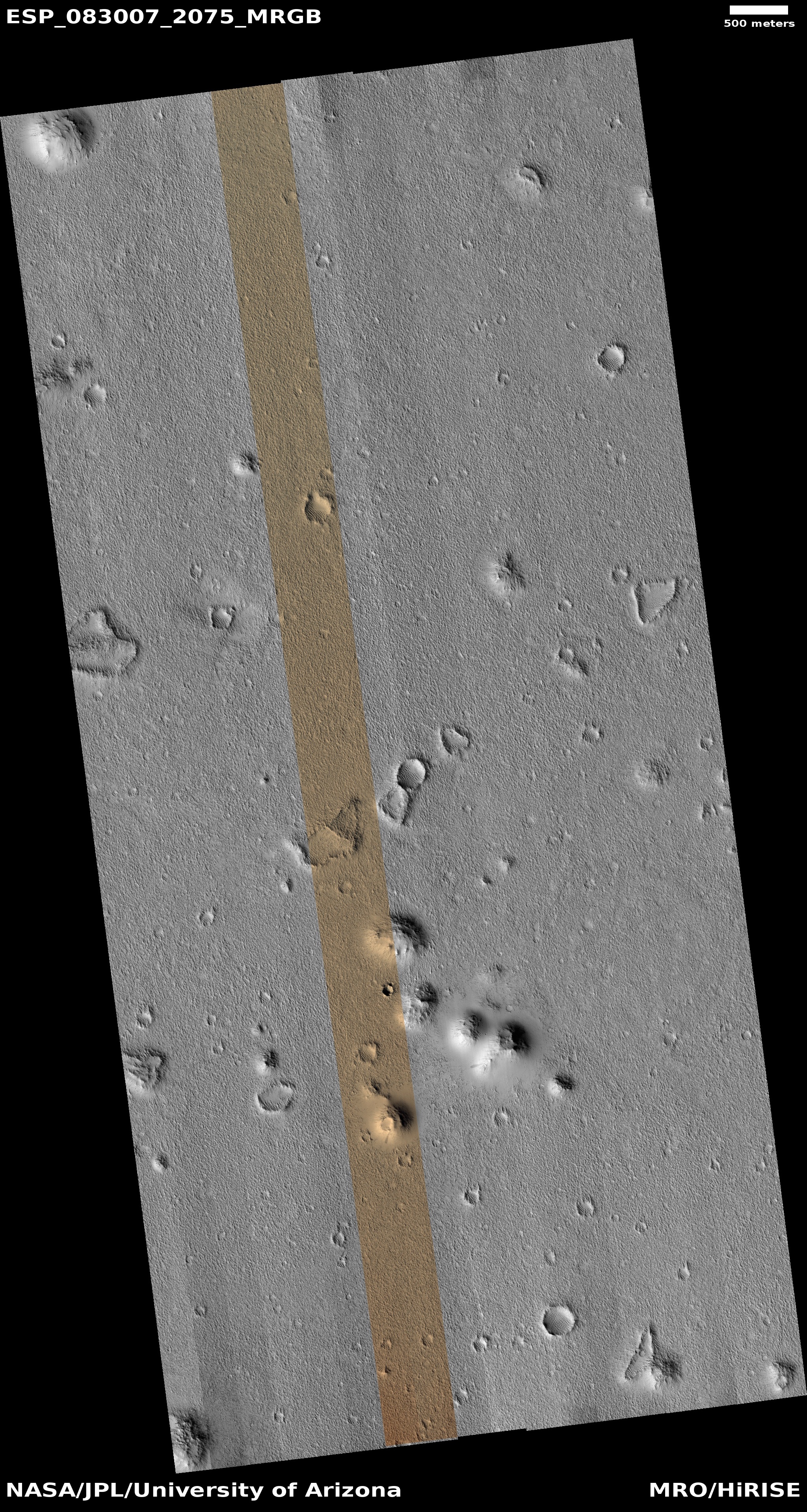
Martian stucco

Martian stucco
Click for original image.

Cool image time! The picture to the right, cropped, reduced, and sharpened to post here, was taken on January 24, 2025 by the high resolution camera on Mars Reconnaissance Orbiter (MRO). Labeled simply as a “terrain sample,” it was likely taken not as part of any specific research request but to fill a gap in the schedule in order to maintain the camera’s proper temperature.

In this case the camera team got something quite intriguing. The entire terrain is reminiscent of stucco found on the outside walls of southwest homes. What makes even more intriguing is that the stucco appears to be material that has covered the terrain, based on the two craters that appear half-buried by it. Moreover, this picture only captures a small portion of this landscape, which extends like this over an area approximately 40 miles squared.

What caused this strange terrain? As always, the overview map below provides a clue, though no firm answers.
» Read more

0 comments

Scientists believe they have found evidence of largest carbon molecules yet in Curiosity drill sample

The uncertainty of science: Scientists analyzing material drilled out by the Mars rover Curiosity back in 2013 now believe the sample included the largest carbon molecules yet found on Mars.

The detection of these long and large carbon molecules was based not on actual Martian data, taken at a site dubbed Cumberland on the floor of Gale Crater, but on follow-up lab work on Earth.

The recent organic compounds discovery was a side effect of an unrelated experiment to probe Cumberland for signs of amino acids, which are the building blocks of proteins. After heating the sample twice in [the Curiosity] SAM’s oven and then measuring the mass of the molecules released, the team saw no evidence of amino acids. But they noticed that the sample released small amounts of decane, undecane, and dodecane [thought to be fragments of fatty acids].

Because these compounds could have broken off from larger molecules during heating, scientists worked backward to figure out what structures they may have come from. They hypothesized these molecules were remnants of the fatty acids undecanoic acid, dodecanoic acid, and tridecanoic acid, respectively.

The scientists tested their prediction in the lab, mixing undecanoic acid into a Mars-like clay and conducting a SAM-like experiment. After being heated, the undecanoic acid released decane, as predicted. The researchers then referenced experiments already published by other scientists to show that the undecane could have broken off from dodecanoic acid and dodecane from tridecanoic acid.

Based on this Earth lab work, the scientists now suggest that Mars could also have these much longer carbon molecules that are associated with biological processes.

Very intriguing, but we must exercise caution. Curiosity did not detect such molecules, only evidence that they might exist on Mars. And even if they do exist on Mars, this is not evidence that Mars has or once had biological life. While such large molecules on Earth are usually associated with biological processes, they do not have to be, as the scientists readily admit in their abstract. Furthermore, in the alien environment of Mars there could be many non-biological processes we don’t even yet understand that could explain their existence.

0 comments

Firefly awards Blue Origin subsidiary contract to build rover for third Blue Ghost mission

Blue Ghost 3 landing site

Firefly yesterday announced that it has awarded the Blue Origin subsidiary Honeybee Robotics a contract to build a rover for its third Blue Ghost mission to the Moon.

Firefly Aerospace and Honeybee Robotics, a Blue Origin company, today announced Honeybee was contracted by Firefly to provide the lunar rover for the company’s recently awarded NASA task order to explore the Gruithuisen Domes on the Moon’s near side in 2028. Once deployed on the Moon by Firefly’s Blue Ghost lander, Honeybee’s rover will carry NASA instruments to investigate the unique composition of the Gruithuisen Domes.

The funding for this rover actually comes from NASA, awarded first to Firefly which has in turn given a subcontract to Honeybee.

Before this 2028 mission however Firefly will launch its second Blue Ghost mission to the Moon, targeting a 2026 launch date. That second mission will not only land on the far side of the Moon, it will also deploy two lunar orbiters, one for European and the second Firefly’s own orbital tug for these spacecraft that will also service as a communications satellite after deployment.

3 comments

ESA announces competitive program to encourage new European rocket startups

The European Space Agency (ESA) yesterday announced a new competitive award program, dubbed the European Launcher Challenge, designed to give contracts to new European rocket startups to help them develop their own rockets.

Proposals are due no later than May 5, 2025. The program will award up to $183 million to each company, depending on its application. The program has two components, one for rockets that will serve government contracts and will launch beginning in 2026, and the second for rockets that are upgraded by 2028. In both cases a company must complete a demonstration launch by 2027 to qualify for any award. More details here.

Essentially, ESA is structuring this program to provide free subsidies to those companies it decides it likes, with anywhere from two to three getting awards. In January six rocket startups — HyImpulse, Latitude, MaiaSpace, Orbex, Rocket Factory Augsburg and The Exploration Company — submitted a joint letter to ESA endorsing the program and outlining how they think the program should be structured.

Interestingly, the two rocket startups did not sign that letter, Isar Aerospace from Germany and PLD from Spain. Of all these companies, these two are actually closest to launch, with Isar about to attempt its first launch and PLD having already completed a suborbital test flight and building its launch sites in French Guiana and Duqm, Oman.

Officials at PLD are quoted here as apparently opposed to this ESA award program.

“We need to let the market select a winner,” Raúl Verdú, co-founder and chief business development officer of the company, said at the January conference. “Today, to be very honest, it is super-hard to select who will be the winner.”

It will be interesting to see this government program play out. Right now it appears designed to play favorites, a typical European approach. There is a good chance however that it will not do this, and will instead succeed in jumpstarting an independent, competitive European rocket industry. The program’s main structure remains sound, truly capitalistic, whereby the government owns nothing and simply acts as a customer, buying rockets from competing companies on the open market.

0 comments

March 24, 2025 Quick space links

Courtesy of BtB’s stringer Jay. This post is also an open thread. I welcome my readers to post any comments or additional links relating to any space issues, even if unrelated to the links below.

2 comments

SpaceX launches reconnaissance satellite for National Reconnaissance Office

SpaceX today successfully placed a classified reconnaissance payload into orbit for National Reconnaissance Office, its Falcon 9 rocket lifting off from Cape Canaveral in Florida.

The first stage completed its second flight, landing back at Cape Canaveral.

The leaders in the 2025 launch race:

34 SpaceX
14 China
4 Russia
4 Rocket Lab

SpaceX now leads the rest of the world in successfully launches, 34 to 25.

0 comments

New Webb infrared image reveals galaxy hidden behind outflow from baby star

Webb infrared image of baby star outflow
Click for original image.

Cool image time! The false-color infrared image to the right, cropped, reduced, and sharpened to post here, was taken by the Webb Space Telescope of the outflow from a baby star, dubbed Herbig-Haro 49/50, located about 625 light years away.

The picture was taken to get a better understanding of the flow itself. Earlier infrared images at much lower resolution by the Spitzer Space Telescope had left many features in this outflow unclear. For example, at the head of the outflow the Spitzer infrared image was unable to clearly identify the background spiral galaxy located there. In those earlier images it could have instead been a part of the outflow itself.

The galaxy that appears by happenstance at the tip of HH 49/50 is a much more distant, face-on spiral galaxy. It has a prominent central bulge represented in blue that shows the location of older stars. The bulge also shows hints of “side lobes” suggesting that this could be a barred-spiral galaxy. Reddish clumps within the spiral arms show the locations of warm dust and groups of forming stars. The galaxy even displays evacuated bubbles in these dusty regions

The actual source from which this flow comes remains unconfirmed, though astronomers think the source is one particular protostar about 1.5 light years away.

3 comments

Rolling Stone provides more details about Jared Isaacman and his nomination as NASA administrator

Jared Isaacman
Jared Isaacman

This article from Rolling Stone published yesterday provides a wealth of new information about Jared Isaacman, Trump’s still unconfirmed pick to become NASA’s next administrator.

Two key details: First, the article quotes Isaacman saying he opposes NASA’s policy of signing up two companies, SpaceX and Blue Origin, to build manned lunar landers.

I will try to help, but this is why I get frustrated at two lunar lander contracts, when will be lucky to get to the [Moon] a few times in the next decade. People falsely assume its because I want SpaceX to win it all, but budgets are not unlimited & unfortunate casualties happen.

In other words, he opposes using NASA to develop an aerospace industry with multiple companies capable of doing things NASA needs done. He also appears to dismiss the value of redundancy that two landers provides.

Second, the article provides links to the financial [pdf] and ethics [pdf] disclosures that he submitted to the government after being named as nominee. In the financial statement he indicates he paid SpaceX more than $50 million for providing the transportation for his multi-mission Dragon/Starship Polaris Dawn manned program. In the ethics statement he asserts he would end that contract if confirmed as NASA administrator, with SpaceX refunding any monies for services not yet rendered. The program itself would be suspended until Isaacman completes his term as administrator.

The Rolling Stone article, though detailed and fair-minded, appears to strongly endorse Isaacman, and thus joins a growing public campaign from many insider Washington players — a large number of whom have been passionately hostile to Donald Trump — to get Isaacman approved. At the moment however his nomination appears stalled because the Trump administration has not yet submitted to the Senate the paperwork needed to allow that body to schedule hearings.

The strange campaign by many of Trump’s opponents to endorse Isaacman continues to suggest to me that the Trump administration has had second thoughts about its NASA nominee. The swamp now wants him, and this is raising hackles inside the administration, which thus explains the slow-walking of his paperwork.

25 comments

South Korean rocket startup Innospace details successful tests of its portable launchpad

Engineering test prototype during tests
Click for original image.

The South Korean rocket startup Innospace has now provided some additional details about its testing of the portable launchpad and strongback that it will use on its first planned rocket launch in July 2025.

The Launch Pad-Vehicle Interface Integrated System Test comprehensively verifies the operational readiness of the launch vehicle and launch pad, covering processes from vehicle assembly and pad integration to vertical erection, propellant supply system checks, and final operational validation. During the test, INNOSPACE confirmed the mechanical and electrical interfaces between the launch pad and vehicle, the transporter erector launcher system, the detachment of the Umbilical, the fuel and oxidizer supply system, and the separation of the launch vehicle hold-down mechanism, ensuring technical reliability and operational stability.

The launch pad that successfully completed the test, is scheduled for maritime transportation to the Alcântara Space Center in Brazil on April 2. Upon arrival in May, it will undergo installation and final verification in the local environment to complete preparations for launch operations. In addition, the launch vehicle used in this test was the HANBIT-Nano Qualification Model (QM), which shares the same specifications—21.8 meters in height and 1.4 meters in diameter—as the Flight Model (FM) scheduled for launch in July.

The company will still need to do these same tests in Brazil at its Alcântara spaceport using the actual rocket, dubbed Hanbit-Nano, before the launch can occur. Thus. meeting that July target date is likely difficult if not impossible. At the same time it does appear the company has a chance of launching before the end of this year.

0 comments

Perseverance spots a rock made of many tiny spherules

Rock made of spherules found by Perseverance
Click for wide shot. The original of the inset
can be found here.

In their exploration of the outer flanks of the rim of Jezero Crater, the science team operating the Perseverance rover have discovered an unusual rock different than everything around it, appearing to be made of many very tiny spherules.

The picture to the right illustrates this. The wider picture was taken by Perseverance’s left high resolution camera, with the inset a close-up mosaic of three images taken by the rover’s micro-imager, designed to get very very high resolution pictures of small objects. From the press release:

The rock, named “St. Pauls Bay” by the team, appeared to be comprised of hundreds of millimeter-sized, dark gray spheres. Some of these occurred as more elongate, elliptical shapes, while others possessed angular edges, perhaps representing broken spherule fragments. Some spheres even possessed tiny pinholes! What quirk of geology could produce these strange shapes?

This isn’t the first time strange spheres have been spotted on Mars. In 2004, the Mars Exploration Rover Opportunity spotted so-called, “Martian Blueberries” at Meridiani Planum, and since then, the Curiosity rover has observed spherules in the rocks of Yellowknife Bay at Gale crater. Just a few months ago, Perseverance itself also spied popcorn-like textures in sedimentary rocks exposed in the Jezero crater inlet channel, Neretva Vallis. In each of these cases, the spherules were interpreted as concretions, features that formed by interaction with groundwater circulating through pore spaces in the rock.

Not all spherules form this way, however. They also form on Earth by rapid cooling of molten rock droplets formed in a volcanic eruption, for instance, or by the condensation of rock vaporized by a meteorite impact.

At the moment the science team has no idea which of these theories explains the spherules. That the rock is located on the crater rim, where ejecta from the impact will be found, strongly suggests the impact was the cause, not groundwater flow.

7 comments
1 170 171 172 173 174 2,413