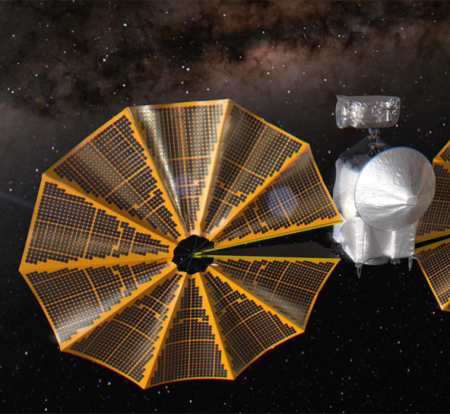
October 12 Falcon Heavy launch of Psyche probe faces bad weather

At present there is only a 20% chance that the Falcon Heavy launch of NASA’s Psyche asteroid probe will occur on October 12, 2023 at 10:16 am (Eastern) as planned out of Cape Canaveral.

The launch window only extends until October 25, 2023, after which the entire project would have to be redesigned, requiring a significant delay.

SpaceX has become very adept at threading the needle when weather restricts its Starlink launch abilities, but it has less flexibility with Psyche. To increase its chances it has scrubbed a planned Starlink launch this week from Cape Canaveral in order to give the Falcon Heavy launch more launch opportunities.

Regardless, the live stream can be accessed here.

0 comments

Aerojet Rocketdyne satellite power units are chronically failing

According to space insurers, problems on power units built by Aerojet Rocketdyne on four different satellites are going to cost the industry about $50 million in claims this year.

According to multiple insurance sources, Yahsat’s Al Yah 3, Avanti Communications’ Hylas 4, and Northrop Grumman’s two Mission Extension Vehicles (MEV-1 and MEV-2) are operating with reduced power to their thrusters following a problem with onboard Power Processing Units (PPUs).

The PPUs from Aerojet Rocketdyne provide the electrical power their thrusters need for station-keeping in geostationary orbit (GEO). One of the sources said Al Yah 3, Hylas 4, and MEV-2 have each lost one of two onboard PPUs since the issue emerged in 2022. The youngest of these spacecraft, MEV-2, launched in 2020.

While the article at the link focuses on the impact to space insurers for these additional claims, what I see are serious quality control problems at Aerojet Rocketdyne, now part of the company L3Harris after a summer acquisition. The new management of L3Harris better aggressively address this, or else it will find its $4.7 billion acquisition a big waste of money.

0 comments

Another Russian module develops leak on ISS

For the third time in less than a year, a Russian spacecraft at ISS has developed a coolant leak, this time in Russia’s newest module to ISS, Nauka.

The Nauka radiator actually has been in space for over a decade waiting for Nauka to arrive so whether there is any commonality to the failures is difficult to assess. Roscosmos acknowledged the leak, but said the module itself is working fine and there is no cause for concern.

The previous two leaks were on a Progress freighter, and later on a Soyuz capsule. Though Nauka was only launched to ISS in 2021, its development began in the 1990s and was originally scheduled for launch in the early 2000s. Because of the delays this radiator was launched to ISS ahead of the module, in 2012. It sits outside the module where it can release its excess heat into space.

The Russians say that the leak is in a backup coolant system, but according to a statement by Anatoli Zak quoted at the link, this statement is too vague. At the moment the location of the leak remains unknown.

2 comments

ArianeGroup demands more money from ESA for Ariane-6

ArianeGroup is now in negotiations with the European Space Agency (ESA) to get a significant increase in the money ESA is pays for the new as-yet unlaunched Ariane-6 rocket.

A few weeks before a space summit which will take place on November 7 in Seville, [ArianeGroup] is negotiating a very clear reassessment of support for the operation of Ariane 6. [It] is asking 350 million euros per year from the States members of the ESA. That’s an incredible increase of 150%.

The problem for ArianeGroup and ESA is that Ariane-6 is expendable (a joint decision by ESA and ArianeGroup back in 2015 that was then a bad mistake), and thus is too expensive. It can’t compete in the modern launch market with SpaceX, and has thus had trouble finding customers.

As a result, ESA will likely pay out these big bucks for the next few years, but the situation creates a big opening for the new European startup rocket companies (PLD, Rocket Factory Augsburg, Isar, and HyImpulse) that are right now developing new small rockets. Like SpaceX in 2010, they have an opportunity to undercut the established government rockets of ESA, and grab market share. To do this however they need to become operational as soon as possible.

Since there are strong signs that ESA is looking to help these new companies, we should see some interesting competitive action in European rocketry in the next few years.

Hat tip to BtB’s stringer Jay.

3 comments

Azerbaijan signs to cooperate on China’s lunar base project

Azerbaijan has signed an agreement with China to cooperate and partner in China’s lunar base project.

No details were released, other than empty PR promises to work together.

So far the only ones to sign on with China are not likely to contribute much, with Russia the only possible exception. The others, South Africa and Venezuela, don’t have any major space capabilities, and like Azerbaijan hope to use the partnership to gain some. A number of individual organizations in Hawaii, Thailand, and Switzerland have also signed agreements, while there are also rumors that Pakistan has or will sign on also.

0 comments

Pushback: Court rules that schools cannot punish or suspend students who defy queer agenda

The shirt that offended teachers at Nichols Middle School
Liam Morrison, wearing the evil shirt that he wore the
second time teachers at Nichols Middle School sent
him home.

Bring a gun to a knife fight: An federal appeals court last week ruled that schools cannot cancel the First Amendment rights of students by censoring or suspending or punishing them if they should refuse to use the preferred pronouns that advocates of the queer agenda demand.

The St. Louis-based 8th U.S. Circuit Court of Appeals issued a preliminary injunction Monday against an Iowa school district policy that threatens suspension and expulsion for “intentional and/or persistent refusal … to respect” a peer’s gender identity, finding it’s likely too vague to survive legal scrutiny.

“A school district cannot avoid the strictures of the First Amendment simply by defining certain speech as ‘bullying’ or ‘harassment'” as did the Linn-Mar Community School District, the three-judge panel ruled in a case that drew friend-of-the-court briefs by dozens of conservative and religious groups and 18 Republican-led states in favor of the plaintiffs.

The picture above shows Massachusetts student Liam Morrison, who was banned from school because he first wore a shirt that said “There are only two genders,” then sent home again for wearing a second shirt, as shown. His case is presently in the courts. This ruling in Iowa will strengthen his case considerable.

Nor was the Iowa case the only recent case where the courts ruled against the queer agenda in schools. The article at the link notes that this same week a state court in Wisconsin also ruled against the queer agenda, stating that “the Kettle Moraine School District’s policy of hiding gender transitions as an intrusion on parents’ rights to control ‘medical and healthcare’ decisions about their children.”

Such rulings are going to come more and more often. Of the five hundred-plus blacklist stories I have covered in the past three years, there has been one overarching pattern: » Read more

5 comments

Ingenuity completes 61st flight on Mars

Overview map
Click for interactive map.

Ingenuity on October 5, 2023 completed its 61st flight on Mars, doing a simple vertical hop that also set a new altitude record for the helicopter, rising to 79 feet.

This flight matched the flight plan exactly, taking just over two minutes to complete.

On the overview map above, the green dot marks the landing spot during Ingenuity’s previous flight on September 25, 2023. The blue dot marks Perseverance’s location.

3 comments

SpaceX launches 21 Starlink satellites

SpaceX tonight successfully launched another 21 Starlink satellites, using its Falcon 9 rocket lifting off from Vandenberg in California.

The first stage completed its fourteenth flight, landing on a drone ship in the Pacific.

71 SpaceX
45 China
13 Russia
7 Rocket Lab
7 India

American private enterprise now leads China in successful launches 83 to 45, and the entire world combined 83 to 73. SpaceX by itself only trails the rest of the world 71 by 73, at this moment.

0 comments

Arianespace’s Vega rocket successfully launches 12 satellites

Arianespace, the commercial arm of the European Space Agency (ESA), tonight successfully used its Vega rocket to successfully launched a weather satellite, an Earth observation satellite, and ten cubesats12 satellites, lifting off from its spaceport in French Guiana.

The Vega rocket has only one more launch on its manifest, scheduled for next spring. Its replacement, the Vega-C, is presently grounded due to a launch failure in 2022, with the redesign of the nozzle on its upper stage taking longer than expected. With ESA’s Ariane-5 already retired, and its replacement, the Ariane-6 having not yet completed its first launch, Europe at this moment has little ability to launch anything into space.

As this was only the third launch for Europe so far this year, the leader board for the 2023 launch race remains unchanged.

70 SpaceX (with another launch scheduled in about an hour. Live stream here,)
45 China
13 Russia
7 Rocket Lab
7 India

American private enterprise still leads China in successful launches 82 to 45, and the entire world combined 82 to 73. SpaceX by itself only trails the rest of the world 70 by 73, at this moment.

0 comments

Software patch saves Europe’s Euclid space telescope

Engineeers have successfully saved Europe’s new recently launched Euclid space telescope by installing a software patch that fixed the telescope’s inability to orient itself properly for long periods.

Shortly after launching on 1 July, the European space observatory Euclid started performing tiny, unexpected pirouettes. The problem revealed itself during initial tests of the telescope’s automated pointing system. If left unfixed, it could have severely affected Euclid’s science mission and led to gaps in its map of the Universe.

Now the European Space Agency (ESA) says that it has resolved the issue by updating some of the telescope’s software. The problem occurred when the on board pointing system mistook cosmic noise for faint stars in dark patches of sky, and directed the spacecraft to reorient itself in the middle of a shot.

The new software essentially reduces the amount of light that enters the pointing system, so that the noise is no longer detected. This means that observations however will have to be longer to obtain the same data, extending the mission.

Euclid’s goal is a follow-up on Europe’s Gaia mission, to map 1.5 billion galaxies in three dimensions. Gaia did it with the stars in the Milky Way. Euclid is looking deeper, requiring far greater precision and accuracy in pointing.

1 comment

Spanish rocket startup successfully completes first suborbital test launch

The Spanish rocket startup PLD today successfully completed its first suborbital test launch, a short flight of its Miura-1 prototype rocket, lifting off from its spaceport in Spain.

I have embedded video of the launch below, cued to just before launch. Though the plan had been to recover the first stage using parachutes, it is unclear if this occurred or was even attempted. The launch was at night, making recovery difficult or much slower, and because the broadcast was in Spanish there was no translation,

Regardless, the data from this launch will be used by the company to build its orbital rocket, Miura-5.

» Read more

10 comments
1 393 394 395 396 397 2,413