Martian pseudo-frost terrain

Martian pseudo-frost terrain
Click for original image.

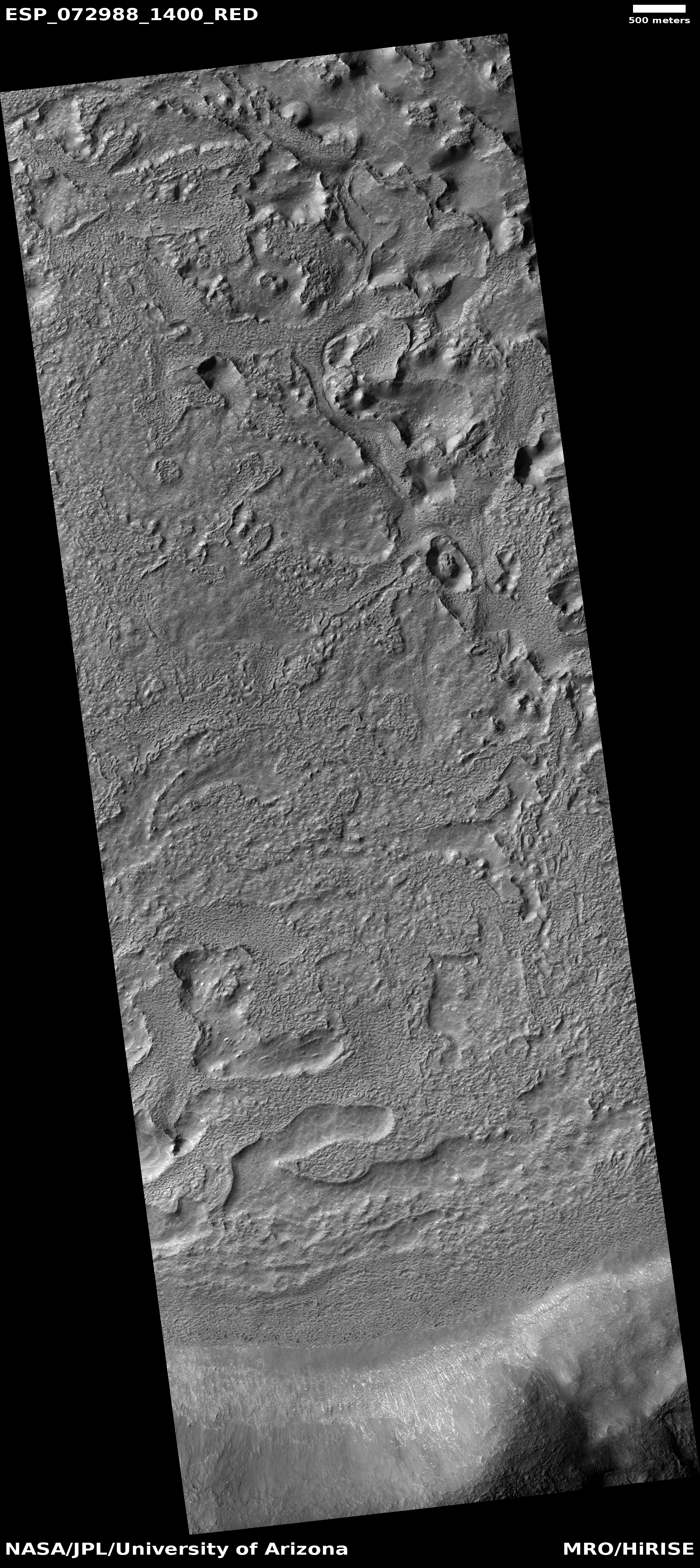
Cool image time! It is always dangerous to come to any quick conclusions about what you see from pictures from another planet. The photograph to the right, rotated, cropped, reduced, and sharpened to post here, was taken on August 19, 2023 by the high resolution camera on Mars Reconnaissance Orbiter (MRO), and shows what at first glance looks like a surface similar to frosting seen on window panes on Earth in the winter, where water condensation freezes to form crystalline patterns.

Your first glance would be wrong. This terrain is about 120 miles north of the Martian equator, placing inside the dry equatorial regions where no near-surface ice is known to exist. If this geological feature is formed by the same condensation processes that create ice frost, then it must involve the deposition of some other type of material.

The explanation would also have to account for the change in the terrain, from finely patterned on the right to more crystalline on the left.
» Read more

0 comments

Space Force puts a halt to the use of AI because of security issues

The Space Force has decided to stop using any artificial intelligence computer tools (AI) because of the security risks that presently risk in using them.

The Sept. 29 memorandum, addressed to the Guardian Workforce, the term for Space Force members, pauses the use of any government data on web-based generative AI tools, which can create text, images or other media from simple prompts. The memo says they “are not authorized” for use on government systems unless specifically approved.

Chatbots and tools like OpenAI’s ChatGPT have exploded in popularity. They make use of language models that are trained on vast amounts of data to predict and generate new text. Such LLMs have given birth to an entire generation of AI tools that can, for example, search through troves of documents, pull out key details and present them as coherent reports in a variety of linguistic styles.

Generative AI “will undoubtedly revolutionize our workforce and enhance Guardian’s ability to operate at speed,” Lisa Costa, Space Force’s chief technology and innovation officer, said in the memo. But Costa also cited concerns over cybersecurity, data handling and procurement requirements, saying that the adoption of AI and LLMs needs to be “responsible.”

This decision appears very wise. The insane fad in the last year to quickly adopt and even rely on AI has more than baffled me. Why are we in a such rush to let a robot do our for thinking and creative work for us? Have we become so lazy and dependent on computers that we’d rather let them do everything?

It is always dangerous to jump on a fad, without thought. That the Space Force has realized this is excellent news.

6 comments

Long delayed and overbudget NASA satellite refueling mission expects more delays and further budget overruns

According to a new inspector general report, a long delayed and significantly overbudget NASA satellite refueling mission, dubbed OSAM-1 and first proposed around 2010, will experience more delays and further budget overruns in order to get it off the ground by 2026, at the earliest.

A NASA plan to robotically repair and refuel satellites in orbit is way behind schedule and well over budget, says NASA’s Office of the Inspector General (OIG), with most of the blame falling on space tech contractor Maxar.

Maxar, one of the largest private businesses working on NASA’s On-Orbit Servicing, Assembly, and Manufacturing mission (OSAM-1), has been involved in the project since 2016, when the space agency’s idea was smaller in scope and known as Restore-L. According to the OIG, Maxar is two years behind schedule on delivering the the project’s spacecraft bus and its Space Infrastructure Dexterous Robot (SPIDER) robotic arm, and it’s unlikely OSAM-1 will come in under its $2.05 billion budget nor meet the December 2026 launch date NASA committed to in 2022. The bus is the main craft framework, and its attached SPIDER will hopefully repair and refuel satellites in orbit, once it all gets off the ground and works.

NASA isn’t without blame for the delays, the OIG said, but Goddard Space Flight Center’s (the NASA facility where the project is being managed) “struggle with development of several key components of the servicing payload” wasn’t the main issue. “We found that project cost increases and schedule delays were primarily due to the poor performance of Maxar … and its inability to provide the spacecraft bus and SPIDER in accordance with contract requirements,” inspectors concluded in their report.

The plan has always been to refuel the Landsat-7 spacecraft in order to demonstrate robotic in-space servicing of satellites. When first proposed, the idea was untested, and the project was intended to get this industry off the ground. Since then however Northrop Grumman’s MEV servicing robot satellite has leap-frogged NASA to twice reactivate two geosynchronous satellites. At the same time, at least a half dozen other private startups have now done robotic rendezvous and docking demos in orbit, and have actual contracts for their own servicing missions.

Moreover, all the private missions have concepts that are far simplier and cheaper than NASA’s. Rather pump fuel into the defunct satellite’s tanks, the MEV simply docks with the satellite using its now useless main engine nozzle, and once attached becomes a service module with its own fuel and engines to orient and move the satellite. The other servicing startups are doing similar things. No need to develop complex robot arms and fueling systems.

In other words, private industry can learn little from this NASA’s mission. By the time it launches the industry will likely be able to run rings around it. It has become a waste of money that should be shut down, now.

13 comments

India schedules Gaganyaan launch abort test for October 21st

India’s space agency ISRO has now scheduled the first unmanned launch abort test of its Gaganyaan manned capsule for October 21, 2023.

The test Crew Module (CM), according to the statement, will be akin to the pressurized module that’ll hold crew members during their ascent to space — this version, however, will be unpressurized. It will be launched via a single-stage liquid rocket specifically developed for this mission that will simulate an abort scenario; the true CM, by contrast, will ride atop a 143-foot-tall (43.5-meter) Launch Vehicle Mark-3 (LVM3) rocket with a solid stage, liquid stage and cryogenic stage. The latter recently received human safety certifications, R. Hutton, project director of the Gaganyaan mission, said during a conference last month.

At present ISRO is targeting 2024 for the first manned mission, but that target date remains very uncertain.

2 comments

Launch of Psyche asteroid mission delayed by weather

NASA and SpaceX today scrubbed the launch of the Psyche asteroid mission because of poor weather, rescheduling the Falcon Heavy launch to tomorrow, October 13, 2023 at 10:19 am (Eastern).

“For our first backup window, Friday morning, 50% chance for go conditions, with our concerns still being associated with storms in the area, where we have anvil clouds, some thick clouds, which are layered clouds, as well as cumulus clouds we get associated with storms,” Moses explained during the briefing.

“Looking at Saturday morning, a third backup window, there is still about the same probability, about 50% chance of go, and fairly similar conditions here, where there may be some storms around, but we expect most of any storms to be after our morning launch window,” she added.

The launch window for the mission closes on October 25, after which a major mission rescheduling will be required to get the probe to the asteroid Psyche, likely causing a year delay.

0 comments

October 11, 2023 Quick space links

Courtesy of BtB’s stringer Jay.

  • Relativity signs multi-launch agreement with Intelsat
  • The launches are for Relativity’s new Terran-R rocket, not yet launched, and will begin as early as 2026. The deal likely also allows Intelsat complete freedom to go elsewhere if Relativity has problems delivering.


  • A picture of the outside of OSIRIS-REx’s sample collector
  • The rocks and dirt in the middle right are extra material from Bennu that were captured and retained outside the collector. The scientists say a preliminary look at the material has found carbon and water (held in molecules of other material), but that is not news, as we already knew both were there.


1 comment

Massive landslide in Martian canyon

Massive landslide in Martian canyon
Click for original image.

Cool image time! The picture to the right, cropped, reduced, enhanced, and annotated to post here, was taken on September 5, 2023 by the high resolution camera on Mars Reconnaissance Orbiter (MRO).

The image shows a gigantic landslide collapse on the southern interior wall of a long meandering canyon on Mars dubbed Bahram Vallis. The collapse was what scientists call a mass wasting event, in which the entire section of cliff wall breaks off and moves downward as a large unit. In this case the falling section, a half mile wide and long, got squeezed near the bottom, piling up rather than flowing out into the canyon floor.

At this particular location the canyon is 2.4 miles wide, with cliff walls about 1,700 feet high. Imagine when this piece broke off: In one instance a giant section of mountain about a half mile long fell about a thousand feet. Even in Mars’ thin atmosphere the sound must have been thunderous.
» Read more

1 comment

South Korea is in final negotiations to cancel two Russian launch contracts

As has been expected since the beginning of Russia’s invasion of the Ukraine, South Korea is in the process of canceling two Russian launch contracts, with the negotiations apparently now in the final stages.

“The Korea Multipurpose Satellite 6 and the next-generation mid-size satellite Compact Advanced Satellite 500-2, both developed by Korea, were initially scheduled to be launched into space using Russian launch vehicles, but due to the war between Russia and Ukraine and the subsequent international sanctions against Russia, there were uncontrollable circumstances that prevented the use of Russian launch vehicles,” the Ministry of Science and ICT said in a statement.

“Since then, Korea has been negotiating with Russia on the terms of termination of the satellite launch contract and it is currently being finalized.”

South Korea has already found a different rocket for the first satellite, scheduled for launch on Arianespace’s Vega-C rocket when it resumes flights in April 2024 (after completing upgrades resulting from a December 2022 launch failure). As for the second satellite, no public decision has yet been announced, though contract bidding has been on-going.

Meanwhile South Korea is accelerating development of its own Nuri rocket, which it has successfully launched two times already.

Russia in turn no longer has any international customers for its rockets. Its invasion of the Ukraine has cost it hundreds of millions of dollars of lost business, all of which will likely not return for decades.

0 comments

Astrobotic resumes suborbital test flights of assets purchased from Masten bankruptcy

The startup lunar landing company Astrobotic has resumed flights and testing of the suborbital spacecraft built by the company Masten Space Systems and obtained when that company went bankrupt.

Astrobotic announced Oct. 10 that it completed the first campaign of test flights by Xodiac, a vertical-takeoff, vertical-landing vehicle, since acquiring it and other Masten Space Systems assets last year. Xodiac conducted four flights from Mojave, California, hovering just off the ground to test plume-surface interactions ahead of future lunar landing missions, supporting research by the University of Central Florida.

Xodiac was built several years ago by Masten Space Systems, based in Mojave, and made more than 150 low-altitude flights for a variety of technology demonstration investigations. However, the company filed for bankruptcy in July 2022 and its assets acquired by Astrobotic that September for $4.5 million.

Xodiac is now part of Astobotic’s Propulsion and Test Department, which includes other assets from Masten Space Systems as well as many of its former employees, who say they have picked up where they left off before the bankruptcy.

Astrobotic has also resumed development work on a larger Masten suborbital spacecraft, Xogdor, also designed to launch and land vertically, but actually reach space.

Because Astrobotic is mostly focused on developing lunar landers, Masten’s technology is perfect for refining that capability for landing on the Moon. It is also ideal should Astrobotic decide to develop a reusable rocket for launch from Earth.

1 comment

October 10, 2023 Quick space links

Courtesy of BtB’s stringer Jay.

  • Sierra Space reiterates its commitment to Orbital Reef and its contracts with NASA
  • Based on the statement, which makes no mention of Blue Origin, this suggests that the rumors about a break-up between Sierra Space and Blue Origin on this project were really referring to Blue Origin getting kicked out, which will be especially embarrassing for Jeff Bezos as he and his company were the originators of the Orbital Reef space station concept.


6 comments

Broken Martian ice sheets?

Overview map

Broken Martian ice sheets?
Click for original image.

Cool image time! The picture to the right, rotated, cropped, reduced, and sharpened to post here, was taken on August 11, 2023 by the high resolution camera on Mars Reconnaissance Orbiter (MRO). The picture was what the camera team call a “terrain sample,” which usually means the picture was taken not as part of any specific research request, but because there was a gap in the camera’s schedule, and in order to maintain the camera’s temperature the team then picks something to fill that gap.

Because of the relative randomness of such pictures, they sometimes show little of immediate interest. More often than not, however, the camera team chooses well, and snaps something cool.

In this case they achieved the latter. The white dot on the overview map above marks the location, inside the 2,000-mile-long northern mid-latitude strip I dub glacier country. Everything in this region seems covered with glacial and ice debris, and this picture is no different. Rather than a glacier however we have what looks like a broken ice sheet, surrounded by that utterly unique and as-yet unexplained Martian geological feature dubbed brain terrain.

0 comments
1 392 393 394 395 396 2,413